
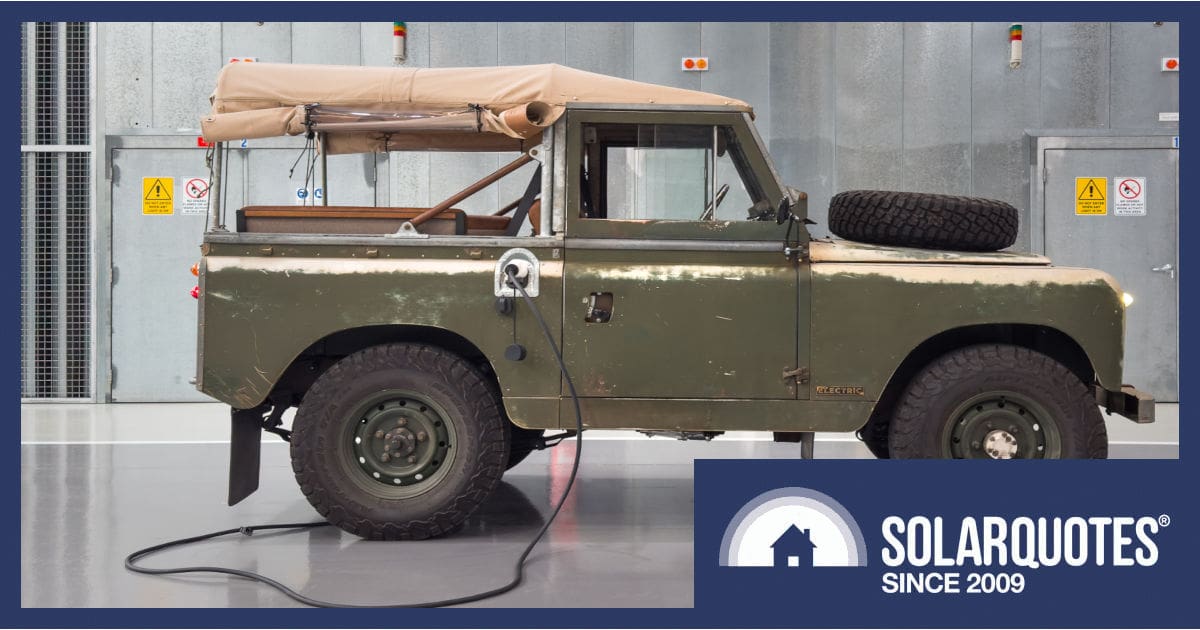
As Australian drivers go electric en masse amidst global uncertainty around fuel prices, classic car lovers might feel left behind. A Melbourne-based workshop is doing the work to make sure they can join the party, converting the automotive stars of yesteryear into EVs.
Fancy A Quiet Little Jaunt?
Whether you’ve got an irrational attachment to a cult classic Land Rover, Mini, Porsche, Volkswagen, Corvette or an oddball like an International Scout, the crowd of weirdos at Jaunt Motors in Melbourne will make it into an EV.
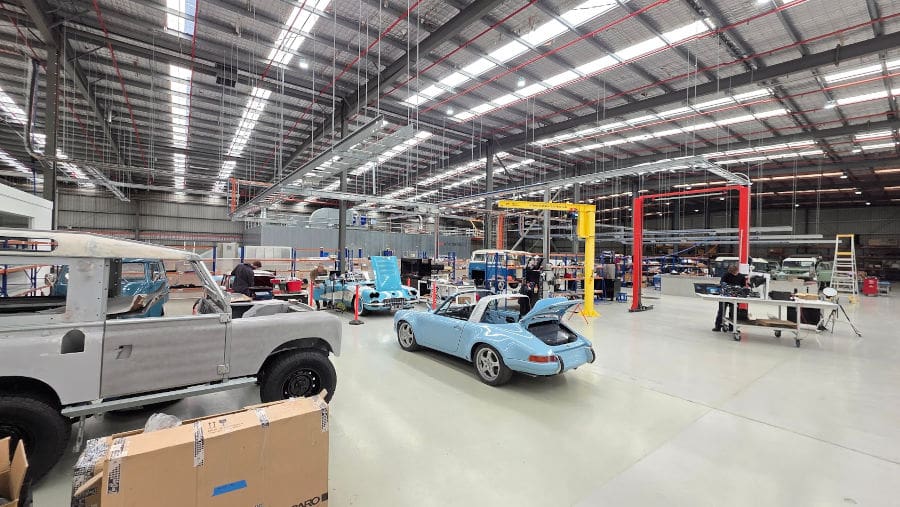
This is not some backyard operation. These are people with passion and first-hand experience from the automotive industry. They have a clean workshop with an original equipment mentality for quality control and proper engineering.
As a restorer of old junk myself, it’s almost intimidating to see how clinical this operation is. They really are taking this seriously and I’m sure the invoicing is reassuringly expensive to match.
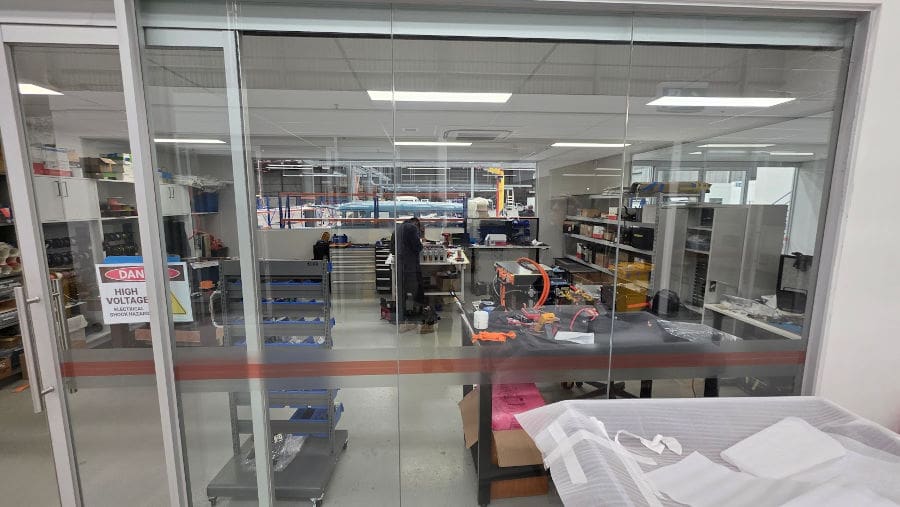
The “laboratory” at Jaunt where high and low voltage wiring looms, control gear and ancillaries are put together.
Australians Still Love To Build Cars
We live in a car culture where people have real emotional connections to their wheels, and to be honest, aside from burnout comps, this isn’t a bad thing.
Cars that people care for actually last. They don’t get thrown away, and that’s ultimately much more sustainable than any recycling program.
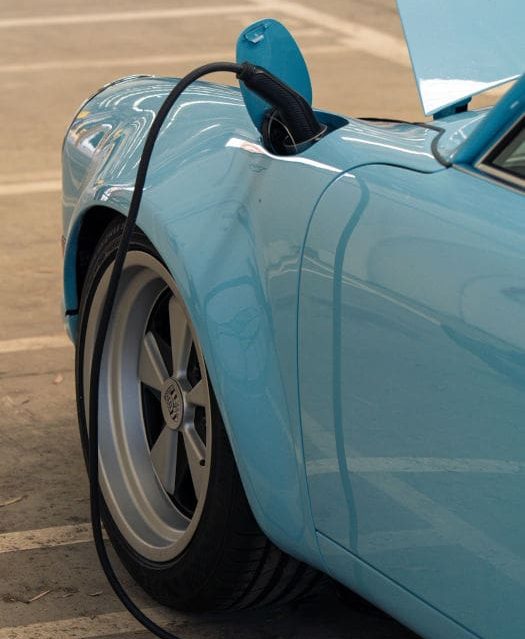
Plug in Porsche 911.
Conventional wisdom says there’s something like 100 tonnes of raw materials invested in every tonne of new car produced. Preserving that invested energy is greener than grinding it up and pouring more resources into rolling, pressing and casting new parts.
This means places like “Rare Spares” have been bought up by large automotive supply chains. Despite arguably losing some local touch, the corporate heft means there’s happily more money for tooling, so you can buy new parts for 30, 40, 50 & 60-year-old cars.
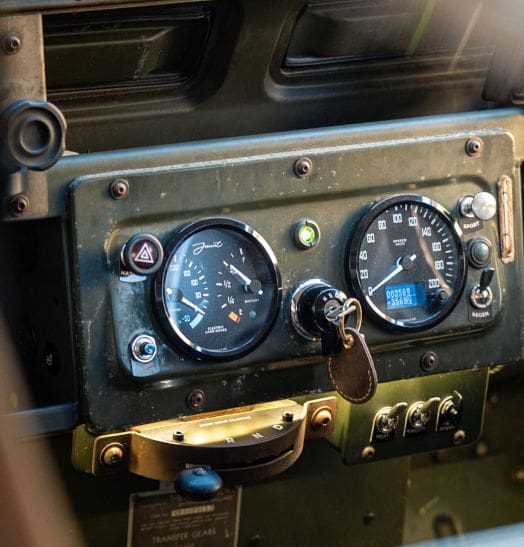
Custom EV instruments look like old Smiths ones but lots of the factory switches are available new.
The UK has been doing the same for many years too, simply continuing to supply parts and repair the cars they used to make, albeit in a much lower volume.
When Rover stopped production of the original Mini in 2000, the press tooling was removed from the factory, modified to produce Mk 1 1960 details, and within weeks it was back in service, making brand-new panels for 40-year-old cars.
How Does This Impact Australia?
Well we had a lot of English cars, our tariffs, quotas & local content law meant they had to be built here in many cases. It meant we had onshore industry for defence projects, so Australian army LandRovers were built here too.1
Jaunt have a great catalogue of reproduction parts available to repair Australian-delivered vehicles from Morris, Leyland, Rover, Triumph, Jaguar, and many others, famous for their oil leaks.
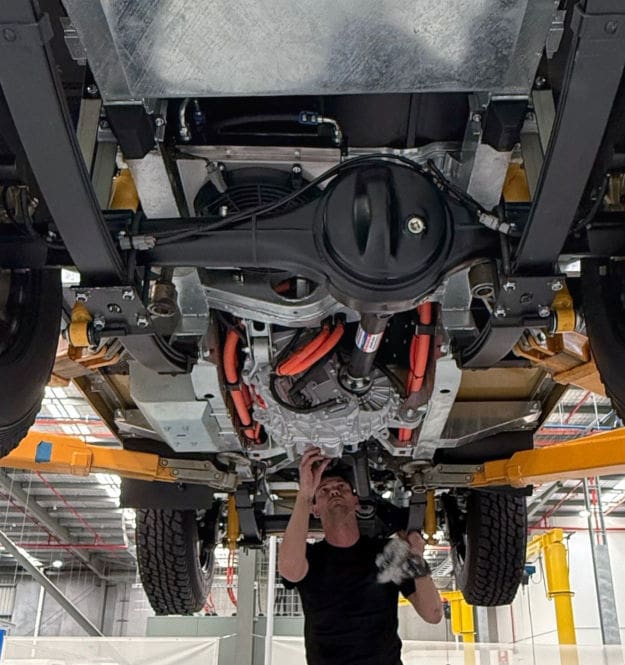
Jaunt get new axles in from the UK and then whack a Tesla model 3 motor in the middle of the car. It’s perfectly simple.
In fact, Jaunt have complete EV conversion packages that come in large lumps straight from Felten in the UK. Your Mini will have a completely new chassis subframe, driveshafts, hubs and brakes. It’s not just new bearings and a lick of paint.
Happily, the folks from Felten realise that Jaunt have a brilliant Land Rover EV conversion, and they send parts for that back to old limey for 4WD enthusiasts who prefer to lie back and think of England.
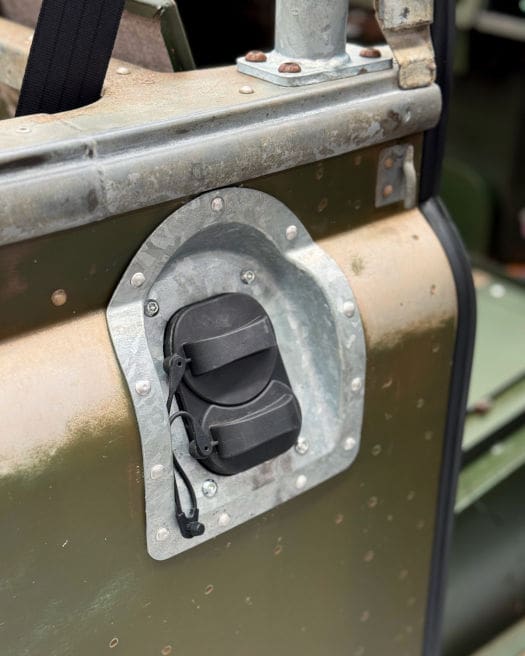
A remarkable amount of work goes into making a slightly oversized “fuel filler” just to get that factory look for a charging port
Jaunt are making cars as functional art. Like the “Snowgum” LandRover which has native eucalypt timber accents inside.
Plus, custom-designed, boutique woven, woollen trim material, grown by native sheep of the snowy mountains. They even made bronze castings of topographical maps featuring the snowy landscape on the ‘guards.
I Lament The Loss Of Australian Made Cars
It’s not just that Ford’s 6 cylinder Barra engine now has a cult following in the USA, that the Falcon’s technical specification would run rings around the Mustang, or that the guys from Top Gear loved flogging a Vauxhall Monaro around England.
For a rear wheel drive niche, Australians made a world-class product, we sold cars into Detroit. There was even a time when the only Commo’ you couldn’t buy with All Wheel Drive was the sedan.
We had an amazing array of large and small businesses that relied on the industrial capacity car making drove. And it meant that you could buy Australian-made & designed parts, like Bosch alternators, Preslite wiper motors, ROH wheels and Hella lamps for your trailer.
And when the volunteers from SteamRanger heritage railway needed a new steam header for locomotive 520, there were car people who would donate their time to design the complex iron casting and a car company where the mould was made.
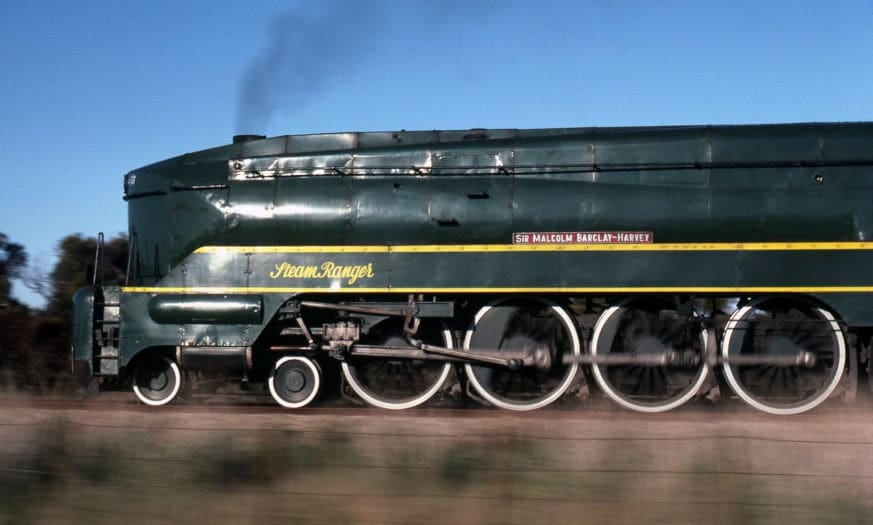
Sir Malcolm Barclay-Harvey still needs work.
There was employment in cars. One of my best mates got his first job out of university engineering the Mitsubishi Magna and 380. My best man designed mirrors for export to the US for Ford F150s.
As uni students, they both had production-line jobs at the MMAL foundry, fettling castings produced for Mitsubishi at Tonsley. That sort of production line work is hard graft and excellent experience for the people who would go on to design the products professionally.
What Happened?
It wasn’t a want of technology or innovation. The CSIRO developed a hybrid eCommodore to show off at the 2000 Olympics, even before the Toyota Prius and lithium batteries were a thing.
The 1970s fortress of 54% tariff protection was silly, but falling to 5%, the Button plan went too far. All car-making countries offer some protection to their industry, but ours had the least.
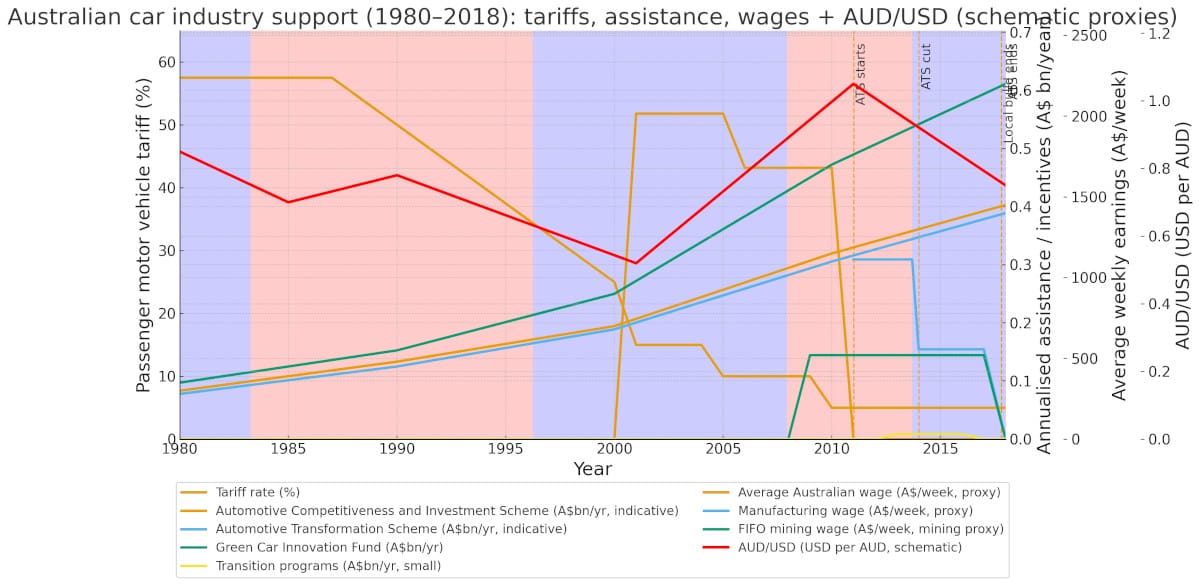
I recall first hand Holden running a profitable third shift producing 24 hours a day, but when the Aussie exchange rate hit $1.10 US it caused a conniption for Australian exporters. We could have protected local manufacturing, like we help farmers in a drought, but halving support, then daring carmakers to leave was sadly the certainty they were looking for.
The small scale of Australia’s car industry was always an issue, but it’s great to see existing local expertise employed by firms like Jaunt, getting involved in the world’s automotive future.
For more on electric car ownership, read our detailed guide to EVs and charging.
Footnotes
- Fun Fact – Australia built aeroplanes locally before we built a whole car ↩
 About Anthony Bennett
 RSS - Posts





Agreed on the tarrif and subsidies point. The AUD was also a problem. Just when we had some serious exports happening.
That also made imports more attractive, along with a greater choice in vehicle types.
We were guilty and bought two German made Ford Hatchbacks around 2010.
Back in the day, there was employment in supporting industries, too. My career began with finishing off the design of the digital clock for the XD Falcon. Ford reported that the prototypes failed “the second time they were switched on”. A trip down to the Ford proving grounds in the You Yangs, with a storage oscilloscope & polaroid camera for a permanent record of the trace, revealed a -600 volt spike on the accessories line when the ignition was turned off. OK, that’s just back-EMF from collapse of the magnetic field in the coils of accessories relays, but wow!
Back at the office in Richmond, everyone else went home, but my instructions were “Deal with it, but it’s not allowed to cost anything.” (The unit price was already contracted and pared to the bone.) A good dose of midnight oil revealed that the CMOS chip had tiny protection diodes on the input, and adding a 220k series resistor limited the spike current to a survivable level.
That was a 0.6c fix, and a beginner’s lesson.
Brilliant story Eric,
I never thought much about the clock but the variable capacitive fuel gauge on those cars was interesting.
I’ve fitted an accessory gauge set that said in the instructions it must have an ignition feed that wasn’t maintained when cranking the engine.
I assume they’re trying to avoid spikes from things like the starter relay or solenoid but it’s a pain when voltmeter doesn’t work & oil pressure doesn’t read for 3 seconds after starting.
Those little things make a difference.
Anthony,
The voltmeter would probably read under 8v on cranking, and oil pressure perhaps zero for a few seconds, if the meters operated. But a dud battery shows up as poor cranking too, so we get by.
There’d be quite a bit of energy in a starter solenoid switch-off spike. The other thing we had to test for was a “Load Dump”. That’s where the alternator is delivering full load, and that’s suddenly disconnected. That can peak at +100v at the start of a pulse decaying over several hundred milliseconds.
Ford didn’t locally adopt the centralised load dump protector I designed, but informal feedback suggested that the circuit diagram found its way back to the states.
They had me experiment on the idea of a capacitive fuel sensor without moving parts, relying on change of dielectric constant. But the difference between air and fuel wasn’t much, so I gave up.
My brother had a little Holden Gemini, and hacked a hole in the dash to take a Ford clock. In 1979, anything digital was spiffy.
Eric
In my experience the XD, XE & XF Falcons all had a capacitive fuel sender in them. The little VDO tester we used (just a resistor pot) also had a dedicated 3 pin plug for testing Ford fuel gauges, so I assume the sender converted capacitance into a resistive output?
Modern indicators use stepper motors sweep the needle back & forth when I’d rather observe the oil pressure climb.
Would a zenner diode across the supply clamp any spikes do you think?
Good to see other Australian companies getting involved in EV Conversion Technology.
ELMOFO based in Newcastle NSW has been doing similar work for the better part of 16 years.
Notable projects include:
2012 – Electric Conversion of a 1981 DeLorean DMC-12 (Currently undergoing upgrades).
2013-2014 – Electric Radical SREV all electric race car, competed against petrol V8’s and secured 1st place in two of the races.
2018 – Byron Bay Electric passenger train – conversion of a derelict heritage train to fully electric with diesel backup, don’t quote me but I don’t believe the diesel backup has be used for operation since its conversion.
More recently we have been concentrating on a few electric Jet Tender boat conversions & our Electric Motocross DIY Conversion kits which suit most Honda, Yamaha & Kawasaki models.
Sounds brilliant Jake,
Feel free to tell us more.
Cheers
They are fabulous stories @Anthony, Jake and Erik. Erik, yours in particular made me smile…the way of don’t tell me the problem, just tell me how you intend to fix it without spending a zac.
Good morning Anthony & Finn
Oh what a tell are the headlines of this article by Anthony, as resent in Finn’s weekly collation. 🙂
Anthony correctly uses the term “classic cars” vs Finn using “vintage cars” erroneously. For long time motorheads like me, a classic is after the vintage and veteran eras. Vintage is pre-1919 and veteran is 1919 – 1930.
Yours fraternally,
Phill
owner of classics: 1948 Acme 125cc motorcycle, 1969 Jaguar 420G, a handfull of 1974 motorcycles & car, a 1992 Peugeot 405 Mi16 sedan et al.
Hi Phil,
Think you’ve got that arse about. The yanks define something pre 1916 (brass era) as a “horseless carriage”
However 1919 – 1930 is vintage.
In Australia veteran is 1918 or earlier, but this is muddied a bit by the poms claiming 1905 to 1919 is Edwardian.
In any case they’re old enough to need rose tinted driving glasses 😉
I have a short wheel base 1952 Landrover in my barn, always wanted to restore it eventually, but to convert it to ev would be brilliant! An older sister for my 2024 MY!
Louise in SW Qld
Hi Louise,
Plenty of people convert LandRovers for a lot less than Jaunt if you want a more basic setup. Many DIY systems too.
https://ozelectricvehicles.com.au/
May I suggest restore the cabin interior and external body work but modernise the engine bay & drivetrain. A suitable business in Morayfield, Qld estimated $50K to do my Pug with a Tesla battery. Another of their customers is paying $80K for an early 3 series Bimmer.
No recomendation, just FYI.
Yf,
Phill
Good afternoon Anthony.
With my ancestors coming from Norfolk, England, I follow the Poms not the Yanks. So I have Jaguars and Villiers as opposed to Cadillacs and HDs.
To each their own.
Yf,
Phill
Just watched this: https://www.youtube.com/watch?v=SFOoEzilPOY
An excellent US video re costs….I’d have to cash in some bullion!
Thanks for all the comments!
Louise
Hi Phillip,
I have T Fords, Morris Mini & Perkins Diesel, they all leak the same oil, but some are noisier. Really it’s what gives you more smiles per gallon 😉
And I having owned six, rebuilt & raced three BSAs back in the day, I know what you mean.