
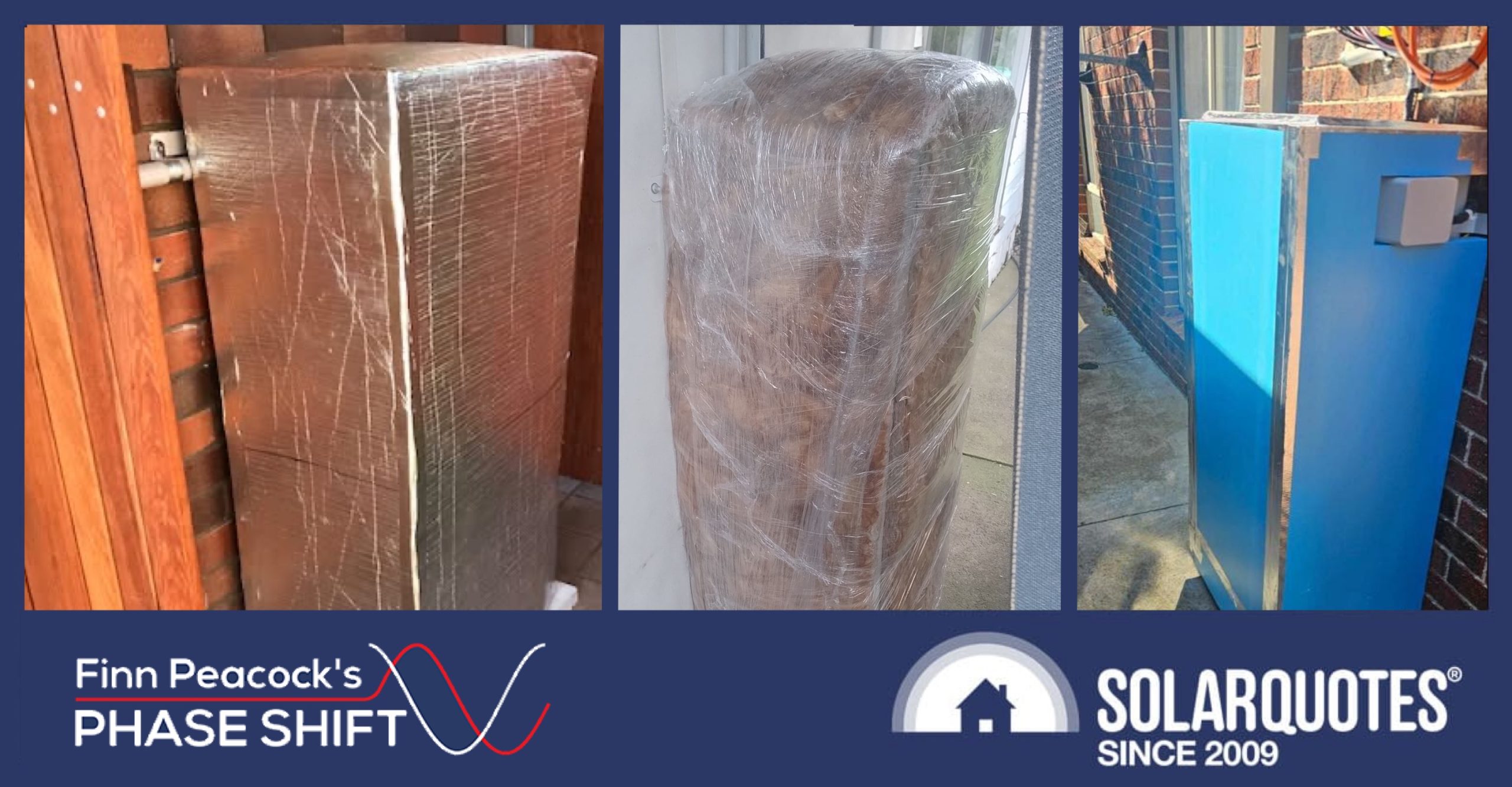
Images of DIY winter coats for Fox batteries – shared on FB by Australian owners: Update: a commenter has told me the middle one was done for a joke and the overcoat was promptly removed.
Fox ESS batteries recently became the most popular battery in Australia thanks to their nice stackable design and a price that undercuts most of the competition. When asked, my personal verdict on Fox has been: I don’t have enough real-world data to vouch for their quality in harsh Australian conditions, and I’ve consistently recommended waiting for a couple of summers before committing.
Turns out it’s not the summers I should have been watching.
It’s early May. Not even winter. Melbourne hit 8°C the other day – reasonably chilly for Melbourne, sure, but hardly Hobart in July – and Fox battery owners started posting. One reported their 10kW system throttling back to 3.8kW. Others chimed in with similar stories. The batteries aren’t broken. They’re just doing what lithium batteries do when they get cold: they get cautious, limit charge and discharge rates, and in some cases trigger forced charging to warm themselves up.
This is a known issue with lithium batteries. The solution, in cold climates, is a battery heater, a small heating element built into the unit that keeps the cells above the threshold where chemistry gets sluggish.
Fox, like many budget battery manufacturers, didn’t include heaters in some of their Australian models.
I can only think of one reason to do that: cost. Specifically, the pressure to hit a low enough price per kilowatt-hour to get as close as possible to the dollar amount per kilowatt-hour of the battery rebate. It’s a rational commercial decision. It’s also a decision that seems to have been made by someone who has never spent a winter in Hobart, or apparently Melbourne.
This is particularly bad news for owners of Fox’s larger battery systems without heaters. The big stackable configurations, some pushing 48kWh, were a huge part of Fox’s appeal. Buyers were transfixed by the idea of a massive battery at a price that would have seemed impossible two years ago. But a big battery creates a big problem in winter. Unless you have a solar array the size of a tennis court, the only realistic way to fill a 48kWh battery in winter is force charging from the grid during off-peak or free-energy windows. And when you’re doing that, you want to charge at full rate – you’ve got a limited window and a lot of kilowatt-hours to shift. If the cold is crippling your charge rate, you’re simply not going to fill the battery in time1.
In every major Australian city except Brisbane and Darwin, winter energy demand for heating exceeds summer demand for cooling. If your battery can’t be reliably filled in winter, your return on investment takes a serious hit.
What worries me more than the performance throttling is what some owners are doing about it. Enterprising Aussies, faced with a battery that won’t charge properly on a cold morning, are improvising. Insulating board strapped around the whole stack. Full DIY overcoats on a device that contains a significant amount of stored energy and needs specific clearances for cooling.
Fox has actually published guidance on this for their UK customers, who ran into the same problem. It specifies flame-retardant materials, minimum clearances from electrical components, what not to block. It also includes this note: improper insulation may lead to elevated internal temperatures, accelerated degradation, or even thermal runaway. You assume all associated risks.
That scares the shit out of me. Because the Australian owners improvising with DIY covers may not have read it. What happens when a Melbourne winter turns into a Melbourne summer, or we have on of those freak warm winter days and someone forgets to remove the insulating board they strapped on? Nothing good.
A few caveats worth stating clearly. Fox will not be the only battery on sale in Australia with this problem – they’re just the ones we’re hearing about, and that’s largely because they’ve become the best-selling battery in the country. When something goes wrong with the most popular product in a market, you hear about it first and loudest. Other brands may have the same cold-weather limitation and we simply don’t know yet because their sales volumes are lower.
It’s also worth noting that before the Cheaper Home Battery Scheme and before batteries got cheap enough that 50kWh systems were suddenly within reach of ordinary households, almost nobody needed to charge their battery at full tilt in winter. Smaller batteries, slower charging, milder use cases – if the issue existed not many people would even notice. The rebate changed everything.
I’m updating my verdict on Fox ESS batteries. It used to be: wait and see how they handle a couple of Australian summers. I’m adding to it: we also need to see how they manage a couple of Australian winters. Early May in Melbourne shouldn’t be breaking a sweat.
Footnotes
- if this is you – have a look at your quote – it should have performance and savings estimates – if those estimates assume full charging power all through winter – you should talk to your retailer about Express Warranties and Australian Consumer Law ↩
 About Finn Peacock
 RSS - Posts





I’m a little disappointed that you’re singling out FoxESS on this, I’ve come to expect more balanced journalism from SolarQuotes. I have installs with 7 other top brand lithium batteries that experience the exact same issue with reduced charge rate. But because the arrays are well sized for winter production, it doesn’t actually have an impact on performance. Needing the battery to charge at 1C in winter is bad design because either the PV array would be oversized, or there would be too much maximum demand on the grid charging.
Did you read the whole post?
Yes I read the whole post and note that you included a caveat towards the end. However the headline unfairly singles out FoxESS, and the article doesn’t address the issue that limited charge rates don’t actually have much impact on system performance on a well designed system. You quote a 10kW system throttling back to 3.8kW – it would be more interesting to know if 10kW was the Pnom of the PV array, and what the expected output was at the time given azimuth, orientation and efficiency. Or was it set to charge at 10kW from the grid but was instead reduced by the BMS to 3.8kW? Was it a 10kWh battery? If so, why would you set the grid charge rate to 1C? What was the actual error message from the monitoring software? It’s quite possible that there was a notification that because of low temperature the charge rate was restricted, but that the available PV and/or grid charge was below the restricted charge rate anyway and so wasn’t affecting performance.
Did you also read the bit that explains this has become an issue now because of all the 48kWh systems made possible by the rebate and the desire to charge flat-chat from the grid over a 3 hour period?
In fairness to Anne, you did single out FoxESS and the issue is worse with smaller sizes. So had these customers gone with say a battery half the size they would be charging at half the rate. 4kw is a about the speed of a single Tesla Powerwall 3 so still decent for the price.
Please send pictures of these other brands where people are covering the battery with pink batts and glad wrap and I’ll happily publish that story.
Say you have a 11am to 2pm free charge window (common).
In 2025, which was a statistically a colder than usual year climate wise. The lowest 11am temperature in Sydney, Melbourne, Adelaide and Perth is >10c.
But lets just same the temp is 7c at 11am (may not ever happen in AU mainland?).
So the force grid charging starts at 11am at 4kw due to the cold (most likely a full 42/48kWh stack of 9 modules would not throttle this much as the more modules you have the higher total charge/discharge capability).
Now as the charging occurs, the battery starts to heat up “naturally” as thats what batteries do when you try to push current into them.
So 10 mins later, the charge rate probably would go up to 5kW?
Another 10 mins, 6.5kW?
Another 10 mins, 8kW?
So by 11:40am its probably reached full 10kW charging ability already.
So in real world a non-issue small reduction in performance?
Hi Anne,
It’s worth pointing out when Fox is happily claiming top position in the market, so potential problems will bubble to the top quickly too. Being #1 cuts both ways.
Finn hasn’t sought OEM input because a chartered engineer is obliged to act when they see potential danger. Our opinion is DIY battery insulation is fraught with risk, no matter whose product, it shouldn’t be encouraged.
Yet Fox UK say officially :
2. Thermal Risk Warning: Improper insulation may impede heat dissipation during
operation, leading to elevated internal temperatures, accelerated degradation, or
even thermal runaway. You assume all associated risks. (my emphasis)
3. Warranty Coverage: … do not cause
any malfunctions. [Your Company Name] shall not be liable for any issues directly or
indirectly arising from the insulation materials or their installation.
I’d be embarrassed to have forgotten the company name
And I must add Anne,
I’m very glad you’re here to share your obvious expertise.
We love having the opportunity to foster an exchange because everyone can learn things in the comments section. I’ve certainly gained some knowledge when people like you, Glen Morris, Geoff Bragg, Richard Mcindoe, Stefan Jarnason or other industry luminaries join in. We’ll even include Karl Jensen 😉
Would be handy if you let the punters know who you work for, just to maintain an atmosphere of transparency and trust. On that point, I might see if we can organise some better avatars.
Cheers
Would be great to provide an article on what batteries have heaters in them and also guidance on what options people have to safety insulate their batteries.
The other observation I have with my Fox ESS H1 5kw gen 2 with 42kw EQ4800 cells is that despite the battery getting warm enough to force charge at the full 5kw, if the battery is still cold enough, as soon as I turn on my EV charger in parallel, the Fox inverter throttles back down to zero. If I throttle my EV charger then the Fox ramps up again. Very peculiar behaviour. I don’t have battery backup and my solar inverter is AC coupled. The EV wall charger is not connected in any special way. It’s on its own circuit.
agreed – watch this space
Hi Julian, I have a 27kw Tesla Powerwall 3 setup and it does similar because I asked the installer to set the GRID INPUT LIMIT to 14.2kw so it won’t blow the 63 Amp Main Breaker. This means the gateway will throttle back the Powerwall charge to maintain the grid input to no more than 14.2kw. Of course if you have more than 14kw of EV charge, hot water heating and Air Conditioning running and low solar output, the breaker will probably trip anyway because the Powerwall can only regulate back to zero. It doesn’t really cause me any issues as I still manage to charge the Powerwall 3 and EV when needed in the free 3 hour charge window. Just for the record the Powerwall 3 with one extension (27kw total) has no problem charging at 8 to 9 kw for 3 hours if needed (13th May Melbourne weather). It does get pretty warm and the fan starts running. Your setup may also have a grid input limit also.
Is this throttling not part or a protection system in the FoxESS prpgramming that prevents the total grid draw from pushing past 63A and tripping your main breaker?
5kW charging is 25A
7kw EV charging is 32A
That is 57A total plus your house load.
The FoxESS can sense your total grid current draw with it’s CT clamps on the main incoming active line between meter and main breaker/switch.
My Neovolt (another very cheap brand that has been workong reliably for 2 years) has this feature – its call Grid Power Limit – after I enabled it and set it to 14kW (roughly 63A after account for voltage sag) I see this kind of behaviour and it has saved many a nuisance trip of the main breaker.
Nothing is charging at 1C.
Most home batteries is 0.5C max
Tesla’s Powerwalls have a working ambient temp range of -20°C to 50°C
In most of Canada, keeping that Powerwall in a space above -20 C ambient means you’d have to install it in a heated garage or inside the house.
We have a 40kWh battery and a 6 hour window to charge from the grid (assuming little to no solar the next day).
To achieve charging from absolutely empty we’d need to charge at 6.6kW/h.
This works out to 0.16C, so a nice gentle charging rate.
I am the guy who wrapped the battery in pink batt’s and glad wrap lol. It was a rage bait post as I followed the UK winter while my system was installed in spring last year. I knew the system was going to throttle on really cold day’s and that forums would be filled with complaints. I didn’t think anyone would actually think it was a serious post or a good idea for more than 5 minutes but here we are 😂
I am so relieved to hear that. Caption updated. The other insulating jackets still worry me though.
Fox have said insulating foil boxes will not void warranty as long as certain clearances and proper materials are used. It’s really not as big of an issue as some are making it out to be. For $150 or less an insulated cabinet can be made in less than an hour. Still good value for Fox ESS considering some of us only paid $7000 for a 42kw battery with 10kw to 15kw inverter. There was always going to be a caveat somewhere.
Finn’s report is totally balanced.
The following paragraph clearly states the current position: “A few caveats worth stating clearly. Fox will not be the only battery on sale in Australia with this problem – they’re just the ones we’re hearing about, and that’s largely because they’ve become the best-selling battery in the country. When something goes wrong with the most popular product in a market, you hear about it first and loudest. Other brands may have the same cold-weather limitation and we simply don’t know yet because their sales volumes are lower.”
I’m sure Finn will let us know when other batteries are reported to have this issue. At this stage it’s useful information, and we should be aware of potential problems. I would rather know than not.
Correct Lawrence,
Being #1 means there’s only one direction you can head, it’s something that cuts both ways.
We’ve never sold the Fox ESS and we never will.
I sold one reluctantly to an existing customer we installed solar for and had a faulty unit which took 2 months to replace. Never again
I am wondering if Sungrow batteries have a heater in them
No they don’t.
Off the top of your head Finn, which ones do have heating ??
This might be a good future article, the differences in features, performance vs investment cost.
Off the top of my head: some Fox batteries do include cell heating – same with Goodwe and SolaX. iStore, Tesla and Franklin batteries have heaters. I’ll get a blog post done that gives a definitive answer soon, and add a row to the battery comparison table.
I can confirm that my Goodwe GW8.3-BAT-D-G20 have cell heating and have no issue during those cold period in May 2026.
Haier home Batteries also have cell heaters built in.
Can charge down as low -10 deg C, and discharge down to -20 deg C.
Hi Finn
I’m in the situation of JUST looking at taking the Governments rebate batteries and I have been looking at this post in regards to heaters in certain batteries -have you had a chance to look into which batteries have a heater in them yet?
and can I ask for your advice in regards to what size battery I should buy I have a 6.6kw solar system with a Fronius inverter I don’t want to buy what i cant utilize !!!!
thankyou in advance
Hi Margaret – we did another piece on batteries in winter which highlighted Hiconics, Tesla PowerWall 3, Franklin WH and Sigenergy as among those with heater.
As for battery sizing, today’s post covers what to factor in, but your own energy consumption is a key factor.
Yes they do at least the SBH Sungrow batteries have an inbuilt heating function see YouTube video https://youtu.be/2Df1o1fbmHk?si=ZnndK2untiwRCnYA
Brian
Hi Brian,
SBH are available with heating in Europe but I don’t know that they’ve arrived here yet.
This seems to be incorrect for the latest Sungrow batteries:
“ Integrated Heating: The newest SBH V12 models include this, which is crucial for maintaining performance during cold Australian winters.
Operating Range: With this heating capability, the SBH series has an operating range of -20°C to 50°C.
Previous Models: While older SBR series units possess robust temperature monitoring and BMS protections for cold environments, the dedicated automatic heating function is a hallmark of the new SBH V12 series.”
Hi Mark,
SBH are available with heating in Europe but I don’t know that they’ve arrived here yet.
Sigen do
Makes a case for installing batteries in the garage in colder climates then. I am in sunny but cold Victoria. The Battery is in the Garage. Not switched on yet, now into the 7th week waiting for inspection.
Sidestepping Finn’s oft-voiced dislike of people owning an ample battery, defending his informative heads-up article seems called for. As the issue is much more marketing than engineering, using the high-volume / low-cost maximal exploiter of the tactic as an example seems eminently fair. Mention of fellow potential deceivers suffices for balance, does it not?
Until Na+ proliferates, the cold weather limitations Li+ & LFP are our lot. My LFPs are indoors. Daytime battery/equipment’s residual heat warms that workshop overnight, so all good.
Poor battery siting is in retrospect also an installer training issue. Failure to anticipate the performance deficit resulting from sub-optimal installation may be a liability shared with the vendor’s sales and installation documentation.
This is also a case where an “oversized” battery protects the customer better than a skimpy one, already barely adequate before cold hits. Ample battery & inverter, both! That’s optimal.
I had a stroke trying to read the first paragraph.
Unfair.
Finn’s “oft-voiced dislike of people owning an ample battery” reference is specifically regarding poorly designed installations comprising 1 48kwh+ battery being fed by a 5kw inverter. A patently obvious BAD design choice that will struggle to fill the battery in summer, forget winter.
A minimum of 10kw inverter is required to fill a 48kwh+ sized battery. Obviously with an equally well designed solar array of 20kw size.
Yes, John, the problem isn’t battery excess, but acutely inadequate inverter size, a legacy of old pricing regimes, and obsolete fixed grid export limits. As we transition to an electric energy economy, it is the old 5 kW inverters which need to go, as the 30 kWh (and larger) batteries go in to meet our growing needs. I think it is positive to challenge backward thinking attempts to pull new batteries down to match inadequate legacy inverters. (Fair or unfair, if it helps people look at it clear-eyed, then I’ll keep doing it. 😉
V2H may be useful in an extended blackout – until petrol is scarce, and you need to go to work. Then a big home battery may be essential to time-shift BEV charging, i.e. big-battery H2V may be what allows life to remain almost normal in the coming long-term fossil fuel supply reduction.
If logistics must also go BEV fast, for fossil fuel for farmers, then big home batteries may be vital for grid off-loading at peak times. Let’s think forward, not backward.
Great write up! Knowledge I wish I knew when I purchased my batteries.
When I first got my Alpha M5 Smile batteries, it was summer and I went down the rabbit hole trying find ways to keep my batteries and inverter cool. Living in Melbourne, I ended up discovering that the cold weather is probably more of an issue as mentioned in this article.
I then found out that the Alpha M5 don’t have built in heaters and my second choice of SolaX actually do. It was cold the past week but the Alpha was able to charge and discharge at full capacity. Using Home Assistant, I am able to monitor the inverter and battery temperature. Noticed that my small solar array which starts charging the battery in the morning did help warm the battery a bit prior to the 11am-2pm charging.
Fingers crossed that it remains this way in the middle of winter!
Should have gone Solax. Such a good system.
I understand all of this…But how can we fix this issue ?
Goodwe ESAs ok on this front?
Hi Dean,
Quick search says Yes, the GoodWe ESA series can have internal heating elements, but it’s optional. GoodWe’s ESA launch materials say the system can operate down to -18°C “thanks to optional heating elements,” and Australian coverage of the ESA notes models with internal heating have a lower charging temperature range of -18 to +55°C.
https://en.goodwe.com/Ftp/EN/Downloads/Datasheet/GW_ESA-5-30kW_Datasheet-EN.pdf
Thanks. And looking at that PDF, I’m getting the GW8.3-BAT-D-G21 ones installed, which doesn’t offer that option even. It also has a narrower charging temperature range (from +2 degrees celsius while the G20 ones can charge from as low as -18). Melbourne can get cold but has a minimum below two degrees on seven days a year average. I can handle that as that’s a low on a day, and might not apply when actually charging on those days even.
Hi Dean,
Ask your installer for the G20 battery modules which come with heating. My understanding is they are the same price.
I received them in my Goodwe ESA system here in SE QLD (not that its needed though). The heating function can be enabled/disabled in the App.
While true, after reading the reports first hand it is more a case of the batteries not maintaining their peak charging speeds. Arguably they weren’t intended to be forced charge at 11kw on a cold day. The exact model mentioned is common in the uk (outdoors), just needs a longer charge cycle.
Good info — looking forward to you guys doing some deeper analysis to find out what’s really going on.
I’m in Canberra, where 8°C might be considered a warm winter day. So now I’m interested in good advice here.
In the automotive world (EVs) this has of course been known for ages. Mostly along the lines of “I’ve been driving for hours in sub-zero temperatures. I stopped for a charge, but I’m only getting one-quarter of my usual rate!! This charging station sucks!”
It’s not the charging station, it’s a feature called battery pre-conditioning. The car can warm up the battery, but since that costs energy, it needs to be told that you’re driving to a charging station. Often it doesn’t work and people complain. It’s an issue.
Sounds like an issue for fixed storage too!
Tesla only seems to preheat the battery when navigating to a Tesla charger. Unless there’s not enough battery to also go all the way there.
For lower power charging at home in Canada’s cold winters (-37 C is the coldest I’ve gone out in with my car) you need a heated garage or a lot of extra electricity to run the battery heaters.
I suppose this cold problem mostly applies to discharging over night to run a heater?
Solar or the coincident free grid hours would be the warmer part of the day and presumably would allow normal charging.
I just checked and my Solplanet battery says it is good for -5*C to +58*C, but I see no mention of a heater. Now you’ve made me curious; I’ll certainly be watching it over the next few months. Thankfully the Adelaide plains rarely hit 0*C, and climate change seems to be making winter shorter and milder.
Yet another anti chinese and anti foxess article..You would think Finn gets paid for his opinion. Oh thats right. He does. And sale of opinion to origin.
Origin should really distance itself from these opinion pieces. Or perhaps that is exactly their aim to distance themselves to better support what they sell as a device installer / retailer
My Sydney EQ4800 with 15kw inverter (H3) has a awning covering it outside. Outside daily sun. It operates at 15kwh and performs normally. No alarms. No abnormal changes. Lifetime Min battery temp 19.1C. A long way for freezing cold.
I can touch the battery and inverter. It would melt ice. Its tepidly warm. Not hot. Certainly not freezing cold.
Hi Paul,
Be aware that Fox ESS installation guidance says the battery installation area should be protected from direct sunlight, and warranty exclusions include damage caused by improper installation or failure to follow the operating instructions.
An awning might stop water dripping but has no effect on wind driven rain or radiant heat from the sun.
Direct sun exposure alone may not automatically void every warranty claim,
but if the battery is installed outdoors in a way that violates Fox’s stated environmental requirements, Fox could treat any resulting failure as non-warranty damage.
As mentioned elsewhere in this thread, shortcomings are highlighted because being #1 in the market cuts both ways.
Jeepers. This is a blog on the SolarQuotes website, not the government TV station. Finn can post what he likes.
Go Finn.
Yo this guys sample size of 1 is all we should listen to everyone! Pack it up we’re done here.
There is report that fox ess is pushing out firmware update to remedy this issue. I think this post might be a bit premature. Waiting for the next cold snap to come through Melbourne to see how things goes. Will compare my Solax system against the Fox ESS. Last round had issues with Fox ess, no issues with solax. Will be interesting to see how the firmware update performs.
“If your battery can’t be reliably filled in winter, your return on investment takes a serious hit” … ay, there’s the rub. In Canberra, even if I match a small 10 kWh battery to my 10 kW solar, I will only get to 8 kWh stored during the winter months. Obviously worse than that if I go for a bigger battery. This curtails the key central heating benefit in the early evening.
It’s why in my climate, battery economics just don’t work. And that’s before taking into account any impairment of battery performance during the Canberra winter…
Yeah, i am quite surprised by that. Given virtually all the batteries for sale in Australia were developed in a colder climate than ours, you would think issues with cold weather would be the last thing you would have to concern yourself with.
Common thoughts are that it is our summers that sort the wheat from the chaff.
I think I have found the post Finn is referring to
Assuming a 10 kw inverter, the system at 7 deg cel has actually only “throttled back” to about 8.5kw. The house is actually using 4.68 kw so there is only 3.78 kw left to charge the battery. The image indicates the battery is showing a cold weather warning.
Note Fox have been the most popular battery in both UK and Germany for 4 years, so there is now significant experience in fox cold weather performance in winter climates significantly worse than ours.
Note: “ oversized” batteries may be more useful in winter than in summer. They do not need to be fully charged every day. On low usage days, there is plenty of capacity to store power for the high usage days.
My experience in Germany is that all houses are overheated and garages often are heated as well. So if they usually place batteries indoors, the battery would not experience temperature extremes. It would be interesting to know which location is more common
Hi I am in Melbourne and looking at getting a sigenergy 16kw system installed inside my garage hopefully that will be big enough for my energy needs all year round. Although I do have a heat pump for my pool so maybe not in winter. Does sigenergy have the inbuilt heater I know it has back up in case of power outage which is good.
Hi John,
Sigenergy have internal heating elements.
They certainly offer whole home backup for all your electrical demands, but from what I’ve heard recently, the after sales backup of the product is lacking.
They are a compelling product but the marketing budget seems to exceed the customer support on offer.
thanks for letting me know Anthony which brand do you recommend and it will be going in the garage and will 16kw be enough to cover my energy needs all year round remembering I have a heat pump for a pool. I hear sigenergy are one of the better one’s for safety reasons fire.
Same with Alpha ESS on a moderately cool day in Sydney?
Still think the Fox ESS 42 kWh battery was terrific-bang-for-buck. Mine is installed in the Garage and car residual heat when parked heats the garage up to a cosy temp. I’m not worried about this at all and a cabinet could be installed quite easily if it became a significant issue TBH.
Just installed a 16kWh Sigenergy battery. just in the past few days It seems to not like the cooler overnight temperatures also. Will watch performance closely as winter really impacts
The Sparkie from ZIP Solar finished installing my 9 cell 42kWh FoxESS battery at noon on Saturday Feb 28th. Alas the light on cell #3, up from the bottom, was flashing red. He said someone will be out on Monday 2nd March to fix it. 73 days later and it is still flashing. The other 8 cells flash green. It’s like an Xmas tree at night. Is it a dud cell or a bad connection or what? But the system seems to be working – 20 panels so 9.5kW and a 10kW Fox inverter. There is nearly always a few watts of power coming in from the grid at night. Why?
I built a sunshade as the battery gets the hot western sun on the side of my house from noon till 3pm and then it is shaded by the fence. Will I need to worry about cold winter mornings? I’ll know in a month. Removable insulation of batts and gladwrap could be the go .LOL
Useful info – thanks Finn.
Our PV panels have a lot of shade in winter (we acknowledged this at the time of installation many years ago). We have two Powerwall 2s and often they don’t have a high SOC by the evening in winter. If the SOC is very low they will start charging from the grid (off peak) in the early hours. Otherwise I sometimes charge them for about 2 hours after 10pm using the Tesla Storm Watch function (allows users with a paired iPhone to start charging from the grid for a selected number of hours). Note that Tesla Support can remotely change the grid import limit on request – users cannot change it.
Regarding the topic of this blog, I would expect that the battery models with very low minimum operating temperatures (say -18C) are likely to have heaters. This may be a quick way to identify them?
Early yet but not been an issue so far in Canberra with a 42kWh eq4800 + H3 smart 10kW in a carport.
While they probably should have sold the ‘H’ model with the heater here and Melbourne, the value for money is still far better than the more premium systems that were quoted twice as much for half the size even if the charging could start slower midwinter.
The system has been great so far, IMO best option to save money on electricity and that’s kind of the point for most people.
I had a Fox ESS installed outdoors in April (42kWh EQ4800 + KH10 inverter)
I’m recording data in home assistant, and looking at the battery lowest cell temp records this is what I’ve seen (BMS v2.016):
>11 degrees:
Normal operation, max charging rate 9.8kW
6~11 degrees:
Charging rate limited to 8.3kW
3~6 degrees:
Charging rate limited to 3.9kW
2.2~3 degrees:
Minimum SoC of 20% was enforced by the BMS (automatic forced charge at 2kW to get up to this point from my default minimum of 10%). I’m not sure if faster charging is possible as I didn’t attempt.
<2.2 degrees:
Don't know yet – 2.2 is the coldest it's gotten so far.
Based on this – I'm looking at using home assistant to automate a forced charge from 10am on cold mornings, to warm to the critical 6 degrees before my free charging window starts at 11am. This might not even be necessary if I'm discharging a decent amount of energy before 11am (but sometimes the battery is depleted too early).
I have the same system in Melb. I discovered that using high levels of battery power in the half hour-hour leading up to the free 3 hour window heats up the battery 2-3 degrees on cold mornings. Mine is located outside on the south side.
Useful for me when im home on Saturday/Sunday watching the world cup. I turned on the wash machine, dryer and a portable elec heater (and turned off the gas log heater).
I figure if the temp rises, and i get to 11c sooner, it means I can utilise higher free power earlier. It appears to be a net gain as the battery is fuller/close to full at the end of free time and i have effectivly load shifted as well).
I am going to build a removable battery cover for winter to block cold and wind chill factor. Plan on using blueboard as the main product. Not keen on the aluminium covered insulation options i see for risk reasons (and is a clear breach of Fox advice). Have a great weekend.