
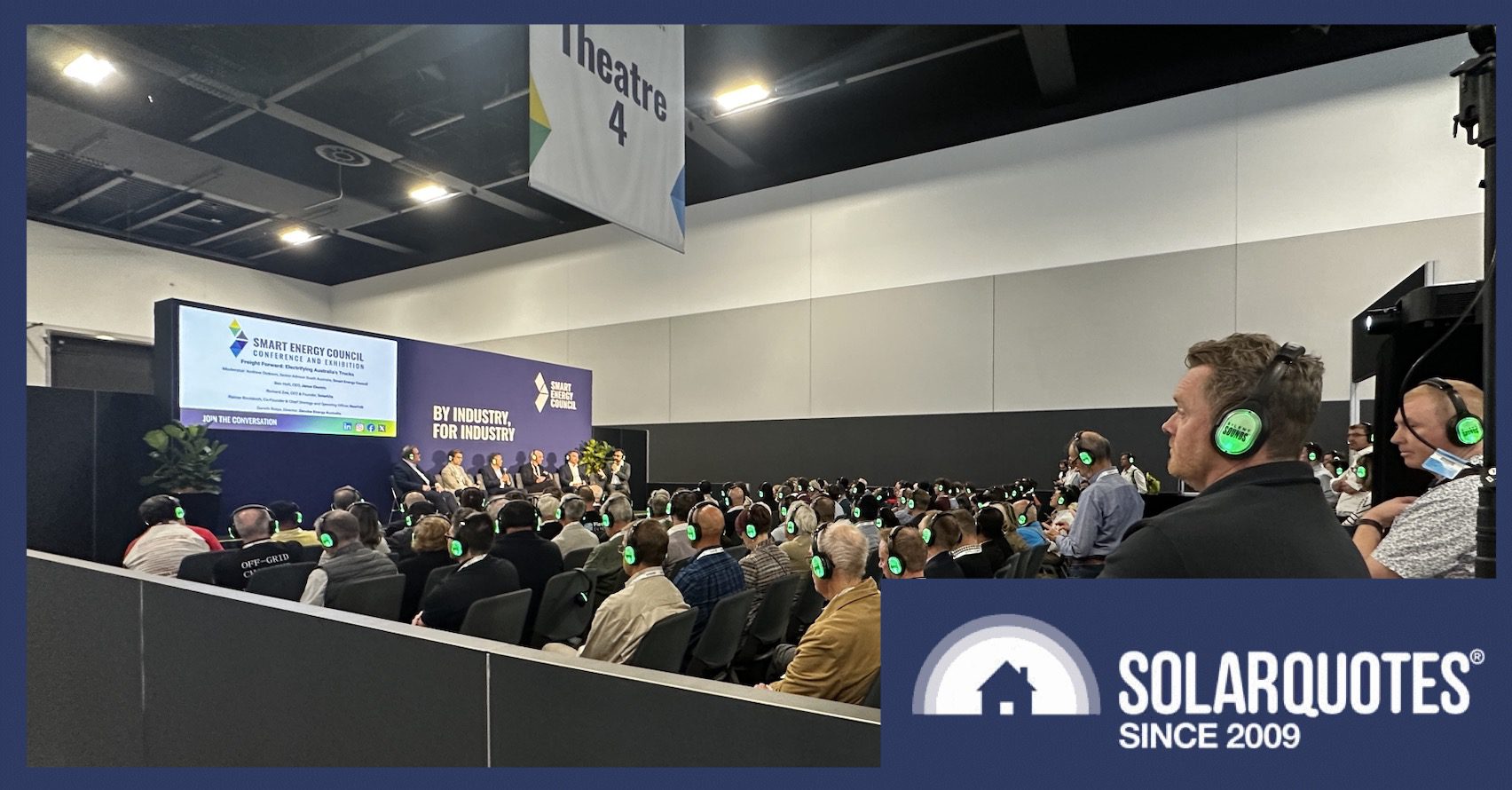
Max is still on holiday. I am still in Sydney. Here’s what happened on Day 2 of the Smart Energy 2026 Conference & Expo in Sydney.
My day started with a walk from the Rocks via Barangaroo to the conference centre, taking in one of nature’s greatest harbours, and arriving just in time for the leader of the Greens, Larissa Waters’ talk.
Larissa Waters: Yes, But…
The day before, Chris Bowen walked into an overflowing auditorium and his words were lapped up by an adoring crowd frequently erupting into rapturous applause. The industry and the minister have $7.2 billion worth of reasons to be nice to each other, and they were.
Waters walked into the same room, about 15% full of delegates.
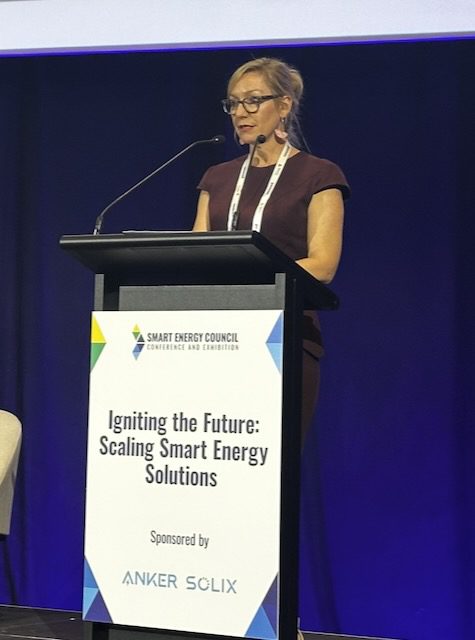
The Greens Senator opened by naming the first thing Labor did with its historic supermajority: approve a massive new coal mine with an operating life running to 2070. She literally accused the government of “climate denial”.
She acknowledged recent wins: the battery numbers, the recent gains in EV uptake, the gas at a 27-year low – but Waters’ argument is that the same government is simultaneously approving “carbon bombs” with 40-year lifespans, gifting billions in subsidies to profitable miners, and protecting gas companies from meaningful taxation.
She also had pointed things to say about the EV road user charge reform the government is considering. Done well, it prices pollution and congestion. Done badly, i.e. the current trajectory, it exempts petrol and diesel vehicles while slugging EV drivers, achieves nothing on emissions, and hands the opposition a gift.
The audience that gave Bowen a group hug and cheers sat quietly through most of this. Which is its own kind of answer about where the industry’s political comfort zone lies.
CSIRO: Let’s Be Smart About Demand Too
CSIRO’s Gabriel Kuiper delivered a dense, genuinely important talk on flexible demand while the entire audience sat in silence wearing wireless headphones. It was like a silent disco that only plays policy analysis. I think the world needs fewer people lost between their own headphones to be honest, but the talk itself was worth the existential discomfort.
What is flexible demand?
Kuiper told us how Australia has spent enormous energy counting widgets – solar panels, batteries, EVs. We’ve long lead the world in rooftop solar per person and increasingly in home batteries. The next frontier is the services those widgets can provide, and the biggest untapped service is flexible demand.
That means getting household loads – hot water systems, air conditioners, pool pumps, EV chargers – to shift when they run based on what the grid needs. None of this requires new hardware. Most of it just needs a timer and a signal and coordination.
UTS calculated there’s 22 GW of flexibility available from smart hot water systems alone. Serious grid-scale storage delivered through appliances people already own, at a fraction of the cost of batteries.
The opportunity
Kuiper’s meta-analysis of Australian studies puts the net present value of properly integrating distributed energy resources – including flexible demand – at $19 billion by 2040.
Britain is showing what this looks like in practice. Last year the network congestion managed by distributed loads doubled, from 4.5 to 9 gigawatts. A 10kWh battery owner there can earn up to £331 a year just for easing local network pressure. Australia has no equivalent national mechanism.
What’s blocking it
The biggest problem is network regulation. Distribution networks earn a regulated return based on the size of their asset base – currently around $95 billion in poles, wires and substations. There is no level playing field between “build more infrastructure” and “use flexible demand instead.” The incentive to build always wins.
Kuiper also bemoaned that VPPs offer no transparency on how profits are split between the aggregator and the device owner. My take: that kills consumer trust and uptake. Only Amber is transparent about this stuff – hence their success at attracting customers.
And ridiculously, consumers still can’t access their own real-time energy data from their retailer smart meters. And there is still no technical standards body for distributed energy resources in Australia.
Britain started seriously working on this in 2010 and is seeing great returns. Kuiper’s assessment: Australia is about 16 years behind.
SolaX’s Clever V2H Workaround
Hat tip to Neerav Bhatt who covered this in detail yesterday – his video is worth watching.
One of the cleverest products at the show was the SolaX AC charger, which solves the V2H problem by refusing to engage with it directly.
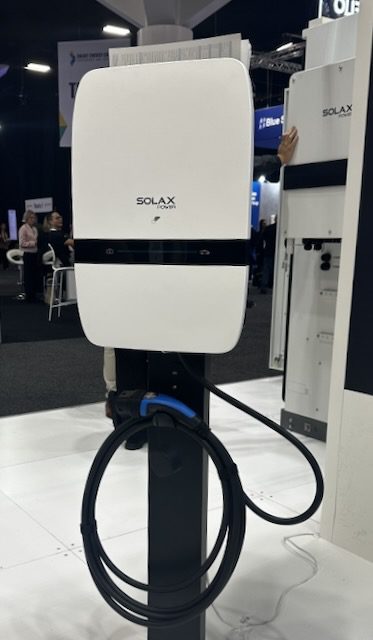
Solax’s Pseudo Bi Directional Charger
Proper vehicle-to-home and vehicle-to-grid requires DC bidirectional charging – a compatible DC charger, a compatible car, potential car warranty headaches, and in most cases network approval from your DNSP. It’s the reason V2G remains almost entirely theoretical in Australian homes despite years of excitement.
But most non-Tesla EVs already have V2L – vehicle-to-load – which is simply an AC output from the charge port, warranted by the manufacturer. It’s designed for running a kettle on a camping trip: the output is typically 2-3 kW AC.
The SolaX AC charger uses that V2L function and passes the power from the car into a compatible SolaX hybrid inverter via this charger. The inverter treats the car as just another AC source and uses that power to run the home or reduce grid draw. No DC conversion, no warranty risk, no DNSP approval process (the inverter already has that tick). Expected retail is around $3,000 for the 2-way wall charger compared to around $1,000 for the uni-directional version.
It won’t discharge your battery at the rate of a proper V2H setup: 2-3kW is the ceiling the car’s V2L output allows. But for most households that will cover a meaningful chunk of evening peak, and it works right now, with cars people already own.
Anker: Designed for the Rebate
Something you don’t often see at trade shows: a product that has clearly been engineered around a specific policy, and has done it well.
Anker’s new battery stack has 7kWh modules. That’s not a coincidence, the Cheaper Home Batteries rebate tiers from May 1 land at 14kWh and 28kWh. Two modules to max out the highest rebate tier ($3,800) and another two to take advantage of the next tier ($2,280) . Someone did their homework.
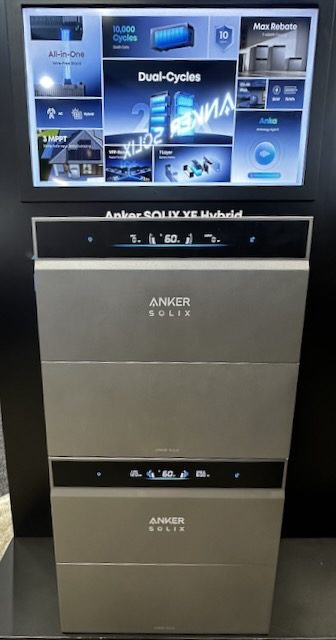
28 kWh, 10 kW, 2 battery modules, 2 inverter/battery modules (with the displays)
The inverter architecture is also worth noting. Rather than a separate inverter box and battery modules, Anker has built a combined inverter/battery module. Initially that sounds like a limitation – each inverter is only 5kW – but the answer is just stack more modules. Want 10kW of inverter? Two inverter/battery units. Anker’s claim the combined module isn’t significantly more expensive than a plain battery module.
The 10,000 cycles warranty is nice too. They’ve engineered a warranty that easily handles two full cycles per day for 10 years. Charge from cheap daytime solar, empty into the evening peak, then charge again on off-peak night rates ready for the morning. Many battery warranties discourage that kind of usage. Anker has embraced it and it makes the most of the smaller batteries being sold post May 1.
And yes, they’re still probably the best looking stacks on the market, which shouldn’t matter and somehow does.
My Takeaway From Two Days
Bowen’s scoreboard on Day 1 was real. The numbers are genuinely good. Kuiper is asking us to be smarter than throwing giant batteries at every problem. Anker, SolaX and others are turning clever ideas into products at speed. The industry is moving.
But Waters’ reality-check stays with me. I walked to the conference along one of the great harbours of the world. My grandkids will do the same walk one day. Whether it’s a comparable experience depends on decisions being made right now: including some being made by the government this conference was cheering on yesterday.
 About Finn Peacock
 RSS - Posts





Yes, sadly most still don’t get it, or think we are ‘too small to matter’ or whatever they have been fed by well funded propaganda.
Even those in the solar and storage industry. Most people will admit they didn’t get solar and now batteries to ‘save the Planet’.
Labor’s battery subsidy is a great policy (influenced by solar advocates) and their limited supported of EVs is better than the nothing the other mob offered and is starting to see dividends. But Labor is no better than the COALition if emissions and Climate Change is the topic.
Thank you Finn for a really well written article. Thanks for the practical summary and sharing new positive ideas from the conference.
Good stuff !
On those last comments by Finn: the political ones.
At 72 years of age I have been a life long Labor supporter. Since I first voted for Gough. And more recently The Green in the Senate. I have even been a Labor party member and union delegate. Last century.
So this super majority Labor government has finally done what the coalition parties could never do: stop me from voting Labor.
With a second grandchild due this month, I shall have to vote Greens in both houses at both Commonwealth and State elections.
Albo, and WA’s Mr Cook, have been such big disappointments!
WAKE UP Labor and get out of the pockets of the big corporates and act for the future generations. As you are supposed to do.
Dr Jim Chalmers for PM!
Phillip, I feel you completely. I (68 years age ) also was once a lifelong Labor voter – my first time voting was also for The Great Man, Edward Gough Whitlam – and I was a one time member of Labor Party. Labor finally stopped speaking to me after Shorten / Labor disgracefully caved in over the Adani Carmichael Coalmine issue, that was it for me and since then I’ve voted Greens – and STAYING Greens with thanks to Albanese / Labor and its full on boostering of Fossil Fuel Industry. Albanese / Labor ( just like the Coalition ) totally captured by Fossil Fuel Industry ‘political donations’. WA’s Cook has some sort of magically control over Albanese, what Roger wants, Rogers gets from Albanese.
On an alternate Labor PM, Edham Husic for mine, when he speaks he makes sense with none of the endless spin that we get from your man Dr Jim.
Great analysis as always, thanks Finn.
The first Industrial Revolution caused enormous disruption to lives. The attempt to do this one, as the UK journalist Ed Conway has said often, in a softly softly market sort of way is unlikely to work. They’re called revolutions for a reason. Why China just went all-in, no-holds-barred.
The market won’t deliver a renewable energy world. There are too many in the status quo who will lose too much, to allow that to happen.
Nick,
Interesting comparison with the revolution which got us into this mess, seeming like progress at the time. (Except to Luddites, who lost work.) It was corporate profitability which drove that one, and I’m optimistic that the same driver will continue to power this one. Certainly, our fossil-pandering government is more obstruction than enabler, so it’s down to business and us, solar, battery, and BEV buyers.
Renewable generation, booming exponentially, exceeded global coal generation already a year ago, when the latter fell by 0.6%. By 2030, the difference will be gob-smacking. BEV car uptake flips now, even here, with good effect on fossil imports by 2030. But trucking uses 30 GL diesel p.a., around $35B balance of trade burden, which all stays home once logistics are electric.
We spend $165M per day on fossil fuel, destroying our childrens’ future. We *are* the market, and its continued failure is our failure. We are what we do, not more, not less. Let us act. Now.
Do you know the story of the North Korean prison camps in the Korean War, Erik? American’s greatest mortality rate in history, and yet the camps weren’t particularly brutal. How did it happen?
The Koreans removed the handful of leaders from among the POWs. The rest then basically laid down and died.
Populations don’t change on their own. All change is led, by a small number. There are no markets.
True. Very true.
It needs a real revolution to change things that have run a course, unhindered, for too long. Rich people get used to their riches, corporarations get used to ever increasing profits, poor people, for a long time, don’t realize that they are slipping down the ladder.
Eventually, and unfortunately it has always been violent in the past, when poor people – the majority – eventually have had enough.
This is not what we want. It has never served a good end. What we need are policies, carried by a majority of MPs, to level the playing field. Does it happen? I can’t see how. Can it happen? Only if pollies from across the spectrum discover their common sense. Is it likely? No.
When you look at the studies of major change throughout history, without fail it only happens when things get broken badly.
It’s possible the mess in Iran may be the kicking that the transition needed.
It has to be said Nick,
The tangerine terrorist is the best friend electrification has ever had.
Hoisted by his own petard.
Glorious to watch. Lots of pain still to come for all of us I think, with supply chain disruptions.
Aemc latest report wants to undermine what Kuiper said
Yes Neerav has lots of great videos on YouTube and worth a subscribe as it’s free !!
The new ora coming out has 6 kw v2l hence would be great with this new solax system and has around a 58 kw lithium battery !!
Thanks for the acknowledgement Finn 🙂
The SolaX AC charger coupled with one of their compatible inverters is a clever workaround for EV manufacturers stalling on approval of DC bi-directional V2G/V2H use under warranty
Sorry to ask questions on the least interesting angle but – why the headphones?
Is this a new way of conferencing where multiple smaller presentations can be held in one large room (with minor dividers) rather than individual smaller rooms?
Thanks Finn. I also attended both days, yet it was great to get your personal perspective (in your inimitable style) on the conference. I generally agree with your comments. Your final takeaway highlights the urgency required for change. A voice of sanity in an apathetic world. We need more of that, or we are screwed…
Cheers, Pablo.
It good that the goverment has finally done something to help home owners be more self efficient with home batteries. Its a shame that they did not allow none solar houses to install batteries as this is a step towards removing the peak with a low environmental footprint. Large batteries are great for smoothing out the supply but they are commercial operations and are subject to the same price gouging as the generators.
Batteries in units would also allow people that do not have access to solar to excape peak tariffs and take advantage of free/ low cost supply. This would further smooth the grid and expand the use of VPP.
I think there will always be a need to have a generator to switch on. Having a system that relies on the environment when the enviroment is changing is a gamble. Gas would currently be the first choice so we need to have more gas.
I know that in the days after cyclones there are 2 or three days of low solar production when I have to fall back on the grid.