
 Imagine the government threatening to tax ex-smokers for no longer contributing to health funding via tobacco tax revenue. It would be the dumbest policy ever conceived.
The slightest disincentive to quitting is always amplified by an addict into a rolled-gold reason to avoid changing unhealthy habits. And that’s precisely what a road user charge on EVs will achieve: it will give petrol and diesel users one more excuse to keep pumping pollution into everyone’s lungs.
Punishing Good Behaviour
The health costs of particulate emissions, the NOx, the PM2.5, shortening lives near busy roads, almost certainly exceed the 3-4 cents per kilometre being proposed. EV drivers aren’t currently freeloading. If anything, it’s the other way round.
So the bad news is it’s a dumb tax that punishes the right behaviour. There are indications it will be postponed until the fuel crisis that is driving so much EV uptake subsides, but it’s likely coming sooner or later, no matter how much I moan about it.
But thankfully, there is good news: with some simple, free changes, it’s easy to claw back at least 4 cents per km – once you have an EV. Enough to wipe out the tax altogether – and hopefully remove the ‘EV tax’ as an excuse to not quit that filthy liquid fuel addiction.
Here’s how:
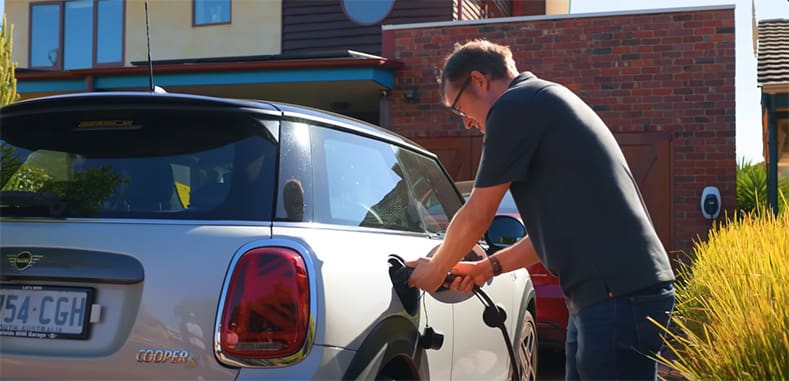
Charging during the day is one of the ways to cancel out the cost of an EV road user charge.
Behaviour change #1: Charge smarter. If you have solar and a car at home, charge during the day. If you’re on a time-of-use tariff, set a timer for off-peak. At 6km per kWh, you’ll save 3-10 cents per kilometre compared to charging at peak grid electricity rates.
Behaviour change #2: Drive more like a grandma. Chill mode – or the non-Tesla equivalent – reduces acceleration and tyre wear significantly. An enthusiastically driven EV might need tyres at 30,000 km; a relaxed one at 50,000 km. At $1,000 a set, that’s roughly 1 cents per kilometre saved.
In fact, now I’ve worked it out, forget this step. Keep Chill Mode off, ready for when that modified HSV ute appears at the lights. Well worth it.
Behaviour change #3: Shop around for insurance. EV premiums vary by hundreds of dollars annually across insurers – some still price EVs as exotic cars. The RUC costs around $600 a year at 15,000 km driven. One afternoon of comparison shopping can recover most of that, every year.
Behaviour change #4: Keep your car longer. Your EV at 150,000 km drives as it did at 30,000 km with little to service. So there’s no mechanical reason to replace it, and any upgrade decision is psychological, not practical. Delay it three years, and the $25,000 gap between selling your old car and buying a new one works for you. At 5-6% cost of money, that’s $450 per year saved – amortised over 10 years of ownership.
Politicians Can’t Stop EV Savings
Mix and match those behaviours, and the EV tax becomes a financial nothing-burger. The politicians may be hell-bent on a dumb tax, but they can’t change the physics of an electric motor, the price of sunlight, or the fact that your EV will still drive like new when their policy is a distant, embarrassing memory.
Phase Shift is a weekly opinion column by SolarQuotes founder Finn Peacock. Subscribe to SolarQuotes’ free newsletter to get it emailed to your inbox each week along with our other home electrification coverage.
 About Finn Peacock
 RSS - Posts






Great tips Finn.
One more for the politicians:
While you’re at it with a Road User Charge, introduce an CO2 emissions charge for ALL vehicles.
Now that’s a level playing field.
On its own, that would produce a piddling amount of revenue, but it could be aggregated together with other classes of revenue into a road user tax based on kms travelled.
This is the calculation for a Tesla Model 3 travelling 100 km, consuming 15 kWh of power, based on 100% solar generation.
The carbon offset is estimated at
0.75 kg CO₂ per 100 km:
That’s extremely low by comparison
You’d need only 1 tree-year to offset 2,500–3,000 km of driving.
The tree won’t offset any fossil carbon. It might offset some of the carbon released by land clearing.
Fuel excise duty is meant to be for supply and maintenance of the roads.
An Ev tax to contribute to that is a level playing field.
It has nothing to do with emissions.
The fuel excise duty isn’t quaranteened for supply and maintenance of roads, it goes into the one pot of S’s called Consolidated Revenue, from which government draws upon to fund spending…like on roads, defence, schools, hospitals and the rest of it.
I’m glad someone mentioned “level playing field”.
Fuel excise, being a cents per litre charge, is reflective of the amount of kilometres an ICE vehicle travels and (approximately) of the weight of the vehicle (as that is a large factor in the fuel consumption).
To have a level playing field, an EV road tax needs to include these factors in the calculation so, for example, an Atto 1 travelling 10,000km per year pays significantly less than a Sealion 7 travelling 20,000km per year.
Unfortunately, the government will most likely want a simple-to-administer flat rate like that implemented in the UK (£195 per year for most cars, £425 per year for cars costing over £40,000.
As you stated, it’s “meant to be for supply and maintenance of the roads”. However, as the state of so many roads across Australia are in such poor condition, the “meant to” does not translate into a real use of funds for our nation’s roads.
And the smoking analogy doesn’t work either. EV’s still drive on roads.
Yes, exactly. The EVs still drive on roads, and any car can crash, if you want to discus expensive publicly funded medicine.
And cars contribute to people walking less and being less fit.
We pay $200 extra a year to register an EV in Alberta, Canada and just the regular $100 for a Prius Prime that hasn’t needed a fill since February.
And if we are going to have a road user charge, let’s look a large trucks. Decades ago it was said a semi trailer did as much damage to roads as 20,000 cars per mile. So while cars have got heavier, so have trucks, only more so. So any road user charge should reflect this. (But tell me “he’s dreaming!” )
My understanding is that Car registration fees aren’t based on just one factor because governments are trying to balance fairness, cost recovery, and policy goals. Different variables reflect different impacts a vehicle has on roads, safety systems, and the environment.
Registration systems and what they cost are a hybrid compromise:
Weight → road damage
Type → safety and usage
Emissions → policy goals
Insurance → injury risk
Fixed fees → admin + infrastructure
No single variable captures all of that, so multiple factors are used.
Please tell me how we pay for schools and hospitals with out the fuel tax of 20 billion that evs refuse to pay a road tax
Roads in Australia are funded by all three levels of government:
Federal government: funds major national highways and provides grants to states, mainly from general taxation.
State governments: build and maintain most major roads using state taxes, vehicle registrations, and federal funding.
Local councils: maintain local streets, funded by council rates and grants.
Additional funding comes indirectly from fuel excise, tolls, and developer contributions for new developments.
Exactly which tax is not being paid by owners of BEVs?
Hi Anthony I think you summed it up well and even put it in which tax EV owners are avoiding.
The additional funding from fuel excise but also Road User Charges.
All vehicles driven on the road should have to pay for using that road. BEVs are heavier than ICE vehicles and should pay on weight same as other users.
Here in New Zealand the implementation of RUCs stalled the EV uptake however our charging infrastructure is worse.
Hi Richard,
EVs do weigh a little more but evenly distributed on 4 tyres that’s 500kg on each corner for a bloated modern SUV of any sort.
We have to keep some perspective though, because heavy vehicles can have 3 tonnes per tyre on a single steer axle (or 2.25 tonnes on each of the 4 tyres on a dual wheel axle)
The whole “EVs are heavy” trope is really fossil fuelled disinformation when in fact ALL modern cars are heavy.
When you consider a Morris Mini would weight a little over 600kg in total, lightness is a virtue we’ve lost sadly.
The notion that EVs are, as you stated without proof, “heavier than ICE vehicles and should pay on weight same as other users”.
Cite me 10 examples and I will cite you 20 examples of ICE vehicles being heavier than EVs.
It’s yet more mis and disinformation that EVs are heavier than ICE. Not true.
What about trucks and buses? They’ve been traversing the continent for DECADES, without anyone saying ‘boo’ about how heavy they are.
Tell me how we pay for all of the climate change mitigation measures that are required without charging ICE car drivers for the CO2 they pump into the air? As people have said here, fuel excise is supposed to fund road maintenance. If you want to make sure those who use and damage the roads pay for repairs and maintenance of those roads, we should do the exact same for those who damage our climate through CO2 emissions.
Eh? I thought my tax paid for schools and hospitals. I’m happy to contribute to a roads only tax. Not for it to be put into consolidated revenue!
Good news—over time we should need less strain on hospitals, as EVs help reduce cancers and other health risks linked to vehicle emissions.
University studies estimate more than 12,000 cancer deaths in Australia alone are associated with this pollution.
The point of the article is that EV drivers can pay à road tax, and save it several times over.
I don’t think civil unrest and resistance was recommended.
I’m amazed how many who love EVs and buy them even support a road user charge for them. That piece of propaganda, that EVs are ‘freeloading’, got deep into just about everybody’s brain, thank you for calling it out!
Love the smoker analogy, spot on.
I see overseas Tesla is now offering its own insurance, and linking it to use of FSD. The more you use FSD, the more safely you drive, the cheaper insurance becomes. And it’s quantifiable. Plus they then embed it in their vertical integration business model, and get more revenue by capturing insurance dollars too.
That’s incredibly smart, and is their business model, which is not spelled out or widely understood. It weaves all of its products, data and customers together into self-reinforcing feedback loops, which makes every component of that connected network more capable and less expensive over time.
Is that why ev owners went to court in Victoria to have the road tax removed
I think part of their motivation.
No, that was not the reason. The reason was that Victorians were asked to pay tax over kms driven on non-Victorian roads, as they paid the tax over the increase in kms taken from the odometer reads between beginning and end of the year.
The case was won on the basis that the Federal Government had the exclusive constitutional right to levy a tax on fuel. Your comment was one of the peripheral arguments.
The Victorian government’s EV money grab was 100% ILLEGAL. Only the federal government can impose a vehicle anything.
The case was won on the basis that the Federal Government had the exclusive constitutional right to levy a tax on fuel.
Yeah probably very guilty of that excuse making – but I dont trust any politicians in the slightest.
Its not so much that they will tax us, it is how much and how that fills me with trepidation and frankly stops me buying an EV at this point.
The cost of the current taxes for an ice vehicle runs about 4c a km for a economical vehicle.
The current road use tax that is in place for trucks (heavy vehicle road user charge) runs at about 25c per litre of diesel, which runs about 10c per km.
So while we hope it will only be 4c per km, we know it will be less than 10c – but how will it be collected? I dont want an extra $500 bill added to my already exorbitant annual rego costs, paying in dribs and drabs at the pump as we do now is a lot easier to take.
If my back of the envelope math is correct, working backwards and with only using the fuel excise (52.6c) & GST total at 4c/km, that theoretical economical ICE vehicle would be using 6.91L/100km.
Or if using the current discounted excise (20.6c) & GST, 17.65L/100km, yikes!
Economical must have very different meanings to us.
Maths in this country! Originally from the Greek word “máthēma” meaning “knowledge, study, learning”. The apparent plural form in English goes back to the Latin neuter PLURAL “mathematica”. So, not singular in nature, as is suggested by the Nth American abomination “math”.
Math and maths are both correct.
Ahh, thanks for your illuminating explanation as to why!
Interpretation
6.91 L/100km → a reasonably efficient ICE vehicle
17.65 L/100km → very inefficient (large 4WD/truck territory)
So your result neatly shows how lower excise dramatically increases the fuel consumption needed to generate the same 4c/km tax.
It does. I disagree 6.91L/100km is reasonably efficient though.
It’s a wasteful amount of fuel to go that distance, especially for a light passenger vehicle these days. Equivalent to emitting over 200g CO2-e/km. Lovely.
The math Andrew is using is terrible and he should not be using it to make financial decisions of any sort.
so… where is my maths terrible?
Sorry Herv but your 6.91L/100km is low for an ICEV unless you’re exclusively considering low end low emission hybrids which would be around 4L/100km, depending on driving type.
Sorry John Alba, 6.91L/100km is terrible for a light passenger vehicle these days regardless. Around 5L would be economical.
Without any other info than what you provided, your 4c/km in taxes does not make sense. The vehicle is not economical in any way. Do you have Toyota hybrid? Yep economical, but then the math is wrong.
The vehicle you drive, which excise applies (discounted or not) would go a long way to figuring out where you get your numbers. Distance driven a year would be a help as well to account for the $500 extra you think you might have to pay. Some where between 5000km to 12500km going by a 4c to 10c RUC?
Also I just noticed this post from you on the AEMC article here
“Andrew says
April 28, 2026 at 9:23 am
Honestly, it looks like i was very naïve when i installed my solar and battery, believing the hype that it was going to let me avoid the exorbitant amount being charged by the power companies…..”
You have solar and battery, you could wipe out your fuel bill (not to mention your own house consumption) completely with an EV.
My vehicle – I30, gets around 6.5l per 100k. I do a bit under 10,000k a year. But the numbers scale regardless of the k’s you do, the excise tax I pay will be about 4c odd a km regardless of the K’s I do. Yes it will go up markedly if you drive a diesel guzzling twin cab ute. But that isn’t an economical vehicle…
So yes if the number ends up somewhere between the two values my bill for the K’s i do would be about $500 a year…
Current Heavy vehicle road user charge (before current exemption) applied is 32.4 odd cents a litre for trucks over 4.5 tonne. Semis get about 3km per litre of diesel. So their road user tax is about 10c a km, also regardless of the K’s they do.
I’m not seeing an error in my calculations…
.
Perhaps you should have included an explanation as to the Fuel Tax Credit (FTC) scheme, which is essentially a way for Australian businesses to get back some (or all) of the fuel tax (excise) they’ve paid, depending on how the fuel is used.
It’s administered by the Australian Taxation Office and is a core part of how Australia distinguishes between “road use” and “non-road use” of fuel.
You state “I dont want an extra $500 bill added to my already exorbitant annual rego costs”
At the uneconomical 6.5L/100km it still does not work out to 4c/km.
But for simplicity lets stick to your 4c. Over that 10k km you’d have paid around $400 in excise/tax.
If you had an EV and the RUC was @ 4c/km. You would pay $400. In driving an EV, since you are not using that liquid fuel, you would not pay that excise/tax of $400. In that scenario it is not $500 extra in costs, its zero.
So you’re thinking that 9c is what its going to be because of the Heavy Vehicle RUC? Is that where you get your $500 from?
Before Victoria had their RUC canned, it was 2.8c/km. $280/y in the above scenario.
Nothing wrong with the calculation I am not sure I understand the point you are trying to make.
As the Australian Electric Vehicle Association has pointed out, a road‑user charge is ultimately unavoidable, but to be fair, it needs to apply to all vehicles: ICE, hybrid, plug‑in hybrid and EVs.
That way the existing fuel excise can continue functioning as a pollution tax, while the RUC simply becomes a distance‑based road funding mechanism.
Even they succumbed to the stupid idea. It’s a regressive tax, the people who travel the furthest are usually those with socio-economic disadvantage, because they’re commuting to and from poorer suburbs, to work. And it means all freight pays a disproportionate share of the tax, even though it’s foresight for everybody. So the freight companies simply pass it on to consumers.
User pays is not a clever basis for essential public infrastructure. Those who need it most are often those who can least afford it.
The alternative is to fund roads entirely from general taxation, which means people who use public transport or drive lighter vehicles, and therefore cause far less road wear, end up paying a disproportionate share for something they don’t actually use as much.
There’s no perfect model, however doing nothing as fuel‑excise revenue declines inevitably leads to reduced road maintenance. If a universal RUC isn’t the answer, what do you see as a workable solution?
Roads in Australia are funded by all three levels of government:
Federal government: funds major national highways and provides grants to states, mainly from general taxation.
State governments: build and maintain most major roads using state taxes, vehicle registrations, and federal funding.
Local councils: maintain local streets, funded by council rates and grants.
Additional funding comes indirectly from fuel excise, tolls, and developer contributions for new developments.
Road funding hasn’t been linked to fuel excise since 1992. The whole urgency is based on a lie. Even when they were linked the excise was nowhere near sufficient to cover road funding. It’s in the nature of all public services that some will need them much more than others, that’s economies of scale in action. It’s like how insurance works.
Governments can fund as much infrastructure as they like, they don’t need to tax to have money. They create money, in countries with sovereign fiat currencies, like Australia. The tax = income line was a political fiction designed to limit the power of government. The only limitation is the skills and raw materials available. It pays for itself many times over in future productivity.
Nick,
That magic pudding thinking is half of what has made housing unaffordable for the young. Printing money is not a cause of inflation, it *is* inflation. Expended on wasteful government vote-buying follies, it does nothing to help wages keep pace, so living standards decline. OK, high rates of immigration with low rates of housing construction exacerbate the social harm, but when I was a teenager, postage was 5c per letter. That’s what $2 is worth today.
Capital gains tax, now without indexation, is an inflation tax, not a tax of capital value increase. The tax system is a govt rort now.
There are votes in making city train travel free, not just temporarily. But drivers have money, the reasoning goes, so it’s a taxing opportunity. It is productive folk who must pay pay pay, ‘cos the unproductive take take take – until the system breaks.
That CO₂ emissions are the cause of $trillions costs in coming decades, is still ignored. A hefty carbon tax is essential, though not enough.
The fuel tax pays for schools roads and hospitals.
I agree a RUC is inevitable, but how about the timing of its implementation is linked to the proportion of EVs on the road. Implemented on all vehicles when say, greater than 50% EVs are on the road (or some other number). And fuel excise stays the same as an air pollution tax (even better remove the excise rebate too!). Any revenue raised by a RUC implemented before then goes to funding public charging infrastructure -which make it an easier sell to existing EV owners.
I think there is a far bigger story you might like to turn your mind to: the loss of revenue from solar power generated behind the meter for self-consumption.
Today the loss of revenue per annum that can be attributed to BEV [300K Units] is 0.15-0.20B and based on a full fleet of 20M vehicles $10-12B
The loss of revenue attributable to the 4.1M solar systems installed across Australia is estimated at 4B per annum [GST 0.4B], of which about 50% is due to fixed and escalating distribution costs [Grid and Retail].
And what is playing out right now is [for those who have stopped smoking, your analogy] :
1. Direct export charges [two-way tariffs]
2. Free exporst thresholds + paid excess
3. Time of use pricing to reflect network stress
4. Lower fee in tariffs as an indirect cost of recovery
All of these aim to ensure solar households contribute to distribution costs even if they import little energy.
So whilst your story is important right here right now which issue carries more weight?
This sounds like the topic being discussed a few months ago where the energy regulator was toying with the idea of increasing the supply charge to “compensate” for losses from solar (etc) and pay for infrastructure improvements etc.
The issue then, and still is: Beware the thin end of the wedge.
If supply charges are significantly increased, eventually the cost of actual energy used will be a far smaller proportion of one’s quarterly bill.
So that will mean having solar (and batteries) will not be cost effective.
And that could mean the solar industry will collapse.
Further, as existing solar systems age they will not be worth keeping.
After about 20 years, the rooftop solar system will be a beacon, a memorial for the fossil fuel proponents to loudly proclaim: “Yet another failed woke, greenie disaster! “
I disagree it’s about ceasing the opportunity.
Good points Finn, although a little idealistic. Australia depends on dumb taxes punishing good behaviour more than any country in the world = Income Tax. I think both laziness and a lack of imagination means politicians won’t bother with sensible alternatives.
Victoria imposed a road user tax on BEVs and Hybrids, which was overturned on the basis that it was a Federal taxing entitlement. That is not to say that the States will not become creative when users charge their batteries from their own generation or subscribe to a BEV Tariff.
To apportion weight to the issue, there are 4.1M households with rooftop solar and 300,000 BEVs in the current fleet of about 20M registered vehicles. Who exactly carries the risk of exposure to changes to taxes or fees and charges, pricing, etc.?
So, if you compare the loss of GST revenue from power generated for self-consumption with the fuel excise not paid by BEVs and hybrids, I would have thought the more pressing issue would be domestic rooftop solar from a loss-of-tax-revenue perspective.
Perhaps the logical solution is to repeal the fuel excise a levy on fuel consumption and replace it with a road user tax that all forms of road transport are obliged to pay. [no advantage, no disadvantage].
I can’t really see how a charge per kilometre will work. If it relies on people reporting distances travelled it will be rorted no end.
And how will it be equitable if it is applied at the same rate to city and rural residents where the latter has to travel a lot further to do the basics?
And what will the money raised be spent on? Any guarantee it will all be spent on roads?
The reality is that most people are honest, and there are already multiple catch‑up points available to verify odometer readings: annual roadworthy checks, connected‑vehicle odometers, routine servicing updates, and the odometer transfer recorded at sale.
No system will ever be perfect, but these touchpoints make compliance straightforward without needing heavy‑handed monitoring.
Most modern vehicles can have an electronic connection that allows vehicle data, including distance travelled, to be read directly from the vehicle’s system. Reporting for billing purposes simply becomes a solution delivered by technology.
And let’s not forget that smart meters can produce kWh data for any tariff class, including those consumers subscribe to that support BEV charging.
For a comprehensive answer, post this question in the AI application ChatGPT, and you will be absolutely amazed at what is already being supported for all manner of reasons.
The question for https://chatgpt.com: “Is there any system where the kms travelled by a vehicle can be automated for cost per km billing purposes?
Fuel excise is taken as consolidated revenue and is not quarantined for any particular purpose. On an expression of interest, I’d be more than happy to post how roads are funded where fuel excise revenue is less than the actual cost.
Actually, it is easy to have a road usage charge based on Rego: Rego authorities already collect this info with the annual rego inspection (where it is done), so easy to track usage. I think in NZ, one buys road tax in 10000Km blocks. NZ at one time even had wheel counters for vehicles with no distance tracking. (Needs fact checking, but is what I seem to remember).
So, either checked at Vehicle annual check, or send a photo of the speedo perhaps? Most people are honest, its only the few who are not, & fines can cover that. The Police can check mileage when they stop vehicles too.
My opinion is that a proportion of the fuel excise should be replaced by a road usage tax that applies to all vehicles. I feel Fuel excise should be charged on all Fossil fuel so helping the economic decision to electrify. (Remove the exemptions, & Fossil Fuel subsidies) Of course, the mileage tax would not apply to vehicles used off-road such as mining & agriculture vehicles & equipment.
Several years ago, In my research on societal costs of road transport I used a 2010 estimate of the cost of pollution – in effect 4 cents/km for ICE cars. That included about 1 cent/km for harm from noise (it seems there are more hoons these days intentional driving in a noisy manner!). There was also a “greenhouse” cost of around 2 cents/km giving 6 cents/km overall. An EV was estimated to have an overall cost of 2.5c/km but this was in the days when most electricity was generated by coal.
There are several other societal cost of car trips, such as infrastructure and (traffic) congestion where EVs don’t have an advantage over ICE vehicles but they still win hands down.
Michael,
Do you have a handle on what the environmental / civilisational cost of a BEV is when all electricity generation is renewable? (I.e. they’re no longer part fossil fuelled) It then presumably reduces to manufacture + road wear. (The latter becomes more costly now that we’re importing lower grade, faster oxidising, more brittle bitumen, due to Donny’s hobby war – and it lasts only 70% as long in use.)
Still, fuel cost savings will amply pay for more intense road upkeep. We just need to shoulder through govt obstruction of the vital energy & transport transition, even leaked on ABC: https://www.youtube.com/watch?v=Fhrs4icqRy4
When falling coal exports drop below being economic to maintain, we’ll be grateful for having eliminated ICEVs, especially trucking. A super profits levy on LNG exports would not harm the foreign exploiters of our resource, but could instantly pay for a national EV charging network *plus* more solar, wind, and batteries to power it.
Finn. I recall in your CSIRO days that you were a respected logic man. My company was a CSIRO competitor in new digital innovative technologies from 1985-2000. We are still logic and numbers focussed. Whats happened to you though Finn?
Cars verses Cows and GHG Emissions 2026
Group Estimated annual emissions
Australian cattle herd, ~31 million head ~62 Mt CO₂e/year
Petrol passenger cars, 12.69 million ~21.2 Mt CO₂/year
Diesel passenger cars, 2.35 million ~4.0 Mt CO₂/year
Petrol + diesel passenger cars total ~25.2 Mt CO₂/year
BITRE lists 12,689,072 petrol passenger vehicles and 2,350,002 diesel passenger vehicles in January 2025. MLA projects the Australian cattle herd at about 31 million head in 2025.
Final ratio: Petrol + diesel passenger cars : cattle herd. 1.00 : 2.46
Conclusion: Australia’s total cattle herd produces roughly 2.5× the greenhouse gas emissions of all petrol + diesel passenger cars combined.
Get back to the old Finn (think).
Lawrence Coomber
Where does the post talk about C02 emissions?
Or cows for that matter?
What does that have to do eith road use? Cows rarely use roads.
Lawrence Coomber, I’d suggest you are using the wrong metric.
Per Australian Petroleum Statistics, Australian fuel sales in 2025:
Automotive gasoline total: 15,797.8 ML
Diesel oil total: _ _ _ _ _ _ 33,598.3 ML
Aviation turbine fuel: _ _ _ 10,074.7 ML
https://www.energy.gov.au/energy-data/australian-petroleum-statistics
Burning 1 litre:
* gasoline/petrol fuel produces 2.3-2.4 kgCO₂;
* diesel fuel produces 2.6-2.9 kgCO₂; &
* jet fuel/kerosene produces 2.5 kgCO₂.
Approx. GHG emissions produced burning:
* Gasoline/petrol: _ 15,797.8 ML x 2.35 kgCO₂/L = 37.1 MTCO₂
* Diesel: _ _ _ _ _ _33,598.3 ML x 2.75 kgCO₂/L = 92.4 MTCO₂
* Jet fuel: _ _ _ _ _ 10,074.7 ML x 2.50 kgCO₂/L = 25.2 MTCO₂
* TOTAL gasoline/petrol + diesel + jet fuel: _ _ _ 154.7 MTCO₂
Australian agriculture contributes approximately 67-73 MTCO₂/year.
Conclusion: Australian 2025 sales of petrol + diesel + jet fuels when burned produce 2-1-2.3 times the annual GHG emissions of Australian agriculture.
Great analogy. But, all those behaviours can be adopted whether there is a road use charge or not, so none is really an offset.
I’m cutting and pasting the article in full and sending, along with a link to it, to my Federal member, as well as PM, Bowen, Health Minister, Treasurer and Finance Minister.
Thanks.
For those similarly inclined here are email addresses including a few ring-ins.
[email protected]; [email protected]; [email protected]; [email protected]; [email protected]; [email protected]; [email protected]; [email protected]
Quick Tip: For formal correspondence to the Prime Minister or Ministers, it is standard practice to address them as “Dear Prime Minister” or “Dear Minister” in the body of the email to ensure professional protocols are met.
The problem is so many punters still think fuel excise pays for roads. This is pure garbage. Fuel excise hasn’t been hypothecated for roads for decades.
I’m all for a distance and weight based RUC for ALL vehicles (except bicycles) and a reduced fuel excise to price pollution and emissions.
PS. I was pleasantly surprised by the low insurance premium for our coming EV. I was advised ‘safety features’ and availability of parts were part of the reason.
EV users bypass excise tax on fuel. Major tax saving. Roaduse charges are for road use. Not fuel use. EV users should pay a contribution for their use of roadways.It is literally called a “road user charge”.
Its pretty simple. You are twisting the facts.
Roads in Australia are funded by all three levels of government:
Federal government: funds major national highways and provides grants to states, mainly from general taxation.
State governments: build and maintain most major roads using state taxes, vehicle registrations, and federal funding.
Local councils: maintain local streets, funded by council rates and grants.
Additional funding comes indirectly from fuel excise, tolls, and developer contributions for new developments.
If by definition road use charges are for road use not fuel use, then ICE vehicles should pay the same road use tax as EVs.
People buying EV’s are looking to save money which is a good thing. But the charging infrastructure is still in it’s infancy if you want to travel country and expect more than 1 charging dual car station per town. If you expect this where does the funding come from to build the network?. Hybrids are the way to go to give you the ability/flexibility to travel which overcomes range anxiety, but the purist’s bitch about using a petrol/diesel engine in the car. If the battery only user’s want the ability to charge when and where they want then there needs to be a charge or levy to pay for it. All conventionally powered vehicles pay for it in registration/road tolls and fuel excises/GST. Problem is, you can’t trust a politician to put the tax back into building/repairing the road network.
Our family will move to a hybrid for the wife’s next vehicle. But when our current diesel Territory stops getting 35 mpg/fill, or dies, we are happy. Too many Chinese cars with dubious longevity stops us.
Hi Brian, true, charging infrastructure is lacking for a fast EV uptake, it’s best drawn out, imho.
It’s also grid power available for multiple charging stations, where there might be 12 chagers all in use, the power to each is hobbled to what the site / grid has available, sometimes painfully slow.
This is not withstanding queues on popular routes, especially at popular times of travel, where the other big bugbear wait times on top of charging time can bite . . .
At least when compared to regular ICE service stations where there might be 40 – 50 pumps that can deliver fuel at faster speed no matter how many pumps are operating.
But hybrids won’t help the need to upgrade charger numbers, locations, or available power . . .
Neither with PHEVs really, as PHEV are fine for the electric motor ops in town in most circumstances, on highways there is little regen braking, and most power on longer trips would rely more heavily on regular ICE fuels.
BEVs will create demand needed.
The average vehicle travels 12-15K per annum, which might suggest that the best recharge option would be residential, serviced by rooftop solar.
With a current fleet of approximately 300,000 BEVs, there would be absolutely no payback as a standalone business other than the Government underwriting the cost of operation. The current problem is consumer volume, which does not exist.
But value-adding to existing businesses such as motels, hotels, caravan parks, parking stations, Employer Business Premises, and Service Stations would make sense.
As for road transport, perhaps the question should be put to Lindsay Fox about his corporate plans for BEV, given the size of his fleet.
It’s a year or two early yet, but I can’t help thinking that medium level charging in shopping centre carparks must take off as the national fleet exponentially goes EV. A medium charging level is cheaper to implement at scale, and encourages extended shopping. That’s a recipe for increased trade.
Many shoppers will not sense any waiting time while shopping, getting a haircut, or enjoying a coffee and chocolate cake. A full lunch stop may even be called for, if the EV is very low. Pizza, anyone? Loyalty points will likely discount charging fees, from day one.
There’ll be more coffee shops than in the old days. And a lot of derelict petrol stations, starting with independents whose operators retire – with not one buyer to be found. That’ll take a little longer, 10 or 15 years, perhaps?
BEV charging is an extraordinary value-added business model. Motel A has free charging. Motel B does not; they are in close proximity to each other, and the quality of the accommodation is the same. You own a BEV, which motel do you choose?
Is it certain that the cost of collecting a BEV RUC would not exceed the revenue collected? I understand that the real motive for the RUC is to stop escape from the tax prison, not actually fund roads, as that is done elsewhere. So maybe it doesn’t matter if it costs more to collect than it yields?
Smoker taxation helps fund their increased health care burden. It is good for smoker cars to do the same, as they significantly cause the increasing loss of housing due to repeated flooding and fires, and put insurance premiums through the roof. The direct health effect of their pollution adds to their harm.
But, true, no good deed should go unpunished, so electric transport will doubtless be taxed, despite it being a significant part of reducing our civilisational decline this century, through a lower global heating peak (only +3°C, around 2080?), and less $trillions spent on amelioration.
We don’t like change either – it chafes. Taxing novelty probably sells well, then.
The estimated number [4.1M] Rooftop Solar has escaped the tax prison:
The value of kWh produced behind the meter for self-consumption is not taxable. In addition, credits for power exported to the grid are not only exempt from GST but also are not considered income in the hands of the recipient.
The estimated loss of revenue attributable to power generated behind the meter is 4B per annum, representing a GST revenue loss of 400M. [Is that a material amount of money that would be of concern to the Federal and State Governments].
If you were to undertake an analysis of the emerging business model, are they [whoever that might be] targeting reducing those attempting to escape the tax prison?
Anthony,
If FiT were deemed taxable income, then amortisation, interest, and maintenance of the installation would all unavoidably be deductible. That is a losing proposition for the ATO, especially if lumped into your tax return with other income – leading to a nice *reduction* in your tax bill. (Mine definitely.)
But can the ATO tax you for the taxi fares avoided by instead driving your own car? Or the electricity not consumed when you heat with firewood instead? Or wearing a coat and warm slippers in winter, as some are forced to do? I’m having trouble following your tax law logic, and expect the courts would quash such an escapade rather quickly.
Mind you, cases of FiT producing a net income from the electricity provider are about to be much reduced by increased connection charges, it appears.
Never mind, consumption will explode within a decade, prosumers just enable BEV S-curve proliferation with lower grid transition cost impost on corporates.
FiT payments may be taxable if your situation looks more like a business, for example:
* You installed a large system specifically to generate income;
* You export a significant portion of electricity consistently;
* You operate in a way that shows a commercial intention.
The ATO may treat you as running a business, and the FiT payments would then be assessable income [with possible deductions available].
If you’re a landlord charging tenants for electricity generated by a solar system installed on the property, you should treat it as taxable rental income. The fact the electrictiy comes from solar doesn’t change the Tax Treatment- the relationship with the tenant does.
There are examples showing how to report these arrangements in a tax return and what deductions you can claim.
Bottom line for most homeowners, FiT payments aren’t taxed because they’re:
* Incidental to private use
* Not part of a business activity;
* More like a cost recovery than income.
If a tax is to be imposed on EVs, the proceeds should first be used to roll out a network of reliable tap and go 20 charger vehicle parks spaced no more than 100 km apart throughout populated Australia. Estimated number of parks 100 to 150. Estimated cost $1 billion. This would give country people and visitors to country areas surety of charging and remove the last plausible argument against EVs. It will move Australia faster towards 50% EVs which will save the country between $15 and $20 billion per year in importing petrol.
Tim,
We can’t afford a one-off $1B for nationally beneficial EV charging infrastructure because we’re giving away $3B per month to foreign fossil fuel exploiters, flogging our LNG birthright at windfall super profits, during Donny’s hobby war. Albo obfuscates that we’re “honouring contracts”, but that’s bunkum, I figure. Neither major party seems to govern for the people, also jamming in more immigrants every day, to make housing ever more unaffordable. (The newcomers are fine people all – I’m one after all, arriving 69 years ago. And I’ve built two houses as an owner-builder, one for me, one for the nation, you might say.) If only the pollies would also put in an effort for our good, not just pander to transnational corporations.
Norway’s fossil royalties yield a $trillion national wealth fund. Our pollies give that to oil companies. Delaying EV adoption also massively profits their foreign masters. We’re still a colony – that seems undeniable.
Every business model takes into consideration the cost to get in, the cost to stay in, and the cost to get out.
Given that there are only 300,000 BEVs in the fleet of 20M, you seem to have forgotten the unavoidable cost to stay in and who pays it?
anthony: – “Given that there are only 300,000 BEVs in the fleet of 20M, you seem to have forgotten the unavoidable cost to stay in and who pays it?”
What’s the ongoing cost to stay with ICEVs?
Physical fuel supplies remain constrained: 11-15 Mb/d lost since 28 Feb 2026 (depending on various reports) from a total pre-conflict production rate of circa 86 Mb/d crude oil + condensate.
Prolonged oil well ‘shut-ins’ risk lasting reservoir damage.
Inventory drawdowns are already in motion. Rebecca Babin, senior energy trader & managing director at CIBC Private Wealth said:
‘…visible global inventories, right now we’ve lost about 250 million barrels so far…”
https://youtu.be/tz9uyZq47-M?t=145
Global fuel inventory buffers are being eroded:
Late-April: below 7,600 Mb (lowest level 2018-present)
Mid-May: below 7,500 Mb
Late-May: circa 7,300 Mb
See graph at: https://youtu.be/tz9uyZq47-M?t=154
High fuel prices are now inevitable, to drive demand destruction.
Now, if I am a Motel and I provide free charging to my customers, and the power is generated by a rooftop solar system with storage, I have complete and absolute control over the cost to stay in, NO?
Depreciation for a commercial BEV charger:
Best case:
→ 100% write-off in year 1 (if < $20k and eligible)
Common case (larger installs):
→ 3–5 years effective write-off via pooling
Worst case (no concessions):
→ ~5–10 years depreciation
Electric vehicle’s wear and tear on roads is more damaging than their conventional equivalents because of their greater mass than cars powered by fossil fuels.
A road user tax on all vehicles based on mass, kilometres travelled and maybe power output might be fairer to all road users than fuel excise and could be set to directly relate to the damage done to roads by each vehicle.
My Dolphin has a GVM of 2000kg and my Ford Hatch 1980kg.
The weight difference will be minimal for most people.
Trucks and buses cause far more damage to roads than private vehicles.
Yes – nearly all wear & tear of roads is from trucks and buses. Mass differences between cars are insignificant for road damage. The road space taken up by a vehicle is probably more relevant for “taxing” light vehicles. In effect road space affects infrastructure (number of lanes etc) and, for urban areas, traffic congestion.
But … tare mass & GVM are recorded registration records so it is easier to tax these values.
BTW – in the societal cost values I mention above I did not include the harm from crashes. These are more or less the same for ICE vehicles and EVs of similar size.
Michael when your EV does 2.5x the damage to roads than its petrol driven sibling as a result of its greater mass I think you’ll not only find mass is important in calculating road damage it is more important than anything else.
The difference in mass between equivalent petrol and electric cars is far from irrelevant.
Many of the most popular vehicles in Australia are dual-cab diesel and petrol utes.
They average 2.1-2.4 tonnes in weight.
Heavier than all popular EVs.
Your comparison is a little unfair (and you didn’t specify models) and you might not realise that extra damage to the road resulting from small increases in mass are amplified exponentially – the power of four is used by engineers.
A more appropriate comparison might be between the petrol and electric versions of the Kona. Electric Kona mass = 1795Kg. Its equivalent petrol version 1427Kg. (1795/1427)^4 = 2.50 (2dps).
That means the slightly heavier electric Kona does 2.5 times the road damage than its petrol fuelled litter mate does. From a couple of hundred kilos extra.
A road user tax would hopefully reflect this exponential relationship.
Best nonsense I have read today given that in a fleet of 20m registered vehicles there are only 300,000 BEVs.
So the Federal (and State) Governments are again capitulating to the Fossil Fuel industry lobbyists and want to *penalise* EV drivers who are doing the right thing and *not* contributing to the over 11,000 premature deaths annually in Australia attributed to ICE vehicle emissions! (Google it.)
EV drivers need to stop with the “it’s only fair …” – it’s not!!! Don’t fall for that propaganda out of the fossil fuel industry’s playbook.
There should be a pollution tax on all ICE vehicles, especially diesels which produce the most toxic, noxious emissions. Besides the toxic exhaust emissions, every single trip by an ICE vehicle emits CO2, thus contributing to accelerating climate change.
Oh and if you want weight included, then trucks would be far and away the highest taxed. (Thought about how much a fuel tanker weighs?). Followed by the giant US “pickup” trucks.
Premature deaths must be difficult to quantify!. Right now on the AQI tracking website, Brisbane’s air quality measuring stations are reading between 0 and 23, Oslo (a smaller city in a country with the highest uptake of electric vehicles in the world) is 10-42. Maybe there’s a stiff breeze in Brisbane right now, maybe it’s the brake pads and tyres in heavier EVs in Oslo, who knows?
https://www.iqair.com/au/world-air-quality-ranking
The Motel A/B comparison seems too simplistic. If Motel A installs their own system and includes it as a free value added bonus to EV user’s to stay there, sorry no such thing as a free lunch or a free charge. Questions to be asked – ratio of chargers to rooms, source of charging power, is it their Solar or GRID, is the charger a 10 Amp service or fast charger, is the room rental exactly the same/night, All these questions deem this argument like a piece of Swiss Cheese. At present EV is incapable of replacing ICV propulsion. The thought of a truck laden with megawatts of propulsion batteries involved in a freeway accident scares me. If you “EV’ it outback,style” , does it concern you that a diesel gen set will start up just to fill your EV Battery? IF you have the need to stay within the city limits and do commute distances each day EV could be for you. IF you expect to be able to fast charge, but don’t put the $$$ into home solar/battery/EV charging, expect to pay a tax to cover cos
Brian Andrews: – “At present EV is incapable of replacing ICV propulsion.”
Evidence/data? Meanwhile, high fuel prices (& constrained fuel supplies) are now inevitable, to drive demand destruction.
https://www.solarquotes.com.au/blog/how-to-wipe-out-ev-road-user-charge/#comment-1734178
Brian Andrews: – “The thought of a truck laden with megawatts of propulsion batteries involved in a freeway accident scares me.”
I’d suggest you talk to police, firefighters, paramedics, etc., who’ve attended Liquified Petroleum Gas (LPG) tanker crashes/fires. They dread dealing with a fire near an LPG tank that can lead to a Boiling Liquid Expanding Vapour Explosion (BLEVE).
On 19 Feb 2026, an LPG tanker truck crashed in Santiago, Chile, releasing thousands of litres of LPG and forming a massive vapor cloud before ignition. https://www.youtube.com/watch?v=KkAtODE1Nj8
Industry data from a 2009 Senate Committee submission indicates about 600 LPG tankers operated in Aus.
I’m sorry, did you want a full financial analysis based on current occupancy rates, with estimated improvements based on providing BEV charging, covering the cost to get in and the cost to stay in, including a Balance Sheet and a Profit & Loss Statement for tax purposes?
What is true to date is that Premium CBD hotels (5-star), like the Brisbane Marriott, have a higher penetration rate in supporting BEV charging services. On an expression of interest, more than happy to provide the data.
Great idea ERIC, BUT YOU NEED TO CONSIDER THE UPFRONT COSTS FOR THE SHOPPING CENTRE, AND BE PREPEARED TO PAY THEI ASKING PRICE!. Next problem to consider is if the local grid has the capacity to support such a centralised high additional load, for basically daytime load considerations. Then you need to beef up the distribution side of the grid and so on. WHEN do you want to stop g’old plating the grid?
AT 6c/KW/H. I use my export to cover the metering charges, not to sell under priced free power back to the Grid to fund the warm fuzzy feelings of EV drivers.
If my location wasn’t in the country, if Public Transport existed near me, I commuted to work each day, I would consider an EV as my preferred transport. I am retired, I avoid the City like the plague, I use Bub/Train with a 2.5 hr travel time. I own a 4×4 which allows me to travel off road around our country, and I accept the costs for doing so, it’s ” horses for courses” ,don’t tar me for my choice of transport.
From another country but have the same complaints from the EV evangelists. Why should they not pay towards the creation and upkeep of the roads that they use same as truckies and internal combustion drivers? What gives them an out on infrastructure costs? There would be a lot more respect from all sides if it was taken that no matter what fuels your pride and joy that you are a responsible citizen and are happy to pay your road taxes, If you don’t pay them then either your pay packet will be that little bit lighter because of increased tax or you will be forever complaining that the local roads are now becoming dirt tracks. Have no problems with EVs (yes they are part of the future) but please pay your way so we can all have better and safer roads.
EV drivers do pay their way. We pay annual registration charges to drive on the road just like any other vehicle.
The argument that fuel tax is not paid by EV drivers is irrelevant because fuel tax is not directly used for road maintenance. Fuel tax is spent on whatever the government decides to spend it on and could be paying for nuclear submarines for all we know.
The same could apply to any road user charge.
Sorry but you’re getting a free ride by not contributing excise+GST equivalent that all other drivers have to pay. If you want the right to use public roads you need to pay comparable costs.
Yes in a sense government could allocate an RUC to anything e.g. a CSIRO study of seagull psychology, but the reality is funds go into the common pool, money comes out to pay for roads, and thus whether it’s the RUC\excise funds being directly spent, or other funds totalling more or less to fund said roads, doesn’t directly matter.
What road users care about is whether roads are being funded, and whether others are getting a free ride. In many cases it’s both issues – roads are being underfunded, and EVs are getting a free ride.
Hi John,
When you say “free ride” have you considered the fact that more EVs mean less pollution for you to breathe?
It’s not just PM2.5 particulate from exhaust that’s eliminated, but brake dust is also vastly reduced.
Except EVs don’t mean less pollution for me to breath. My area, it’s clean air … most of the time, and petrol\diesel fumes are not the issue.
And if you’re thinking of brake dust and other non-exhaust emissions, EVs are far heavier than comparable ICEVs so naturally will emit more.
I’ll grant dense personal transport use in inner cities might be a different matter – Mexico City or Beijing levels of smog, but that’s a slightly different issue.
Hi John
Speaking of dense, anyone arguing that EVs are heavier and thus use more brake pads is either as sharp as a bolwling ball or idealogically welded to rank willful ignorance.
I own a PHEV outlander and at 150,000 km it still has 60% or more of it’s original factory fitted brake pads.
My previous employer had a hybrid Lexus that had 40% of it’s original factory brake pads at 270,000km.
Regenerative braking turns forward motion into free petrol, not waste heat and dust.
These are not hard things to grasp.
The ‘free ride’ is spin. Fuel excise was officially decoupled from road maintenance 34 years ago in Australia.
We need to seriously challenge the idea of making essential public services user pays. We don’t do it in health or education, or at least we didn’t use to, though attempts are being made there as well. The minute you cross that line, it stops being a public service.
Well, that is not entirely true when it comes to a Life Insurance application, where the questionnaire aimed at assessing risk is designed for those who currently or have previously used tobacco products.
Would you like a list of the typical questions they have to answer, looking for conflicting answers where the answer to one question is No, but another is Yes?
Life insurance isn’t a public service.
Nick
As it happens, treatment for individuals who have smoked is in the discretion of the medical practitioner, and/or Hospital based on risk to the patient.
Officially decoupled and recognised as decoupled are two very separate things. Why the excise if there’s no valid basis for it?
Should essential public services be user pays? Well you’d need to define essential public service. A consumption charge on road use in inner cities would be one way to fight excess use for instance. I believe Oxford (UK) was doing something along these lines vis-a-vis 6 main roads threading the city. And of course levies on road use have a long history.
Charges for health are also common e.g. dentists. The question is more which health services or procedures.
Likewise education is increasingly pay to use. Not only does government generally enjoy the lower cost of parent funded independent education, but state education is pushing higher costs as a way to increase their budgets – though some of this is ‘voluntary’ albeit failure to volunteer means public shaming for your kid, denial of access to ‘special activities,’ and unpleasant letters from the school.
Hi John,
SA just announced they would cover the cost of any public school fees.
Many private schools are now getting more public funding than comparable public schools, but public schools as a whole still educate more disadvantaged students and remain underfunded relative to their targets.
There’s no good reason, in fact it’s preposterous that a school debating a new orchestra pit, olympic pool or polo field should exist under the same public funding, in the same city, where teachers are buying supplies and classrooms aren’t air conditioned.
https://grattan.edu.au/news/lopsided-funding-gives-more-public-money-to-private-schools/
The excise is still there because it’s revenue for government, and nobody surrenders revenue easily. They should be taxing fossil fuel producers a lot more and consumers a lot less, but we all know the lack of backbone there.
Dentistry isn’t part of public health care in Australia.
Private schools don’t save governments money, it’s like saying if we all got government subsidy to install swimming pools in our yards, government would save on public pools. But they still have to fund the public pools as well.
Public services are there to increase the capacity of the nation to do things, they’re not freebies. They’re investments. Making them user pays turns citizens into customers. The UK is a good example, a train wreck after decades of private provision of public services.
Anthony, that sounds like classic agitprop.
Independent schools receive less funding than state schools, except where state funding is ignored in comparisons because only federal funding is spread around.
State schools should educate more disadvantaged students going purely by the number – the split is about 2:1, but the reality is less clear. So long as the fee requirement isn’t a barrier to parents, many choose to escape state schools to offer their kids a better alternative. I’ve family doing precisely this, though it’s not their primary reason.
Treating elite schools with orchestra pits, Olympic pools, or polo fields as standard independent schools is pure agitprop. A better comparison is neighbouring schools, one public, one independent. One hopes that students turn up and aren’t knocked up and hung over, the other has happy, healthy kids, most of whom are eager to learn.
And even good schools, some teachers still spend their own money on rewards for their kids.
Nick, no government doesn’t like surrendering money. Not sure what additional money you think fossil fuel producers should pay, unless you’re thinking Pocock and the Greens’ claims v Albanese and Abbott?
Dentistry is still a matter of health, and there are public dentistry options, though I’m not familiar with them.
Independent schools save government a bundle!!! Government can educate 2 students at independent schools for every public school student. Yes it does depend on the school in question, but I’m talking averages rather than elites.
No, public services are usually freebies. When they’re not they tend to get privatised. Can’t comment about UK issues. Most of the complaints I read about are government supplied public services e.g. NHS or schooling.
Then the way to fix that is by increasing registration costs and/or remove fuel excise and apply the road user tax to all vedhicles.
A history lesson for all – Fuel excise was introduced solely as a means of introducing the concept of world parity pricing. Most fuel was supplied locally at the time and the government of the day wanted to consider petroleum as a scarce resource. It was nothing to do with road maintenance, the idea was the more inefficient your vehicle the more excise you paid. BEVs use no fuel so no need to pay in my eyes.
Show moreShow less
Introduced: 1929 by the Australian Government
Original purpose: Fund road construction and maintenance using a user-pays approach
Shift over time: Became part of general government revenue (no longer dedicated to roads)
Today: A major revenue source, indexed to inflation since 2014
Current issue: Declining effectiveness as a road-use proxy due to fuel efficiency and electric vehicles
I’m pro-RUC, & open to replacing excise with a universal RUC, but can’t the advice in this piece basically be reversed?
#4 Keep your ICEV. If it ain’t broke why fix it? A basic new ICEV e.g. Corolla costs $500 on a Corolla v a basic Model 3. When comparing insurers make sure it’s apples to apples, & real coverage offered.
#2 Agreed. Sedate driving saves fuel, & rubber. Don’t alternate between flooring it then slamming on the brake. Also consider gravity – coast down hills, gently crest over them.
#1 Shop smarter. Use fuel sites to monitor where petrol is cheapest, & get to know the service stations on the routes you travel. You can save money without going out of your way.
#0 Consider walking, or biking, or … God gave you legs, probably, so if you’re healthy, & your destination is local, why not get some exercise?
I feel like I’m forgetting something …?
Hi John,
You’re probably forgetting the decades long psyop we all live in, where shiny new things are coveted and consumption is venerated over frugality.
We literally use Bugs Bunny & Thomas the Tank Engine to beat consumer behaviour & capitalist deference into children.
Still, the point is when your family has outgrown the Corolla you’ll need something electric.
When the kids leave home, you can downsize, to something electric.
Clearly I missed something because frugality was something I was raised with, and my friends tended to be likewise. Case in point – it was only after years of friendship that I learnt a friend’s father had multiple rental properties. Maybe not so lower-middle class background?
Bugs Bunny & Thomas the Tank Engine are great kids entertainment. Not sure how they pertain to capitalism or consumer behaviour. Frankly I’d say Captain Planet was the ideologically driven series.
And no the Corolla is fine, unless you’re meaning family larger than 4+ adults?
Again no, a Corolla has a great boot size combined with good range, and decent mileage. There’s no concerns about getting groceries with it, or visiting family. Can’t say the same about most EVs!
John you can’t fit 3 baby seats in a Corolla, in fact they won’t even fit in a Pajero.
There are roughly 120 new EV models available in Australia now, with about 30 more models expected soon. The most current figure in the sources I found is from The Driven’s Australia EV model list, updated 23 April 2026.
There are variants in every segement so your blanket statement about most EVs is poppycock, especially when Kia’s EV 9 offers 505km, 7 seats like a landcruiser and an even longer wheelbase.
In case you missed it, Thomas the Tank Engine wants for nothing more than to be a really useful engine so in other words he’s conditioned to be a cog in the machine, a subservient part of the network, nervously tugging his forelock in deference to Topham Hat. It’s an efficient way to manage a railway of course, it might be light entertainment, but it’s all about toeing the company line, not about original thinking.
That’s a fairly Marxist spin on it, certainly not an angle I’ve heard before. Then again, servant minded tends to be seen more positively in my circles.
This is sort of related but up a different tree!
Has anyone done a ROI (Return on investment) on an ICE, EV and a home battery say around 20Kwh to 25Kwh?
I’m not able to work this out but maybe the home battery stacks up well all things considered
This could come in handy when BBQ discussions arise!
Hi Neil,
Probably best to have a look at Rewiring Australia or perhaps Electrify 2515
They’ll spell out the arguments and you can bookmark the infographics to show your reactionary uncle at the BBQ. 😉
I think there is a fundamental flaw in the thinking about evs not needing to pay road user charges. While I accept all the reasons for not using evs (after all I am a seriously happy owner of a Tesla), these same evs contribute to road wear. While it would be fair and proper that these taxes all go to road maintenance (as it once was), it does not really matter where the money comes from. In the end, roads need to maintained (as the Victorian government suddenly realised) and money made available.
So, yes, I think evs should pay road user charges.
No, I don’t need to change my Tesla to Chill mode to achieve tyre wear like it was in Chill. I can easily accelerate My YLR gently off the mark, without any problems, but know, that if and when a quick burst of torque is required, my Tesla is ready.
Yep, charging at home off excess solar is my primary way of charging my car. Recent use of Tesla’s supercharging network, proves that the Tesla eco-system is THE standard to which every other EV manufacturers cannot begin to challenge. What a BRILLIANT system is the Tesla EV & charging network.
Haha touched a nerve there. Your well structured arguments rebutting my proposal suggest you were head of debating at your school.
When an electric car does 2.5x the damage to the road than its petrol equivalent shouldn’t that be reflected in a road user tax?
Is there a something about user pays that offends you?
Owning an electric car doesn’t free you from contributing to the system no matter how superior you feel about it.
IQAIR air quality readings for Oslo right now are 6-38 just after dawn. Brisbane right now just after lunch is 6-38. The EV vs ICE car pollution argument doesn’t really stack up.
Building new roads would seem to be a reason to toll them. If you want to use them, our Governments are more than happy to dodge the responsibility themselves by not calling on Consolidated Revenue, which is where our fuel excise goes to. The amount being collected could repair our broken roads. Victoria chooses to take but not give back a fair proportion of collected revenue. Fuel excise crudely taxes vehicle by consumption which relates to distance travelled. EV’S have no other taxation except registration which does not relate to distance travelled.
This. discussion has been very lively but is going off topic, and it is plaiin to see that proponents on both sides of the fence have valid concerns. As I stated previously I see the future will shift towards the BEV. We have this power race similar to the 1960/70’s to sell cars. Who can justify a BEV needing 400+ Kilowatts of power and 0-100 KM in 3 seconds to go A-B distances each working day in the cities or suburbs? SUPERCARS?