
Once again the solar and storage industry is facing some uncomfortable questions about whether the rules we work with actually line up with each other.
Finn did an excellent job of explaining this issue a few weeks back1 but strap in and we’ll get into the weeds of wiring rules and ask, why are they being ignored by installers, inspectors and regulators and who is going to bear the cost of getting this right?
The cables used to carry the DC electricity from both solar panels and batteries are the same type, but the rules about protecting them are very different.
Rules For Solar Panel Wiring Are Strict
Solar panels can only push out so much current. Even if you create a dead short circuit, a string of panels will only deliver about 15 Amps. The cables used are so oversized they’ll never overheat. That’s why solar wiring hardly ever2 needs a fuse or circuit breaker.
The solar standard (AS4777) requires these cables to be double insulated and enclosed in protective tubing (called conduit) for their full length, from the panels on the roof all the way down to the inverter. The one exception: up to 300mm of exposed cable is allowed where the wires plug into the inverter, because you need a bit of slack to make the connection.
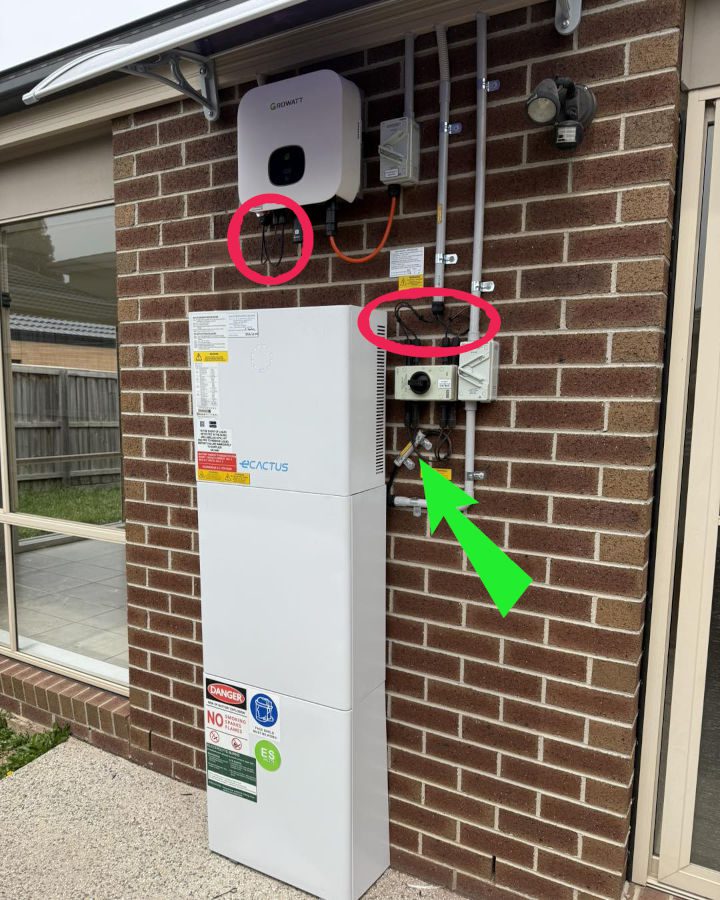
The cables circled in red are compliant loops of solar DC cable, and the conduit arrowed green could even have 300mm of DC solar cable exposed either side of it. However there’s a few other rules broken here, which is often par for the course with cheap equipment attracting cheap installers.
Rules For Battery Wiring Are Stricter
A battery is a different animal.
If you short circuit a battery it will try to deliver all the energy, all at once. Some of the warning stickers on batteries look like nanny state hyperbole, but it’s worth considering a decent arc flash from a battery can turn a spanner into a shower of white hot liquid, quicker than you can blink. Overalls and a face shield aren’t unreasonable requirements.
Under the battery standard (AS5139), battery cables must be physically protected for their entire length. No exceptions, no 300mm of slack.
If you have an all-in-one stackable system like the GoodWe ESA for instance, this problem has been engineered out of existence.
But for systems with a discrete, wall mounted battery or hybrid inverter, I have seen different makers scramble to protect the cables where they come out of the battery at one end and into the inverter at the other.
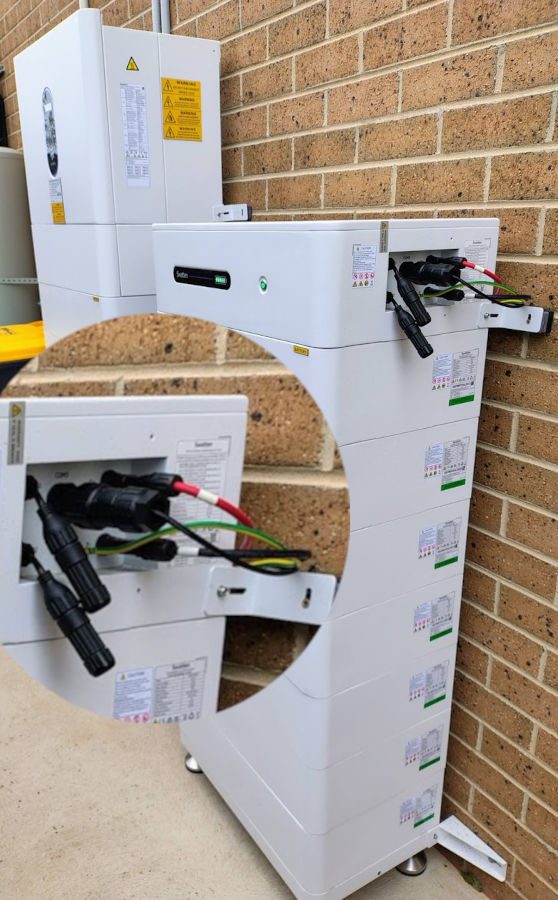
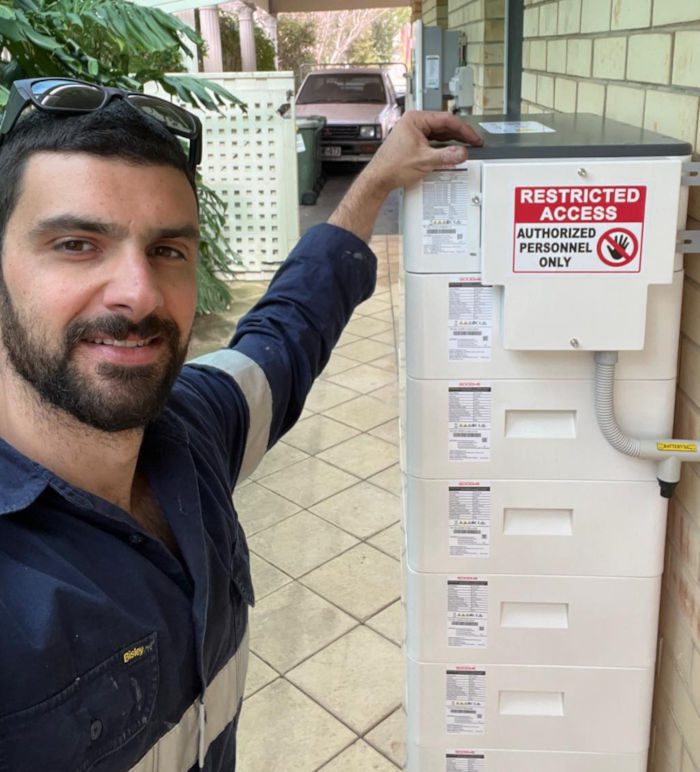
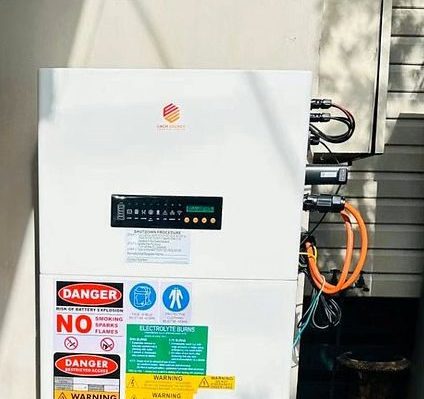
You can see this Swatten battery has plastic plugs hanging out the side. It takes little imagination to see a toolbox dropped off the top, or a rake falling over, to smash one of these off. Without mechanical protection this simply is not compliant.
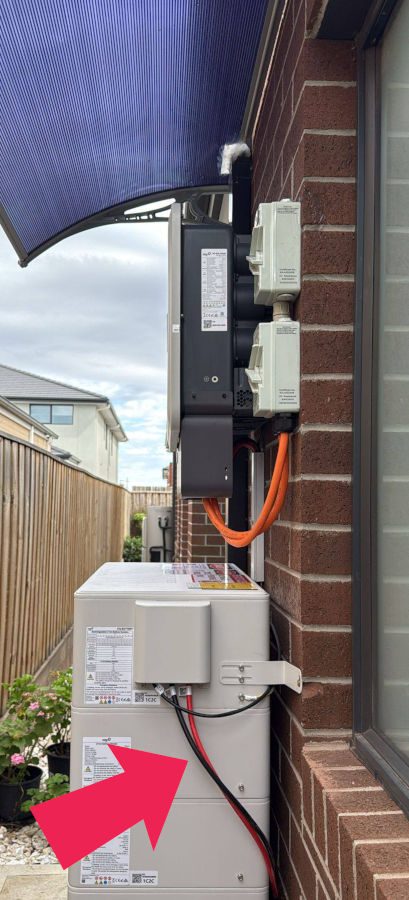
Red arrow shows missing conduit isn’t compliant, this should be reported to your local technical regulator. Cheap batteries will sadly attract even cheaper installers, but blown out bricks and ineffective shades are just typical of slap dash work.
Good installers have been crafting air conditioning duct, sheet metal or 3D printed covers because there’s genuine concern. The plugs on a battery are fine under normal conditions, but they’re not tough enough to survive garden tools, bikes or other garage gear crashing into them.
GoodWe Lynx with appropriate battery terminal housing. A real credit to Dino from Eastern Solar Solutions.
Thankfully there are ethical installers like MC Electrical in Brisbane and manufacturers like BYD working together, to fix this by designing compliant covers for Australia.
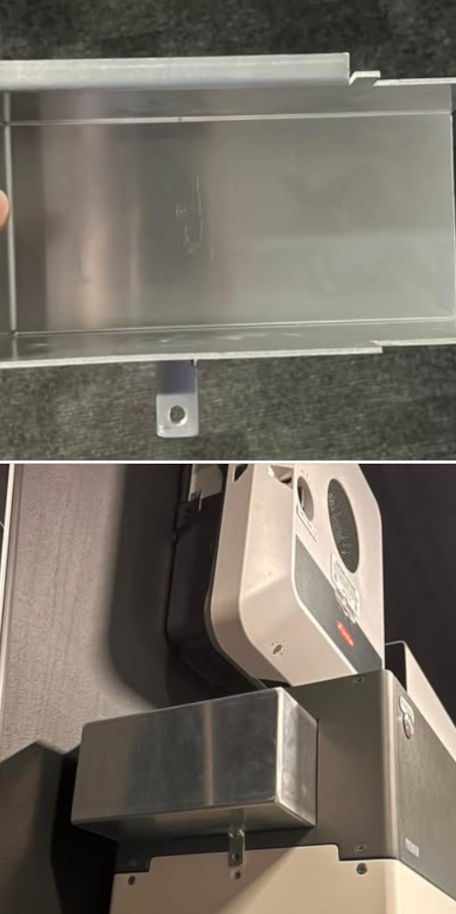
BYD HV batteries needed a cover made so MC Electrical stepped up to make them available, then helped BYD design their own.
However someone at BYD’s Australian agent, Alps Power needs to return this installer goodwill. I’m told they have been taking months and months to deliver BYD’s new covers. It means these premium products are not compliant unless your installer cares enough to make their own cover.
SolarQuotes has spoken to highly qualified industry types who say vast numbers of installations aren’t fully compliant.
Incorrect labelling is the main culprit, but unprotected battery cables come second. And in my opinion it’s a problem created by manufacturers who aren’t offering a compliant product in the first place.
Thousands of these battery hybrid inverters are already out there in the wild, so the question begs, are we going to ignore the standards or is someone going to have to go back and fix them?
The Fix Is Simple: Supply A Cable Cover
When you look at Sungrow Hybrid Inverter, it looks neat and tidy because there’s a cover, supplied by the factory, protecting the wiring plugged into the inverter (but it wasn’t available when the inverter was originally released).
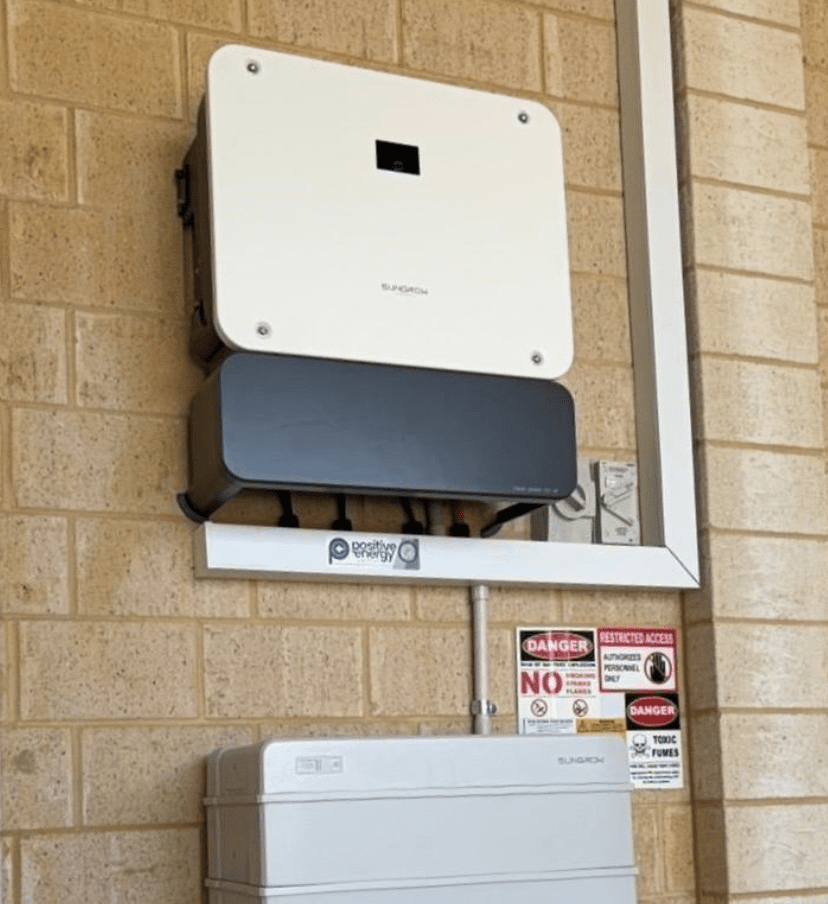
Sungrow inverter + cover. Credit: Positive Energy Solutions
Kudos to Fox ESS
Recently realising the problem with their product, Fox have been shipping new units with terminal covers this year. We’re waiting to see how they make good for existing owners.
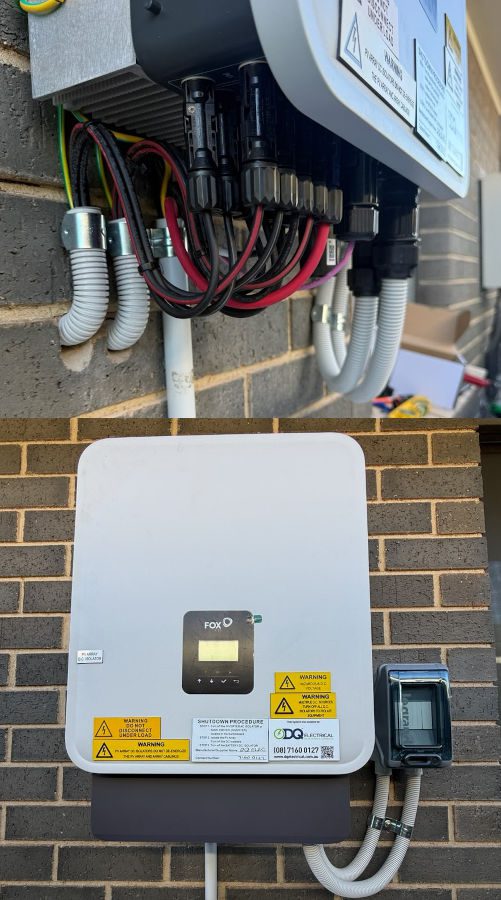
Budget brands done right by DQ Electrical.
But Why Are Some Products Even Allowed?
Installers should not be copping penalties from the authorities, when the CEC are allowing “approved” products which don’t meet the rules when installed.
Thanks go to Aussie Solar Batteries for submitting this to our vetting council. We’re glad to reject this kind of junk at SolarQuotes, it would be nice to see the CER auditing it though.
Covers Aren’t Always Simple
There are examples where products are made non-compliant because a cover blocks access to the DC isolator on the inverter. In fact AlphaESS require an unusually long screwdriver to reach theirs.
Some Sigenergy fans say you don’t need a tool to unclip a cosmetic cover, so they’re fine, but without really specific labelling, they’re kidding themselves. They could easily remove a “knock out” in the moulding, but don’t for aesthetic reasons.
I’ll argue that if you can’t see the handle, and operate it with one hand, it’s not accessible and not compliant.
Why Isn’t Anyone Enforcing This?
Every day I see examples that don’t meet the rules, all over social media. What puzzles me is that the Clean Energy Regulator has access to photos of every single installation and yet they don’t seem interested in policing anyone.
As an installer I have to take geotagged photos of everything, plus selfies to prove I was the qualified electrician on site at setup, midpoint and finish. This system is designed to prevent fraud. It’s quite rigorous and it’s been tightened recently, but maybe it’s time to actually look at these images and knock back government incentive payments for the ones that obviously don’t comply.
And I’m really confused as to how non-compliant products make it to market in the first place, given the Clean Energy Council runs an inspection scheme and approved products list. It costs thousands and takes months to get products approved, and apparently they’re still no good?
We’ve levelled criticisms of the CEC before but their approach to accountability is simply to ignore, obfuscate and delay. The CEC answers to the Clean Energy Regulator and it’s only when we’ve repeatedly pushed the government authority that we’ve got any answers at all.
What’s The Upshot?
Battery wiring must be protected, and the standards exist for good reason.
For the industry, it’s about improving training and limiting the financial damage to installers who might be required to go back and fix products that were badly designed from the start.
For the end user: we’ve shown some good and bad examples here. What you’ve got installed might not be fully compliant. Maybe it’s tucked in a corner and poses little risk, but it’s worth having a look and asking your installer if anything needs tidying up.
 About Anthony Bennett
 RSS - Posts






Good article.
Next, you can talk about the ticking time bomb of the CDC requirement, in the legislation, for batteries larger than 20kWh…
Nobody cares, most don’t even know about it (certainly not the government), but insurances will make a dog breakfast of it, once all these cheap batteries installed by thousands will start failing, very shortly.
Thanks for flagging this! You’re right, it’s a real issue that’s flying under the radar. In NSW, batteries over 20kWh fall outside the exempt development pathway and technically need a CDC or full DA, but most installers don’t know (or don’t ask). With average system sizes now nudging right up against that 20kWh mark, the number of non-compliant installs is only going to grow. We’ll dig into it properly and have a post up soon.
So with the initial install of a 5 module stack of HVM modules my system was compliant then “if” it was upgraded it becomes non compliant. Wonder what issues there are re insurance etc.
NSW would have hundreds if not thousands of systems non compliant for this reason.
What document would have this requirement spelled out?
@Matthew
https://legislation.nsw.gov.au/view/whole/html/inforce/current/epi-2021-0732#sec.2.41
2.41 Section (5)(e)
(5) Development for the purposes of a solar battery system is exempt development if—
(…)
(e) the system is not capable of storing more than 20kWh of energy,
Thank you very much for posting that information. Have had to become quite familiar with much of the SEP recently; however, missed that.
I wonder if setting charge limit in control SW to make the battery only store 20kWhr maximum would satisfy the requirement. Could it then be considered not capable of …
The Battery Sizing guide section in “NSW Home Solar Guide” published by the NSW Gov and other resources by them don’t mention this 20kWhr limit before approval is required. They do mention batteries above this limit.
I wouldn’t be surprised if the authors and editors of these NSW Gov resources are not aware either.
Hi Anthony, your image of the HVM or HVS byd had me going straight to the garage to check the connection to our HVM Battery.
The solid conduit finishes with a short length of corrugated conduit and a conduit coupling fitted over the connector on the battery.
Seems the the coupling is a very firm push fit. Can’t imagine any sort of adhesive would have been used and there is no sign of this.
Seems like a compliant solution with out the need to fabricate a cover?
Interested in your opinion. If you look at the customer photos in fins review of BYD batteries on this web site you will this method used.
This one?
Only issue with the install pic you have posted is that there is no room for a future upgrade to an 8 module stack.
As well as not mechanically protected correctly. I wonder if all battery cables are double insulated.
I believe if they operate over DVC-A 60v DC they need to be double insulated.
Hi Matthew,
I think that’s a compliant solution but I’ll dig up a photo to describe why it’s not my preferred method.
Series 1 BYD batteries are designed to accept a conduit using a removable access panel.
Series 2 use plugs, but a cover is the best way to protect them.
Some others fit the plugs parallel to the side of the battery, inside a recess, so they’re inherently better.
Hi Matthew,
This is the bottom of an old Delta inverter, the pin highlighted in red had about 900VDC available as an exposed live part.
The rigid though panel mounted MC4 plug had been snapped off.
I’ve indicated in green where the plastic is broken and the mating surface where it should be attached, through the hole where the live wire is just hanging out.
Though I’ve no doubt these plugs have been strengthened over the years, I don’t think that small (green) cross section of plastic is a good way to secure a conduit over the battery wiring & plug.
Thanks Anthony, I can now see why the coupling over these connections is not the best. Where that is used on our battery, at least it is high up at the top of an 8 module stack and relatively protected
Would you please post a link to what ever document would verify this 20Kwhr limit (with out approval) to battery size in NSW.
Thank you, Anthony. Another great article. My biggest worry is over the next mouse plague. In rural and rural-suburban areas the mice seemed to develop a love for plastic when food ran out a few years back. Tractors, trucks and cars all fell victim to short circuits caused by rodents eating the insulation off wires. Whilst many home batteries are weather rated, they don’t seem to be vermin proof and those warm battery and inverter cooling fins are too inviting on our harsh winter nights. I am hopeful that someone will come up with a great after-market idea of mesh cages of various sizes that can be placed around a home battery to protect it from vermin.
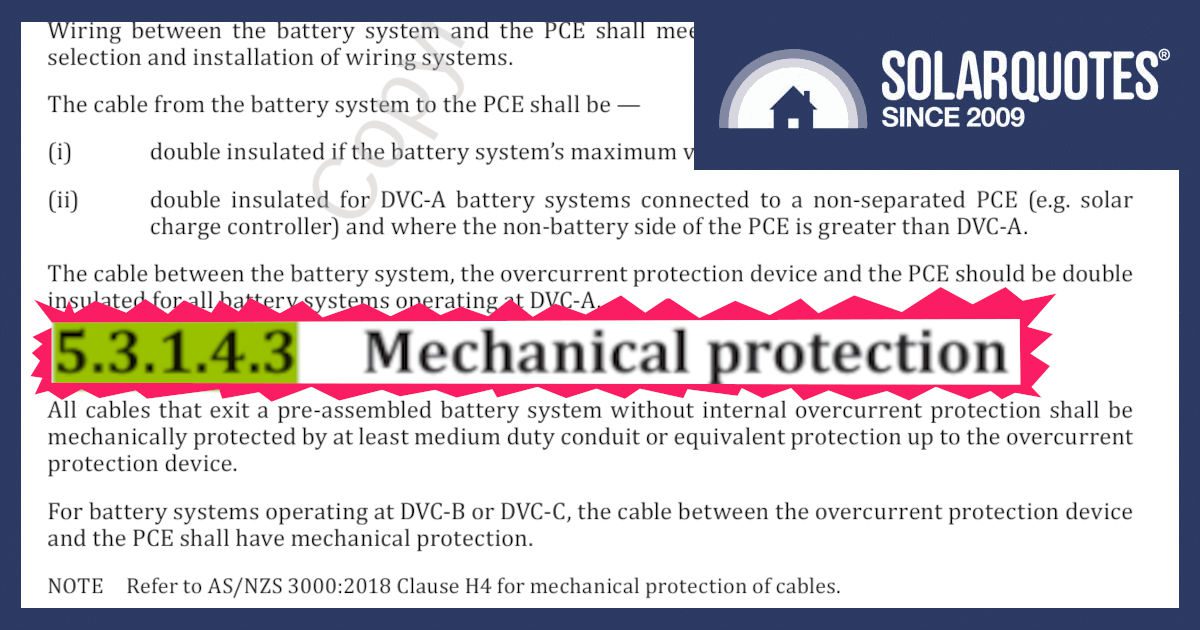
Forgive me if I’m interpreting this wrong but section 5.3.1.4.3 clearly states
All cables that exit a pre-assembled battery system without internal overcurrent protection shall be mechanically protected by at least medium duty conduit or equivalent protection up to overcurrent protection device.
The BYD battery you guys keep mentioning has internal over current protection, therefore it meets this clause’s requirement and can have a short section exposed.
Is it better to install the inverter and batteries in the garage if you have a choice?
It would seem that this could solve the water ingress and overheating issues
Anthony, love your work!
Is it possible to retrospectively update these articles and informative pieces with foot notes that Fox ESS has provided a mechanism for customers to safely achieve mechanical protection at the physical battery and physical inverter despite installers still choosing to use ‘Temu’ style air conditioning conduit between battery and inverter.
The work that Fox ESS has to be applauded!
If I wanted an honest review of my install who can I send it to for feedback!
P.s not looking for a FB style rate my install piece 🙂
Hi Chris,
We might be able to add a hyperlink about getting a DC cable covers but generally don’t revisit blog articles, there’s thousands that reflect the moment in time they were published.
Please feel free to add your own rating for an installation here :
https://www.solarquotes.com.au/battery-storage/reviews/fox-ess-review.html