
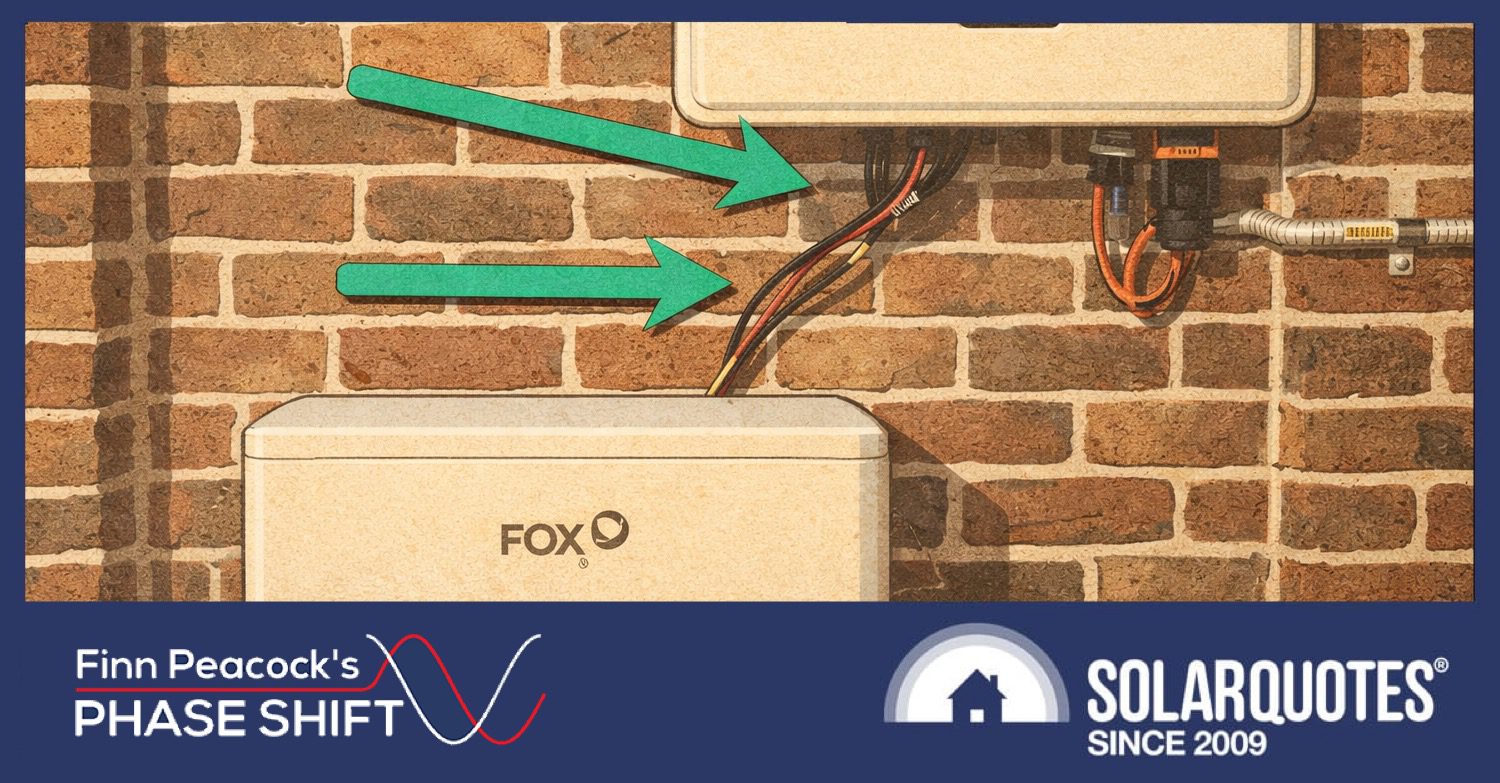
 If you’ve got a high-voltage stackable battery system and the DC cables between the battery and inverter don’t have mechanical protection, you’re not compliant with Australian standards and your systems could be classed as unsafe – and shut down.
This column explains why, and what the standard requires.
A Quick Word On Voltage Categories
The ‘home battery standard’ AS/NZS 5139:2019 classifies DC voltages into three tiers:
- DVC-A (up to 60 V DC),
- DVC-B (60–120 V DC), and
- DVC-C (above 120 V DC).
Every mainstream high-voltage stackable battery sold in Australia today operates well above DVC-C.
What The Standard Says
Clause 5.3.1.4.3 of AS/NZS 5139:2019:
“For battery systems operating at DVC-B or DVC-C, the cable between the overcurrent protection device and the PCE shall have mechanical protection.”
The PCE is the inverter. In most modern HV stackable systems, the overcurrent protection device is built into the top (Master) battery module. So the protected run is from the battery stack’s DC output terminals to the inverter’s BAT input. For DVC-C systems, that entire run requires mechanical protection.
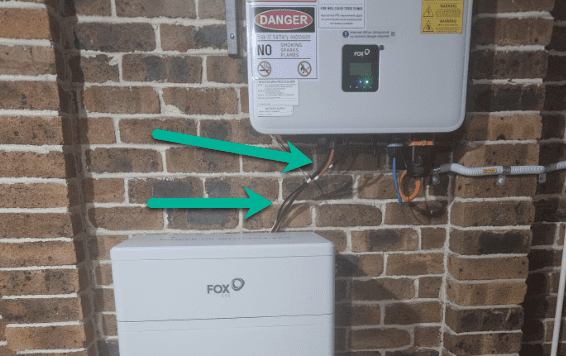
Unprotected battery cables from the battery to the inverter. Not even close to compliant.
There Is No 300mm Allowance
Many installers apply a 300mm exposed cable allowance at the inverter end – a habit carried over from the solar panel installation standard AS/NZS 5033, which does permit a short exposed section of solar DC cable at the inverter connection point.
That allowance exists in AS5033. It does not exist in AS5139. Glen Morris – Standards Australia committee member and principal of Smart Energy Lab – confirmed this to me explicitly: there is no exception for mechanically unprotected DVC-B or DVC-C battery cables in AS/NZS 5139, unlike the 300mm allowance in AS/NZS 5033 for PV array cable at the inverter.
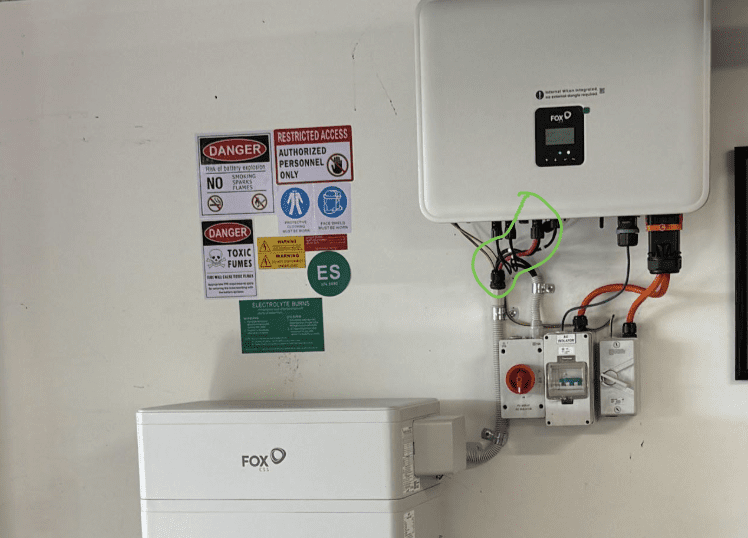
Not compliant – battery DC cable is visible. Unlike solar DC no exposed battery DC cable is allowed. Don’t get me started on the stickers…
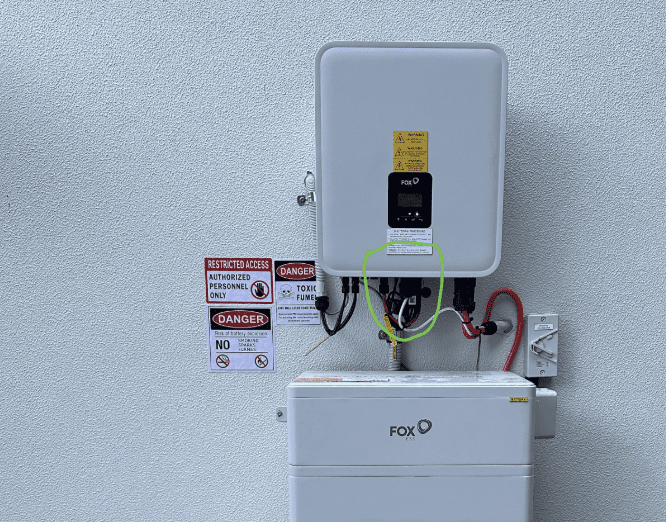
Does not comply.
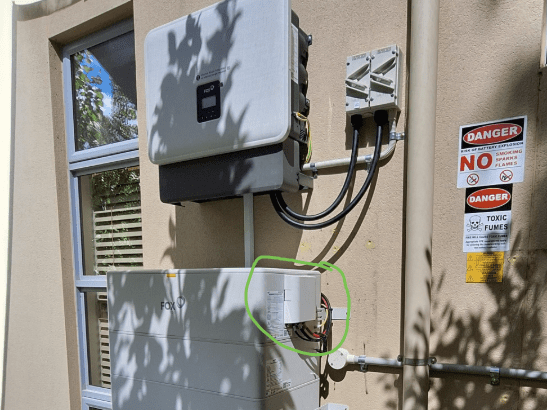
Inverter looks good: shame about the exposed DC at the battery.
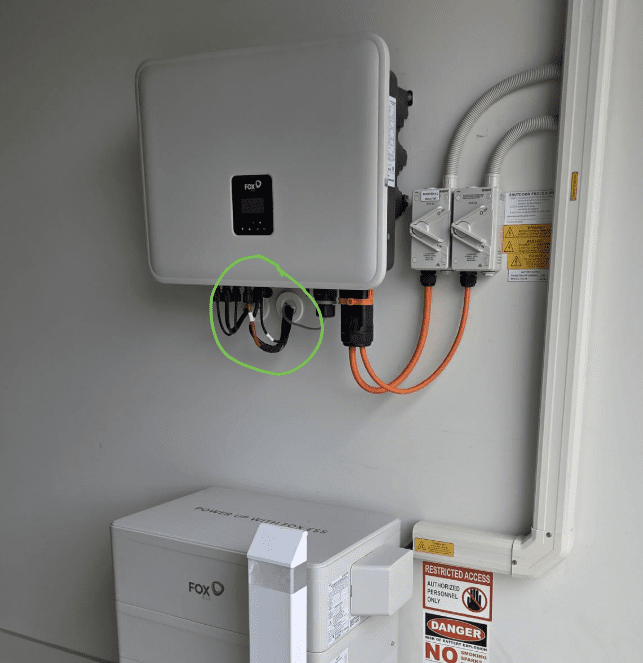
Nice and neat. Not compliant.
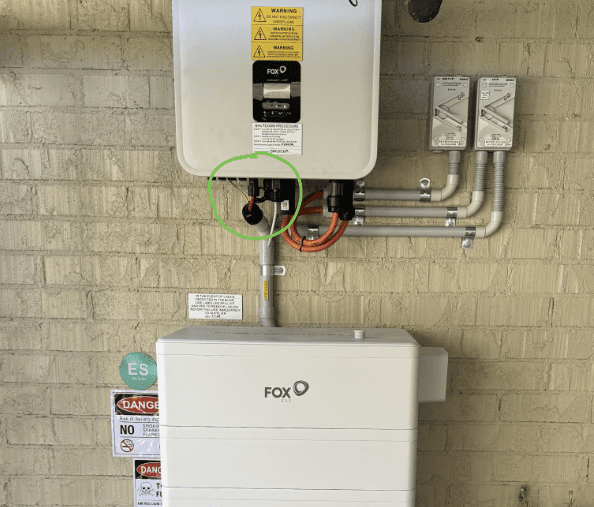
Close – but no cigar.
Why Battery DC Is More Dangerous Than Solar DC
A high-voltage battery stack is a voltage source with very low internal impedance. Drop a tool across unprotected battery DC cables, or rub insulation against a sharp edge until conductors touch, and the available fault current is in the thousands of amps. The arc that forms is violent and sustained. It will keep going until the overcurrent device trips, and in the time between fault initiation and trip, enormous energy is released at the fault point.
What Protection Is Actually Required
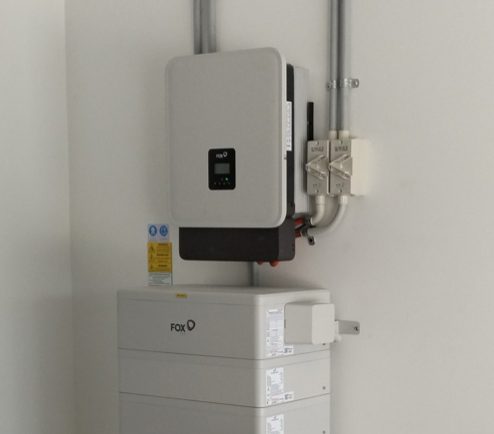
An example of battery cables with proper protection.
AS/NZS 5139 references AS/NZS 3000:2018 Clause H4 for mechanical protection requirements. For most domestic battery installations, WSX1 classification applies. AS/NZS 3000 Clause H5.2 lists what satisfies WSX1:
- Wiring systems meeting requirements of the appropriate tests of AS/NZS 30131
- Light or medium duty conduit
- PVC duct with clip-on covers
- Small sheet-metal ducts with clip-on covers
- A sheathed cable immediately adjacent to a projecting timber batten or masonry corner
The protection needs to cover the full run from the battery DC output to the inverter BAT input. There is no permitted exposed tail at either end.
Why Our Examples Focus On Fox ESS
Update: Since the publication of this article Fox ESS has contacted SolarQuotes to express concern that their products feature in all the included images, when these issues also crop up with other brands. We do notice these problems frequently with Fox ESS installs – we believe due to this brand’s popularity among cheap installers. The images are all of the same brand as this makes it easier to highight different problems to readers and contrast that with how a compliant install should look. Fox ESS tells us it has taken action in recent months on this, such as providing free mechanical covers. We’ll cover more on what Fox ESS and others are doing and what other actions could be taken in an upcoming article by SolarQuotes’ in-house installer Anthony Bennett.
The Enforcement Reality
This requirement has been mandatory across Australian jurisdictions since around 2021. Glen Morris (who helps write the standards) told me he comments on dozens of Facebook posts every week, pointing out non-compliant installations, and only about 10% of installers appear to be getting this right.
That’s a systemic problem that makes home batteries less safe, and it’s about to become more costly. Clean Energy Regulator inspectors can and will shut down non-compliant systems. They are going to be busy…
Phase Shift is a weekly opinion column by SolarQuotes founder Finn Peacock. Subscribe to SolarQuotes’ free newsletter to get it emailed to your inbox each week along with our other home electrification coverage.
Footnotes
- these are pretty brutal cutting and impact tests ↩
 About Finn Peacock
 RSS - Posts





A quick look at the CER site shows the following…
if they inspect and deem the system unsafe, they will shut it down.
But it also says
“Participation is voluntary and the inspection can only go ahead with your written consent. ”
So that means If you agree to an inspection there is the possibility they will turn your system off and leave you to sort it out.
If I got selected for inspection I think i would rather say no, then pay an independent person to inspect it for me – and actually fix any issues found then and there, rather than risk letting this lot shut down my system, then have to find someone to fix it and go through he rigmarole of getting it reconnected.
So have you had it independently inspected?
I would prefer to know my installation is correct and safe rather than always wondering if my house is going burn down.
Short term cut off is better than long term death.
Thanks Finn for such a clear and concise explanation of the problem.
I couldn’t agree more. All legislation and any dependent materials should be free of charge. If legislation is incomplete due to “pay walls”, the legislation should be updated to include the information required to reflect the compliance.
I expect all issues raised are valid, but you should have flagged that this problem could be found across a wide range of battery brands/ installs.. ie It is not a specific problem just with Fox installs.
Regards
Greg
Thank you Finn for this detailed and concise explanation of the DC cables compliance. It would be really helpful if the referenced standard is made available without cost so we can share that with the installer as its now information out there and my duty of care to follow up as well.
Further justification for AS/NZS standards to be available either free of charge or for a nominal fee. If you do not know, then how can you ensure compliance (and safety).
Standards Australia is owned by SAI Global who was purchase by Intertek Group (2021) for a deal estimated at 1.2 billion. Intertek Group are listed on the UK stock exchange.
I guess publishing Australian Standards is now all about returns to investors primarily.
By contrast, Standards New Zealand is a government run organisation operating out of the NZ Ministry of Business, Innovation and Employment (MBIE) and makes the very same joint standards that we have in Australia for free to those working in the electrical industry (must be members of the Electrical Workers Registration Board – the organisation that licenses electricians).
I am a licenced electrician and I don’t have the latest copy of the any of the standards I need. There are so many needed, the costs are exorbitant! The company I work for refuses to purchase them as well.
I’d love to know the Government Bastards that got a big fat bribe for allowing our Standards Australia to be sold off.
Fox installers need to step up their game haha
Interesting to compare Australian requirements for ‘cable protection’ with the UK. As part of my solar journey I’ve been watching YouBoob videos from Artisan Electrics and Gary Does Solar, amongst other UK sources.
Now Artisan promote themselves as a top notch installation company. And certainly their workmanship appears very neat and thorough. However in no installations do I see continuous conduit nor trunking over cabling around their inverters, battery banks and adjacent load centres [switchboards].
Same voltages and currents as DownUnder. Even the same language and, I thought, high regard for safety. And yet from what I can tell the installations Finn has pictured above, whilst unsightly, would all be compliant in the UK.
Has Australia gone overboard with it’s standards – again?
Yes.
If you can damage cable, you can also damage the conduit around the cable, then damage the cable.
If cable has thick insulation that is designed for exposure to the elements, then it should be ok to expose it to the elements.
Many DC solar cable sold in Australia by reputatable suppliers like Altronics is marketed as “armoured” for direct outdoor exposure and use.
High voltage DC battery systems have similar current to solar. For example, it is common to have a high voltage DC battery system that operates at ~600V with a max current capability of ~20A, which is identical the the string of solar panels that is connected to the same inverter.
The battery packs have internal BMS/fuses/proection that does not even let the current go over the limit for a second, as that will cause thermal runaway and fires. So the currents that can in reality go through these cables are the same as solar.
Low voltage DC batteries that do 100A+ normally have factory supplied short armoured cables
I have a sungrow system with battery. It has a sheild covering cables but if you have to reset the WIFI dongle on the inverter it has to come off. Stupid design.
The home battery voltage levels used in this Australian standard (5139) seem to be deliberately confusing.
AS 3000 defines a lot of home batteries as extra low voltage or ELV, because they are below 120 volts DC. AS3000 also considers DC voltages over 120 volts and under 1500 volts as “Low Voltage”, and DC voltages over 1,500 volts as “High Voltage”. I doubt any new “high voltage” battery installations would be above 1,500 volts DC. Are you saying that one Australian Standard treats “high voltage” batteries as LV, but another one treats them as “HV”? There’s a recipe for confusion!
Also, it might be worthwhile mentioning that not all home batteries are “high voltage” in either standard as they are below 48 volts. I’m sure you wouldn’t want your article to lead people with “ELV” batteries to assume that they have a non-compliant installation because their battery leads are not in some sort of conduit..
Or have I got that all wrong.
Hi Dave,
The classifications are confusing.
It’s like ordering coffee, where nobody from marketing wants to sell a “small” cup and there’s a size or two larger than what they brand “large”
ELV is basically conventional car wiring & garden lights.
A 48V nominal battery isn’t classed ELV because it’s not unusual for them to go over 60V when charging.
Just seeking to clarify, a 48V(51.2V) nominal LiFePO4 (16s) battery has a float voltage of around 54 V and a maximum charge voltage of 58.4V
This is below the 60V threshold.
No 48V battery should see greater than this at the terminal.
Am I right in assuming that it is therefore a DVC-A system ?
I have also had previous experience with lead acid 48V systems and their charge voltages also never exceed 60V, the PV feed to the inverter/charge controller is in excess of 120V DC but the voltage on battery cabling never exceeds 60V in either set up
Your comments above seem to contradict this by saying that ‘it is not unusual for them to go above 60V when charging’, in a correctly setup system this is not the case and would be indicative of a fault and/or cause the batteries to fail prematurely
Could you clarify please ?
Brett, I agree with what you are asking. I know lithium batteries need a high charge voltage to get them to 100%, but I wouldn’t have thought a 48 volt lithium battery would need to see 60 volts to charge fully. Maybe some do, or it is too close to the allowable limit that the standard is trying to cover.
Anthony, ELV is not just for car wiring (14.7-ish volts) or garden lighting (typically 24 volts AC). ELV is also used for many traffic signal installations, which make them far safer in the event of a collision which knocks down a signal pole.
Glen, I hear what you are saying, but the fact remains. AS3000, AS5139 & this article do not agree on how to define low voltage and high voltage. a 48 volt home battery that charges up to 58 odd volts is defined as LV by AS3000, DVC-A by AS 5139, while this article suggests that all modern home batteries are HV – which AS3000 says is above 1,500 volts DC.
I do agree though that cable protection is always a smart move, regardless of the volts
Hi Dave, Glen Morris here from the Standards Australia Committee (EL-005) that produced AS/NZS 5139.
As a normative standard to AS/NZS 3000, compliance within the scope of AS/NZS 5139 (12-1500Vdc) is required.
5139 defines battery systems above 60Vdc as DVC-B/C and equivalent to an LV installation as defined in AS/NZS 3000 (ie. hazardous).
Thus mechanical protection to the equivalent level of 240V a.c. wiring is required. As Finn pointed out, WSX1 would be sufficient for domestic installations.
Yet another Solar Quotes article that depicts a single (chinese) brand they seek to slander. Never stops. Go Origin. Go Finn the champion of rip off tradies
My Fox ESS install was selected for a detailed “audit” soon after install. Perfect pass.
One third of tesla or the other “”safe”” brands endlessly peddled here. The fear of warranty, install defects etc. its how the community of scam installers exist.
Hi Paul,
I’d be pleased to see your install if you’d like to send us pictures I’ll include them in a follow up article coming soon.
In light of this battery cable issue, you can look at the review page & see just at a glance around 1 out of 7 jobs are compliant.
https://www.solarquotes.com.au/inverters/fox-ess-review.html
Good installers can do good work with most brands.
However cheap gear always attracts cheap half arsed sales companies, dodgey subcontractors & sadly the customers that deserve them.
good
Had 50kw battery installed mid January. Wiring is a shambles. System works perfectly but not a professional installation. Voltx have been contacted with pictures of my issues and still waiting for follow-up. At least we haven’t actually paid for it yet. Your posted pictures are exactly what kind of dodgy workmanship I have. Is there a statute of limitations on how long this should take or are they likely to sweep the problem under the carpet?
Hi Rod,
Let us know how you get on with Voltx and perhaps leave a review.
https://www.solarquotes.com.au/installer-review/voltx-energy/
Must the standard battery post-installation inspection assess compliance with AS5139? If yes, why aren’t the inspectors doing their job properly? I pointed out exposed DC wiring to my inspector and he said it was compliant.
Hi Geordie,
I run training courses for electrical inspectors in Australia and New Zealand and am doing my best to bring them up to speed with the relatively new battery standards AS/NZS 5139.
I would expect that should your installation be inspected by a Clean Energy Regulator inspector (they randomly inspect a statistically significant number of installations approximately one year after installation), then they would pick up this defect. This may mean your system gets shut down and will require rectification work prior to re-energising.
Why is it so hard to comply with the required standards. Apart from the out and out cowboy shonksters, don’t installers take pride in their workmanship anymore.
Many don’t read the required standards or if they do don’t have the latest versions. While its a small cost it adds up having to purchase them every 3 or so years. Just the 3 standards mentioned in article are below, and there is literally dozens that apply day to day all averaging probably $300 just for a single person access “license”.
AS3000:2018 $260+
AS5139:2019 $321+
AS5033:2021 $296+
Companies are supposed to provide them to electricians, but that’s an uphill battle always. It’s not an excuse for it however and I always made sure to try and have the relevant standards available and read over in the office.
Many of the pictures appear to be pure laziness in discarding a provided cover, unless it’s recent addition to newer models.
Is that cost for them due to the fact that the standards have been privatised rather than a government owned business? If so, it’s another example of how privatisation of government authorities has cost consumers more. It’s a never ending story.
As customers how would I know if the system is setup by an accredited person. The system should not penalise the customer for the wrongdoing of the installer.
So make the installer correct the defect.
FoxESS battery DC cables do not use MC4 plugs, they use Amphenol H4 cold form pins (technically not Amphenol but a compatible brand). The correct crimping tool cannot be found in Australia because Amphenol does not supply H4 plugs here. So there is another issue, when installers cut the cable to fit the conduit and use a lug crimper which is unsuitable for the H4 plug, it may void the warranty.
Wet dreams! All of these exposed cables passed the official certification done by the certified, independent certifier, who confirmed it all on a piece of paper.
I had a 42 kW system installed in Qld in Jan 2026. I took a photo outlining the exposed wires as referenced in your article and asked the company I went through to rectify the issue. I received the following reply:
The DC cabling used between the battery and inverter is double-insulated, heavy-duty sheathed cable, which already meets the mechanical protection requirements under AS/NZS 3000.
The short visible sections (often referred to as “tails”) at terminations are permitted where:
The cables are not subject to mechanical damage
They are installed in a controlled, restricted-access area (as indicated by the “Authorized Personnel Only” signage on your battery system)
The cables are securely fixed, supported, and routed directly between equipment, minimizing exposure and risk
Both the battery system and inverter connection points are designed by the manufacturer to allow short exposed terminations for proper connection, servicing, and compliance with their installation
I guess we’ll have to wait on see if the CER inspector fails it.
Great comment!
The core claim is that the cable meets mechanical protection requirements under AS/NZS 3000. That’s possible: but the relevant evidence would be AS/NZS 3013 type test certification for the wiring system as installed. If that documentation exists, it resolves the question immediately. I’m genuinely curious to see it.
If it doesn’t, IMO no combination of the remaining justifications: the restricted access signage, the secure routing, or the manufacturer’s installation instructions can substitute for it.
(I added a top bullet to the WSX1 requirements in the post to make it clear a wiring system that passes the AS3013 tests is also acceptable)
Yes I bought a FoxESS KH9.9 plus EQ4800-L9, looking at the instal now all after it’s been ‘inspected’ by Access Canberra Inspections mine is similar to most of the others here with no mechanical protection, but would certainly benefit from having it.
I read above that Fox ESS has taken action in recent months on this, such as providing free mechanical covers(??)…. so how do we get these ‘free mechanical covers’….. and really they should have been part on the installation kit supplied, and also one of the suppliers, installers, or electricians who did my install should have made me aware that they were available, even at an extra cost.
There just a bunch of cowboys, you can’t get in contact with any of them, they just ignore you. It’s so disappointing.
I understand that there is considerable difference in opinion on how battery system cables are to be mechanically protected. This article takes the opinion that wiring enclosures or barriers be provided. But: the standard doesn’t actually say that.
Clause 5.3.1.4.3 of AS/NZS 5139:2019+AMD1 requires at least medium duty conduit for cabling exiting a battery system without internal overcurrent protection, and otherwise requires ‘mechanical protection’ for cables internally protected against overcurrent for DVC-B and -C battery systems. The note under that clause refers us to Appendix H4 of AS/NZS 3000:2018, which itself refers to location as a means of mechanical protection. Clause 3.3.2.6 of AS/NZS 3000:2018 mirrors this, as well as 3.9.4.1.
This is about _accidental_ damage, and location in general is a means of mechanical protection. If the committee didn’t mean that, it should have been written differently. As far as I am aware, this defect would be overturned in Victoria.
Thanks Jack. This is the kind of detailed technical pushback that makes these discussions worthwhile.
Yes: AS/NZS 5139 Clause 5.3.1.4.3 uses the broader term ‘mechanical protection’ for the OCPD-to-PCE cable run. The article overstated the requirement by implying enclosures or barriers are mandatory at that point in the circuit.
Where I’d push back is what H4 ultimately defines ‘protection by location’ to mean in practice. When you follow the chain through to H5.2 – where WSX1 mechanical protection systems are specified – protection by location is defined as a cable positioned immediately adjacent to a projecting batten or masonry corner with the projection not less than twice the cable’s dimension, (Fig H1). That’s a specific geometric arrangement, not a judgment.
But the standards are confusing & the chain of references is non-trivial to follow. Do you know of a specific ESV determination or inspection outcome in Victoria that has tested this interpretation?
So to be clear, an electrician is connecting some electrical wires between two pieces of electrical equipment, and that requires reference to a stack of expensive documents published by a self-serving private company.
Thank Dog nobody is trying to do anything innovative that might bridge multiple of the traditional trade silos.
Correct. It’s absolutely nuts.
Australian Standards should all be published for free on a website.
As long as you are on the official site, you will always be looking at the latest version.
To follow a reference, you simply click on it.
All changes are tracked so you can roll back to a certain date – to check the standards at time of installation.
Suggested changes can be submitted by anyone and collated.
The technology to do this is decades old, and free.
I’m thinking of starting a lobbying outfit, specifically to make this happen….
Hi Finn, I fully support your initiative to get Australian Standards back under goverment ownership and available to industry for free (as they are in New Zealand who never sold off their standards).
Because battery DC conductors present unusually high energy hazards, any exposed and accessible cable is inherently vulnerable to accidental damage and therefore requires a dedicated physical protective system.
Do you have any examples for Sungrow installations? Fronius have a very good setup where the front cover extends well below the inverter connections and has entry points to connect conduits but on Sungrow the connection points are all out in the open and it makes it very hard to collect and protect all the cables. They should have a cover for their domestic inverters like they have for some commercial ones.
Hi Paul,
It really depends on the model but I wouldn’t be surprised if they sell covers as spare parts?