
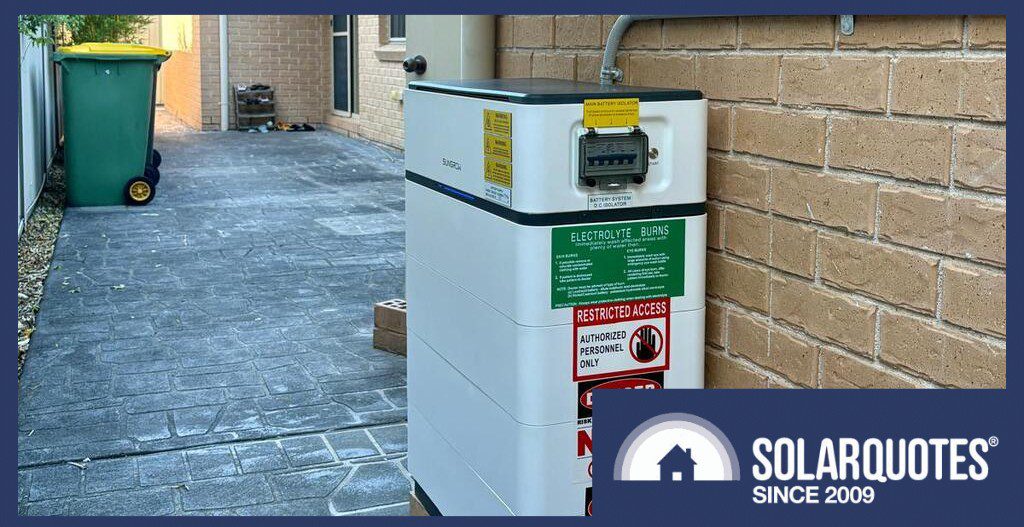
Batteries shouldn’t be put in the bin, and nor should bins be put into your battery – but has your home energy system been installed in a way that can handle a wheelie bin or worse of impact?
How Much Protection Does Your Battery Need?
We’ve covered the need for mechanical protection on battery wiring recently. But once you accept the cables need protecting, the next question is: how much protection, exactly?
The battery standard AS5139 requires it. Installers are trained to interpret the standards. But the people who wrote them didn’t always picture a home battery bolted to a garage wall when they were drafting the rules.
The Standards Were Written For Things With Wheels
When we refer to clause H4, it becomes apparent the wiring protection standards were written with mobile equipment in mind. Vehicles, trailers, machinery. Applying those same classifications to a stationary battery on the side of a house takes some pragmatism.
The two levels that matter here are WSX1 and WSX2.
WSX1 covers protection against light impact. It’s generally accepted that the medium duty conduit specified in the battery rules provides more than enough protection at this level. If your battery is mounted in a low-traffic spot, tucked into a corner of the garage, WSX1 is the classification most installers are working to.
WSX2 covers protection against medium impact. And this is where it gets interesting. If you take the broader guidance in the standard at face value, WSX2 isn’t out of the question for batteries installed in a passageway beside the house, where someone’s regularly passing with wheeled traffic.
The standards actually mention a wheel barrow, but I’d argue the modern equivalent is the wheely bin.
Just as unstable, you’d be silly not to anticipate it’ll wobble past your battery installation, every single week.
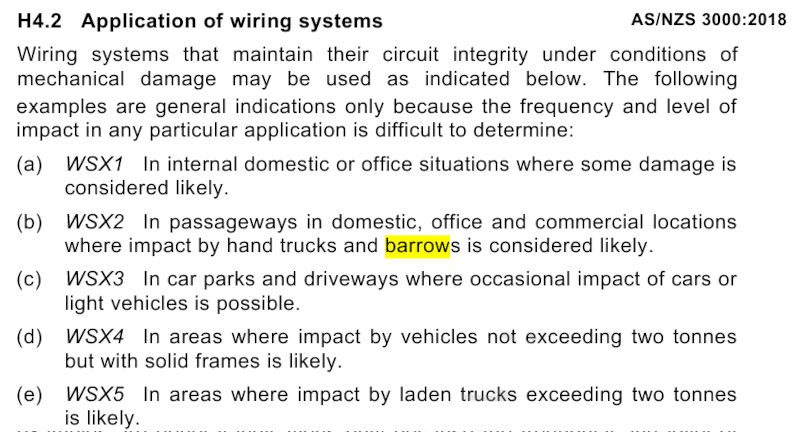
Perhaps the most important point to consider is wether there will be repeated impact on whatever protection you use.
So Which Rule Applies?
That depends on where the battery lives and what’s going on around it. A battery stuck behind a nib wall inside a domestic garage is a very different situation to one sharing a shed full of garden tools, different again to one mounted on an external wall, in a path where the kids ride their bikes.
Most of the industry is treating WSX1 as the default, and for a lot of installations that’s perfectly reasonable. But if you’re signing off on an install in a high-traffic location without thinking about whether WSX2 applies, you might want to reconsider.
The Air Con Duct Question
This brings up another issue. Good installers have been using air conditioning ducting as a practical way to protect battery cables and tidy up installations. It keeps AC cables, data, metering, DC solar and DC battery conduit all marshalled together, out of harm’s way and looking good.

This air con duct doesn’t always look good, pumped full of silicone with no conduit for the battery cable.
There’s a catch though: plastic air conditioning ducting might not be type tested for wiring protection. It could be more decorative than compliant. We’re all aware that the insulation on pair coil piping for air conditioning won’t last in the weather, and invariably there will be AC cables run along with it, however if an inspector questions it, can you point to a test report that says it meets WSX1?
Medium duty conduit is the safe bet if you want something that’s clearly within the rules. The air con duct might be perfectly adequate in practice, but “adequate in practice” and “compliant on paper” aren’t always the same thing.
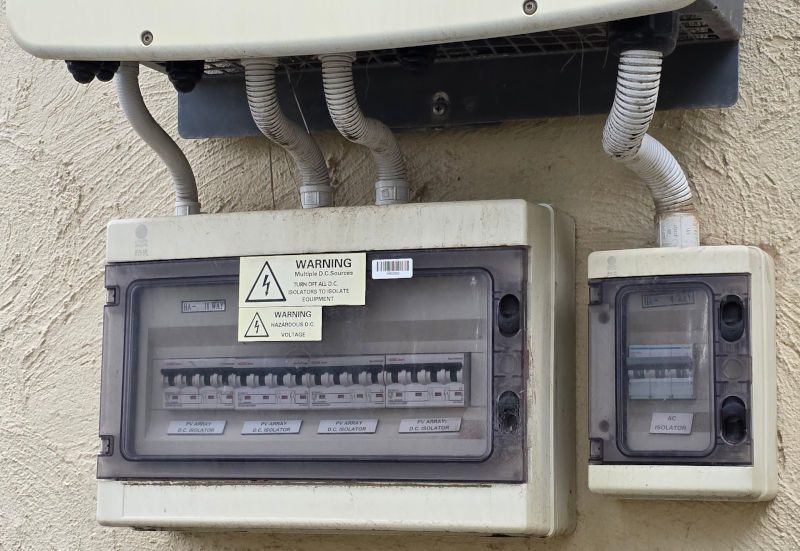
This might have been compliant when installed, but in practice, these “s” bends in the conduit put stress on the cheap plastic isolator enclosure, causing water leaks.
Going Deeper Pays Off
Older air conditioning installs often used metal ducts for piping and to be honest I think they’re still a winner.
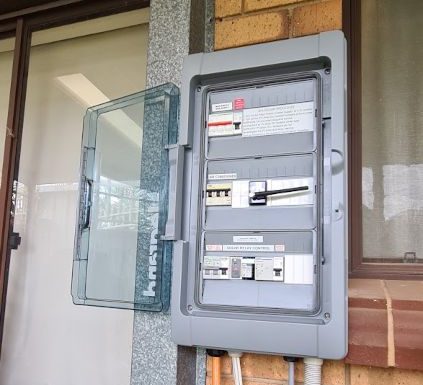
This sub board has a large 3 phase supply, single phase solar hybrid, solar controlled relay for hot water, air conditioning, metering and room for future EV charging. The existing service duct made perfect sense here.
The extra depth available means you run 25 or even 32mm conduit, drilled through to meet the inverter on the same plane. This saves battling with short radius bends in flexible conduit, plus you can use more durable rigid conduit. Best of all, it doesn’t interfere with installing the duct cover.
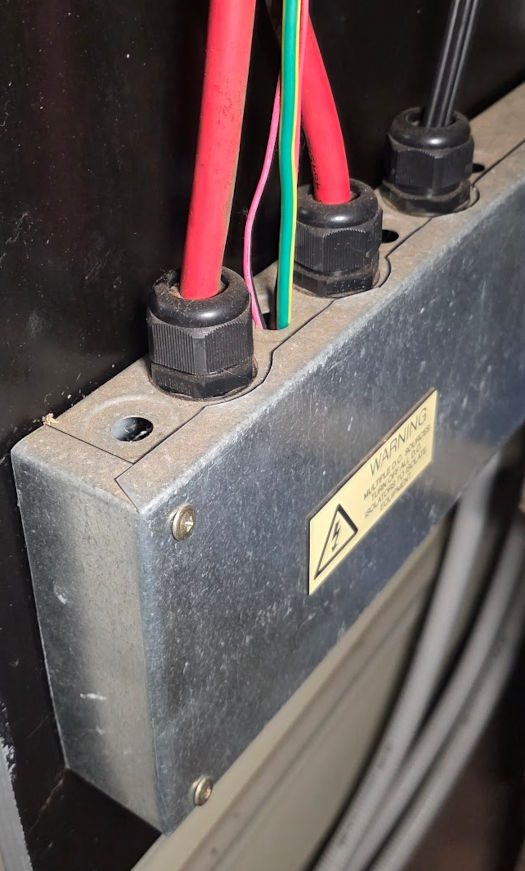
A folded end and two button screws makes this tray lid super neat, but cutting semi-circles in the edge to clear the conduit fittings is a pain
There are deeper plastic cable ducts available which are also very good. However I don’t recommend plastic duct with internal barriers for cable segregation, it’s frustrating to work with and falls apart easily, especially when you’re working inside a shipping container in Innaminka.
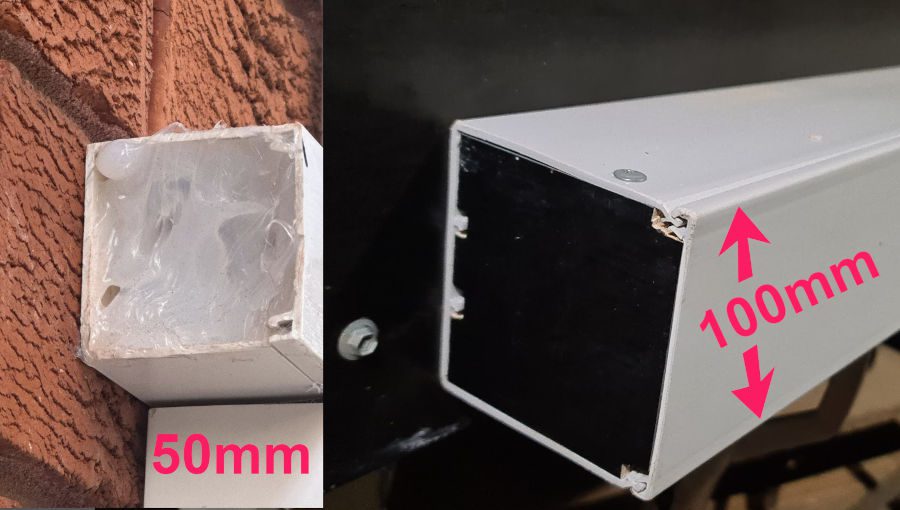
On the right we have generous sized duct with well fitted formply to close the end. On the left is cheap junk pumped full of silicone.
Cable Tray Ticks More Boxes
Ordinary ladder tray for electrical cables isn’t as deep, but it’s certainly a good solution for organising, protecting, and neatening up an installation. DC solar cables can be run “bare” in a cable tray without having to wrangle conduit, it’s very handy for legacy installs where you need to remove a DC isolator, extend solar cables and cover up the scars on the wall.
Better installers will also paint or powder coat metal trays. In fact some of the best I’ve seen will get the local roofing supplier to custom fold a tray lid in matching colourbond material. Not only are they more durable in the sun, they really look a million dollars and unlike plastic, they will do for years.
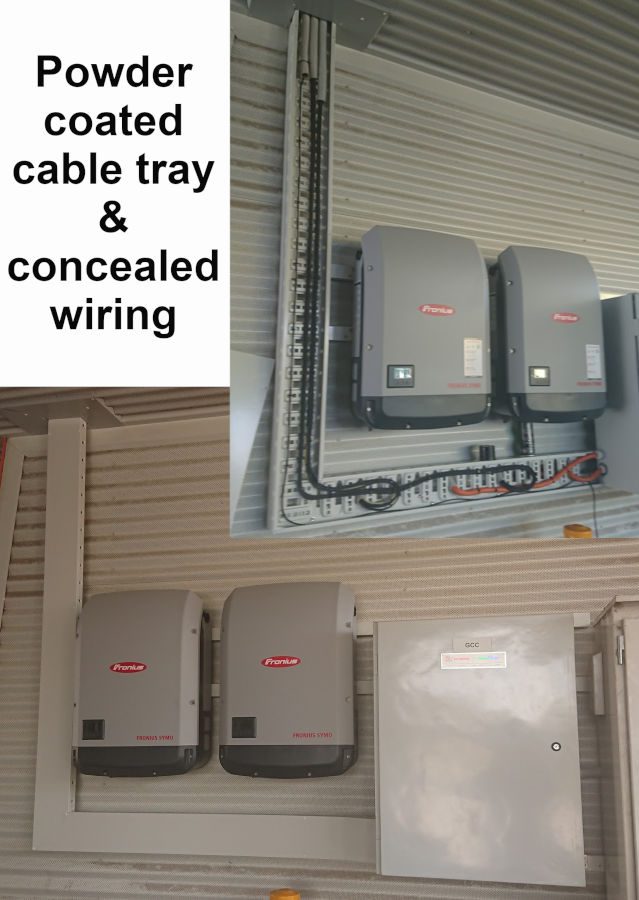
This job was a showcase for an exacting customer, it won work across another 50 petrol stations
A Note On The Jargon
You might have noticed certain words in italics: light impact, medium impact, mechanical protection. These aren’t casual descriptions. They’re defined terms in the standards with specific meanings you need to understand to make the right call on an installation.
Getting comfortable with this language matters, because when an inspector asks an installer why they chose a particular level of protection, “it seemed fine” isn’t going to cut it.
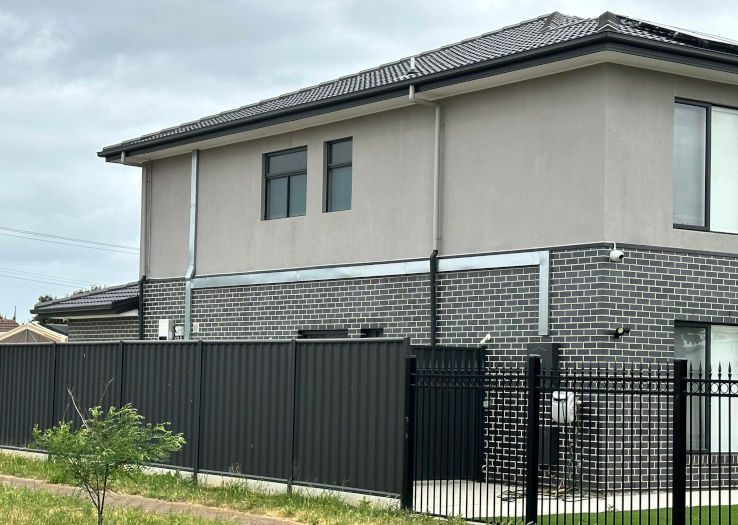
This cable tray is a bit confronting but would almost disappear with paint
The Bottom Line
For most residential battery installs, WSX1 with medium duty conduit will keep you on the right side of the rules. But take a moment to look at where the battery actually sits and what’s likely to bump into it. If the answer is “wheelbarrows and bins,” WSX2 is worth considering.
The standards might have been written with different equipment in mind, but the principle is sound: match the protection to the risk.
For more on protection of solar and battery wiring, read my explainer on how some installers are compromising the weatherproofing of inverters by drilling holes for conduit.
 About Anthony Bennett
 RSS - Posts





Anthony, if only we had you on our Standards Committee! Such a sensible interpretation of the risks. Thank you for an excellently researched article.
Cheers Glen,
Thanks go to Max for making it readable.
I suspect the standards could use more images and less semantics but that’s another story.
Anthony, thanks for bringing up another “Rules with multiple interpretations” story. It highlights once again, how a good installer meets the everchanging legislation for solar system installing. The “shonky”
operators are still doing poor work and getting away with it. Having installed consumer products outside in the weather for over 30 years, I consider flexi conduit has its limitations, Most flexi is recycled plastic and is not UV stable. Put a tight bend in it to look good, and its sure to fail even sooner if on an external structure. Some of your photo of recent jobs really needed a bit more pre-thought with cable runs and flexi was used to disguise the fact that the 2 holes in the wall were not vertically aligned. The job can be done in UV stable 20/25 mm conduit with a bit more time using a heat gun and coiled spring inside to get the bend nice and neat. Now as for mechanical protect of the equipment, the poor quality installers guess the WSX1-4 requirements based on cost,
What constitutes mechanical protection for inverter/batteries installed on a garage wall with vehicles hitting it, or in a traffic walkway? Does the good installer place 1 bollard in the middle, and hope a side impact does no damage, or does they consider the worst event and go for 2 bollards, one each side? In my case ,I was the one to ask for a bollard or two to protect the equipment on the back wall of a carport where cars up to 4×4’s can park. I got one bollard in the middle under protest. I would class this job as a WSX-4 requirement. If seems to me, that the C.E.R. are falling down on compliance, and some non compliant jobs get Solar Vic STC rebates with ease. My job is full of mistakes made including non compliance with the inverter and 4 batteries in one stack, violating manufacturers maximum of 3 units per stack, yet the inspector passed it. My issue is that the heat-rise in the inverter and top battery has the inverter case too hot to touch. I put a 3 fan cooler on it now.
Timely advice that’s really been missing.