
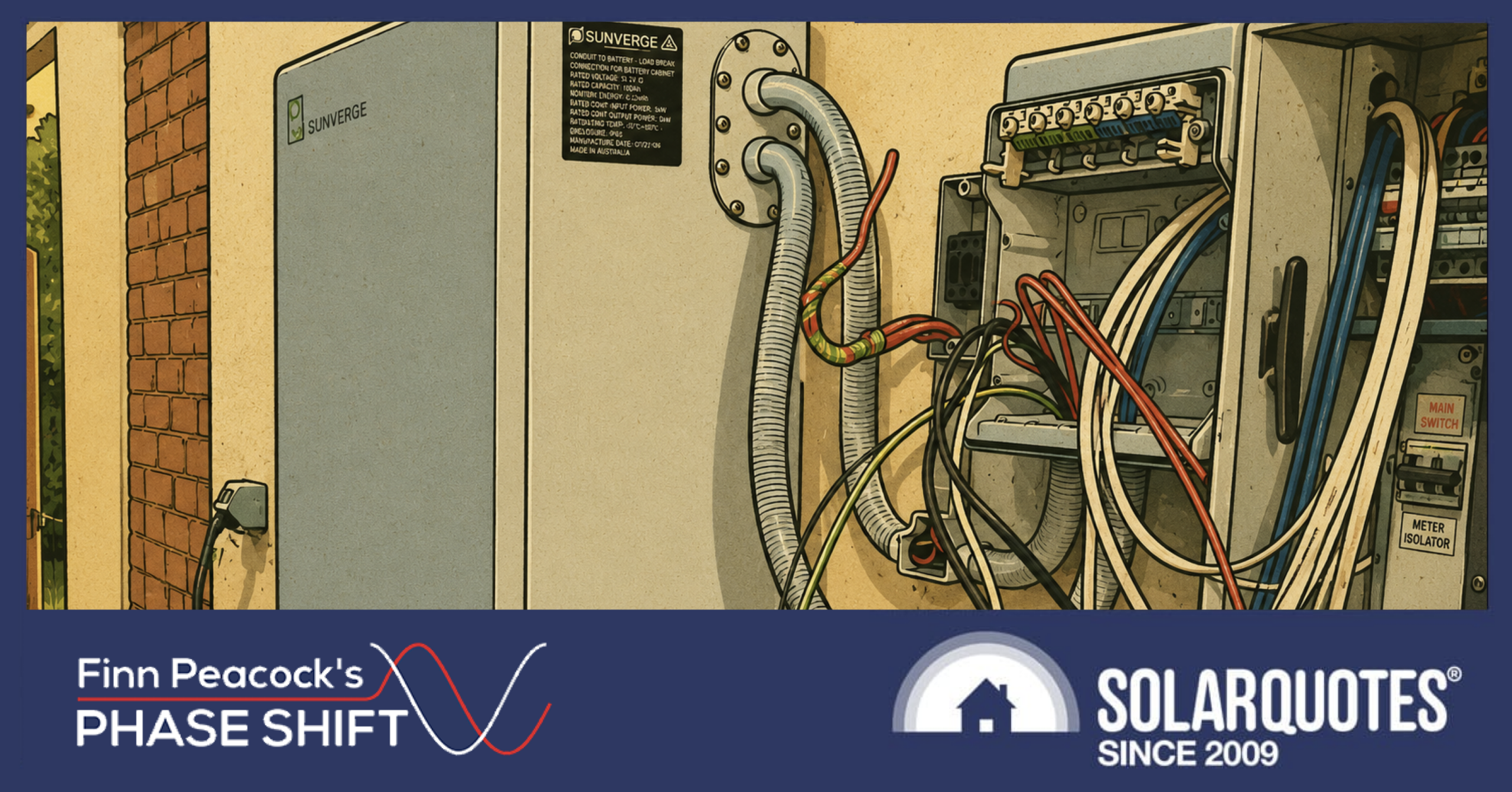
 My first proper job was at a nuclear power station. If you wanted to change anything you started with a drawing.
You marked the change up in red. An engineer reviewed it. The drawing office turned the red ink into real drawings. The work was done to that drawing. Someone checked the install against the markup, and signed off the drawing ‘as-built’.
I always thought that would be overkill for a domestic switchboard. Until I read a thread on one of the big Australian solar Facebook groups this week.
A savvy installer posted that inspectors are now auditing battery and solar jobs for busbar overload. Underneath, a dozen qualified electricians and a couple of engineers argue about whether a residential busbar can actually be overloaded by adding an inverter to it. One quotes Kirchhoff. Another posts a photo of a report from work. A third says move the inverter supply to the opposite end of the bar and you’re fine. A fourth says no, the bar is one conductor and the currents add. They are all confident. They cannot all be right.
Here is the problem.
Too Many Passengers On The Busbar
The main switch on many Australian houses is 63A. The busbar feeding the rest of the board is often rated 80A. When the only source on the board was the grid, life was simple. Grid in at 63A, busbar easily carried 63A, everyone went home.
Now we strap a battery and a solar inverter onto the same busbar. The grid still supplies up to 63A. The inverter pushes another 32A or more. The kitchen, the EV charger, the heat pump, and the spa pull more current than the conductors in the board were ever built to carry. Depending on how the board is arranged, wires in that switchboard can now carry the combined current from the grid and inverter sources long enough to exceed their rating – and melt.
AS/NZS 4777.1 clause 3.4.2 has explicitly banned this since 2021. No conductor in the installation shall be overloaded by summation of grid and supplementary supply. The standard exists. How many recent big battery installs have even considered this is another question.
And the loads are getting worse. Karl, one of the FB contributors, notes that 145A through a residential switchboard happens at his place every other day. Three EVs, cold winter, induction cooktop, two splits, electric hot water. The maximum demand assumption that sized your board in 1998 is dead.
As Anthony points out; The first step for any electrification work should be assessment of your switchboard and then planning for upgrades.
The underlying problem is that much of the residential sector now runs serious currents through boards assembled over decades of piecemeal upgrades, often with no accurate documentation.
For the record, I hate bureaucracy. But paperwork for high-current electrical work earns its keep, the same way a structural engineer signing off your house plans earns her keep. Nobody calls that red tape. It’s the reason your roof is still over your head.
Keep A Paper Trail
Here is what we should do.
Before any battery, solar, or EV charger goes on, someone qualified draws the existing board. Every cable, every breaker, every busbar rating, every conductor size.
The proposed change is added to the drawing in red. The worst-case current at every point on the busbar is calculated. If anything exceeds rating, the design changes before a cover comes off. After the install, the person signing the compliance cert confirms the work matches the drawing. The drawing lives with the property and gets updated the next time anyone touches it.
Lots of people reading the previous paragraph will think I’ve lost the plot: “Typical bloody engineer!”.
But this is not radical. It is what every industry that runs serious power already does. And it is arguably what AS/NZS 3000 section 8.1.2 already demands when it says any alteration must be verified not to impair the safety of the existing installation.
Drawing Power
In my experience, you cannot confidently verify the safety of a modern energy system without a drawing. Domestic boards are now carrying commercial currents. The paperwork needs to catch up.
Will it? Unlikely. Because the market now rewards speed and low headline prices above careful engineering.
But right now, too much residential electrical work still relies on memory, assumptions, and optimism. That worked when houses drew 40A peaks and had one energy source. It is a far riskier bet in the age of solar, batteries, EVs, and all-electric homes pulling 145A.
Phase Shift is a weekly opinion column by SolarQuotes founder Finn Peacock. Subscribe to SolarQuotes’ free newsletter to get it emailed to your inbox each week along with our other home electrification coverage.
 About Finn Peacock
 RSS - Posts






My househild has a 5kw solar inverter, 5kw battery inverter, 7kw EV charger and the usual domestic devices.
Upgrading the switchboard from 32A to 64A this Thursday.
There’s a lot of old boards out there.
I suppose if it has an asbestos warning sticker, batteries, EV split system, heatpump hw, I should look at it?
Ouch 🙁 Probably. We had asbestos issues too.
My board (the actual underlying board, not the circuits wired into it) is ancient, and asbestos. Multiple electricians have drilled it over the years, none have removed it though one did at least add a ‘caution asbestos’ sticker to the board. There’s still a layer of dust sitting in the bottom of the external cabinet, which I’m careful never to disturb.
Reminds me any chance (if i haven’t missed it) you might do an article on the different meterbox’s available?
Going from that anyone feel like giving some recommendations to look at for QLD. Mainly want to know what it will be before going through with a possible three phase upgrade i was looking at a 48din one for future proofing.
Though still not sure if the sub-board will need work done until an electrician can check what the underground line to the sheds rated for.
Hi Nathan,
Cheers for the question, you reminded me to add a couple hyperlinks to the article.
The first step for any electrification work should be assessment of your switchboard and then planning for upgrades.
My service fuse actually melted. In that case the connections inside were loose and that was the likely problem. But it’s made me wary since about exactly what you’re talking about here, how much my old home’s original wiring is up to these sustained higher currents.
As far as I can see the wiring from the connection point to the grid to my board is the 16 mm2 newer type that will cope with higher sustained grid loads. But again I had to try to assess that myself, visually, and trust the installer had covered it.
I now do all EV charging at night, to minimise simultaneous charging with the battery. I also had my installer restrict my grid import to 12 kW. I avoid loading the whole thing up at once, wherever possible.
Well I thought a busbar might be a minibar at the back of the bus which sounded fun but when I read the article I got worried.
My 35 year-old 3-phase house has ~20kw of panels, 29kw of battery, 15kw inverter and loads coming from an 18Kw ducted air con, 11kw EV charger, 3.6kw hot water service, regular glass cooktop, 1kw pool pump, and the other lower powered usual stuff like dishwasher, washing machine, kettl etc.
Not sure if the board will melt but it hasn’t yet in 3 months since installing the battery and extra panels. It did trip the inverter a few times when aircon was running, kitchen appliances in use and it restarted when the pool pump started. I flipped the switch in the switchboard so it’s now running on grid-side instead of EPS which stopped the trips and everything still runs off the panels and battery before pulling from the grid which only happens when it rains for a few days.
Sparky is coming back to take the air-con off the EPS so I’ll ask him about the busbar…
Andy,
A google for “ac mains busbar comb for DIN rail circuit breakers australia” shows a bunch of images of what is usually in there, at least in a half-modern switchboard. As often as not, it’s just a strip of copper sheet, punched out on one edge to fashion narrow tabs at standard breaker spacing, with insulation, nowadays. It’s scewed into the breaker terminals after they’re mounted on the DIN rail.
What might be found in a switchboard from early last century doesn’t bear thinking about. Adding substantial solar to that, rather than total replacement, would be each case for itself, I think. But making do can delay replacement design until the number of EV chargers, aircons, etc, catches up with free rooftop energy supply and growing battery capacity. Having at least a few spare breaker slots, even then, has much to recommend it.
My house was built in 1991 – not by me.
The switchboard is a mess – wires are jammed in and the backplate barely shuts due to the number of wires. At least a dozen electricians have worked on it over the years and all recent ones complain but don’t propose to fix it.
It blew a service fuse a couple of years ago which required a Level 2 sparky to fix.
How would I know what my busbar is even rated at?
3 phase power
2 x 10kW inverters
Fully electric household
Average daily power consumption – 40kWh in summer, 60kWh in winter
Also if I do upgrade it, what is a reasonable price for a quality install? Some of my local sparkies charge extremely high prices….
I was in a similar situation to you. After adding solar, battery, EV charger and extra splits my switchboard was a plastic one crammed with so much wiring you couldn’t see what was going where and could barely push the cover back on. There were no busbars. I upgraded to two large metal IDP switchboards, one has a 100amp main switch set up with 3-phase busbars and one is a 30-way for the essential circuits backed up by the battery. Almost all the RCBO’s were replaced. I also had a 3-phase circuit added in for an induction stove at the same time and it cost me $3630 +GST back in 2022. Money very well spent IMO. Very happy with upgrade.
I’m with the engineer invoking Thevenin: “The currents at a node sum to zero,”
But I’d evaluate a non-zero length busbar as at least 3 nodes for starters.
Supply feed (grid & site) to the centre, with loads either side, would cool the busbar, but concentrate breaker heating, so a busbar upgrade instead improves reliability.
Here, off-grid, domestic loads run off two subboards with 63A main switches, so all is good in them. But they’re off a main board fed by 24 kW of PV and battery inverters. Surge capacity is over 30 kW, 130A at least, but that board has a 63A main switch, so the only problem is capacity utilisation, due to an undersized main board. An upgrade to 80A or 100A comb and breaker would not take long, but I have yet to exceed 14.5 kW of consumption, even though BEV + HWS + microwave = 11.2 kW. Add a couple of aircons, and it comes close.
But put in two EV chargers, and trouble looms. The energy transition needs bigger busbars – that’s unavoidable.
Thanks for the heads up Fin.
My existing 3Kw (AC w mini inverters) 2013 system was destroyed in a severe storm just after 10KWh of batteries (5KW inverter on a new sub-board) were added. No probs for about three months.
I have a 3 phase old (60s or 70s) switchboard which is about to have a massive upgrade. New system is 12KW of panels, 15 KW inverter and another 10KWh of batteries – all split across all three phases complete with “blackout backup”. Shortly after an EV charger addition is possible.
You can bet I will be checking the busbar ratings whilst the new stuff is going in. Thanks.
US has the 120% rule.
Some systems (Tesla) have Virtual Panel settings/limits (PCS system). Sigenergy, etc might have the same.
For systems that don’t, if would probably be easiest to just have a supply bus & load bus
Hi Finn,
As an engineer, I totally agree, but I think that the reality is much worse.
Firstly there is a problem of customer mentality. I cant see many people who rush for the absolute cheapest solar and battery, spending extra to fix an old switchboard. When I upgraded my solar 10 years ago, I paid an electrician $2500 to upgrade my switchboard, and the electrician said that the upgrade it is not necessary, but it is barely enough today.
Secondly its the electrician. Most of them are incapable of doing a compliant installation (shown in SQ blogs and over the internet), let alone to re-design and execute the switchboard.
Also when something goes wrong (and it will) it is the customer who needs to pay, again, so it works for electricians.
So, where do we start?
The correct saying is “on the drawing board”, but in the residential sector it will not happen.
Well said Alex. Unfortunately too true. I’m an electrician and am constantly baffled by the poor quality of workmanship and bad product selection I see in our industry. I’ll bet there is less than 25% of electricians even using a Busbar, for some reason preferring just twist a heap of individual wires together and jamming them into the main switch!
I’m in NSW. We have virtually NIL inspections by our regulator (Department of Fair Trading), so the problem will not go away. There needs to be a widespread advertising campaign educating the public to always insist on receiving a Certificate of Electrical Compliance from the electrician they have engaged, then having regular random inspections by the regulator. This would have a flow-on effect of making the cowboys in the industry lift their game or disappear. Wishful thinking though unfortunately…
Another question for older houses is; “what is the current rating of the supply cable coming from the street network?”
At least that is OK in my case. 3 * 100A @ 240V feed. A (very) large bore pump (about30 metres down to water) was installed in the late 80’s. The lines were upgraded to 100A then. From what I read lately, that is now unusual.
A huge question, I’m told a older homes can have 6 or 10 mm2 cable that is insufficient for a continuous 63A load. A good installer should check this I’m also told, but who knows!
I believe you can have a 50A single phase service main as a legacy option.
The article’s battery-phobic headline misrepresents reality, which has *nothing* to do with batteries. Site power can be entirely PV – zero batteries, same problem. Supplementary generation could even be pure wind – like the article headline. Thoughtlessly inadequate AC busbar protection, through random current sourcing addition is nothing but careless AC wiring practice.The inverter’s AC isolation breaker must safely current limit, for adequate summed current protection. Got it?
The article’s real substance then reduces to a contention that sparkies can’t subtract two breaker limits from the busbar rating? Really?
That breaker and simple arithmetic is essential on any solar installation checklist, where supplementary power feed is to the busbar.
Carelessly making unsafe wiring alterations makes the sparky directly liable for any consequences, I submit.
Is supplementary training needed?
The size of connectors and lugs has always puzzled me. Large diameter wire attaches with a lug of much small cross section for example.