

Australia’s vehicle-to-grid rollout has been significantly expanded, with the Australian Renewable Energy Agency (ARENA) committing an additional $13.6 million to scale Amber Electric’s V2G trial from 50 households to 1,000 EV-enabled homes.
The project is the largest real-world test in Australia of whether electric vehicles can operate as both transport and energy storage — charging when electricity is cheap and exporting power back into the grid during peak demand.
The expansion also forms part of ARENA’s Driving the Nation program, which is focused on accelerating technologies that integrate electric vehicles into Australia’s energy system.
What’s Been Holding Back V2G?
ARENA says the expansion is aimed at addressing barriers that have kept V2G stuck in early-stage trials, including coordination between vehicle manufacturers, energy networks, customers, and charging technology providers.
“To unlock V2G at scale, we need to bring together customers, car makers, networks and technology providers,” ARENA CEO Darren Miller said.
A major hurdle remains manufacturer support for bidirectional charging, including concerns around battery cycling, performance and warranty coverage.
The expanded project will initially work with BYD, with ARENA hoping the trial will generate the real-world data needed to encourage broader participation from vehicle manufacturers.
“A big part of that is giving manufacturers the confidence their vehicles will perform as expected, including through validated approaches to battery use and warranties,” Miller said.
Climate Change and Energy Minister Chris Bowen said V2G reflects a broader shift in how electric vehicles are used within the energy system.
“Vehicle-to-grid technology means your car does not just get you from A to B, it can help power your home and support the grid,” Bowen said.
He said EVs will increasingly be able to store excess renewable energy and discharge it when needed, helping reduce costs and improve grid stability.
Can EVs Cut Electricity Bills And Even Generate Income?
Vehicle-to-grid technology is being tested using wholesale electricity pricing, where electricity costs change throughout the day depending on supply and demand.
Prices fluctuate throughout the day, often becoming very cheap during periods of high renewable generation and significantly higher when the grid is under stress.
The trial uses automated systems to manage when EVs charge and export energy based on real-time market signals. Decisions are fully automated.
V2G builds on this by turning EVs into flexible energy storage, shifting when they charge and discharge in response to wholesale price movements.
For most households, the primary benefit is reducing exposure to peak electricity pricing by shifting energy use into cheaper periods.
In some cases, the same mechanism can also produce direct financial returns.
During a South Australian heatwave in January, when wholesale prices surged to the market cap of $21/kWh, Amber advised SolarQuotes that one participant earned more than $1,000 in a single day by exporting energy from a large EV as well as a home battery system.
These outcomes reflect exceptional market conditions rather than typical daily performance, but they illustrate how EV batteries can respond to extreme price volatility.
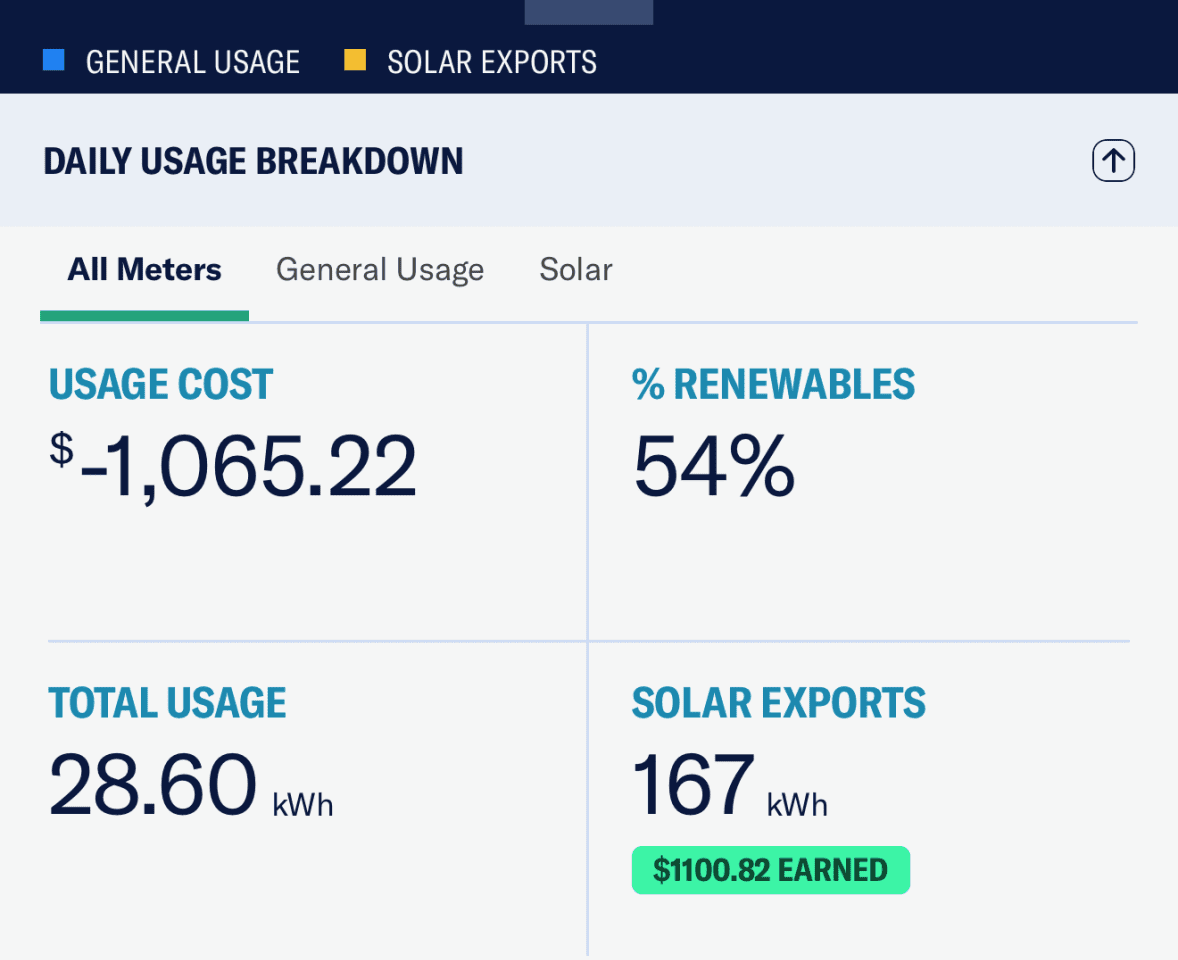
One Amber customer earned over $1000 in a single day in January, with half the profits from V2G exports from a Ford Mustang Mach E and the other half from a 40kWh Sigenergy battery.
How V2G Fits Into Australia’s Energy Transition
The focus of Australia’s energy transition is increasingly shifting from building more renewable generation to managing when and how that energy is used across the grid.
Vehicle-to-grid is being explored alongside home batteries as part of that shift, helping manage when excess solar energy is stored and released across the grid.
The expansion comes as other major energy companies, including Origin (the owner of SolarQuotes) and AGL, continue to explore how EVs could interact with the electricity network as EV uptake grows.
What Happens Next For V2G?
The expanded program will scale to 1,000 homes in a staged rollout, providing one of the largest real-world datasets in Australia on how EVs perform as grid-connected energy assets.
The key test will be whether V2G can deliver consistent value for households beyond rare price spikes, and whether manufacturers fully support bidirectional charging at scale.
It will also determine how effectively automated systems can remove the need for user involvement in energy trading decisions, making participation simple enough for mainstream households.
If successful, the trial could help shift V2G from early demonstration projects into commercially available household energy offerings.
For readers wanting to understand how V2G (vehicle-to-grid), V2H (vehicle-to-home) and V2L (vehicle-to-load) systems actually differ in practice, we’ve broken it down in our explainer article on bi-directional charging.
 About Kim Wainwright
 RSS - Posts






What is missing is who can take part in this. Or is this another so called test where selected people will confirm pre-defined results.
That’s a fair point. The ARENA announcement focuses on expanding the trial from 50 to 1,000 homes, but doesn’t provide much detail yet on how participants will be recruited or who will be eligible.
We’ll definitely be following this up.
Having been a lucky participant in Amber’s Amber for EVs trial, I certainly did not verify predetermined outcomes. From my feedback it would have been obvious it had a long way to go, and still does in my opnion.
“lucky”?, because the Zappi2 was provided free of charge, I just had to get it installed by Amber’s contractor; not so lucky, but we got there.
My experience with an EV (not V2G) is that the car must be at home during the maximum solar production, if I want to charge it for free (obviously) and even so, in winter cannot fill my massive 82kwh vehicle battery.
As most people work during those hours, this leaves the V2G cars suitable for night workers, pensioneers or people working from home.
Alternative is if workplaces would have masive solar installations coupled with masive charging points and day workers charge for free.
But, I can’t see that happening in Australia.
This is the biggest hurdle, followed by range anxiety (yes in Australia for foreseeable future), price (vehicle and charger are more expensive), lack of standards (easy to fix) and lack of vehicle availability.
There are numerous electricity plans (including Amber) which give you free or very low priced (or negative in the case of Amber) electricity during the middle of the day. If a business had one of those and was not restricted, it could charge it’s employee’s cars from a mixture of PV and grid. Charging as many cars as possible from the Grid during the middle of the day may well be welcomed as a soak as more and more renewables flood the network
In theory is feasible, but not practical.
I just can’t see any business spending milions in infrastructure costs just to charge employees’ EVs for free.
Companies are looking to cut costs, not increase them.
Hi Alex,
Employers could do a lot worse than simply putting in some power points for daycharging. Taking a tank of fuel home to run the house at night is what the whole network needs.
https://www.solarquotes.com.au/blog/ev-chargers-at-work/
V2G seems to be a solution looking for a problem to me, very much a niche product. Apart from the obscene cost for V2G chargers it relies on cars charging off solar/free grid during the day for exporting during peak.
If you actually use your EV on a regular basis, thats problematic. Far better served by a real home battery setup.
The new iX3 has both V2G and V2H capabilities which you can select via the BMW Wallbox charger. Anyone know if it’s been approved for V2H use in Australia?
This is what I’m waiting for. I don’t want to go down the house battery route if I’m going to get an EV
No need to double up. Announcements on this capability seem very thin on the ground, is it a legislative or manufacturer issue?
Very frustrating
There are YouTube videos from BMW showing how it all works, just don’t know when it’s going to be available here. It think it’s regulatory. The V2H move is probably worrying both power wholesalers and battery suppliers.
I’m also waiting for the new Naxtra Sodium Ion batteries that CATL are producing in huge numbers this year. Don’t remember if SQ have done an article on them yet but for EVs, Grid scale and home storage they could be a game changer.
Should be helpful for solving the duck curve with the much bigger batteries than house batteries on average !! Every little bit helps !!
I see the new ora has a 58 kw battery and 6kw v2l and wonder how that’d go with hoem for the house !!
At least the government is being proactive and not just sweeping it under the carpet !!
Except for Alex’s nominated demographic, is the real-world practical solution to just install 100 kWh of Na+ home battery as prices drop? Then time-shift its stored rooftop solar into the BEV once you’re back from work, whether office-bound or mobile subby. If the rooftop array is a bit small, then “three free hours” is even better, as it offloads the grid around midday, while the ample home battery deeply offloads the grid at night. Win – win!
What proportion of our more than 400,000 home batteries perform grid support now? The proportion of BEVs which could afford to be without much range in the morning is probably limited.
And who’ll remember to plug the darn thing in every night, unless the FiT is humungous?
It may be a fine theoretical notion, brought undone by both current practicalities and technology cost trajectories. And if the BEV is the only car still mobile, pending arrival of your one monthly $100 jerrycan of petrol, the grid has Buckley’s. Hormuz has yet to hit.
If you buy a Sigenergy battery with the DC Ev charger you automatically have V2G. No need for trials many are doing it already.
Good work getting all stakeholders on board to agree on standards ASAP as I fail to see what the battery concerns are. Battery discharge stats can be monitored using software to inform warranty limits and export of 22kW V2X would be the equivalent of an inefficient ev travelling at 110km/hr anyway?
V2X should not be behind a paywall and can easily be controlled by home solar inverter software, and then the consumer can then choose what is exported. If consumers want a power company to be paid for controlling this instead then so be it, this is a minor issue between solar inverter companies and power supply companies to work on I would think?
Hurry up and make the standards a requirement for selling these products in Australia. Then bake it in with the battery rebates and consumer behaviour before the mass EV adoption adoption train leaves the station, and adds any further unnecessary strain on the grid and the planet. Let’s go the other way, and now!
Every time a V2G/H topic is discussed, it seems like there are always comments talking about how home battery is the way to go not V2G, which is frustrating to me as V2G is the solution I am looking forward to.
Limited by space and budget, I just can’t find any battery that suit my needs. V2G on the other hand, will be perfect for us as I work from home most of the time and my car sits in the driveway 90% of the time. I have even considered to not have a car but sadly it is too inconvenient to not have a car in my suburb.
I agree that V2G is not for everyone. But don’t we always talk about we should solving the energy problem with multiple approaches but not just one? V2G suits me and I am sure it suits quite a lot of people as well.
Home battery already got a 7.2 billion rebate budget. This V2G trial only got 0.2% of that for now. I don’t know why some people are so against it
Hi Matt,
V2G has a lot of long term promise but if you want to get going with it right now, there are neat and modest options available. They’re not seamless if you have to swap a plug over, but they don’t endanger warranty or require network permission either.
I agree there’s a lot of pensioners like me who’s cars are home most of the time because we only drive sometimes and v2g will be great !!
Matt,
I’m sorry if I seem to be against V2G. It’ll be great for retirees and folk who work from home, I guess. However, for the large numbers not home in daytime to charge, but requiring electrons in the BEV in the morning, to travel to work, I’m just not seeing a way it could work, except maybe modest partial discharge on big pricing peaks, which would seem economically unsustainable. Maybe the retirees will V2G feed the BEV charging of all the office and factory workers, and subbies, who were out all day?
And long term, when many households have two BEVs, one could often be garaged, allowing arbitrage. The niche might very well grow beyond (my) expectations.
Hi Erik,
I agree with you that V2G/H could be a niche tech. I think our disagreement lies in how niche it will be, which is fair as I can’t predict the future. From my perspective, I work in the tech industry so all the colleagues in my company and even my some of my vendors work only 1-2 days in the office so in theory they can all benefit from this tech. My friends who work in engineering and consulting also work from how at least half of the time. And as mentiioned by you, retirees can benefit as well. So I think the amount of people that can make use of this tech is not that small. I know all these people can just install a battery as well and a lot of workers need to commute every day who cannot benefit from V2G/H. What I want to say is that I think V2G/H is at least worth a fraction compared to the home battery investment contrary to not worth it at all
Matt,
You could be right. If the looming AI thing runs amok, there might be even more folk working from home, saving the cost of office space as well. And here, in growing fossil fuel scarcity, they’ll soon all have BEVs. (Even while oil companies print money.)
If a new research paper is right, and global heating hasn’t recently doubled from 0.18°C/decade to 0.36, but is in fact now 0.48°C/decade, accelerating at 0.049°C/decade², with +2°C by 2035, then we might see incentives for *anything* which helps gridscale & home batteries kill off coal and gas peakers faster.
The imminent El Niño is but a blip, but the waters under the 3.4 zone is +6°C over SST, which should rise there by +2°C – the threshold for a “super” El Niño. There is a (remote) possibility that it could serve as a global wake-up call?
Any (even low income) BEV incentive would benefit our grandchildren, with V2G the cherry on top. I think we have to do it all – and even that won’t be enough for minimal harm.
Does anyone know how to become involved in the BYD trial?
I don’t want to buy an EV unless it comes with a battery warranty for V2G.
My local BYD dealer knows nothing about it.