
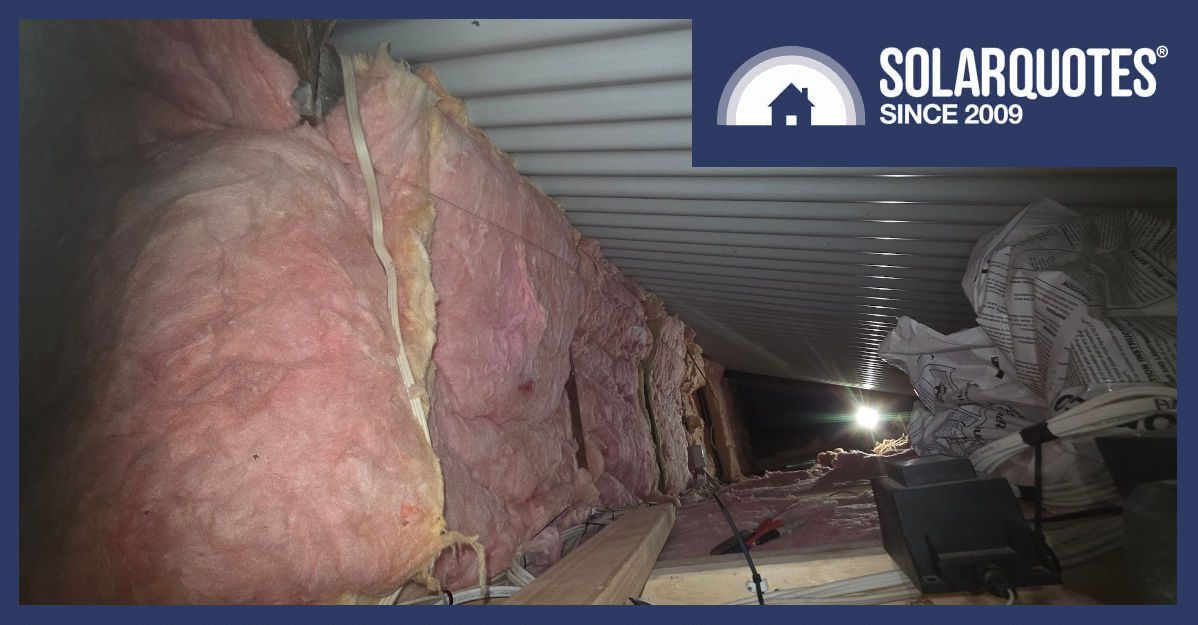
As winter closes in again I’ve set about some improvements to casa del cottage.
So can you retrofit efficiency? Yes, but it’s difficult to get the best results – especially when you’ve already got solar. As a qualified builder I often lament my fellow licensees are sometimes hopeless. Many just don’t know how important it is to get the details right and maybe more of them don’t care?
When you add a tendency to be conservative or even suspicious about changes in building practice, and undergird the whole system with cheapness, the long term results are uncomfortable and expensive.
Getting What You Pay For
To some extent people get what they deserve. Keeping up with the Joneses means flashy finishes and pretty porticos eat up the budget when we should be spending big on insulated slabs and extra thick wall framing.
Sadly we all pay through the nose for fashion. Despite some improvements in standards, the woeful design and execution of Australia’s glorified tents is generally overcome by brute force and energy consumption.
Investors buy them, builders throw them up and energy companies collect revenue, but it’s the residents who pay and pay, for the poor decisions, season after season. Renters are most vulnerable because they have no power to improve the situation.
Insulation Matters More At The Outset
My little house probably dates to the 1940s. It has weatherboard cladding, fibrous plaster lining and precious little else in the walls. Even though there’s mineral fibre/rockwool insulation on top of the ceiling, the floor is uninsulated and there’s gaps and drafts everywhere else.
Recently, we had a renovation done on the bathroom, which was built under the original verandah outside the house proper.
The whole project was a bit of a disaster (it makes me wish there was a “bathroom” option for SolarQuotes but that’s a story for another time).
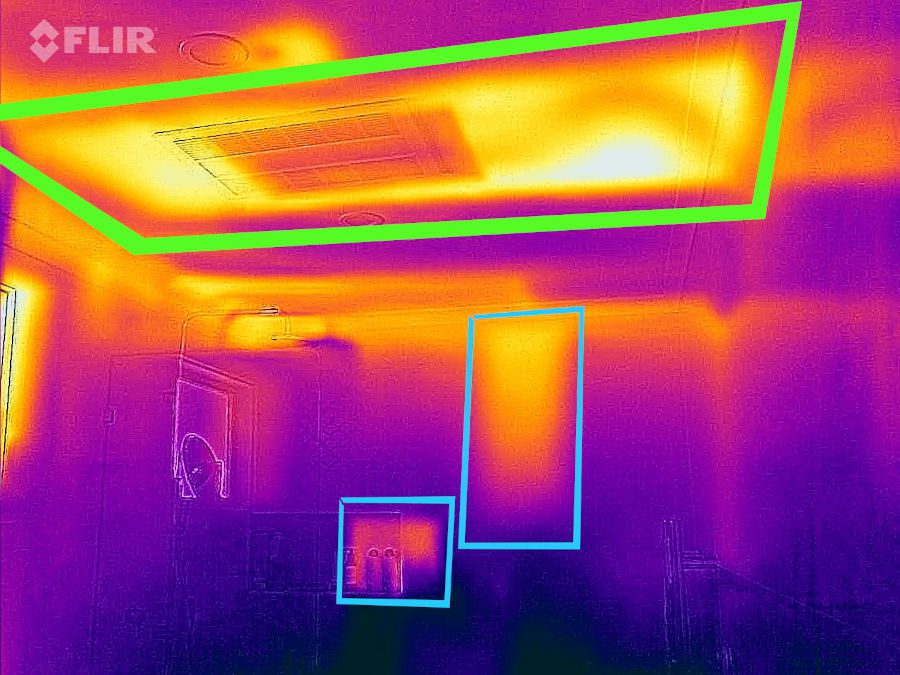
In green we see the electrician has simply discarded the ceiling insulation, while the carpenter forgot about the niche and left a piece of wall insulation to fall out.
Retrofitting Is A Pain
While the bathroom walls were stripped bare, the builder stuck batts into all of the wall frame and I made sure they fitted properly. Except where they fell out because the carpenter wasn’t competent and didn’t give a rats arse.
What is now an internal wall of the house has insulation, but it only extends to the lower ceiling height of the bathroom. The top section of wall remained uninsulated like the rest of the external walls.
I took a thermal image during summer, which shows the problem vividly.
Having A Crack
I curse myself for not realising at the time, but insulating the wall would have been far easier when the bathroom ceiling was out.
However there was a spare bag of insulation left over and I thought I’d have a go at installing some – only problem was the very poor access. Any normal person would pull some roofing iron off to get into the limited space, but my options were limited by the zealot who’d already put PV solar panels everywhere.
This is a good example of why we recommend sorting out roof improvements or repairs before installing solar.
I have opened an access panel under the verandah, so the bathroom exhaust fan could be ducted outside the roof space, hence I threw a long cupboard door in there to crawl on and pushed a few batts of rockwool in front of me.
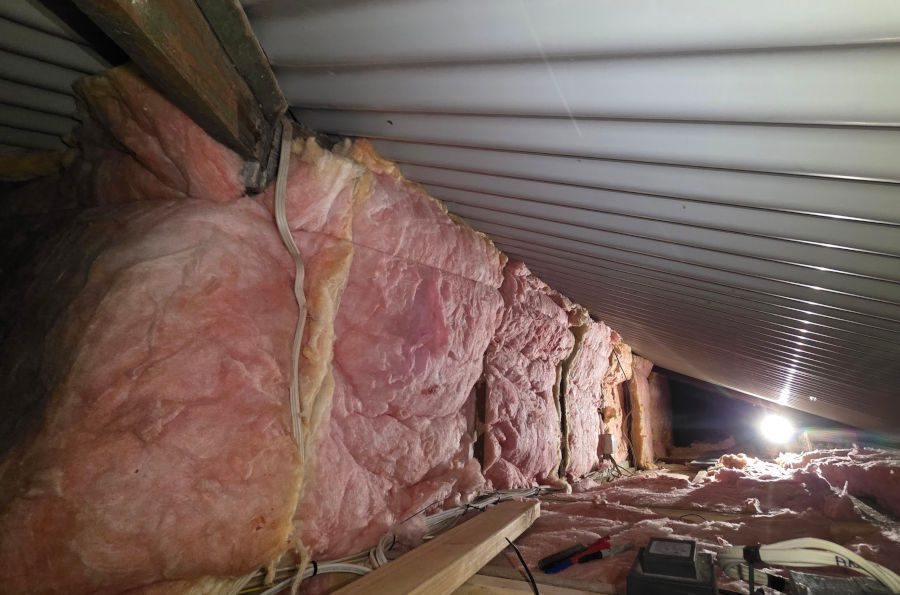
Insulation wrapped around the corner & held with string. Legally none of this wiring has to be clipped, none of it is “accessible” unless you’re a madman.
What A Bloody Mission
Using a bread knife to cut insulation to size, an impact driver to put a few screws in and then builders’ string line to keep the batts in place, I worked along, feeding the pink fluff as far as I could into the cavities.
It was hot, dirty and especially awkward because I didn’t want to crash through the new bathroom ceiling, but nor was there enough space to crawl. The distance from my knee to my backside was more than the available headroom.
A Mildly Unsatisfying Result
No matter how valiant the attempt, the problem was always going to be how well the batts could be fitted, and in this case it was hard.
Insulation works when it sits against a surface. It has to trap air and prevent drafts carrying heat away, but it mustn’t be compressed.
Perhaps the best way to demonstrate is when you get into bed, you instinctively pull the bedding to your neck don’t you? Pressed against your skin, an electric underlay might be hot, but the air around you under the blanket takes a little while to warm.
Stark reality hits when you lift your knees. Skin remains warm where the blanket stays in contact, but cool air from the room rushes in to fill the void.
Poorly fitted insulation suffers the same. If your “blanket” has gaps totalling 5% coverage, you’ll lose half the rated performance.
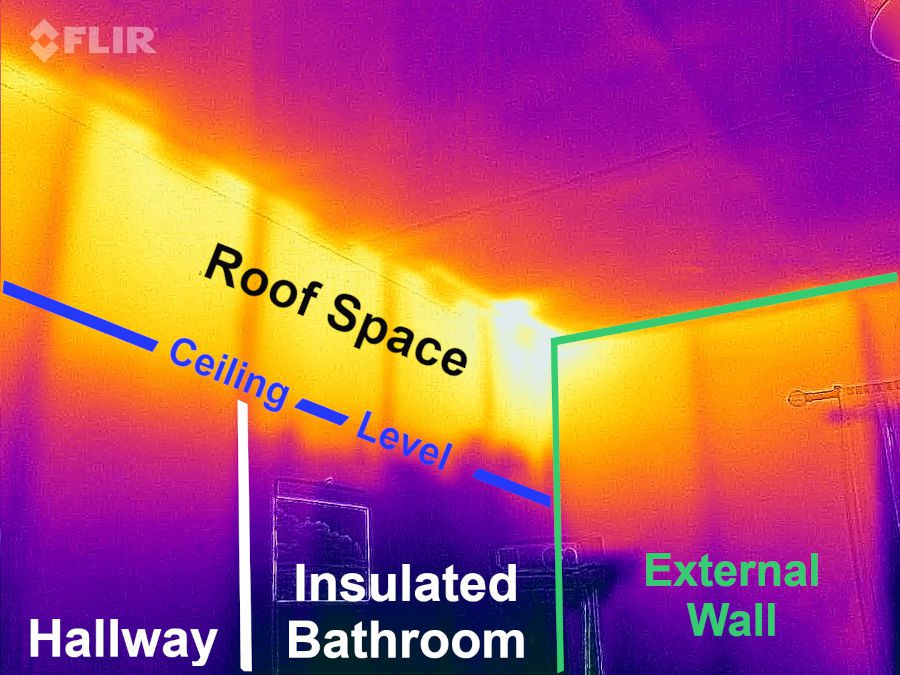
An enclosed verandah forms the bathroom, hence the ceiling is lower outside. Hallway was not insulated but is “inside” the house now. Roof space is blazing hot.
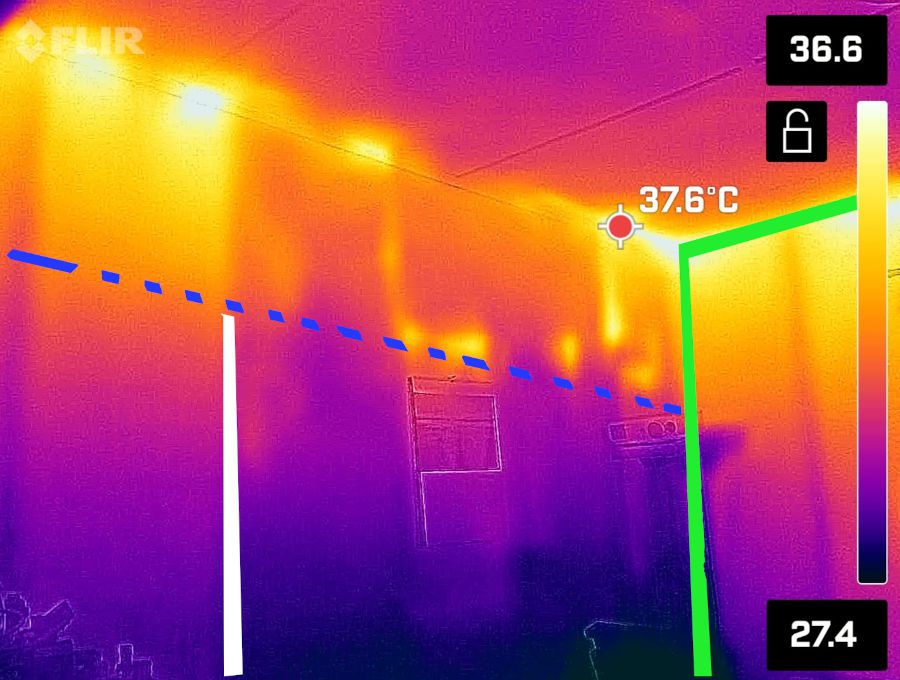
The wall above the ceiling line is now better insulated but nothing to write home about.
Do It Right The First Time
In many cases poor buildings are impossible to fix. You can’t turn the place to point at the sun or get under the concrete slab to insulate, but that doesn’t mean we shouldn’t make improvements.
Double glazed windows might be an option, I’ve done them on the cheap myself. Walls can be improved if you gut the house, or cut a few dozen holes to pour beads into the cavity, but it’s difficult to increase wall thickness.
Draft stopping and ceiling insulation is a simple and very effective improvement though. It is rewarding impact for the effort spent.
Whatever efficiency you can claim will help with bills and more importantly, make your place inherently more comfortable to live in, even before you turn on the climate control. That reduced energy consumption means that when you do get around to installing solar panels, a smaller and cheaper system may suffice.
 About Anthony Bennett
 RSS - Posts





Anthony, one of the problems I face, is that even if you do improvements to the ceiling insulation before installing solar, a time will come to ripp off the old solar and replace it with new solar.
Then you have to deal with installers messing up your carefully installed no-gap batts in the attic.
This is because installers insist on running new cabling (maybe justified) on top of the batts compressing and moving them. I wonder if a better solution wouldn’t be the installation in the attic of plastic or metal trays attached to the timber structure well above the ceiling batts? This way any future cabling will stay neatly in its designated place without messing with ceiling insulation.
Ceiling batts fitted between joists can’t be compressed without risking a foot through the plasterboard they’re lying on. Here, I ran 30m of walkway of three parallel slightly separated 90x45s under the ridge, 1.5m headroom. Side excursion is by pieces of chipboard spanning joists, for a comfortable seat. You need at least 2, +1 for tools. (I put up ceiling batts from underneath, prior to plastering, held in place with fibreglass joint tape, stapled to the joist undersides – easy, quick.)
Electrical rough-in was in the walls, and I fitted batts after. I allowed solar cabling only on the wall top plates, reserving all of he ceiling space for ELV DC lighting. (Separation by distance.)
Afterwards, I sealed cable penetrations in the (to the roof) firewall between workshop & living, with retardant goop. That wall is also insulated to reduce internal heat loss.
Slab edge insulation is a thing, but not needed in Victoria, with bathroom in middle of the house, aircon heated – open door
Your comment about insulation beads had me off researching these to possibly solve a problem down to lazy inconsiderate trades. That lead to a no way I would dream of putting that …. In my house conclusion.
In case anyone reading is thinking about using it, flammability, reaction with electrical cabling and compliance issues should make that out of the question for anyone.
It made me itchy just reading about you crawling around retrofitting insulation.
“Beads” don’t have to be polystyrene (which can be problematic for wiring) but if you talk to people like Cosywrap in Adelaide, they’ll explain pumping retrofit insulation into cavity walls.
If you’re going to fill a few dings in the plasterboard and paint a wall anyway, fixing a dozen holes where insulation was pumped through isn’t much extra work.
Your bedding analogy is a good one – ” Stark reality hits when you lift your knees. Skin remains warm where the blanket stays in contact, but cool air from the room rushes in to fill the void.”
No pyjamas eh? wink, wink!
In total murky overcast, 27 kW of panels is yielding only 2.2 kW, but 500W into the aircon, producing perhaps 2 kW heating, has the double glazed 72 m² at 22°C, 14°C outside. That leaves 1.7 kW to bring the battery back up from an overnight low of 84%. (Charging the excavator finished after sundown yesterday, but 46 kWh house battery into 18 kWh baby excavator battery is good enough for this pioneering small-battery transition period.)
If the HWS cools, I’ll light the wood heater, for in-flue heat-exchanger HW boost, using time-shifted solar, stored in cellulose/lignin energy units, with zero net CO₂ emissions. The HWS is in the middle of the house, so heat leakage boosts room heating.
I ducted the bathroom extractor fan to the porch soffit, using collapsible foil duct from Bunnings, 20cm ordered in, as 15cm seemed thin for a 4.5m run. Duct tape actually used for ducting!
I put a 7 kW aircon in the uninsulated old lounge, but today, I’d light the wood heater there, if in use.
Hi Eric,
Modesty on the low sun days is going to be key for everyone I think.
Did you hear back from the electric digger people about availability of a larger model?
Anthony,
Funny that you should ask. 😉 My brother is waiting in the wings to buy the little one from me at half price. I’ll get onto them, with a link showing a 2.5 tonner being imported into USA. It also seems to have smoother controls – the little one’s “pilot controls” seem to be via solenoid valves? – a bit tricky to inch yaw slowly. I’ll give Ken a call.
I’m a bit obsessive now about not burning fossil fuel for off-grid power, but I think even 30 kWh of house battery can be enough to bridge a week of overcast, given adaptation and ample arrays – 36.5 kWh used here on sunny May 25th, 6.7 kWh on overcast following 26th, taking the 46 kWh battery down to 89% overnight. Most important here is to charge the BEV in sun/cloudy/light-overcast, as it’s the only car, and it’s far to town.
And washing piles up until there’s a sunny day for drying on the cothesline. A little bit of “last century country lifestyle” goes a long way toward adapting, I think.
Hi Eric,
The 1.7 tonne units are popular because they’re a bit more capable and mainly they’ll just about fit on an aluminium trailer which grosses under 2 tonnes… and that’s easy for people to hire without needing electric trailer brakes.
The 1.2T unit is surprisingly capable, just 10 to 20 more seconds to grub out a 3m high bush with a half metre diameter rootball, roots deep in hard soil. A bit of technique makes a helluva difference, but the machine can buck a bit on the short 1.2m tracks, even with the blade down. (0.9T breakout force doesn’t even annoy a big bush, unless you cut the side roots first, and bring the machine close for max pull.) They say anything under 5T isn’t a stumper, but if it were not for the tens of thousands of bushes to send flying, even 1.2T electric gets it done, better than diesel.
I figure 1.7T has 1.5m tracks & blade further out – better on the back when working hard. But still only 1 km/h? That’s a pain on the 1.2T. This 2T does 3.6 km/h in high, I think: https://www.youtube.com/watch?v=1rDUHj00KIk
I’ve contacted Huayee in China, to see if they make anything electric around 2.5 to 4T – still OK for towing around the farm on a bigger trailer behind the tractor. I’ll post if I find one
Anthony,
The importer’s management is happy with how the 1.2t electric excavators are moving – latest shipment was only 6, but they all went, with one customer paying freight to quickly bring his down from Brisbane. They’re not yet in a hurry to bring in a 2.5 to 3 tonne electric.
I’ll find and send them the link to a clip of a neat one currently imported into USA. It has smooth controls, and price in USD was OK, if memory serves. Global diesel shortage should manifest around August, as feedstock tank farms drain. Focus on selling the cheaper diesel excavators may be shifted by customer demand (beyond mine) after that.
I’ve prompted that working one’s contacts now, to prepare possible import options “for your consideration, oh mighty managers” is the only viable way to obviate management inertia. I’ve offered to pay up front, given a video clip & specs, so no commercial risk for them. They need to find a machine they can support in volume, so due diligence will take a bit of time.
Erik Christiansen: – “Global diesel shortage should manifest around August, as feedstock tank farms drain.”
Global diesel fuel production was already in decline prior to 28 Feb 2026.
https://www.solarquotes.com.au/blog/new-vehicle-emissions-data-ev-shift-means-for-solar/#comment-1732675
US petroleum geologist Art Berman said recently (recorded 6 May 2026):
“I think by July, which is not very far off, that we are going to be feeling a, a pronounced crunch in which gasoline, diesel prices are at levels where a lot of people just can’t afford to fill up their, their tanks.” https://youtu.be/Gk6xm5IuY4w?t=872
JP Morgan’s commodities research desk suggests world oil inventories are draining at record pace, and are likely to reach an “Operational stress level” by June 2026, and an “Operational floor level” by September. https://youtu.be/rzyl42KqofQ?t=282
US SPR is draining at record pace:
https://www.eia.gov/dnav/pet/hist/LeafHandler.ashx?n=PET&s=WCSSTUS1&f=W
Erik,
How is wood burning net zero CO2 emissions?
And having the HWS in the middle of the house isn’t leaking heat in summer too?
Let alone that the HWS are not beautiful to look at or maybe you covered it with something nice!
Good question, Alex.
(Suggested search: biosphere carbon cycle diagram)
Just as the carbon in a tree has cycled between atmosphere, ground, and vegetation for many hundreds of millions of years, without *any* lasting impact on Earth’s energy balance, the woodheater step in that cycle releases only carbon previously removed from the atmosphere, thus restoring prior balance. (My 2 sq km of forest personally removes the emitted CO₂ in a day or less, but that’s incidental.)
It is only adding fossil carbon to the biosphere which alters the long-term balance, though deforestation causes a temporary shift, as in the many large jungle-smothered ancient cities in South America. Will it happen again?
The planet protected us from that carbon’s harm by safely burying it. Greedy moronic idiots poison our future by biosphere carbon addition.
Growing more trees helps temporarily. Swap to a BEV to reduce the heat-caused death & destruction. Woodheaters (best rural?) replace gas/coal = very good!
Alex,
Apropos HWS: In summer the only off-grid energy problem is how to use the generated excess. The tank’s integral insulation allows the small 3.5 kW (thermal) aircon to keep things cool, at zero emissions and $ cost.
With no wife to complain, the HWS sits exposed in its masonry niche, near the heater. I have a pair of glulam counter tops, to be cut down for neat doors, but I’ve only done 1.35 km of 5km of fencing needed to exclude firewood thieves who made 1.5 km of new tracks in my forest last winter, to take over 40t so far. A much needed tractor shed is barely started. Kangaroo traffic (100 – 200 per night) smashed 40 plastic insulators on the first 0.8km of fence – now fixed.
At 72, I’m pedallling as hard as I can, but it all takes time – not least clearing 1.7 km of 2 to 3m high dense weed bushes to even see the 100 yo vestigial front fence, let alone replace it. The first 1 km took 55 hrs on a 1.2t electric excavator – back not yet fully recovered.
It’s on the list. 😉
Erik.
I know how you feel. The list just gets longer and the hours feel shorter the older I get. I don’t know how I ever held down a full time job, as well as worked on all the other projects.
We burn wood for heating too, but it’s stuff destined for landfill plus what falls off our trees.
I’ve been trying to convince my husband that a small electric HWS in the corner of the bathroom would be fine. Close to all our hot taps & would warm the bathroom a bit in winter. I want to start using our solar power instead of getting nothing for it & stop heating our water with bottled gas.
One thing I notice in a lot of old rental places is that not only are they not insulated at all but most still have the old wall vents in place from the town gas era. We own an old commission built, concrete walled house with vents through the ceilings instead of the walls. The ceiling was well insulated but the installers had carefully cut holes out of the insulation batts where all the vents were!
Julie,
If you’re in Victoria, then the state subsidy for gas to electric (heat pump) HWS conversion can pay the full cost of a smaller system. My mother had her bottled gas powered HWS replaced a few years ago, and it’s still running fine, with a low electricity bill. It’s a half-height unit, but we’ve done 4 – 5 showers in quick succession. A bigger unit could entail a copayment. A quick google can find details.
Burning fossil gas adds to global heating, while burning wood does not. (Its carbon has been in the biosphere for millions years, without lasting effect. OK, particulates are an issue in cities – not just from vehicles, but rurally, forget it. Replacing fossil fuel burning with renewables like wood helps save future generations.)
Half a century ago, I lived in a flat with high wall vents. I sealed them off in the first winter, not planning to use a kerosene heater. That there could still be any in existence is appalling waste.
Erik,
Unfortunately burning wood is not carbon neutral. Its true that the CO2 was initially captured by the trees, but in decades, while by burning it is released immediately.
Regrowing trees takes time while CO2 stays in the atmosphere contributing to global warming.
Also burning wood releases fine particles (PM2.5), carbon monoxide and volatile organic compounds (VOC).
EU is moving towards stricter emissions standards but not Australia, so you can continue burning.
Alex, You asked why burning wood is good for net zero CO2 emissions.
Wood is natural.
Fire is natural.
Fire consuming wood is natural.
Where’s the relevance in your question to the overall health of our planet?
Peter, firstly, I asked Erik how is the wood burning net zero CO2 emissions? I did not ask “burning wood is good” (this is an affirmation).
Because it is not. Burning anything is not sustainable and is polluting.
“Natural” was once considered consuming fossil fuels, hunting, smoking, going to wars with your neighbours, but today it is not considered natural.
So, I can’t see what the notion of “natural” has to do with the subject of this post!
Hi Anthony,
What are the viable options for enhancing insulation to ceiling when it is already done some time ago (40 years) with what is likely R1.5 fibreglass batts. Should it be removed (horrible job) and replaced with new, or can it be covered in another layer? There are places where cabling is on top of existing batts and I know that it can’t be between batts.
Hi David,
Wiring can be run through insulation but it must be rated for being “completely surrounded” in thermal insulation, which can halve it’s capacity.
Running vented cable tray would be perfect but seldom happens outside industrial or shops.
You can cross hatch a second layer of insulation over the first, which helps eliminate gaps.
Or in Adalide at least I could recommend Cosywrap to vacuum out all the old batts, rat shit & possum piss, then they’ll do a great job of insulating with new batts.
Good insulation companies will insist on an electrical inspection & certificate of compliance. Ideally you get the rubbish sucked out & any wiring/switchboard work done before new batts go down.
When insulating keep in mind condensation issues. The NCC now has great technical notes on it.
Thank you Bohdan,
It’s incredibly important and something Australians aren’t well aware of, because the leaks we normally build in help dry things out.
Better sealed buildings will hold moisture and create mould and rot if we’re not careful.
Cheers
Most houses are just Eskys with only the lid insulated, totally useless.