
 Margaux Parker, breakfast host on Triple M Brisbane, announced last week that she would rather pay ten dollars a litre for petrol than drive an electric car. She’d also had enough of smug EV drivers.
When I heard that, I thought, who’s actually being smug here? The person who bought a car and said nothing? Or the person on the radio who decided to announce, at some length, how much they disapprove of other people’s purchasing decisions?
Margaux is not liberated from the EV but defined by her rejection of it. The smug EV driver she finds so insufferable has, by contrast, simply gone home and plugged in to a fuel source that can be made at home for 1c per km.
I could happily spend the rest of this post channelling my favourite modern philosopher, Alain de Botton, who has spent a career explaining why humans make self-defeating choices and then dress them up as principles, but I won’t.
Because underneath the performative EV-rage, there’s something real worth acknowledging.
The Real Reason For EV Hostility
For many people, the internal combustion engine is wrapped up in some of their most charged memories: a first car, a parent who showed them how engines worked, a version of themselves at 17 with the windows down and the engine roaring. There’s a genuine human attachment to something that is, slowly and undeniably, being replaced.
The hostility toward EVs is often grief in disguise. Grief for a tactile, mechanical world that felt comprehensible. Where you could hear the engine working, where mastery meant something physical you could adjust with a spanner. The EV, silent and software-managed, feels like a black box in comparison1.
The combination of the loud derision and the quiet grief leads to an unspoken apprehension I’ve sensed recently: the person who’s been running the numbers for eighteen months, who knows perfectly well that an EV would work for their life. Who has watched the fuel price climb with a growing sense that they’re on the wrong side of a slow-moving argument.
And yet they haven’t bought one because they’re worried about what other people will think.
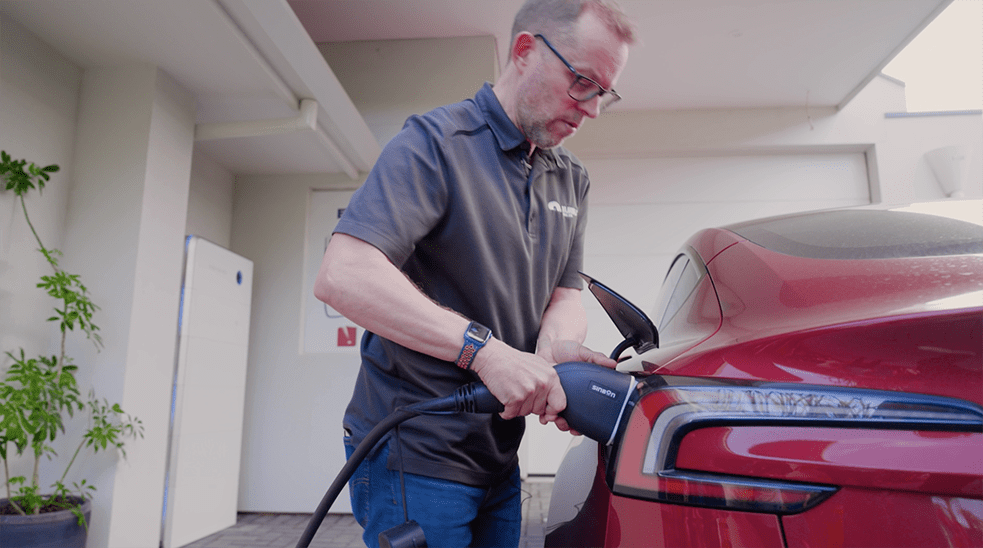
Charging my Tesla instead of getting overcharged at the petrol station.
It’s Time To Accept Reality
But the imagined audience is almost always harsher than the real one. The family or friends who’d give you grief about an EV are, in practice, often at the servo forecourt, staring at the price board, running their own quiet arithmetic.
So if you’ve been sitting on the fence, buy the car. Buy it because it makes financial sense. Get it because you’re tired of watching the number on the pump climb. Get it because they are so nice to drive day-to-day. Get it because you did the research and you’re confident.
You’ve already made the hard decision. The social one. The one that required tuning out a Brisbane breakfast radio host and the ghost committee of imagined disapproval that’s been voting in your head.
Please, just go and buy the bloody thing.
Phase Shift is a weekly opinion column by SolarQuotes founder Finn Peacock. Subscribe to SolarQuotes’ free newsletter to get it emailed to your inbox each week along with our other home electrification coverage.
Footnotes
- my prescription for your mechanical grief: do a DIY EV conversion! ↩
 About Finn Peacock
 RSS - Posts






There is still a lot of misinformation about EV’s out there, and many people believe it.
As an EV owner for 18 months I know most of it is not true and much of it is political in nature.
I sometimes pull people up when I hear them talking nonsense but mostly just let it go. It is their loss.
I would rather have had a more progressive uptake of EV as the highway infrastructure has a bit of catching up to do. Compounding the rapid take up will be that many new EV drivers have not acquired the knowledge of charging protocols leading to frustration and long queues – and the smug TV news grab of long waits at Holbrook over Easter.
But we will get get there.
Thanks for your article Finn- very well put!
William,
Not having yet used a public charger, even after 2+ years in the BEV, I can only listen to the experience of others, and understand the frustration, especially at Easter and Christmas.
My experience of other BEV drivers is entirely limited to seeing more and more of them on the highway, especially in the last three months. High petrol cost is perhaps more bearable on short city errands, so out on the highway, especially at 100 km/h, using at least 25% more energy than at 90 km/h, natural selection is for BEVs now.
The ICE Scorpion that was my first car was a lot of fun to drive, and 5 on the floor is a lot to give up. I sometimes still reach for the stick, coming out of a corner. A BEV is just like an automatic, just with zippier low end torque. Maybe it’s being over 70 which makes that change easier?
Clear sight of what’s coming is the kicker. Car fuel off the roof is mobility security – essential out here in the sticks. I can’t afford the risk of oil dependency.
Would disagree that highway travel is more suited to BEV. New owner here, and my observation is long wait times at EV Chargers, slower refueling times (20 minutes to 1 hour to get to 80%), and mostly courteous and understanding people also waiting for a charge. There is a queueing etiquette.
Recent 2700 km trip cost $360 at public chargers. Open Tesla chargers were consistently fast and cheaper than most (if I discount pinching energy from my son’s house – slow and very low cost).
The equivalent trip in my diesel Ford Ranger would have been $780 at $3.00 per litre and saved me 2 hours waiting time for chargers and charging on the trip to Melbourne from Canberra.
My mechanic son describes EVs as appliances on wheels. I’m concerned about the lack of noise. Many people are unaware of an EV approaching from behind because they can’t hear anything. Mercedes did have something added to make a sound which alerted people to the vehicle before it was too late. We should mandate such a system. Doesn’t need to be loud, just present for most people.
An acoustic alert has now been mandated for all new vehicles in Australia (the rule is phased in from November 2025 to November 2026)
https://www.legislation.gov.au/F2024L00089/latest/text
There is a terrible malady that, for many, there is no cure. It is called “If it is not broken, you do not have to fix it syndrome”.
Employers to avoid retrenchment payments exploit this syndrome by changing an employee’s job, expecting that they cannot accept the change and will instead vote with their feet.
“If it’s not broken don’t fix it” should be the mantra in many cases. I could fill a hundred books with examples of working ideas being dumped because someone thinks they know better than the people who designed the original. Perth’s traffic lights worked well until we imported some people from another city. Then the intelligence was removed and the congestion became ridiculous, but those in authority say it’s better now than then. On the other hand, adverse banking on roundabouts is dangerous and needs to be fixed but is being defended instead.
I am not sure the message came through. Let me put it another way. No business is established, or maintained, for the express purpose of employing anyone, says Rodney Robot. And the problem is that very few individuals replaced by Rodney know how to reinvent themselves.
Comment responding to your comment about a decision to buy a more expensive EV tipping you over a pension income/asset threshold. That’s not how it works. If you have, for example, $500,000 in assets (which includes cash, money in the bank, shares, property or whatever) and you use some of your assets to buy a more expensive EV, the money has to come from somewhere (ie your assets). Therefore, such a decision will have no impact on your pension because you’ve simply rearranged your assets. In reality, if your bought a brand new EV for say $50,000 including stamp duty, dealer costs, registration etc the actual value for Centrelink purposes, is what you could sell it for – not what you paid. So actually, your pension would probably increase not decrease!
Buy an EV!
I own one of those apparently useless 80km ev range hybrid Chinese utes…my biggest problem with it is that the petrol it carries around doesn’t last forever and I have to go on longer trips or remember to not plug it in to charge so I can use it before it goes off….
I’m told that they are useless due to it be the mix of the worst of both ice and ev…and due to the manufacturer not being able to somehow get around the laws of physics that demand more fuel use as combined total weight increases…
Oh well bach to my horrible life as a hybrid owner who buys 1/2 a tank of fuel about once every 6 months or more often if I add on the campervan and go bush…oops I’m being smug again over making the right choice for me ..
Nice to hear you are happy with your Chinese ute, I assume it is a phev, not hybrid only?. So you’re finding you can do most of your local driving using the electric side of the equation?
I’m seriously considering a shark at some point in the future – once the government gets around to letting us know what they are doing road user tax wise.
Yep that’s the one I have. Am I happy…no not entirely, the colour choices at first were a bit boring and the subsequent additions would work better for me…such a 1st world issue… Some of the driver protection systems arent as good as they were in my previous car.
As an old IT guy BYD has a bit to learn about regression testing and change management with OTA software updates. I don’t know when there happening or why and usually know cause something unrelated broke…. But to be clear that’s in terms of size of issue a small one…that pushes my buttons. Good enough that if I could wind back time I’d wait just long enough for the second tranche of colour choices to become available.
It does what it promised and very well imho.
cheers for that info!
My brother bought one – one of the first over a year ago. He made it clear that he wasn’t going to buy an EV as it was not a long distance towing option, but I steered him to look at the Shark. Long story short he loves it. Charges it using some off peak thing that costs him cents. He filled up the tank the other day to be sure he had petrol and he’s used a total of 70 litres of petrol in almost 18 months. Says its the best car he’s ever owned.
He knows that when he tows it will be more costly than his old Pajero, but for that month or so he is miles ahead.
I just wish BYD would make a single cab chassis for me….
My brother has a BYD hybrid with the same EV range as yours, and also does his local driving entirely on photons. But he’s down from NSW (1200 km) helping me with a few km of fencing. That’s worth a few emissions, I think, and the 200 Ha of native forest we’re fencing still makes the operation highly carbon negative, so it’ll do.
The slow public charger roll-out does force some drivers to mix petrol and high voltage electrons. They’re much braver than I am.
The little 1.2t electric excavator drives the 30 cm auger nearly 1m deep in deep sand in no time – lifting the dirt out on the auger is the slowest. Photon-powered stayset installation is a dream. Had to rock the old strainer posts with bucket & thumb before it could pull them out. (Have asked the importer if they have a 2.5t one in the pipeline. That would speed things up a bit.)
Lets leave Centrelink and those on a partial asset tested age pension out of what their cashflow benefits might be bundling Rooftop Solar and a BEV together. But lets not ignore that the depreciation rate on the BEV value of cash to get in is about 12% PA.
So you buy a BEV which has V2L functionality, The vehicle has a 60 kWh battery. The vehicle, based on travelling 20 km per day, consumes 3 kWh.
You have a 10 kWh Solar System that produces 37 kWh per day, and household consumption, including the vehicle, is 30 kWh per day. No O/S Capital.
The import tariff is $0.32 kWh, and the export tariff is $0.08 per kWh, with a daily fixed fee of $1.67. The vehicle V2L supports household demand during the shoulder and peak time intervals.
Do I achieve a no cost for BEV kWh consumption and no import demand, and does what is available to export offset the daily fixed fee? The value of a 13.6 kWh battery not installed is 10,600 [savings when buying a vehicle with V2L].
I know the answer
The ‘smug’ thing is just the latest attempt to turn people against EV buyers. Which is of some concern because if the fuel crisis continues, this can lead to actual violence, against EV owners and their vehicles. We’re already seeing it.
In the workplace different pressures are building. The staff who invested in EVs are under increasing pressure to be at work no matter what, because they’re not impacted by fuel prices or shortages. Meaning they may end up shouldering more of the burden of face-to-face work.
And/or they’re expected to put their hands up to be a sort of taxi service for other staff, who don’t have EVs.
These are nasty, dangerous times.
Nick, a lot of the anti EV hate has stemmed from some very obnoxious posts / throughout social media by EV owners . . . rubbing peoples noses in how much better BEV is over ICE, low cost, tech, etc etc.
I agree for a lot of road users, EVs are great !!!
For some they’re not so great (yet), but each to their own, best for this to be a slow transformation, we aren’t near ready to see a huge move into EVs just yet.
Same applies the rapid push for the EV road tax.
If they’d keep their petty comments to themselves, and not draw attention to this road tax ‘saving’, there might be a lot less EVs keyed or otherwise damaged to date, and BEVs might slip under the radar somewhat longer.
Of coarse Tesla owners bear the brunt of this hate, much of it directed from the loon left and the Musk factor.
Have you not paid attention over the past 5-10 years? There’s a heavily sponsored industry in producing constant negativity and abuse, directed at EVs and their drivers. To me it’s laughable to now blame EV owners for the latest round of abuse and violence.
For every ‘smug’ EV driver enjoying not being impacted by the fuel crisis, you can add 10 smug ICE drivers who have been poking fun at EVs for at least a decade. Making fun of their range, of their apparent spontaneous combustion, etc. etc.
All of this is classic politics, the fossil fuel status quo has been funding misinformation and abuse for years, to obstruct the transition.
See that all the time on youtube for sure.
But I see a lot of posts on all social media by EV owners not helping the situation.
Far better to educate with facts and actual statistics of the benefits.
I don’t really see that supposed anti-EV sentiment, even in Alberta, Canada. But against EV mandates with impossible timelines, being ordered by people two thousand miles away to buy a car you couldn’t afford or stop driving? oh, definitely.
“…best for this to be a slow transformation, we aren’t near ready to see a huge move into EVs just yet.”
In reality we’re so far behind in the energy transition required to limit warming to a point where life on the planet will be even slightly recognisable at the end of this century. Saying we aren’t near teady to make even a s ientifically, environmentslly and finanxially well supported change to an ev is just adding to the problem, inertia of bad habits.
Let’s not ignore those credit providers whose policy decisions [Lower Interest Rates] favour BEV Vehicles.
And as an Age Pensioner, will Centrelink allow me to write off my ICE vehicle as having no value for the partial pension asset assessment?
Why do you think that your ICE vehicle would have no value? So long as some people want ICE vehicles then they will retain the value that those people put on them. Check the current value of your make, model and condition and simply advise Centrelink of that value – that’s how it works. However, if you value your ICE vehicle based on what you think that it should be worth, then in this everchanging transition you could be losing out. Do the research, do the maths, do the update – simples.
For every $1,000 in reduced value, our Centrelink [partner] pension would increase by $3.00 per fortnight.
Now I really don’t care what the market is prepared to pay for the vehicle it is what Centrelink think it is worth.
So if I can keep the car and write down the value by $10,000, our annual pension would increase by $780.
The depreciated value of the vehicle is put at $12,000 Centrelinks accepted value is $20,000 wholesale value is about $15,000 [it is a Holden, which is a brand that has exited the market, which affected its wholesale value.
I have done the research and the maths; my issue is to convince Centrelink that it is no longer worth $20,000. At 80 years of age the vehicle has reached the end of my useful life.
Just get a copy of the redbook value – thats all you need and you will be able to show it to centrelink and they must accept it – not their inflated value based on an outdated depreciation model
I had to recently go in with my parents in law and argue this – took two levels of escalation in the centre before we got someone who was able to actually think for themselves
Yes, Centrelink is a challenge. Last time I was there, I was sitting in the waiting area, looking across to their open-plan office. I got the feeling that together with those who worked there, we all had something in common. Nobody was doing anything.
This is what the Social Security Guide says.
“Vehicles
A person’s estimate of the market value of their vehicle is accepted UNLESS the valuation:
-is significantly over or understated, and
-would affect their payability or rate.”
The Redbook is useful but it cannot account for the actual condition and therefore value of your vehicle.
If you think that your vehicle has a particular value because, for example, it has lots of external damage, a cracked head, a seized engine or whatever, accompany your revaluation with photos, a mechanic’s report or similar to justify your valuation. In my experience (as my EV has collected dents and dings), simply going on-line and updating your estimate is simple and uncontroversial.
On behalf of all those individuals on a partial asset-tested age pension, thanks for that, Steve.
Thanks Steve. It looks like I have no option but to keep driving my 16yo ICE vehicle because buying a car of higher value could well tip me over the threshold for keeping my pension. I have a rental property, occupied by my son, which has increased in value so much I’m too close to that threshold already and the allowed amount hasn’t taken into consideration the increase in property values. The things we have to allow for when deciding on a replacement car!
Finn
As a retiree of twelve years who still has six ICE cars in my ‘collection’, I say:
Here, here.
Four of those six are classics in their own way. The other two are a small 22 y.o. ‘local shopping’ trolley and the other a later mid-size SUV I use for hauling a trailer and long distances (a 2012 car with 356K+ kms).
As a self funded retiree / pensioner of 12+ years I have been saving up for ages to buy my first non-pure ICE car. I was going with hybrid initially. But having been a repeat customer of Solar Quotes since c.2014 and an avid reader of your blog, I am about to change homes this year, mainly to be closer to family but also to have a home that will be able to go fully electric Plus my first EV, a full EV.
I opine that vehicle shall free up my time so to have more to work on my XJ Jaguars, a Peugeot 405 and a Subaru Brumby. Hobby cars that will likely be ‘show and shine’ event participants, i.e. virtual mobile museum pieces.
Thank you for your honest articles.Phil
I feel the only classic is the driver….´bout time you bought an EV ya cheapskate!
My recent return trip to Sydney (1500Kms) cost me less than $200 charging at the exorbitant rates at major brands chargers (69c to 80c/kwH): I realise this is not the billing provider, but the site owner generally, but still a bit over the top when that T swearword provider now undercuts that! (end of rant, but still heaps cheaper than burning dinosaurs, esp atm)
Regards, Anonymous (Mate of the above!)
“Here, here”
Should be “Hear, hear”.
You want people to hear your message. You aren’t telling them to walk over to you.
Yes, but Not until I hear more about the proposed road user tax and how it will be collected!!
Can’t crunch the numbers until i know what it is actually going to cost me to drive the thing!!
Governments seem to be all about bait and switch when it comes to renewables, look at network connection fees, time of use tariffs and pitiful feed in tariffs as an example of how they keep moving the goal posts when it suites them.
Andrew, you are free to go on paying your ICE auto 52cents litre excise / road user charge and stress yourself to the max at the same time about paying maybe a few cents per kilometre EV road use charge if you buy an EV. The longer you delay going EV, the longer you keep paying that 52cents per litre….and stress a bit more again when the next CPI uplift to petrol excise comes, due in August.
you seriously think it will only be a “few cents a km” ? I suspect it will go a lot closer to a one for one replacement of the current fuel excise and GST charges.
You are right to assume that it will be one for one and the per km r EV ate they pick will be absute worst one using the most inefficient petrol car they can find for the kms travelled per litre.
So expect them to pick say no better than a 10km a litre figure for efficiency (as opposed to a 20km a litre figure a modern hybrid can do) – so your EV per km figure will 5.3 cents a km not half that that the petrol powered hybrid goes.
That’s what they did in Kiwiland – they whacked EVs with the exact same per km rate as 2.5 tonne diesel utes (who don’t road taxes at the pump unlike petrol drivers). They justified this partly on the basis that EVs are heavier so cause more damage ergo they’re all 3 tonne weight monsters ergo they must be treated as such.
Total BS of course. The narrative sticks.
Plug in hybrids (who sometimes run on petrol and other times on non taxed electricity) got whacked a 5.4 cents a km rate based on some seriously dodgy calculations of the usage split.
That’s what I fear!
Actually i crunched the numbers and you may not be far off in the amount you estimated, fuel excise costs me about 4c a km at the moment for my ICE vehicle.
Yes, you are correct, fuel excise is about $0.04 per km, which would be a value I would use as a potential road user tax for a BEV in any calculation that includes the cost to get in, the cost to stay in, and the cost to get out.
Even at a higher cost to get in [purchase price] for an equivalent BEV, the five-year total cost of ownership calculation still favours the BEV, provided you travel more than 12,000 km per annum, and less than that an equivalent ICE vehicle starts to make cost of ownership sense. Any more than 12,000 km per annum, and the total cost of ownership favours the BEV.
On an expression of interest more than happy to provide a total cost of ownership of any class of vehicle with has a BEV equivalent.
Cheers, retired 3 years ago and have put 15000k on the car since.
Call it simplistic, but has anyone considered replacing the fuel excise (only applicable to ICE-powered Vs) with a tyre and GVM excise? The more rubber that hits the road (trucks/B-doubles v. passenger vehicles), the higher the excise. Sounds fair and equitable to me.
Asking for a friend 🙂 !
Not smug, but happy every day for acquiring an EV two years ago and doing most of its charging in the garage off the rooftop solar. Envy can be the only motivator for all the vitriol, so I just keep quiet and smile.
IOn top of GVM and per kilometre charges that all road users should pay, ICE vehicles, especially diesels, should also pay an extra charge to cover the significant health costs generated by gaseous and particulate exhaust polution
Alberta, Canada has a $200 per year fee for any road vehicle without a combustion engine. So instead of $100 annual registration fee for a vehicle it’s $300 for the Tesla.
But no extra fee for our Prius Prime that’s done the last 1,052 KM on 9 litres of regular gas and a 1500 watt wall plug in the garage.
Some Provinces have no EV fees, but coincidentally those provincial governments own the crown corporation that owns the hydro and nuclear generation and sells all the electricity.
I’m impressed with your uncluttered garage!
My MG4 51kWh Excite has an advertised range of 375km and it has been calculated that private PV costs about 6c/kWh, so 51kWh x 6c/kWh = $3.00 for 375km.
This car still costs about $36,000, but smaller and cheaper models are being sold by BYD. With battereis becoming better and cheaper, the days of ICE/EV parity pricing are not too far off.
Mmmm…. we are very happy with our 4y.o. Nissan Leaf. 39,000 FREE km so far. Charged by 36 roof panels. Sure the no-battery inverter drops out during a cloud but resets again. The inclined and near-horizontal panels work in fog, OR light rain, OR light overcast. Perhaps the last say re the hostile breakfast host comes from the reflections downwards from the UNDERSIDE of clouds directly above giving a small charge just after sunset. 🙂 Backup is available from another 36 panels on the house battery system, or a 3kw generator, or as a last resort the spare public charging lead in the boot .
Hi Frank, am I correct in thinking you have a total of 72 panels?!
If so, I’d hardly call the Leaf kms “free”
You must have a huge roof area
I have been a HUGE admirer of ELON, read quite a few books on him, watch the progress of his companies and ideas that try to improve the wellbeing of earths collective population, even the contraries get to access the technology, though unwittingly.
Elon’s temporary migration into the political “sphere”, if only to identify massive corruptions in the US economy using his AI and gang of independent taskers, had BLOWBACK not even he (as smart as he is) never foresaw.
One of the biggest upheavals in electrification of road vehicles is gang membership or “what TRIBE are you in?”.
The warfare of collective stupidity has been locked, loaded and issuing hot vicious rhetoric for years in the battle between ELECTRIC versus INTERNAL COMBUSTION and the oil industry LOVE it when it “flares” into the hearts and minds of the “motoring” purchase.
Machiavelli nailed it. (Pinched from a Goodreads review, no idea who translated it)
It ought to be remembered that there is nothing more difficult to take in hand, more perilous to conduct, or more uncertain in its success, than to take the lead in the introduction of a new order of things. Because the innovator has for enemies all those who have done well under the old conditions, and lukewarm defenders in those who may do well under the new. This coolness arises partly from fear of the opponents, who have the laws on their side, and partly from the incredulity of men, who do not readily believe in new things until they have had a long experience of them.
Niccolò Machiavelli, The Prince
Ahhh yes..
I use The Prince as a proverbial touchstone in matters political..
Great instructive book.
When it comes to politics, I have chosen not to wear the recommended white robe with holes cut out for the eyes and ride the horseless carriage.
Every time there is some sort of petrol supply crisis I am subject to this same hostility because of my means of transport which runs on weet-bix, is always first in the queue at a red traffic light, has special short cuts up one-way streets and is always parked right in front of wherever I am going (called “film-star parking”).
Well said, Fin.
I have some friends that are business people and are real social climbers. He drives a diesel Landcruiser ute, 5km to his office and back, drives a Lexus hybrid SUV, real Toyota people.
I’ve been at them to get BEV for ages and finally they went to have a look at, you guessed it, the new Lexus BEV SUV, they liked it but were not impressed by the range.
So back to the drawing board.
“…best for this to be a slow transformation, we aren’t near ready to see a huge move into EVs just yet.”
In reality we’re so far behind in the energy transition required to limit warming to a point where life on the planet will be even slightly recognisable at the end of this century. Saying we aren’t near teady to make even a s ientifically, environmentslly and finanxially well supported change to an ev is just adding to the problem, inertia of bad habits.
Love our EV for all the daily driving and the cheap solar charging. 95% of my driving.
Love our 2 door, straight 6, manual convertible.
Weekends, roof down, the fruity exhaust noise, changing gears, wind in your hair. Changing the oil, plugs etc.
And its over 25 years old, so on cheap club registration.
……………….not so cheap 98 fuel.
You can have both.
As a classic owner, be aware that 98 is not optimised for old motors. Best to find some 95 octane if you can. 98 has too many volatile agents & goes off faster. 95 burns better. (Owner of old Moto Guzzi bikes circa ´76 )
As someone who has had plenty of obnoxious big V8s (and loved them), spent his 57 years watching touring cars, supercars, Formula 1 both live and on TV, and still drives a high performance German car, I found the perfect option….
We kept the small performance car and switched the family car (with the highest fuel consumption) to a high performance, luxury EV 3 weeks ago.
The difference is stark, and as a luxury car it’s simply amazing. The range is now good enough for any decent road trip, the charge time is fine for > 600 km trips.
I like the dinosaur juice car, and the wife loves the EV that I threaten to take any chance I get!
What an ignorant, stupid woman.
6.5 years of Tesla ownership has been fantastic- and we have also recently upgraded to a new Y and could not be happier.
Our other car is a diesel SUV, which sits sadly rejected in the garage, now used ONLY for heavy towing : our 3tonne caravan. I hate driving that car now- slow, noisy, expensive to run, expensive to maintain, and “out of the ark” in comparison. My wife used to drive it- but now refuses to, so we have to both make do sharing the Tesla, admittedly not too hard as I’m retired. One thing for sure- we will NEVER buy an ICE again.
Agreed, but if money is an issue, buy a second hand one. They depreciate a lot in the first couple of years, which means that there are bargains to be had amongst near-new EVs.
The other reason for buying second hand is that batteries are about to get much better, and today’s EVs will seem outdated when the better batteries arrive. A second-hand EV will serve perfectly until that happens (and long after as well).
Hard to find s/h EVs atm. Seems everyone wants one! As far as batteries go, my 2019 Kona EV now has ~170000Kms, & no discernible battery degradation. It is also more efficient than my Atto3: Kona ~14Kw/100, Atto3 ~17Kw/100. Both have Continental Ecocontact6´s.
I have a Kona EV, just over 1 year, wondering what is your tyre life? Mine has done 21000km, more than half tread left.
country driving dodging potholes= short life! Abt 30>35K per set. The Kona 17¨ are hader to find in eco tyres. We have just fitted Nexens again, but different type. The Nexens fitted to early Kona EVs were attrocious. These seem better, & seem to keep the rims off the road! Time will tell…Tempe Tyres did not have Conti Ecocontacts available in required size, hence the Nexens.
Some great points. Of course, Margaux is also just preaching to the choir, to an audience that is most likely not composed of early adopters, technology boffins, change managing thinkers and those who make decisions without caring about what others think. Like shock jocks, they are chasing ratings among a certain audience and this is how you do it. And usually in the comfort zone of high incomes that protects them from having to care about the impacts of such outrage. Whether or not she behaves that way in practice is another matter.
I worked for most of my career in change management. I helped people and organisations manage major change processes. I also worked closely often to help employees deal with it. Some saw change as an opportunity while others felt fear – loss of a job, a trade, a profession could be high. With support, many of those could adapt or find ways to come out the other side in a good place. The big challenge was to shift attitudes and prompt action.
Apparently back in the day there were 3 cavemen, one was busy smiting some hapless creature with the jaw bone of an ass, the 2nd standing some way away opined to the 3rd with him, that the jaw bone of an ass was indeen some magnificent smiting tool..
Nah said the 3rd I’ve heard that there’s thing called a wooden club coming soon..wouldn’t be caught for dead with an ass jawbone….
While humans manufacture there will always be something bigger and better (and always more expensive) just around the corner.
An approach of wait for a better EV is fine while fuel is still generally available ..it becomes less of an option when that isn’t the case. At that point in time 1000 folk will all be competing for the 100 available alternates. Pretty sure that won’t end well for 900 of them…..
Before you buy an EV, here are some other things to consider.
1. Will the brand still be here in seven years’ time? China has far too many car brands, and many will not survive.
2. Does your brand stock spare parts in Australia, or will you have to wait for months for the repair panels to arrive by sea?
3. Does the driver ‘assistance’ want to hurl you into on-coming traffic on a regular basis? And can it be turned off easily. Do your research on the model you want to buy, because you don’t want one that beeps at you three times every minute.
4. Does the battery have all its cells glued into place, meaning that a single bad cell will require a complete new battery pack? Or is the battery divided into modules, like for instance the MG4 which has eighteen separate modules within the battery pack. If one goes bad, it can be replaced.
That said, EVs are definitely the way to go. Just go carefully.
“Will the brand still be here in seven years’ time? China has far too many car brands, and many will not survive.”
Is this before or after the vast majority of existing western marques have already become extinct? Bottom line is that in this space things are now evolving fast. Western Marques have historically evolved very slowly.. Toyota as a great example of evolution at sloth pace….. I’d argue that unless they change they won’t also be around for long…. Toyota spent years of marketing constantly arguing that evolution needs to be slow, don’t take on new until it’s proven…..that approach now is death…
Toyota management has been heard to opine that they may not be there in a decade, as sales decline. I won’t bet on VW, that’s for sure.
The MG brand is owned by SAIC, and that’s ~ 70% government owned. It cannot do anything but be powering to dominance long after Toyota and VW are bankrupt. (Not that far off, I expect.)
Yes, China had around 500 car brands, but the small fry do not export. So let’s get a little bit real here – the big fish selling here are probably all government owned, so very hard to kill. (A google confirmation is within your power, Nicholas.)
The most risky purchase would be something American. Their car industry is doomed to extinction, as China innovates the global auto future at a rapid pace and inimitable price.
Having to disable the MG4’s Lane Keeping Annoyance at every start is a small irritation. The BYD doesn’t have it, but I still prefer to drive the MG4.
I have much admiration for the Chinese. I visited there in 1978 (to see the 10000 pottery figures in Xian: possibly the first tourists to do so! as the digs were not opened yet: another story). Then bright or gifted students were picked from schools & sent to schools to improve their gifts. If one considers every child in China still has that possibility, & the huge population, is it no wonder co´s like BYD can now employ 100000 engineers? Compare that to the West, where only affluent children have the best chance of succeeding, is it no wonder all the current better advancements seem to be coming from China? Even the Wests refusal to sell the Dutch optical equipment to make advanced chips I feel will backfire: The Chinese will develop the next generation optics to build better computer chips!
I feel the Western Auto makers are doomed: The Chinese are already more advanced & the West is playing catch-up. Perhaps the US in time to come might be like Cuba with their old ICE chariots??
“2. Does your brand stock spare parts in Australia, or will you have to wait for months for the repair panels to arrive by sea?”
No cars are made in Australia these days so this applies to ALL cars, not just EVs. My partner recently had the misfortune to have an altercation with a kangaroo in her Kia and had to wait a couple of months for a part to arrive from o/s.
A bit of unnecessary vitriol on display about one media personality’s opinion. Better to be smug and not respond.
Crystal ball method of calculating the road user tax for a BEV based on an average ICE newer efficient cars: often 6–9 L/100 km vehicle, is let’s say 8 litres per 100K @ $0.526 per litre = $0.04208 per km.
The real total cost of ownership, irrespective of a vehicle’s drivetrain, is the cost to get in, the cost to stay in, and the cost to get out.
Pre-Iran crisis, the average price per Litre was $1.80, and the total cost per 8L at 100 km would be $14.40.
Tesla Model 3 average per 100 km 18.5 kWh @ $0.32 per kWh [Ergon FNQ General Tariff including GST] $5.92 plus estimated road user tax $4.208 total cost $10.128 per 100 km
The difference is $4.272 per 100 km, which, based on 12,000 km per annum, indicates that the BEV is $512.64 cheaper to run, based solely on fuel costs.
Now I chose not to produce a cost comparison based on an Ergon smart setup (controlled load): 18–19 c/kWh or optimised (daytime/solar tariff): as low as 7–8 c/kWh
Don’t be silly assuming the people who set these things follow logic.
The per km rate for EVs won’t be based on any sensible metric like modern vehicle fuel efficiency.
Nah it’ll be based on the efficiency of oldest dungers still in the fleet, that are towing the biggest and heaviest load that’s road legal – so they’ll base it on a figure more like at best 10km a litre or maybe even 9 or worse km a litre (so pretty closer to the old 25 MPG level).
Meaning you’ll pay well north of $5 per 100km.
So a cost for BEV that was discriminatory when compared to fuel excise would not be capable of being challenged? But on a cost to stay in calculation a variance is likely and that would be a buyers decision NO?
You could try and argue but it’s the (Federal) Government politicians who will set these per km EV rates. And because the efficiency figures of petrol cars is so wide over the entire petrol cars in the Australian fleet it provides them with a lot of “flexibility” for these politicians (and also the fossil car industry who will lobby long and hard for high per km road tax rates for EVs) – and also, why eventually the fossil fuelled car will in turn be required pay a LOWER per km rate than EVs do when they too move to per km rates.
You are free to pick your per km rate but whatever it is, it will effectively make your EV “fuel” running costs (electricity & per km road tax) comparable to the cost that your “average” fossil car pays.
Hardly fair but that’s how it will play out. Lobbyists for the fossil car industry will make it so.
If a road user charge is to be introduced it should apply to all vehicles coupled with a slight reduction in fuel excise. The money should also all be spent on roads which is currently not the case with fuel excise.
It’s a regressive tax. Will be paid disproportionally by those who have to travel long kilometres, for example people who have longer commutes from poorer suburbs, and those who live in regional areas.
It’s pretty standard “user pays” sort of a tax. The more you use the roads the more you pay.
Like a consumption tax (which is also regressive). It tends to fall most on the people least able to afford it, and least able to change because a major part of their disadvantage in the first place is not being able to buy an alternative behaviour.
Essential public services should never be user pays. It’s like asking the sick to pay more for health care.
Some people get themselves into situations with bad lifestyle choices
Fuel excise It is not a road user tax because the value is not quarantined for roads alone but is treated as consolidated revenue.
Roads are subject to a totally different method of Federal and State Funding, not limited to the value of fuel excise [details posted elsewhere in this thread].
Fuel excise is also subject to GST, no different to Alcohol and Tobacco Excise, the value of which is also subject to GST when sold Retail.
In answer to Ross, one needs to consider that people live where they can best afford.Often this housing is away from Public Transport, etc, so they rely on their car. An example is the boom in EV ownership in Western Sydney. A road user tax must effect them more due to the increased distance they would travel.
I feel there is a need to assist people in financial stress. In a rich country like Australia, there should be minimal homelessness & Social security should be enough to subsist on. There is a need for Govts to correctly tax Fossil fuel exports, & reduce Fossil Fuel subsidies then move that money to the disadvantaged. I feel it is far too easy to blame the unemployed (or underemployed). Even some workers now are living in their cars. Look around Industrial areas & shopping centres to see the number of Camper vans, etc. Many of these workers & the poor would be living in that mobile accommodation. Many would be Women, mainly over 50, an increasing demographic for homelessness.
Federal road works in Australia are funded mainly through:
National Land Transport Network – money for major highways and freight routes.
National Partnership Agreements – co-funded projects with states for specific upgrades.
Targeted programs – e.g., Black Spot Program for safety, freight route upgrades, and local road grants.
Funding sources – fuel excise, vehicle registration fees, and general taxes.
State/local role – states usually manage projects and contribute part of the cost.
In short: the federal government provides funds from national taxes, often shared with states, for major roads, safety projects, and local infrastructure.
Finn: “Please, just go and buy the bloody thing.”
… ‘cos the BEV’s free after 8 years if it’s an Atto1, after 11 years if it’s an MG4 – it pays *you* in fuel savings as you zoom along. (Cost free here.) A damned ICE burns your wallet every time you drive it. Can’t you smell the smoke?
Where someone can’t afford a new ICE + fuel costs, dumping the obsolete money burner saves $3k p.a. ~ repayments on a little BEV. If your ICE is past its prime, dump the boat anchor, get a new shiny that’s a dream to drive … for bloody free(in time)! (My last 18 thousand km have cost $00000.00 in fuel, folks. Just off-grid photons.)
Clear-felling & replanting 30,000 km² (the size of Belgium) each year, and sinking the billion trees in deep anoxic Arctic waters would sequester 2.5% of our CO₂ emissions. That’s a sh*t-load of chainsawing – swapping to cheaper non-polluting cars & trucks is a damn sight less work, does more, and is much more fun.
Test drive an MG4 – then whatever catches your eye!
What if fuel supplies become much scarcer?
Per MSO accounting, which includes in-country & coastal waters stocks, plus inbound tankers within Australia’s Exclusive Economic Zone, stocks of MSO accounting diesel fuels have declined from 2,973 ML as at 3 Mar 2026, to 2,634 ML as at 31 Mar 2026.
http://crudeoilpeak.info/wp-content/uploads/Comparison-MSO-APS-stock-levels.jpg
That’s a net loss of 339 ML of diesel fuel over 4 weeks (a decline of 11.4%).
On 22 Mar 2026, during an interview with David Speers on ABC TV’s Insiders programme, Minister Chris Bowen said:
“So, we get on average around 81 boats a month delivering fuel to Australia.”
https://youtu.be/aOk3msvju3E?t=60
On 4 Apr 2026, Bowen said: “…more than 50 ships on their way to Australia…” Where’s the other 30 or so ships?
Please, enough with the psychoanalysis.
There are plenty of rational reasons to stick with an ICE car.
And plenty of irrational reasons to buy a BEV. One is the belief that you are doing your bit for climate change. Unless you have enough spare solar in your house, and usually apply it for recharging your car, when you plug the car in somewhere a fossil-fuelled power station runs a little bit harder: hence, CO2. That’s because Australia’s renewable power system does not input to the grid on demand. And it won’t until storage (be it giga batteries and/or pumped hydro) is sufficient to backfill the intermittency of wind and solar. The net CO2 credentials then come down to the petrol engine’s efficiency versus the marginal efficiency and transmission losses of the grid to get the fossil power to you. And the CO2 per MJ of petrol compared to the marginal fossil fuel being burned; natural gas fair, coal terrible, petrol in between.
Hi Michael – EVs generate far less emissions across their life on average, including specifically when drawing from the grid even if there’s fossil fuels in the mix.
I read in Renew magazine that the point at which a typical BEV’s zero emissions, when 100% solar charged, negate its extra “embodied carbon” cf an ICEV, is around 22,000 km. Some BEV drivers would then find themselves saving the planet in one year, but my more modest motoring has it taking around 2.5 years. So for the remaining decades of car life, it’s a beacon of zero emissions beauty. (My Scorpion held for 21 years, the Ford ute for 25 – the body was pristine, but the motor had died twice. That doesn’t happen to an electric motor.)
Even grid-charged BEVs will be clean when coal goes extinct.
Hi Pope,
If you have a look here I think even the most regressive troglodyte will be able to see a trend.

green and gold are good
And if you’d like a well reasoned and researched examination as to why more EVs on the grid will be a boon, then there’s this old post. It shows there’s a lot of potential we’ve already paid for will be going to waste unless we have more storage.
Fuel cost is just one cost. Depreciation is another.
I recently purchased a Porsche with a classic flat 6 petrol engine that goes vrooom. It’s a few years old, so likely now actually appreciating in value year on year. Porsche actually offer an EV sports model — the Taycan — but it’s depreciation is so steep and the secondary market demand is so low that even Porsche often dealerships won’t take them off your hands as a trade-in (which was pretty much unheard of). Porsche recently announced they were cancelling the production and rollout of another EV model, the EV Cayman, due to an unanticipated weakening demand for EVs.
I don’t hate EVs, but in my use case, owning a classic Porsche is actually the far less costly option. And a lot more fun, actually. 🙂 Vrooom.
And that analysis makes the same error as most – summarised in its own statement “as the grid gets cleaner, the EV produces less and less emissions”. Nonsense – this conflates AVERAGE grid intensity with MARGINAL grid intensity. Any additional draw on the grid is marginal, always supplied by fossil-based generation for decades to come. Open-loop gas turbines are a common topping generation with an efficiency of just 35%, which when combined with transmission losses comes close to a petrol or diesel ICE.
Hi Pope,
If you have a look here I think even the most regressive troglodyte will be able to see a trend.

And if you’d like a well reasoned and researched examination as to why more EVs on the grid will be a boon, then there’s this old post. It shows there’s a lot of potential we’ve already paid for will be going to waste unless we have more storage.
Sorry that analysis might have been accurate historically but it sure isn’t now. AEMO wants more generation they signal that and instantaneous quotes come in. AEMO sets a price and before the gas guys can even think about spinning up a turbine a pretty much instantaneous battery system has stepped in and filled the hole.
You may not like it, it may totally be against all liberal philosophies and beliefs but it’s what’s happening.
Meanwhile iny garage, despite all that AEMO manoeuvring my large PV system which wasn’t free, but it’s marginal.producton costs, seeing as we must use that incremental mechanism of quoting costs, certainly are free.. I don’t believe in the year I’ve owned my inefficient phev car that I’ve spent 1marginal cent charging it as it has 100% paid for all my local transport…
Feel free to twist the facts to suit your agenda, it won’t change 1 thing I do unless it’s marginally cheaper, and unlikely as someone paying me to drive is I’m not gonna hold my breath…
Let’s also call total BS on this gem “Any additional draw on the grid is marginal, always supplied by fossil-based generation for decades to come.”
Read this https://www.facebook.com/groups/NEMWatch/permalink/2773731239692169/ and tell me how the statement “always supplied by fossil-based generation for decades to come.” Can be at all true… Thank the Lord that Australians weren’t stupid enough to believe all that we need nuclear baseload BS at the last elections…or to put it another way, cheaper home battery’s and more renewables have delivered that reduction nothing else has…..
Borrowed sons MYLR for the past 6 days intrastate break, did 1685km, mostly highway, used 231.5kwh for $150 (avg 64c/kwh), worked out to $8.90/100km direct cost to ‘push it along’.
Driving that here in town on the 8c rate would have been $1.10/100km, maybe less as town driving is marginally more efficient.
I did the same comparo for the drive with our Elantra, based on 7.5lt/100km, it would have cost $17.25/100km, based on current 91ULP avg $2.30/lt.
If we took his old MX75D, it would have added 2.5hrs or so extra charging time to the trip each way, and not quite as efficient wh/km.
The Y was annoying with the ‘updated’ FSD safety features, actually got blocked from one section for ‘not paying attention’, when I certainly was . . . being treated like a naughtly child (at 63) by your EV parent is a bit off putting.
The X is fine with it’s autopilot features, well enough for me to use.
Out of interest I ssked AI some questions.
If all the cars in the NEM (Eastern Australia) were battery electric, how many kWh per day would be needed to o run them.
Answer: between 85 GWh and 110 GWh
how much rooftop solar energy can be exported to the NEM each day mid winter.
Answer: about 25 to 35 GWh.
Fixing the deficit between renewable generation and ev consumption is a problem worth tackling.
Hi Ian,
Have a look here for some explanation as to why we need more EVs.
Did you take into consideration underutilisation of generator capacity at full demand? Did you also turn your mind to a change in the business model that involves time shifting demand to production?
No. Not looking at a business model. And not looking at possible ways to shift loads to flatten the solar duck curve.
Purely looking at the numbers of excess rooftop solar and possible ev consumption that possibly define the fundamental problem.
I will see the problem writ small with my solar generation and EV consumption, particularly over winter.
Ian,
Even with The Donald’s encouragement, BEV adoption in laggardly Australia is slow enough that renewables provisioning can easily keep up, I think. It’s a flood of BEV semitrailers with 729 kWh batteries and 2 MW chargers, which might be a brief infrastructure squeeze, if diesel supply can’t support food transport, as it’s reserved for food production.
Despite being off-grid, my 65 panels are running two households and keeping a BEV, a PHEV, and a 1.2t electric excavator fully charged in mid autumn. The key is that electric motors are 95% efficient, while an ICE struggles to reach 25%, wasting 75% of the vehicle’s on-board energy.
The increasingly cloudy weather here in Gippsland might mean that I’ll have to put up more panels in a decade, but a 46 kWh battery allows full whack BEV charging right through clouds, with catch-up while I’m on the road. Stuff “solar surplus only”, it’s not fully opportunistic.
Nice setup. A key outcome for me is self consumption, but it is comforting having a grid to fill the gaps, even if exports get curtailed. I would rather a stable grid than not.
I was in two minds about home battery, and now am even less inclined to install one when there is a 77kWh battery on wheels in the driveway. Canberra weather is sunny for much of the year, and I do recall Gippsland as being rainy most of the year and the water dripping off trees for the rest of the year (spent 2 years at the Thomson dam project 1979 – 80).
I’m with you…if I ever build another house I’ll skip the tile or tin question and just go for 100% PV roofing solution. This whole adding PV to an existing roof makes sense for existing homes but is crazy for new. I’d assume for most average size houses that would equate to circa 30kw of capacity, but I have to say having owned a small and then replacing it with a large array being able to generate useful amounts of energy when it’s raining or overcast is particularly attractive to me.
Andy
Hi Andy,
If you search the blog for “builders” there is a couple articles on roofing.
I think the ideal is a standard iron roof, insulated of course, but using an east west split skillion.
Avoid hips & valleys in any case.
Anthony, to add to that, if you use Kliplok roofing one can mount the panels with no penetrations (except cable) & no rails using S-5 clamps. These also increase the roof hold down too! One can also use the heavier gauge to reduce damage from foot traffic. Suggest try to have cables near ridge so less water issues.
That is the roof I intend using if I get permission from the finance committee (female!) to build again.
Doug,
Here the solar clips on the KlipLok carry rails, and the panels go landscape, for better fit. There is then also more clearance under, should cleaning ever become necessary. The clips are only rated to a roof slope of 40°, which I designed in for north and west roofs – the former for better winter yield, and the latter for evening yield, especially to avoid aircon draining the off-grid battery late on a 43°C day.
Erik,
I know you can have a rail-less install using S-5 on Kliplok, in landscape as you mentioned. The cables can be clipped to the panels, & conduited between rows at the top so any penetrations are high on the roof (even better if penetrations in the eaves so future leaks do not penetrate the house). There are other co´s that offer Clips to fit tray roofing, but as you say some use rails which I feel is not really required on Kliplok, which has strong ribs.
I feel the most efficient roof is rectangular, with slopes facing East & West, & most panels on the west. This gives a good overall return. Of course the house design may change these decisions, but who would new-build now without designing the house around the roof (dreaming, in an ideal world!).
One thing we all agree on is put as many panels up there as will fit. Even South facing. Hips & valleys are best not used on new builds these days I feel.
I can always pick the data that best supports the story I want to tell.
Distributed PV, including domestic and small business, excluding Utility Scale solar systems, exports on average 35-40 GWh per day.
The current fleet of EV is estimated at 300,000. Electricity consumption in Australia is 1.5 – 2.0 GWh/day, and in the NEM it is 1.3-1.6 GWh/day.
Today’s BEV load is almost invisible at grid scale; Rooftop solar exports (35–40 GWh/day) are 25× larger than current EV demand.
Which means:
We already have more than enough surplus solar to run the entire current EV fleet many times over. The transition challenge is scaling + timing, not energy availability.
The estimates do not include behind-the-meter batteries, EV Charging, V2G, V2L or VPP arrangements.
MMM probably funded by mining & resources lobby!l And she probably has a sticker on her car like so many others (typically on v8 commodores or RAM type trucks) that says “f@#k cancer” but don’t put 2 and 2 together that reducing fossil fuel emissions will reduce causes of cancer. Silly people.
I have. A ICE Mazda 3 fully paid for.
Mazda now has an electric offering which I can pay off at &270 per.week
As I am a part pensioner it doesn’t make sense to me to buy electric. We don’t drive every day anyway. Perhaps the government could subsidise the purchase price of all electric vehicles like china has and I think one of the Scandinavian countries has also instead of subsidising more storage tanks and possibly more refineries
Hi David,
EVs don’t make sense for everyone, especially when your existing car works and you’re not doing lots of kilometres.
Where they will be a boon is in a Vehicle to Grid situation. All of a sudden the bulk fossil tanks aren’t needed because the energy storage is now spread across the network. If it were appropriately supported, a low mileage application like yours would work well because you can prop up the grid.
Biggest problem is implementing it fast enough… but wars will help with that, sadly.
A BEV subsidy for the impecunious could be money well spent, I think. But switching to a BEV when my 25 yo Ford Ute curled up its toes was natural and no burden needing support. (The fuel cost saving is bonus enough.) I’m impressed by those who switched a decade ago, showing us all the way toward climate survival. Saint Donald the Climate Saviour deserves a medal, though, as he demonstrates fossil fuel insecurity, and makes BEVs the cure for wallet range anxiety. (He wants a halo now?)
Global heating is accelerating visibly, ramping up twice as fast as around a decade ago. The late 2026 to 2027 El Niño is predicted to be a doozy – almost enough to make doubters think. Five climate models have us hitting +2°C by 2037, but my earlier guess of 2032 may be closer.
It’s +3°C before 2060, and +4°C before 2084, which are the looming killers, quite literally. ICE is a sinister drug, a filthy deadly habit. If only we were rational.
Erik Christiansen: – “Global heating is accelerating visibly, ramping up twice as fast as around a decade ago.”
https://doi.org/10.1029/2025GL118804
Erik Christiansen: – “The late 2026 to 2027 El Niño is predicted to be a doozy – almost enough to make doubters think.”
A “doozy” indeed. Latest official NOAA ENSO Probabilities, Fig 8:
https://www.cpc.ncep.noaa.gov/products/analysis_monitoring/enso_advisory/figure08.gif
Erik Christiansen: – “Five climate models have us hitting +2°C by 2037, but my earlier guess of 2032 may be closer.”
What models? Linear? Quadratic? Or other?
And what’s the threshold criteria? First year? Or 3-, 5-, 10-, 20-year running mean? Other?
https://parisagreementtemperatureindex.com/global-warming-futures-series/
This chatty “review” of a paper summarising five leading models is my source:
https://www.youtube.com/watch?v=EYVKW04ukiY
(I don’t have time to check them out individually, so the table is a major convenience.)
Apologies for the late response. SQ follow-up notification does not work for me – no amount of ticking that box does anything at all. So it is only assiduous scanning of recent blogs which allows me to see your posts.
My inference is that the European model (ERA5) is more on the money in the near term, than the others. But I do hope the others are closer further out, just to give us a little more time to adapt. Their general consistency, and correct modelling of current trends, suggests their projections are likely fairly close to what is coming our way.
Decade-long running means only show what has already run us over years ago. The recent near-doubling of heating rate would be covered up by blind retrospection. Let’s not hide the data.
Sam Evans (The Electric Viking) reports Mazda has been fined around $40M in Australia for lack of BEV offerings. They appear to have sourced a Chinese BEV to put Mazda badges on. It seems doubtful that they have a long term future, given such circumstances.
https://www.youtube.com/watch?v=zAwG4yOteF8
Can you tell me who fined Mazda $40 million.I’ve never heard of any organisation with that kind of power. The new Mazda ev certainly looks like a Mazda and not some Chinese knock off. It has a purported range similar to Tesla’s
David,
You may have heard of the Australian Federal Government, if not their less well known New Vehicle Efficiency Standard, which is used to penalise importers of petrol guzzlers. It definitely has the teeth to make Mazda pay tens of millions for their inability to reduce emissions – now being remedied.
Looking further than Sam’s report, it seems that Mazda has a “joint venture” with Changan, the current Chinese manufacturer of Mazda EVs. Changan is a state-owned enterprise (SOE), so should outlast Japanese Mazda, I figure.
I’d stick to a brand which has a sales history here, following TV news reports of widespread chassis rusting in LDV vehicles, predominantly ICE – diesel ute, diesel/petrol van. There’s nothing like letting a bunch of ’em go by before buying, just to see what falls off.
I bought a Tesla Model S long range in 2020. Thank you dear Mum. My wife actually insisted on the S, rather than a 3. At the time I was driving an Audi S5 In grunt mode it roared and rumbled like a beast just released. My fear was that the silence would be deafening. The Tesla is the best car I have ever driven. Would not go back to an ICE for any inducement. Right now I have to say I am indebted to my mum and my wife.
When I bought my 2010 Prius I was spat at. Physically attacked and my car had several deliberate car park dents.
I don’t blame the Luddites. It was there jobs disappearing.
these people are mourning disappearing support for foreign oil.
What we need to remember is how the first horseless carriages were accepted, pretty much similarly to the EVs. What really gets me is that when you think about it, the internal combustion engine is a total rubbish piece of designing. It moves up and down when it should go around. It still uses the over 100-year-old method of stupid poppet valves. Even the Formula One engines are just old junk.
We motor racing enthusiasts see ICEs being like the mechanical Rolex watch, something that works really well when it does but takes lots of skill and patience to keep doing it. EVs are like the latest Seiko watches; you just put them on, and that is that!
It will take time, but by 2060 ICE cars will just be novel things that a few will own.
Yep. Combustion engines were rubbish technology the day they were invented, and they still are, from an engineering point of view. Hopelessly complex and inefficient, and much of that inefficiency is unavoidable, it’s basic thermodynamics.
At the time the electric motor was already 50 years old and was the preferred motor for vehicles. It was only Rockefeller’s cheap oil that swung the balance the other way. Now ICE enthusiasts cling to things like the noise of a combustion engine, which is literally the noise of the muffler, muffling the engine’s farts (not an analogy – it’s exhaust gases).
Entire generations were habituated into thinking that noise = ‘grunt’. It’s the opposite, any engineer will tell you it’s just wasted energy, the first thing they target when they try to make combustion drivetrains more powerful and efficient.
In the end, the dual-fuel Mazda Bravo ute is very cheap to run. It’s a 2004 model. The previous owner, a courier driver, had no idea. The petrol pump melted in the empty tank, and the head valves were gone. It ended up costing me $3000, all up, after I did all the work. Now with over 403,000 kms on it, it’s earned it. LPG is the way to go for now, but not forever.
Another view. Please remember that the whole EV thing, and the whole solar thing, is intended to cut CO2 emissions rather than to save money short term. Nothing wrong with saving money short term, but if we don’t cut CO2 emissions, the long term cost will be massive. My home insurance has gone up by 50% over the last few years, mostly because of climate change, but at least where I live I can still get insurance.
If smugness is buying a car, boasting about it, &\or commenting on others’ purchasing decisions, aren’t smug EV owners a thing too? Most folk silently buy their ICEV, use it, & quietly refuel as needed. So what’s driving performative ICEV-rage?
Is it elitism, a desire to demonstrate superiority to ‘ICEV plebs’, a desire to return to the days when only the ‘right kind’ of people could afford to travel, concern over what peers would think if they were caught dead in an ICEV …?
Myself, I can’t fathom the logic. None of my friends or family have EVs, nor have any announced an intent to get one. One might do so, leans toward the Green side of the political spectrum, but I’ll forgive that. Yes fuel prices are up, but it’s not that big of deal, especially given all the other increases & issues. Seems kind of overblown. Will the next car be an EV? No – the cost, reliability, & origin concerns simply rule that out. Odds are it’ll be a reliable hybrid, & probably not this decade either.
John Alba: – “Yes fuel prices are up, but it’s not that big of deal…”
One aspect that appears not to be gaining attention is that ‘shutting in’ oil wells risks oil reservoir damage that might be difficult or even impossible to fix. JP Morgan’s recent analysis shows many Middle Eastern oil producers have already reached a full storage situation.
Days from start of conflict to well ‘shut in’:
Iraq: _ _ _ _ _ _ _ _ _ _ _ _ _6
Kuwait: _ _ _ _ _ _ _ _ _ _ _14
UAE (excluding rerouting): _16
UAE (including rerouting): _19
Qatar: _ _ _ _ _ _ _ _ _ _ _ 20
Saudi (excluding rerouting): 36
Saudi (including rerouting): 65
https://youtu.be/vveYYZN_p48?t=812
It has been 39 days since the conflict began on 28 Feb 2026.
The longer crude oil & gas wells in Iraq, Kuwait, UAE, Qatar & Saudi Arabia are ‘shut-in’, because the oil/gas haven’t been able to go anywhere since the conflict began, that increases the risks that they may NEVER RECOVER to pre-conflict production rates.
There are also claims that Ukraine has by now seriously damaged 40% of Russia’s oil export channels – either refineries or terminals. And once the Russian wells are shut in, that’s reputed to be the end of them, as they do not have any worthwhile recovery capability.
I think we need Albo to report on how many shiploads of BEVs are on the way – not just the petrol. And, yes, while we need to eat, we still need diesel for tractors. (Used the forks on mine to drop in strainers and lift top rails onto fence staysets today. Leaving ample room under the wires, for the kangas to zoom under – in the hope that even the big ones won’t twang the top wire so much.)
New York-based natural resource investors Goehring and Rozencwajg, have indicated that US tight oil has been crucial to world crude oil supply growth & that the best parts of those plays are fully or nearly full developed. Thus there’s little if any further significant capacity for more US crude oil production growth.
https://blog.gorozen.com/blog/is-us-oil-production-surging
EIA’s Feb 2026 Short-Term Energy Outlook indicates US tight oil has peaked, is now in decline & the EIA expects that decline to continue through its projection window to the end of 2027.
https://www.artberman.com/wp-content/uploads/u.s.-tight-oil-production-peaked-in-december-2025.jpg
There is nowhere in the world that has anywhere near the combined production capacity to compensate for the current major shortfall caused by the conflict affecting shipping, particularly tankers, through the Strait of Hormuz.
The world will now be forced to begin to make do with far less petroleum fuels.
John, I feel you have been misled by the anti-EV hype. I have 2 of EVs: a 2019 Kona EV (160000Km+) & a BYD Atto3. Both ultra reliable & cheap to run with servicing abt 30% of ICE equiv, & 80+% charged from my PV. Neither battery shows any sign of degradation.
Trips have not been an issue: 3600Km in Atto3 last year & many trips to Sydney (750Kms) The trip time is abt 30min longer than an ICE trip at abt 40 min on the charger for that 750km trip.
The Chinese built cars are really well built: robots are accurate & finish can surpass European quality. The only repair was a broken cruise control switch on the Kona, that I repaired myself. Servicing is mostly checks, & changing the cabin filter! Kona had the coolant changed at 150000kms. These vehicles are very reliable, & safer than an ICE vehicle: ICE vehicles are more prone to fires, but if an EV catches fire it is harder to put out: eg a Tesla near Goulburn burnt after a truck dropped a tailshaft & it pierced the battery.
John, I don’t see why it is classed as being smug if an EV owner corrects misinformation that a regular diesel or petrol car owner says or explains the benefits and features of an EV based on their ownership experience?
I see it as education and helping a fellow human being out.
Similar if somebody recommended a particular brand of car tyre, say Dunlop over another brand – “I used to have ‘Brand X’ but I now have Dunlop and I find they are cheaper and last longer and have more grip”. Most people would say “hey, thanks for that info, I’ll definitely consider Dunlops when my current tyres are due for replacement” (insert other brand name and other product for a scenario that relates to you)
No different to Finn and friends here on SQ saying “Our recommendation based on 50 reviews and my own experience at installing them, ease of dealing with the supplier and general excellent quality is ‘Brand Y’ solar panels”
John,
It was recently the same with horses, buggies, and bullock wagons – no need to fix what had been good enough for granddad, dangnabit. The skillsets, the trades, and the habits were tried and true – you knew where you were with bullocks and wooden wheels – not too hard to fix, either. None of that smelly newfangled smoke-belching infernal combustion. And fossil fuels don’t grow in the paddock, do they?
Well, now we’re back to being able to produce our own propulsive fuel, and are free from grubby oil changes.
Both in 1976 and 2000, I encountered ox-cart transportation in India. They may still have them after ICE vehicles here need an app to help locate the last few petrol stations on interstate highways. The disruptive S-curve is arching steeper now, even before the fuel supply scarcity hits. Our balance of payments will boom in the long term.The past is vanishing a bit too fast for some – but not fast enough for the low-lying, as we are seeing more and more.
A couple of points not mentioned here so far:
1. Savings are not just fuel costs, ICE maintenance costs can be significant especially for higher performance vehicles.
2. Charging costs vary in many ways: Home or commercial, time of day, location, Home tariff details etc.
You can pay up to 60c/Kwh on the road, or charge from the grid at 0 cost at home during the 3 hour middle of day window now offered in some states by some retailers.
Currently, renewable generation is being curtailed during the day everywhere due in large part to home solar generation. This drives prices negative and commercial renewables disconnect in order not to have to pay to generate.
For those able to make use of free power, and more retailers will be offering this from July 1, this is a golden opportunity to shift load to that window.
Owning a Tesla and a RAM definitely makes me feel like public enemy number one sometimes if I read too much on social media haha.
I still get people asking how I can risk mine & others lives with a vehicle that will spontaneously combust at any moment… And don’t get me started on what they say about the Tesla.
As a car lover … I don’t understand the hate. Give me interesting and fun vehicles and I’ll try to own & drive it. Period.
The biggest drawback buying an EV is the upfront cost, on a lower income with a big family we need an affordable to buy car with enough space for my 6ft teenaged not to knee me in the back, realistically the budget is only $5k, so we are looking for secondhand magna, Commodore, etc. if you can find a secondhand EV for that price range I’d gladly switch.
Hi Isac,
I’ve bought a modest EV for $5000 before but it was a lucky break.
I sold it on, but despite the battery being tired at 16 years, it’s a perfectly good commuter car and the new owner loves it to bits.
If you can find $10,000 or more then a Nissan Leaf is likely the most common thing you’d find.
The people I know have one as a runabout second car. It won’t have great range but that’s not a problem provided you have your own parking space to plug in & keep it charged.
If Isac drives enough, then fuel savings could make a $10k BEV competitive with a $5k ICE, and cheaper after two years. (I’ve saved $5k of fuel at today’s prices in 2 years, on sub-average annual km.) In these times, it’s an advantage to be a bit adaptable – if cost of living allows.
I may have missed it as it is a long blog. What is the expected life span of an EV? My Subaru Outback is now 16 yrs old, only has 136000 kms on it, and is as good as new. I expect I can run it for many years yet. Does the economic analysis take this into account, or do people just use kms for the analysis? If the battery is not expected to last more than 10 yrs (the warranty on most home batteries), I don’t want to have to buy a brand new car again in 10 years time….
Hi Mike,
I wrote this article a while back but the new owner of this 2010 build EV is still carrying on with it’s original battery.
Bearing in mind the technology is over 16 years old, the same car can now have a repacked battery with almost double the capacity & more than double the real world range.
I know first hand Subarus are famous for doing astronomical mileage, but modern ones are also expensive when it comes to replacing timing belts at 10 years or 100,000km?
Keeping cars on the road is better than scrapping them but sadly I doubt think doing EV conversions is going to be a mass market solution either.
My 2019 built Kona now has approaching 170000Kms on it. No noticeable decrease in range. No major issues except for tyres. Much cheaper than an ICE vehicle.
Mike Johnson: – “What is the expected life span of an EV?”
https://www.racv.com.au/royalauto/transport/electric-vehicles/how-long-do-electric-car-batteries-and-motors-last.html
What ongoing costs (fuel, maintenance) will you be paying to run your Outback?
Mike,
I’m on my 3rd car in 48 years – a Mitsubishi Scorpion did 21 years, with an engine rebuild, before body rust buried it, then a Ford Longreach ute did 25 years, with an engine rebuild, before the engine went again. The MG4 BEV should do 30 years, if the body holds that long, as the motor will still be fine, and if the battery drops to 75 – 80% capacity by then, that’s still more range than I need. They tend to use Silicon Carbide IGBTs (semiconductor power switches) to generate the three phase motor drive in the best BEVs, and they’re damn near indestructible. (And can boost range by 7% vs plain Silicon devices.)
There are Teslas out there with well over half a million miles on the clock – that’s a lot of km. It does seem that statistically it’ll be the body which gives up first, or the driver prangs it, sending the amazingly rugged battery pack to a stationary storage afterlife.
Crossing the fossil-burner to BEV tipping point by a fair margin (99:01 -> 29:71 of sales) took 7 years in Denmark, without any fossil fuel crisis: @57 seconds in https://www.youtube.com/watch?v=dPAeaoH6vso
Watch the next year.
We’re much less adaptable down here, but as fossil fuel rationing kicks in, the utility of switching to the only reliable *long term* private mobility option currently available becomes increasingly obvious.
Mobility security is now electric. A BEV logistics transition ought to have gone on a war footing when the lunatic war began. We’re slow enough to create unnecessary shortages on a grand scale.
Off-grid here, there was energy rationing today: For 3 hrs, charging the electric excavator had priority over the BEV, in murky overcast. Now it’s the BEV’s turn, to top up for free mobility without need for dinosaur juice.
(It took 4 hrs to clear 40m of weedy scrub, 3m wide along the fence, yesterday. 1660m to go – but no diesel used. May want a 2.5 tonner?)
William,
Finn, you Overlooked, mentioning, as a reason for, some, people’s, un-reasoned, and un-reasonable, Hatred, of EVs, And, for the Folks who drive them, and it is One of the Most Powerful, of Negative, Human Emotions, and Motivating Forces, and that IS, Simply, ..outright ..JEALOUSY…!
Never, Underestimate. IT, as the Reason, for a LOT, of people’s ..Craziness, for what ..they, ..Do, in this World…!
This chatty “review” of a paper summarising five leading models is my source:
https://www.youtube.com/watch?v=EYVKW04ukiY
(I don’t have time to check them out individually, so the table is a major convenience.)
Apologies for the late response. SQ follow-up notification does not work for me – no amount of ticking that box does anything at all. So it is only assiduous scanning of recent blogs which allows me to see your posts.
My inference is that the European model (ERA5) is more on the money in the near term, than the others. But I do hope the others are closer further out, just to give us a little more time to adapt. Their general consistency, and correct modelling of current trends, suggests their projections are likely fairly close to what is coming our way.
Decade-long running means only show what has already run us over years ago. The recent near-doubling of heating rate would be covered up by blind retrospection. Let’s not hide the data.
Erik Christiansen: – “This chatty “review” of a paper summarising five leading models is my source:”
That YouTube video was a discussion of a non-peer-reviewed ‘pre-print’ paper. The peer-reviewed paper has subsequently been published on 06 Mar 2026, which includes Table 1 at:
https://doi.org/10.1029/2025GL118804
Paul Beckwith discusses the Global Warming Has Accelerated Significantly peer-reviewed paper here: https://youtu.be/aX3fInf7iaU?t=604
Later in the same video, Paul Beckwith discusses the Hansen communication titled Another El Nino Already? What Can We Learn from It?, which includes Fig. 1 at: https://youtu.be/aX3fInf7iaU?t=1184
Climate scientist James Hansen and colleagues suggest the year-2027
annual mean is likely to be around +1.70 °C. And the longer-term +2.0 °C anomaly threshold is likely to be crossed sometime in the early-2040s, or perhaps sooner, in the late-2030s.
Burning more carbon-based substances is ‘civilisation suicide’!
Paint me a pessimist, but after the recent acceleration of global heating from 0.18 to 0.35°C/decade – a doubling in a few years, it is unbelievable that +2°C will not be crossed until the late 2030s. Another doubling of heating rate could easily occur in that decade – this roller coaster is exponential, and an educational bit is just ahead, I expect.
It is underwhelming that planned preparations are aimed at better than best case, with no sign of considering the downside risk, and the benefits of early proportionate action.
An electric truck fleet now, please. We’ll need the diesel for tractors, as going electric there is a longer haul, and far from cheap.
BEVs replacing ICEVs has tipped now, the rational national stampede just following the S-curve. To finally not need to argue that case, is a small but important step toward civilisational survival. But the triggered climate tipping points may make that more of an existence, than the easy life we had.
Act now, please.
Erik Christiansen: – “…it is unbelievable that +2°C will not be crossed until the late 2030s.”
James Hansen, Pushker Kharecha, Dylan Morgan and Jasen Vest published on 30 Apr 2026 their latest communication titled 2026 On Track for Warmest Year. They suggest:
http://www.columbia.edu/~jeh1/mailings/2026/2026GlobalTemperature.2026.04.30.pdf
We’ll see…
It is claimed that electric trucking is difficult, but this one company runs 60 electric trucks out of 80 total: https://www.youtube.com/watch?v=m35JqtZzhhA
Even slow learners can emulate success, hopefully.
That is has taken years to make the switch confirms it has not been cheap at early adopter prices. But the cost curve flattens with broader adoption.
The later pile-on is easier on followers’ wallets.
It is true that the best way to eat an elephant is “one mouthful at the time”. The only way to make it take longer now is to delay your start.
Donny’s new long term Hormuz blockade ensures that oil companies can continue to gouge a grand golden handshake as oil production dies out.
There seems to be two ways forward; pay through the nose for fossil fuel in an artificially created scarcity, then make the switch when the oil price breaks us, or go BEV soonish, and use the not insubstantial savings to pay off the new mobility.
Power your car with a star – Oh what a feeling!
The Old Orange Fellow’s hobby war may have been precipitated by the fact that it is too easy to quit petrol: https://ember-energy.org/latest-updates/electric-vehicles-avoided-oil-consumption-equivalent-to-70-of-irans-exports-in-2025/
(And we thought he was a fool.)
With global EV sales at 1.75 million in one month, the exponential transition was going to kill off oil profits in a growing landslide. Donny’s artificial scarcity creation gouges a few last $trillions from slow learners, before the shop closes permanently.
We will pay too much for food, as truckers are slow to switch to cheaper electric transport. Govt loans would fix that, accelerating BEV truck adoption and their 1MW+ chargers. Farm tractors will be expensive too.
Cut out fossil fuel cost – the money is better spent on food, I figure.
Who anticipated that the oil mafia would tip the BEV transition into a hard switch? Ah, our pain is their gain. Not so strange in hindsight, is it?
OK, the world’s abandonment of fossil fuels in favour of electrification has surreptitiously progressed further than is at first apparent. At 1:40 in this TED Talk: https://www.youtube.com/watch?v=VXwGvLj4rak
it is revealed that the world is now investing more capital into just Solar (let alone the other renewables) than into oil.
That means the oil companies are now doing what coal power has done for years – run the rusty old iron into the ground, with minimal maintenance, to milk final profits before walking away from the heap of rust. (OK, adding fake scarcity – black gold, literally.)
At 6:35: CATL’s new battery with a 1.5 Million km Warranty. Worry: Will you be able to buy a new car to swap the battery over to, after the wheels fall off?
Cheap batteries will be the biggest flood. I have only 115 kWh in BEVs & house. Many have more, and what farm will have less than 1MWh in 2040?
Petrol was hard to quit. Electri the easiest way forward now. And the predominant way before 2040.
Erik Christiansen: – “Petrol was hard to quit. Electri the easiest way forward now. And the predominant way before 2040.”
The world is STILL predominantly dependent on oil, gas & coal. It will take time to get off fossil fuels, but we/humanity don’t have any more time remaining.
Gerard Reid said (in 2024): “We’re close to peak oil demand, right?”
https://youtu.be/VXwGvLj4rak?t=477
I disagree – I’d suggest we’re NOW in a permanent post-peak oil SUPPLY world.
Eric Nuttall, Partner and Senior Portfolio Manager with Ninepoint Partners LP, said: “…this is by far the biggest energy crisis that anybody alive is experiencing.”
https://youtu.be/V75YP7GXhTk?t=31
Middle Eastern production is “down 14 Mb/d” – or 64 days x 14 Mb/d = 896 Mb production already forfeited. Even if the Strait of Hormuz is reopened tomorrow we’ll still lose at least 1.5 Mb of forfeited production. Inventory buffers are being rapidly depleted.
Making do with 16% less oil supply!
Geoff,
Peter Zeihan, like many a prognosticator, is liable to predict more than can be entirely relied upon, but he has long appeared deeply knowledgeable on oil. Here he confirms suspicions that Russian oil exports are in the process of terminating permanently: https://www.youtube.com/watch?v=Kyzjlwn0ZsI
We’ve long heard that once stopped, the Russian wells cannot be restarted, but the detailed reasons are interesting, and the strikes on 170 shadowfleet tankers, plus widespread refinery destruction, would seem to make the end inevitable now.
It would seem to be that petrol will quit us, just as we abandon it at an exponential rate, currently at the slow end.
This is the sound of electric trucking accelerating into our immediate future: https://www.youtube.com/shorts/9pA9ajq6BKk
Yep, slow (to arrive) chargers with 1MW+ power are still a hold-up, but adoption rates accelerate exponentially.
Diesel can’t keep up – neither up hills nor opex-wise. Diesel trucking is about to go rapidly extinct.
More grid batteries needed for a national switch? Demand creates supply where the technology is good to go, and the growing Li supply can expand beyond our mid-term needs. (Up until Na+ supplants it, at lower cost.)
It’s just like a camping trip – much more comfortable with some advance planning and preparation. But we’re half way there, and not prepared for the conditions we’ll encounter.
Diesel trucking is not about to go rapidly extinct! Electric trucks at the moment are only good for short distance travel, up to about 300km. So ok for around town or shorter regional routes. So no good for long haul routes in regional and remote areas.
This will change once CATL and BYD Blade and other emerging battery technology is released and incorporated into trucks. Still a few years away from coming to trucks I think, not even sure if they are in EV production cars yet.
Then as you mention, there is the (lack of) charging infrastructure for EV trucks. These 1MW+ chargers draw a lot of power that some areas, in particular the regional and remote ones, the grid won’t be able to support (if there even is a grid in the particular location). Perhaps solar and some large batteries may help.
The Tesla semi has only just begun production very recently and not approved for sale yet in Australia, not sure what transport authorities will have to say about the central driving position.
Ross,
Please check for yourself: A Windrose BEV semi does 670 km at 49 tonnes GVM, on one charge. Legally required driver rest breaks and rapid 1 MW charging makes the range virtually unlimited. A few are already running on our roads. Tesla trucks may be illegally overdimensional here, for now.
Adaptation’s first step is to understand the imminent fossil fuel crunch, and its now unavoidable transport impact. If legacy truckers hesitate, NET and other new BEV truckers are set to replace them within a decade, latest, but more likely by 2030. Escalating diesel cost + dwindling availability means BEV’s higher capex is OK by xmas. Lower opex eats the competitors’ lunch.
I’ve reminded the minister of the need for rapid DER expansion for firming of the old thin grid. Gridscale batteries must go in with minimal red tape, or there could be power restrictions for logistics priority – unless midday ((lunch break) truck charging becomes a thing. But no more “3 free hrs”, most likely.
Ross: – “Diesel trucking is not about to go rapidly extinct!”
Where are sufficient/affordable supplies of diesel fuels going to come from in the years/decades to come?
Antonio Turiel said: “…global refinery output of diesel is around 15% lower than it was in this period running from 2015 to 2017.”
https://www.solarquotes.com.au/blog/new-vehicle-emissions-data-ev-shift-means-for-solar/#comment-1732675
The closure of the Strait of Hormuz (SoH) has made the global supply of diesel fuels much worse/less.
It’s now 69 days since the conflict began (on 28 Feb 2026). Circa 14 Mb/d x 69 days = 966 Mb of global crude oil production has been lost so far, and there’s no sign of the SoH reopening to normal traffic any time soon. Eric Nuttall suggests at least 1.5 Gb of crude oil production will be lost, even if the SoH were to be reopened today.
https://youtu.be/V75YP7GXhTk?t=19
US$150-200+ /barrel crude oil price by Jun 2026? https://youtu.be/sHxrf31l7f8?t=364
Norway’s car sales have been over 98% EV for some time now. Denmark has just crossed 96% for private buyers. Ethiopa is 100% EV sales, as ICE car sales are banned there.
Significantly lower cost BEVs should be here by next year, helping us to catch up, despite falling living standards, due to rocketting corporate profits and excessive govt borrowing. (A 25% LNG super-profits export levy is looooong past due.)
Even if only 200,000 EVs are bought here this year, it’s in the region of a 50% EV fleet increase in one year, reaching one million around the end of 2027?
Ah, the sun’s out – now putting 6 kW into the BEV + 6 kW into the house battery, recouping cloud fill. $0.00 spent on car fuel in the last 2 years, and 70 hrs of small excavator work also fossil-free, as it’s star-powered BEV as well.
Errrr … when it’s time for a new one, what’s so hard about going modern, clean, and more economical?
The 670km range figure is quoted from Winrose. As you are probably aware, there are several different standards for measuring EV battery range, all very optimistic and quite different to real life (as are similar standards for ICE vehicles) One of these is most likely what they are quoting.
The videos on their youtube are a lightweght puff piece showing a prime mover full of men in suits, sans trailer of any description, driving around Paris…hardly a typical day in the life of a truck. And the Windrose trucks are centre steered as well, same as the Tesla. Again not sure if transport authorities here in Australia are on-board (pun intended) with that yet.
At least one Australian company who trialed an EV truck (semi trailer) has gone back to conventional diesel truck because diesel is cheaper and also the battery range was around half of what was advertised. – https://www.whichcar.com.au/news/byd-desert-flash-charging-demonstration-hints-at-australian-suitability
Central operation has been used on trucks before: I remember (Bedford?) timber delivery trucks that had central control. The bed ran up each side of the central cab.
There is also an Australian company Janus that converts existing diesel trucks and prime movers to electric with swappable batteries (I believe the SA forestry company truck that was deemed too expensive to run is one of these). It is quite cost prohibitive for the conversion, costing around $200K. There are other downsides to these as well. You then have to either buy the gantry type setup that swaps the batteries (looks expensive) or may be able to make do with a forklift (still a $20-$30K investment that also has to be made if you don’t already own one, plus ongoing fuel/maintenance costs). Not sure how you change the battery over on the side of the Hume Hwy at 2am in the morning, would only really work at the depot or dedicated change-over stations. Perhaps existing servos could become swap n go, like some are now with BBQ gas cylinders? There may be different shapes/sizes for different trucks?
As I said, EV trucks are only really suitable for short distance travel at this stage
Ah, if it really were true that BEV trucks were so range limited, then they must recently have moved Turkey and Portugal closer together:
https://www.youtube.com/watch?v=THYB_OS9t8E
If you watch it all, real life reveals that it is primarily mandatory driver rest breaks which predicate the stops on cross-continental runs.
Norway will be 100% BEV trucks by 2030, on current trend. NET’s Aussie 480 km run with 36t cost $50 for fuel vs $300 for a diesel run. BEV was 40 min faster.
https://www.youtube.com/watch?v=aD5HgEI4xcs
Again: It is driver rest stops which limit range.
Starting with 20 BEV semis, ramping to 50. Watch them, and learn.
Blind denialism is peculiar – how is it maintained *after* the denial has been demonstrated to be bunkum? Worldwide! Daily, in practice.
We can doubtless agree that the chargers are lacking here. But that’s easier to fix than no diesel. The extra 20% grid energy needed will be there before the chargers are rolled out – if the diesel lasts.
Interesting videos. Fran Kelly seemed surprisingly savvy about EVs and trucks. Dan Bleakley was knowledgeable too with some stuff but had to be asked twice after waffling about the price of diesel before he would reveal that the cost of an EV prime mover is about twice that of a regular diesel truck. This is a huge upfront cost – $500K per unit.
There is also depot infrastructure to consider for lge companies like Toll. If depot is even suitable for electrification – if not a complete new depot would need to be sourced/built, costing possibly 10s of millions of $).
Yes diesel trucks use millions of $ of fuel but this is an ongoing running cost, not a capital outlay and is covered by the income coming in.
The EV infrastructure in Europe is light years ahead of Australia, let alone the non-existent EV truck infrastructure. Population of Europe is far greater than Australia so they need and can afford better/more charging stions with associated food outlets, bathrooms etc.
Ross,
You’re right about the higher BEV truck capex. (That’s why I’ve mentioned it nearly every time.) I do then worry about the majors wiping out small owner-operators with less borrowing power for the switch. Janus talk up the economy of a BEV conversion of a prime mover with 15 years left in the chassis, but a worn out fossil engine. Their battery swapping network is apparently expanding from 3 stations to 9 soonish. That avoids MW charging rates, which ought to extend battery life?
When your $30k/month fuel bill shoots through $50k, the repayments on a dearer prime mover soon begin to look more manageable.
NET are on a good thing – backing from charger vendors. Co-investment, to push chargers to market prominence, is strategic, I figure. OK, only the first 12 units, it appears, but a leg up is a flying start. All it takes is their initial 20 BEV trucks paying back the extra $250k ea in a couple of years, then being around 30% cheaper to run for the next decade or two.
The price of the truck is a capital cost, the fuel is a running cost psssed on to customers, different pots of money.
Going from $250K to $500K for one truck, is a major step for most companies, even for Toll and Fox. Then to install charging facilities at the depot more expense again.
All tbis infrastructure you talk of is still in the planning stages and won’t be comissioned for years. We potentially only have weeks maybe some months until fuel supply is majorly disrupted here (and the rest of the world) and EV trucks and associated infrastructure will not be ready by then.
EV truck charging infrastructure in Australia is decades away from being half as good as Europe, if it ever occurs.
Regional areas (even the Hume Hwy corridor Syd-Melb) have marginal electricity infrastructure that some areas struggle to cope with general household demands would not have a snowflake’s chance in hell of coping with 10 trucks all charging at once using 10 Tesla car’s worth of power to recharge. Ma$$ive upgrades to electricity grid needed for these areas. Can’t see govco being overly interested in doing that for a few potential votes come election time.
Maybe private companies will come to the party to build charging infrastructure with solar and batteries but will charge accordingly and may make EV trucking unviable.
I hope mainstream EV trucking in Aust happens and EV cars and infrastructure continue to grow. Trucks in particular IMO are years off being at the same point EV cars are now in Aust and decades away from Europe.
Ross,
I had hoped that the regional BEV truck charging use-case could make a battery farm in one of my back paddocks a viable proposition. But, dammit, NET is showing there’s a better way. They’re installing something in the order of a 50 MWh battery at their charger base. It only needs a piffly 5 MW grid feed, but can charge 50 trucks – only expected at night, as they have to be out on the road, or you lose money. (By the time they exceed 120 trucks, there’ll be more distributed bases.) The umpty GL p.a. of available diesel savings ($Billions p.a.) can launch a national crash transition, once the bean counters wake up.
The tech is there now. Well sited batteries entirely obviate grid limitations during ramp-up. $B of opex gains easily pay for all extra infrastructure eventually needed – at least for private corporate chargers, strategically placed to maximise grid power availability.
Diesel will hang on, out the back of Bourke, for 15 years yet, I’m guessing.
Ross,
Any trucking owner/operator probably hopes to hell that BEV won’t cut it, as the capex for a switch is a massive hit. Fortunately for them, it’ll take years for the industry to go electric, but the 20% lower opex covers the extra capex quite quickly, according to NET, who have industry backers for their 20-truck start-up, ramping through 50 toward 200. (Grand plans)
Less waffle, more info after 22 min in: https://www.youtube.com/watch?v=loVPSK4S1xA , and again @ 41 min.
Sydney – Wollongong – Canberra is a modest start, without range challenge.
Backing from charging vendors is strategic. Syd – Melb is step 2. Who will beat them to it?
Own charging at bases, big battery backed, solves grid issues – no peak demand, except in “3 free hrs”. Secure private truck chargers are less prone to cable theft, and always available – no unexpected waiting.
Australia is richer and more food-secure once this is done. Corporate profit makes it inevitable, if cautiously slow at first.
Oh no! It’s not just electric trucks wiping out diesel in Europe, but electric roadmaking equipment will apparently become mandatory for public contracts. Here’s one being delivered by BEV truck: https://www.youtube.com/watch?v=e9KAhFose4U
Site-delivered energy is now by container-battery, not diesel tank. But with very similar handling.
And there are cities banning diesel trucks from their centres. OK, “last mile” is electric anyway, for max profit, so it’s maybe just environmental emphasis.
Now, that’ll take a while here: All electric trucks running on electrically paved roads, all excavation electric.
It’s a bit too cold and windy here today for me to want to sit on my electric excavator – a bigger one with a cabin would be nice. Still, the hours done have freed up diesel for food transport. That’ll be more important in coming months.
I feel there will be govt incentives to electrify trucking, & other diesel uses.
Two reasons: firstly Oil future strategic reliability & second the improvement of balance of payments. Every litre saved is some dollars not going o/s in $US to pay for oil. Of course, it might soon be Yuan!
This Renew Economy article quantifies the balance of trade benefits and emissions reductions. It also evaluates a 4 year payback, so it’s mostly the hassle of establishing the charging infrastructure which holds up this very profitable transition:
https://reneweconomy.com.au/electrifying-all-road-freight-between-sydney-and-melbourne-is-a-no-brainer-the-payback-is-less-than-4-years/
I can see a mad scramble once NET’s private charging station and initial 20 BEV trucks start eating the competitors’ lunches.
Yes indeed, Eric, EV truck charging infrastructure here in Australia is still in the caveman days compared to overseas, China in particular.
Not sure if Australia will ever get to the 20th century with this, let alone the 21st century.
The electricity grid will be the main sticking point stopping introduction of MW chargers. I believe that it will require significant upgrades before it has the capacity to deal with a 100 MW Hub (someone such as Finn may like to quanify this; I am no electrical engineer).
I think it’s worth mentioning that the vast majority of really high speed chargers do so by having their own internal battery infrastructure which can charge from grid or local to it PV at levels far below the rated charger maximum and then discharge at the really high rated levels across smaller timeframes. This so that it doesn’t kill the grid every time someone who can use the rated capacity of the wonder charger kicks off a session.As such the suggestion that we might likely never see these types of infrastructure in AU is, imho simply wrong. My hybrid EV battery is 30 kWh in capacity, whether it trickle charges for 25 of every 24 hrs in a day or is charged in 5mins using a wonder charger it can still only absorb 30kWh plus losses… Seems to me that wholesale generator pricing is still about zero or less in the middle of the day, so lack of energy isn’t a preventing cause…
How big a battery/batteries would be required to kit out an EV truck hub capable of charging hundreds of trucks at a time? I think too if you were going to try and supplement it with solar panels they would probably take up the space of a suburb. Then there is the cost for all this, no idea how much, many million$, possibly billion$, but not an issue apparently if the govt pays for it, just tax the peasants harder to make up the shortfall.
David Osmond has excellent analysis.
Here’s the average generation profile over the last 12 months. Wind generates on average 62 GWh during the 13 hours from 6pm to 7am. A typical EV driving 35km/d will require ~6 kWh per night, so 62 GWh is enough to charge 10m EVs. Clearly wind produces different amounts each night, but the vast majority of weeks will have some nights with above average generation, and most EVs could get by with charging just once or twice per week. If you include hydro, that’s another 23 GWh per night or enough for another 4m EVs
https://www.facebook.com/photo.php?fbid=10165012792313245&set=p.10165012792313245&type=3
Ross,
Battery size is no longer a significant consideration. NET are starting with a 50 MWh battery at their private charging station – more than enough to charge 50 trucks with the grid down. Their 5 MW grid feed can 100% recharge in 12 hrs at low grid load, so 100 trucks is fine. Before then, they’ll have 2 or 3 more bases, so maybe no need to expand the battery with the profits of lower opex.
An XC9150-EV 55t wheel loader has a 1MWh battery, the new 126t XC9260XE will have over 2 MWh of vehicle battery. And 50 or 100 MWh site battery will become common.
Billions for oil tanks is sunk capital, reducing profits through high stock backup. It’ll be redundant before it’s paid off. The few billions for truck charging is paid off in a few years by lower opex. And the billions saved in balance of trade – every year, for the love of Mike, is a super dividend.
Once it’s done, all can see how dopey we’ve been, buying $billions of liquid muck and burning it, so we have to buy more.
Andy,
The doubters are adamantly asserting that it’ll take a decade or more for BEV heavy trucks to become predominant in long haul logistics. If that is half true, then their battery-buffered 1MW to 2 MW superchargers are unlikely to be noticed, as their steady draw, peaking around midday’s solar peak, will be more than covered by new renewables.
Let’s not forget that transport can afford a much higher grid tariff than households are used to paying. So I think generation will follow the money. Just watch.
Ross: – “Not sure if Australia will ever get to the 20th century with this, let alone the 21st century.”
Find ways to do so, or be starved of energy!
US petroleum geologist Art Berman said recently (recorded 6 May 2026):
“ I think by July, which is not very far off, that we are going to be feeling a, a pronounced crunch in which gasoline, diesel prices are at levels where a lot of people just can’t afford to fill up their, their tanks.” https://www.youtube.com/watch?v=Gk6xm5IuY4w&t=872s
Later, Art Berman said:
“So my view is, in the best case, we will be screwed through the rest of this year no matter what.” https://www.youtube.com/watch?v=Gk6xm5IuY4w&t=1092s
Berman talked about a chart recently published by Kepler, which suggests that the best case for marine traffic resuming flows through the Strait of Hormuz would be at around 40% of pre-conflict flows by the end of this year (2026) & into next year (2027).
Trump has blundered big time!
Ross,
We may sneak up on it. (Europe is more than a decade ahead, and maybe half way to optimum, if that.) NET’s initial 12 private 1 MW chargers, off a 5 MW grid feed and 50 MWh battery is a small grid load with very high peak delivery. The site is scaled for 50 chargers, if memory serves.
If the logistics majors follow suit, then their borrowing capacity makes for an easy steady transition – build a couple of bases, and switch 10% of their trucks in the first year, to prove it as scale. (On top of trials running now) Then switch another 20% a year later.
Public truck chargers will be slower, as the business case is much more uncertain. It will cost more for small operators to use them, even after they materialise. This will lead to market concentration, I figure.
There’s an intermediate model starting up now in Melbourne – ten logistics companies signing up to an electric truck charging provider. That offers the provider an assured revenue stream, and the truckers have assured timely access.
They’re planning the next three stations while the first is being realised. Ten years is not a long time, but logistics will have changed by then. The many 15-year old fully amortised re-engined trucks will be gone, and new diesel will be like a coal power station – as viable as a lead balloon.
There is no IF, it’s only a matter of how fast. (Those who say it can’t be done only need to stand back for those already doing it. 😉
Then there is the matter of who is going to fork out the US$21M to build it (after all the govt red tape of finding/purchasing suitable land, approval for all the electrical infrastructure, environmental studies etc etc). Cost will no doubt blow out to double or more of the original estimate and/or it will be built in such a way that it is not actually suitable for the purpose.
As the article points out 12x 50 bay stations or 6 x 100 Bay stations are needed along the highway – so 12 or even 6 x US$21M is a significant amount of money for anybody, even the govt (which is already in record debt).
Again, these facts and figures are all just words written on a piece of paper and don’t mean much until bricks and mortar and wires and cable actually happen.
Hi Ross,
It’s worth rembering that debt is productive when it’s spent on the right assets.
Comparing the federal budget to a household one is apples to oranges, the government never dies and produces it’s own currency.
Debt puts surplus funds to work in the economy, it creates the things needed to grow the pie so provided you manage that without excessive inflation, everyone benefits.
Government running a surplus removes real cash flow from the economy and is actually regressive.
We’d be better off spending $5 billion on EV chargers than $50billion on fuel storage.
Anthony, Totally agree.
I feel there is a need to look outside the box at the overall issue. Obviously big chargers need to be near major power lines, but I feel should be near wind/solar PV resources. With a big built-in battery, the station can also be a grid forming resource. There is no need for the station to be co-located with a fuel stop (unless economics dictate otherwise). The Winton site is a green-field development.
What we do not want is heavy vehicles charging at car chargers. There was a new bus en-route to Brisbane that charged at Coffs Harbour. That took hours, while some waited. Just an interim problem, but still a problem.
The costs are what they are. Building costs have escalated. I do not see the costs precluding new fuel stations….
Isn’t govt spending part of the reason there is such high inflation at the moment?
I understand the reasoning behind govt spending, to provide community facilities and services and to help stimulate the economy by providing employment.
Not my personal view, but I think govt redirecting funding toward EV infrastructure rather than fuel storage would be seen to be a very unpopular decision with the great unwashed – I’m guessing you’ve probably seen the outrage over the proposed $1.44 per annum EV charger tax. All the fossil fools getting most upset about that, imagine the outrage and entitlement over $50B! The universe would explode, civilisation would cease to exist.
Getting back to EV trucks, good in theory, impractical in a lot of cases in real life. for reasons already mentioned. Even if the electricity grid was up to powering 6 or 12 or however many EV truck charging hubs and even if they were approved to build today they would still be years/decades away from completion.
Here in FNQ a sugar mill has ordered four new battery electric locomotives for it’s cane trains. Whenever they are at the sugar mill the flat batteries will be swapped for charged ones. It is estimated to take about five minutes to swap batteries at the charging facility.
Surely this would be the way to go with electric trucks.
I should add that the locomotives will be fitted with a diesel generator which can be used if and when required so the trains can never become stranded due to unforeseen circumstances.
There are now battery-powered electric axles which can be fitted to semi-trailers. They are said to save up to 50% of fuel – particularly beneficial now.
Regenerative braking is part of the gain. That may work well for a small operator taking loads on his own trailer.
That provides an immediate opex boost, with reduced diesel dependence, without any modifications to the prime mover. It might be worth doing the numbers, where that’s an option.
It also provides boost on hill climbs, the weakness of diesel trucks. Shorter trip times also boost income.
I am wondering when we may see Battery Electric trains? Once a train is moving, there is less need for power: Surely they could charge off a pantograph for some distance from the towns, then use battery only for the distance between the (pantograph) charging locations? They would need an emergency charging backup, but the battery weight is not such an issue with trains.
I also wonder why we do not add & subtract carriages off moving trains? 2 trains: one drops carriages (at freight stops) without stopping, next one picks up carriages that are accelerated by a linear motor. All possible with current technology. Much more efficient & faster because the full train is not starting & stopping. The train can average 100Km/h between the start & stop point, so faster than trucks as well as easier on freight.
I don’t see why not. Canberra and I think Sydney has electric light rail (trams), which are kind of the same thing. The Canberra LR currently use the overhead wires but with the next stage of it going near the parliamentary triangle they are going to use battery version instead, so the pollies don’t have to look at unsightly wires.
The only sticking point with an e-train I would think would be the range perhaps?
Australian Rail Track Corporation have already been doing the numbers on battery trains and they work well from what I’ve heard.
Track sections that are easily electrified can be strung with wires, especially the inclined parts.
Tunnels, embankments or any other expensive sections can be covered by a battery.
The issue is ARTC are corpratised and while they’re government owned, their horizon has been lowered to “returning shareholder value” so without any long term vision and investment, they can’t even complete inland rail.
Range would not be a problem if some sections had overhead. The overhead would both power the train and recharge the battery while the train travelled along that section.
light rail, aka trams, aka battering rams. The cause of huge expense to deliver, huge expense to maintain, hugs expenses for repairs to tyres and suspensions in other vehicles, huge contributions to pollution where they interact with cars, buses and trucks, and total inflexibility when something goes wrong.
Hi Steve,
I’ve honestly never heard of damage to vehicle tyres from tram tracks.
However I’m aware that driving a new tram route through a town is a great way to uplift the real estate values and drive urban renewal nearby.
Adelaide had a significant tram network and people lament it’s loss.
https://en.wikipedia.org/wiki/Trams_in_Sydney
The tram flangeway can trap narrow tires (commonly impacting cyclists).
To reduce risk of damage:
* Cross tracks as close to 90° as possible to avoid your wheels getting stuck in the groove.
* Try to stay out of the narrow flangeway.
* Slow down when crossing or driving parallel to tracks, especially when wet, as the metal is very slippery.
The damage to tyres from tram tracks is slow and progressive. Just as with pot holes in the roads the impact on tyres from hitting the tracks causes damage and aggravates other damage. Try driving across all the intersection points in Melbourne are you’ll take some distance off those tyres. Another issue is damage to suspension. I used to get 100K+ from one set, but when I went to Melbourne for study I was told to expect to change all shocks every 40K. Most people also don’t realise that turning the steering wheel while stationary is like rubbing your tyres with coarse sandpaper. When we steer around a corner the tyre flexes rather than being scraped.
The problems with battering rams – and that was a term used by a Melbourne radio personality in the 1990s – really relate to the amount of damage created in construction, the lack of flexibility, the time taken to make any changes, and the pollution caused by requiring drivers to stop every time the tram stops.
Hi Steven,
As a qualified automotive trade I’d call bulls#it on the assertion that the life of car suspension would be more than halved simply because trams exist.
The problem with tyres, brake pads & exhausts is they all create PM2.5 particles, that’s air pollution small enough to pass from the lungs into the addled brain of a radio shock jock.
Trams are electric so not only do they regenreate energy when braking, they’re unaffected when the straits stop Hormuzing, as are the ticket holders who have more money left in their pockets.
If you want to argue pollution, space, noise, public infrastructure budgets, safety & amenity… then the main problem with cities is they’re full of cars.
The South Jutland railway (Denmark) has around 4 new short battery commuter trains, recently replacing the old diesel units. But you can cycle from west to east coasts between breakfast and morning coffee, so battery demands are much less than here.
The billions of litres of diesel used in trucking offer the saving of $billions p.a., with enormous balance of trade benefits. A few train runs here and there would seem to be orders of magnitude less significant – unless there’s a lot of unseen rail freight?
To me the argument about whether we can or can’t do truck electrification is too microscopic, pull back and ask the question why can’t we electrify Y, where Y is anything that currently uses some form of energy.
In the past where electricity was few hubs and many spokes we understood energy demand and usage 100%, their revenue collection demanded it. Now that I 100% generate everything that my family needs behind my meter and out of view of everyone but the cloud view of my inverter/battery OEM who knows what the total behind the meter grid demand is or could be if I and others strike a position where for reason/disaster X I suddenly need the grid. We have already and increasingly are totally loosing view of the big picture…..
Personally, I feel Electrifying Transport is similar to making ones home more efficient: One looks at the biggest easiest place to change, then once that is underway, look to the next biggest one to concentrate on.
I will help set up an Aeva group in Lismore, NSW. I feel one project we can look at is electrifying couriers & mail delivery. Rural Mail delivery is a good candidate: The runs are usually under 250Km/day, so within the range of an EV. The stop/start driving, with a lot of reversing is also more efficient for an EV. The issue is charging the vehicles overnight. What I am thinking of is a secure overnight carpark with type 2 chargers, run by a 3rd party billing entity (such as Chargefox). During the day the chargers would be available for public use. There is Govt funding avail to assist the project. I know there are mail contractors already interested in going EV.
(Any North Coasters interested in AEVA, pls contact me… It will be promoted on FB & Byron Echo.)
It’s easy to chuck fossil fuel now, I think: Look at BYD’s latest BEV sedan; 900 km range for under US$30k – around A$45k landed? https://www.youtube.com/watch?v=cGeJcUgIbic
But who needs HUD and massage seats? And it’s a bit big. But rear wheel steering is nifty for tight U-turns, I must admit.
Legacy fossil-burners are horse-n-buggy now, aren’t they?
And with Volvo assembling electric trucks in Australia, and competing truck charging enterprises ramping up now, we’re only a decade behind Europe, and able to catch up with the cheaper tech now available. It’s only Capex – the Opex is well in front. City distribution is increasingly electric now. Regional is about to take off – high penetration by 2030, I figure. Long haul may take till 2035 for the same, due to charging infrastructure timeline.
None of it is hard now. It’s just a substantial build-out. Building housing is not judged important enough to expedite it, but this make profits, and avoids fossil fuel anxiety. Stand back!
Andy,
Yes. The Renew Economy podcast I heard yesterday claimed that the sunlight falling on Australia in 3 minutes can power the nation for a year. Any claim that there could be a renewable energy shortage is nuts.
There is only one question – how slowly will we roll out the kit to use it all?
The transition is challenging for the nostalgic. I get that. Horses and buggies had a lot of commerce and industry behind them. When steam (External Combustion Engines) was tweaked slightly, making the fire Internal, much industry encrusted on that old tech, still on the roads. But it’s dead tech rolling, now, obsolete as bow and arrow, inefficient as blazes, and creating a climate hell. Fossil fuel supply is insecure, dwindling, expensive.
In ten years, it’ll be hard to find a petrol station, if any still exist. Exponential change surprises the unwary – completion is sudden. OK, late adopters get a tech bargain, but miss out on interim savings. Adaptation is the only option.
To be clear I’m not talking about a disaster of rare/biblical proportions. In 2009 where I live it was more widely El Ninio, but locally that translated to flooding and vastly reduced solar radiance due seemingly never ending cloud cover. Currently my PV setup has been sized so that my family energy needs are more than 100% met by the system even at the lowest time of the year. But to be clear a repeat of 2009 would see me moving to need the grid where I haven’t for the past year or so. My system is the anomaly I’ve sized it well above average…. When I do need it due to a weather event that is foreseen, but rare, I think it highly likely that it won’t be there.Engineers are great at reacting to what they know, behind my meter they simply don’t and currently can’t know about…
The nostalgic can correctly claim that BEVs are currently not much chop when it comes to dragging a caravan around Australia. But there is new evidence that Homo Sapiens can adapt to that. This news item (sorry, it’s in Danish, so I’ll summarise the one interesting data point) reports that in Denmark, half-year to summer caravan sales are down 64% on 5 years ago.
https://www.dr.dk/nyheder/indland/elbiler-er-en-klods-om-benet-lars-ferie-forretning-jeg-haaber-de-faar-laengere-raekkevidde
That’s where car sales are around 94% EV now.
The salesman hopes for improved BEV towing range. (It’s in the title.) But if Elon can build a world where shared cars come when you call, why own a caravan, and clutter the lawn with it, years on end? Driving is so much nicer when not dragging an anchor, I figure. Booking in somewhere has to be cheaper than a new caravan? Its ROI is negative, surely?
Straighten out Hormuz? Nah, there’s disagreement on that.
Adaptation may be needed.
Agree Erik. I’ve never understood the logic in paying tens (hundreds?) of thousands of dollars for a gargantuan fuel guzzling SUV to tow an equally expensive and gargantuan house on wheels a couple of times a year on a so called holiday when there are plenty of comfortable motels/hotels/AirBnBs available in most towns and cities.
I read recently about someone that used $3K worth of diesel towing a van from Adelaide – Darwin. Not sure how someone thinks this is a rational and sensible way of spending money and couldn’t think of a more cost effective alternate way of doing it.
I think in the next couple of years as EV battery technology improves an EV SUV may become a viable alternative to ICE for vehicles for towing heavy trailers long distances.
Oz tent & an Induction cooker! We have a good air bed & raised bed. Use it if no B&B avail, or other suitable accomm.
V2beer: https://www.youtube.com/watch?v=YK3u-H3RqZI
Powering stuff from vehicle batteries doesn’t have to be at home.
And a truck battery shoulders quite a load.
Recouping charge in mountainous terrain leaves diesel for dead.
Why is diesel so easy to quit? (Once the chargers are there, and the capex is managed, admittedly.)
Just returned Armidale, NSW to Lismore in my Atto3: 320Kms approx: on one charge! (71Kms left). Just shows going downhill does make a difference (went there via Tenterfield so I could use T charger: T is so much cheaper @ 48c/Kwh when u pay $10/mo) Wonder when the other Fast charger retailers will compete?
And now regenerative energy recouping works for aircraft too. See part 2 of this clip, where an EV-converted commercial aircraft flies to 30,000 ft:
https://www.youtube.com/watch?v=sItidMkTjQ0
Running “units” on my Linux box gives:
You have: 30 tonne * 10 km * 9.81 m/s^2
You want: kWh
* 817.5
Or, for purists, wanting it in Megajoules, as that’s more fundamental:
You want: MJ
* 2943
But it makes more sense to me that with passengers, fuel, and luggage, there’s more than 1 MWh to be recouped on the way down, while avoiding too much speed pick-up on the landing approach. Try stuffing jet-fuel back up the exhaust pipe. 😉
In the first part, another electric aircraft flies for 27 minutes on US$5 of energy during tests. It’s intended for 200 km commuter hops, battery only, 800 km in hybrid mode. Opex comes out 40% lower, so airlines have invested US$9.5B in it now – presumably ‘cos they don’t want to be out of business in a decade.
Bye bye oil.