
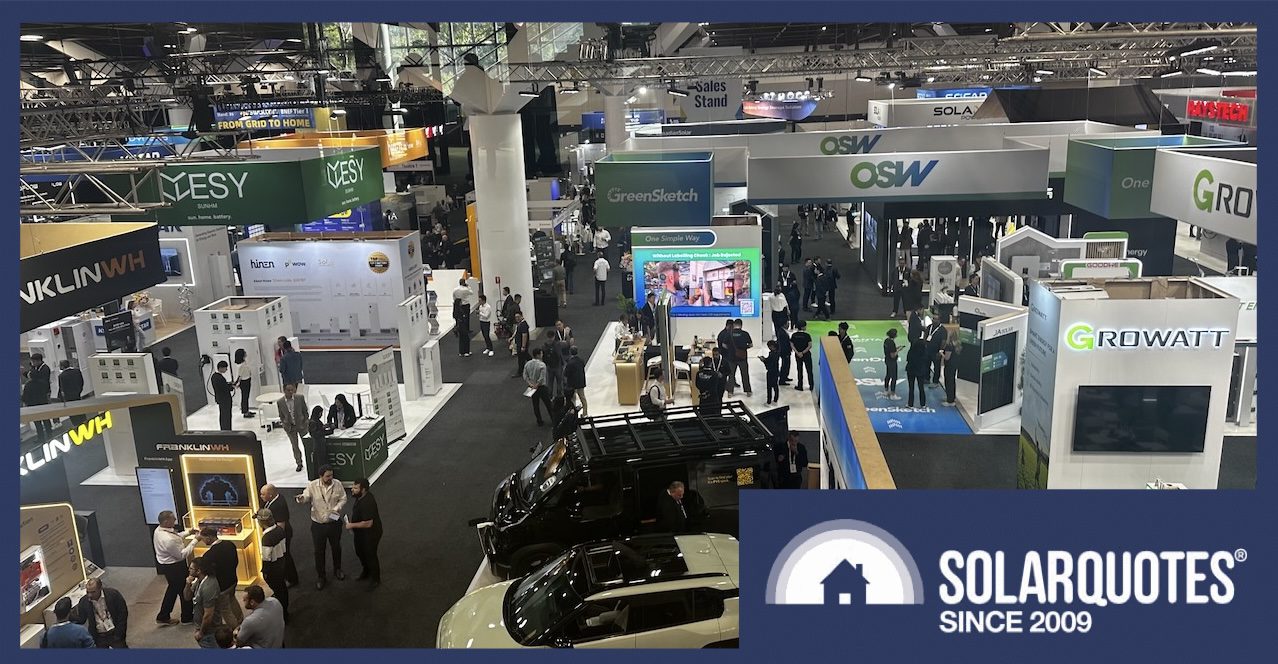
That Smart Energy 2026 Conference & Expo: Australia’s leading show that isn’t All Energy.
I’m filling in for our editor, Max, who has taken himself on holiday like someone who doesn’t understand the gravity of the Smart Energy Conference. Someone had to go. So I went to Sydney. Here’s what happened.
Andrew Forrest Opens With a Manifesto
Twiggy Forrest kicked off the day with the kind of keynote that makes you wonder whether you’re at an industry conference or a revivalist meeting. The man runs the world’s fourth-biggest iron ore miner and appears to be one of the world’s biggest advocates of solar, wind, batteries and smart grids.
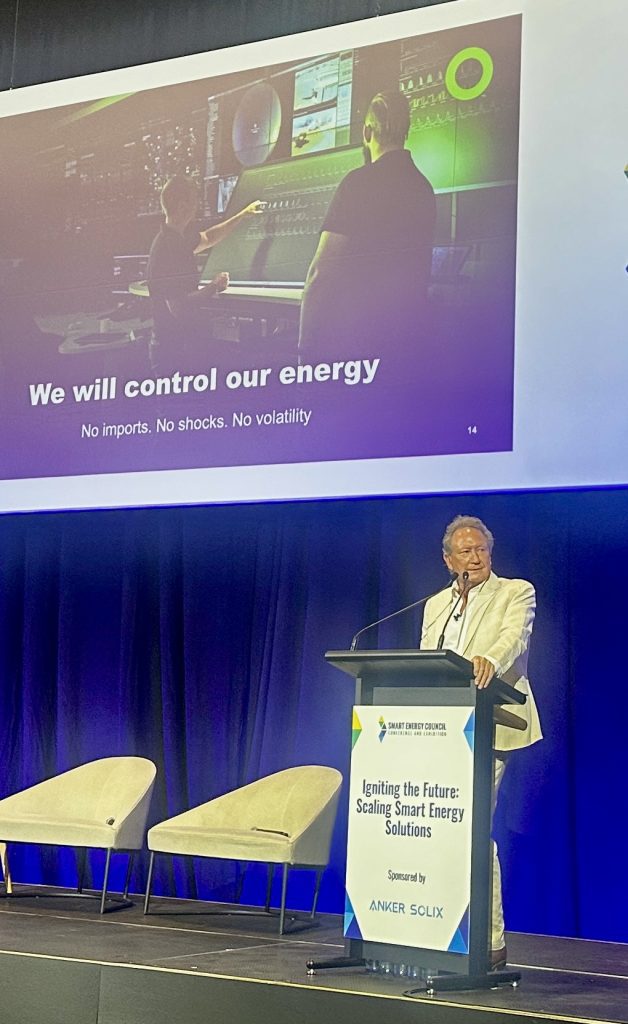
He opened by calling for the end of the diesel rebate – a subsidy that benefits, among others, Fortescue itself. The rebate is about a thirtieth of Australia’s 18 biggest miners’ operating profits, so they’ll be fine. The world’s most fossil-fuel-soaked industry, represented by its most famous executive, saying: “cut us off”.
His argument is simple and he makes it with genuine fiery passion. Net zero is a fiction built on offsets and creative accounting. Real zero means actually stopping the burning of fossil fuels and naming the date you’ll do it. He’s betting Fortescue’s future on it, he’s put a date on it: 2030, and he seems to enjoy the fact that this unnerves people.
The evidence he brought: Fortescue has built a giant green grid in the Pilbara with 1.2GW of solar capacity, more than 600MW of wind generation, and 5GWh of battery energy storage. The diesel burning mobile equipment is all going battery electric including electrified their 240-tonne dumper trucks. If you can run the biggest machines on earth on solar, wind, and batteries – the argument that heavy industry can’t go real zero collapses. These are a working machines in working mines.
He also said he expects the Strait of Hormuz to stay closed for the foreseeable future thanks to an unlimited supply of Iranian DIY drones making the whole exercise even more urgent. The miners relying on billions of litres of diesel to run operations over the coming years are screwed.
He was full of energy and slightly terrifying and the typically anti-billionaire crowd was very happy to have him.
Chris Bowen: Victory Lap, Earned
The Energy Minister gave a speech that was notable for what it didn’t contain. No persuasion. No case being made for renewables. He walked in and read out a scoreboard to a room that already knew the score – and the crowd loved every number.
The shift he described seems structural:
- Gas at its lowest quarterly use since 1999
- Coal down 4% year on year
- Batteries setting wholesale electricity prices 32% of evening peak hours
- Renewables hitting 50% of generation in Q4 2025 – during the hottest summer on record – with zero reliability events
That last one shows the old attack line – renewables are unreliable – is as dead as Barnaby Joyce’s liver. The highest electricity-demand quarter in Australia’s history, and the lights stayed on. No load shedding required.
The EV numbers have the same shape. One in 50 new car sales were EVs in 2022. One in four today. Australians went from buying one EV every 50 minutes to one every three minutes in April 2026.
As for Bowen’s baby, the Cheaper Home Battery Scheme, AKA the battery rebate: 380,712 installed. Ten gigawatt hours of storage, in under a year. The program was expected to be popular. Even the optimists, Bowen included, were not expecting this. Australia now accounts for 10% of new battery capacity installed globally. We are not 10% of the world’s economy or population.
One stat he didn’t bring: how many of that 10 GWh are cheap, oversized, misconfigured 40-50kWh stacks with 5kW inverters that will almost never do a full cycle. If I had the balls I would have asked him about that. But I’d have probably got lynched by the adoring crowd. So I chickened out.
On the Iran crisis, he acknowledged the government had been scrambling to secure fuel supplies: 400 million extra litres of diesel, 100 million of jet fuel. Interestingly, in the previous session, Twiggy had told us exactly how they had done that: by simply outbidding poorer nations who are likely going to really suffer as a result.
The audience deference was real and interesting. Politicians, usually get a wary reception from industry crowds – they’re either asking for something or regulating something. But Bowen has just injected $7.2 billion into the industry he was addressing. When the minister who funded your industry’s decade-long ambition walks into the room and the program has worked, the vibe is going to be closer to a group hug than a Q&A.
The Expo Floor: What’s Hot, What’s Boringly Brilliant, and What’s Banned
The integrated battery stack is now the default.
Walk the floor and almost every storage brand is offering the battery and inverter as one stack. The old model – inverter here, battery there, DC cables between (often unprotected & non-compliant) is becoming legacy. The exceptions were Fronius and Sungrow, who seem committed to keeping the inverter discrete. I’m genuinely not sure why. It may be a product roadmap thing, there may be a solid technical reason, or it may be stubbornness. Either way, they’re swimming against the tide.
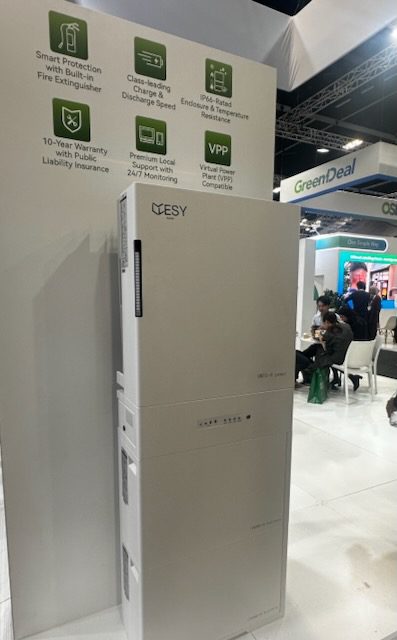
ESY inverter and battery stack. One of the better looking budget stacks at the show.
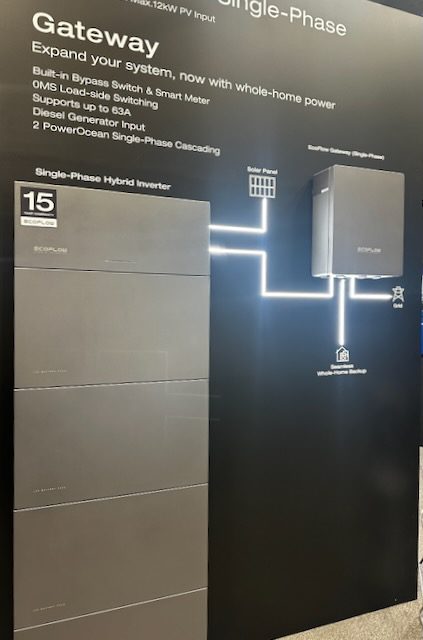
Ecoflow battery and inverter stack. In the flesh it looked well-made.
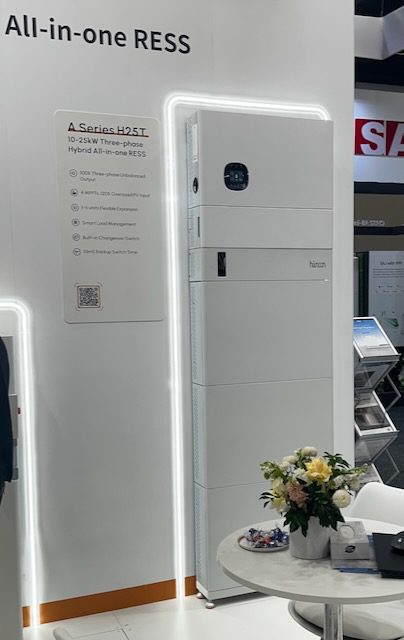
Hinen battery and inverter stack with a daring two-tone colour scheme.
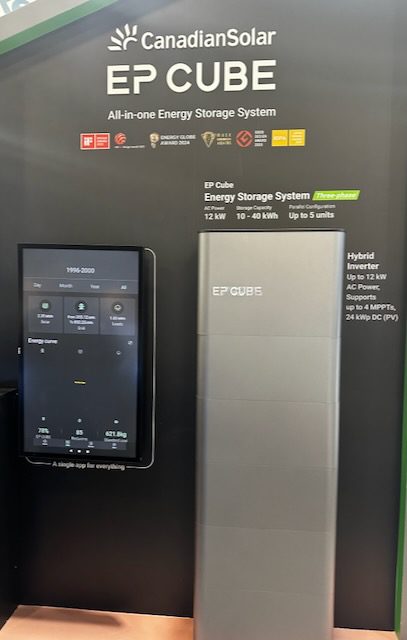
Canadian Solar Panels? Yes, please. Canadian Solar Battery? Yeah, nah.
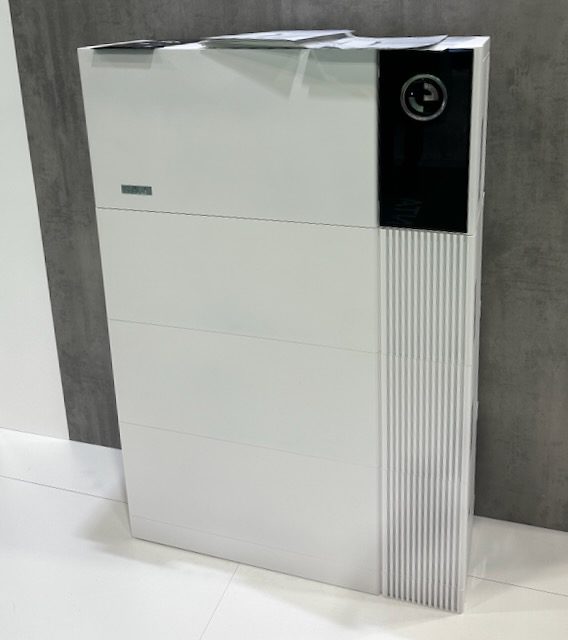
The SAJ aesthetic. I’d love to know the school of industrial design this came from, so I never ever send my children there.
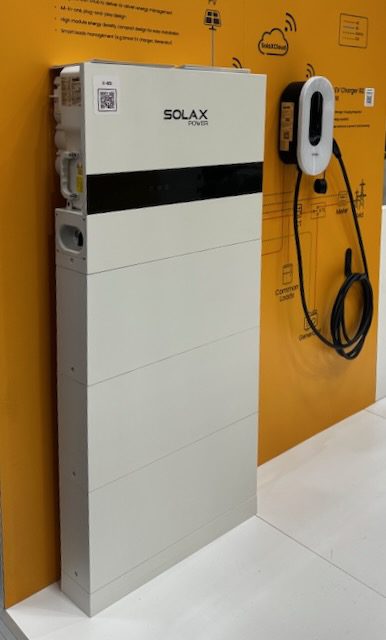
Solax. Initially I thought it had a cover missing. But that’s the design.
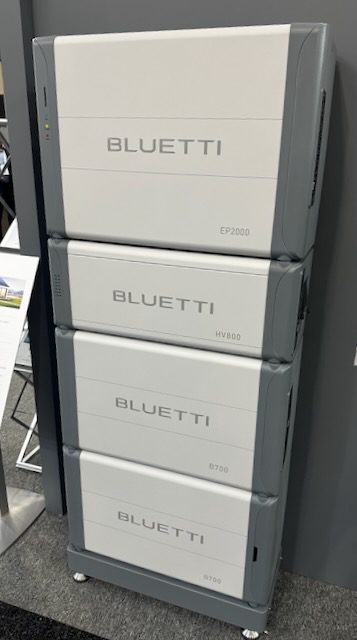
Bluetti battery and inverter stack. This looks really well made IRL..
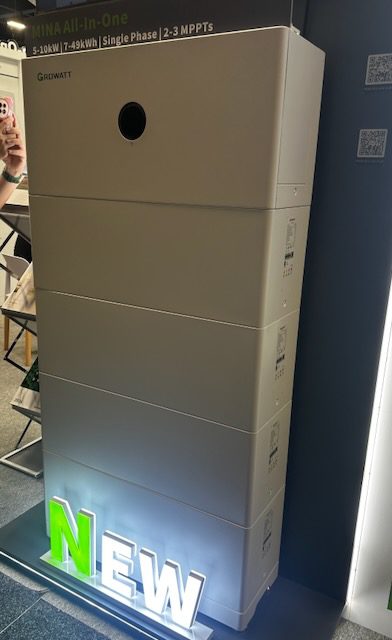
No, what? A badly installed Growatt? Or is the inverter meant to stick out like that? Update: Growatt claims that this photo was taken after an on-site stacking installation demonstration that left the product temporarily misaligned, and the product is not the final installed condition.
Three Boring Things That Made Me Genuinely Excited
1. AC Solar Warehouse’s battery signage system.
This sounds boring because it is. But it is one of the most practically useful things I saw all day. The problem: battery installations require specific safety signage, and the current reality is a chaotic collection of stickers – wrong ones, faded ones, ones stuck to the battery instead of next to it, ones often with the wrong shutdown procedure for the model installed. This is the biggest cause of non-compliance on battery installs in Australia.
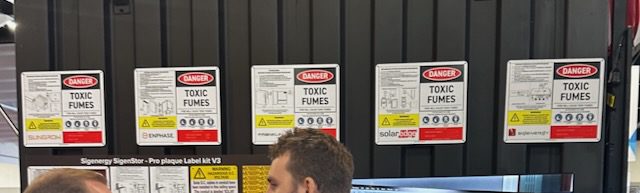
Compliant sticker plates for every brand. Brilliant.
AC Solar Warehouse has made custom, model-specific shutdown signs for every major battery brand. Rigid, professionally printed, screwed to the wall next to the battery. Correct information, correct format, looks like it belongs there. Great stuff.
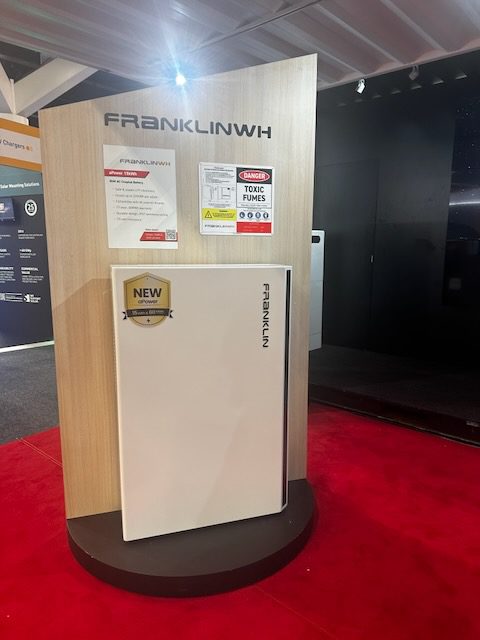
Franklin nicely labelled.
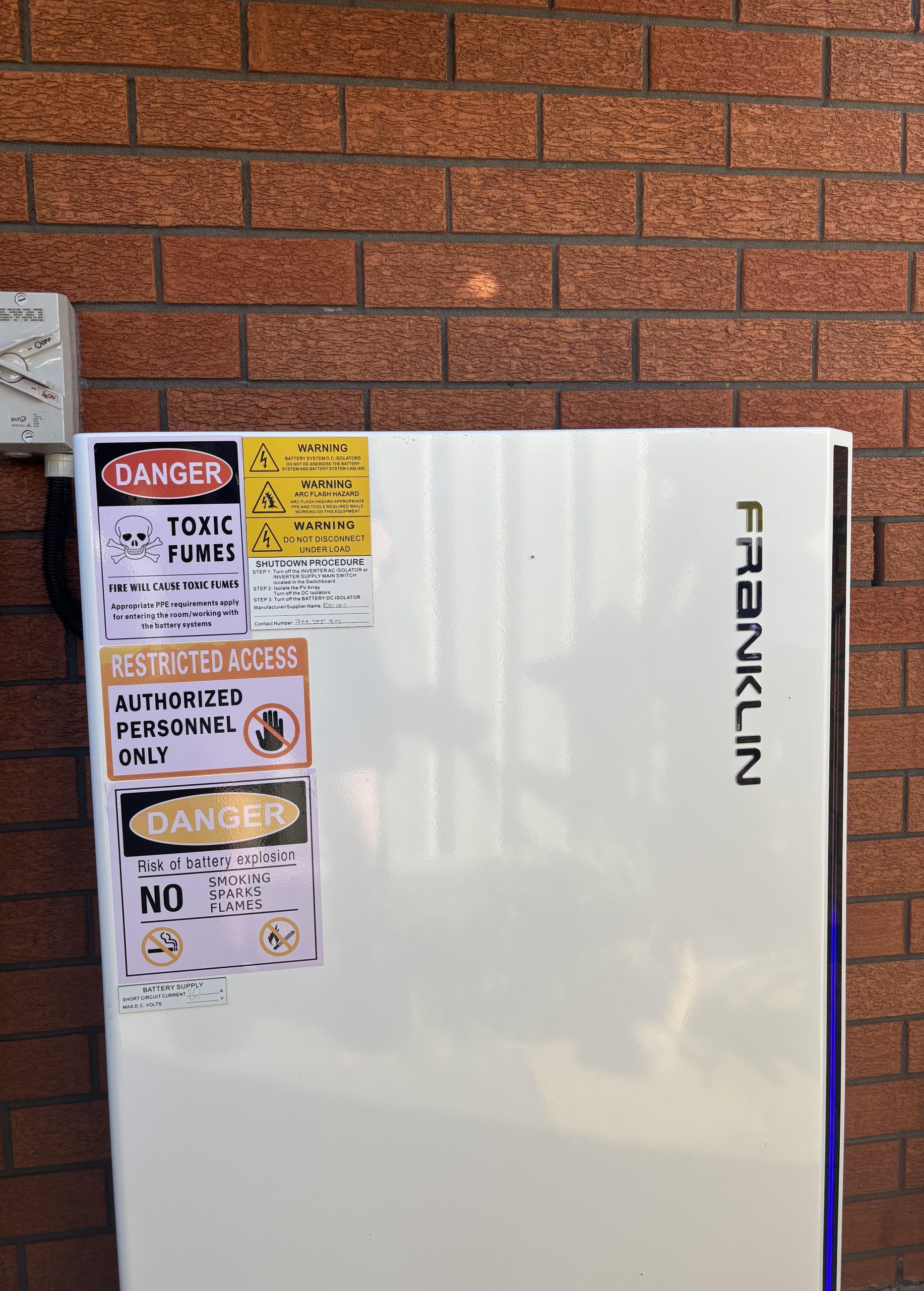
A typical real-life Franklin installation with stickers. Compare the pair.
2. SolarMG’s OptiMount cable tray system.
I have a soft spot for cable tray and am not embarrassed about it. This is cable tray designed specifically for solar installs, and the details are right: overlapping fixing holes along the full 3m length for mounting flexibility, side knockouts every 200mm so you’re not drilling holes on a roof and leaving swarf that rusts through colourbond, feet designed for corrugated, Trimdek, and Spandek profiles, ZAM coating (zinc-aluminium-magnesium) for serious corrosion resistance, and DC warning markings imprinted directly on the lid for compliance. Small innovations, real-world time savings, cleaner installs. Brilliant.
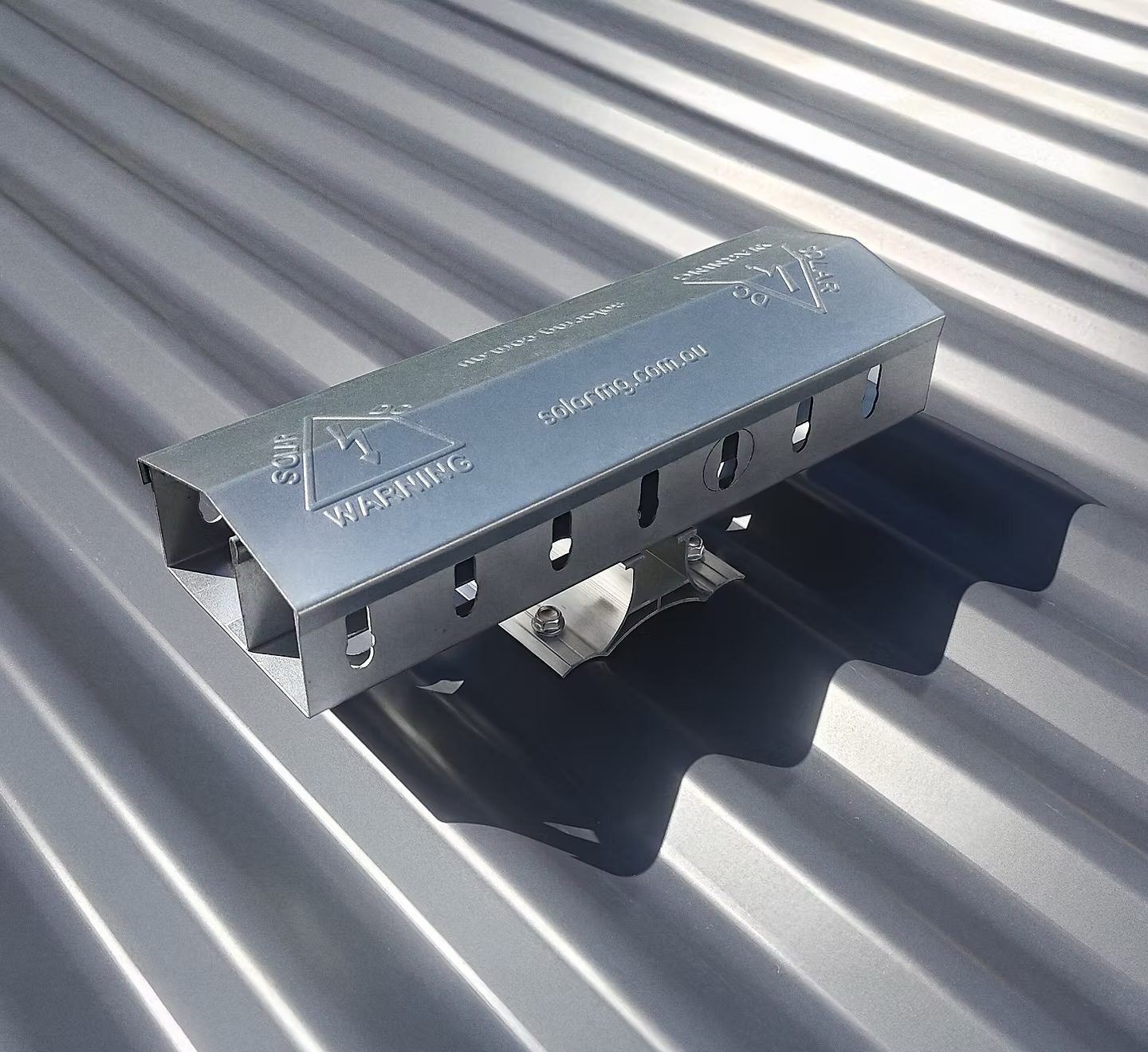
Brilliantly designed cable tray for solar.
3. Noark’s Trinix switchboard.
Every breaker in this board measures power flow and reports it to monitoring software over WiFi. This is the kind of product that makes you realise how backwards we’ve been about energy efficiency. The industry’s instinct when someone has high bills is to throw a bigger battery at it. The Trinix tells you where your energy is actually going, at circuit level, in real time. Every home should have one. We need to get serious about efficiency and monitoring again.
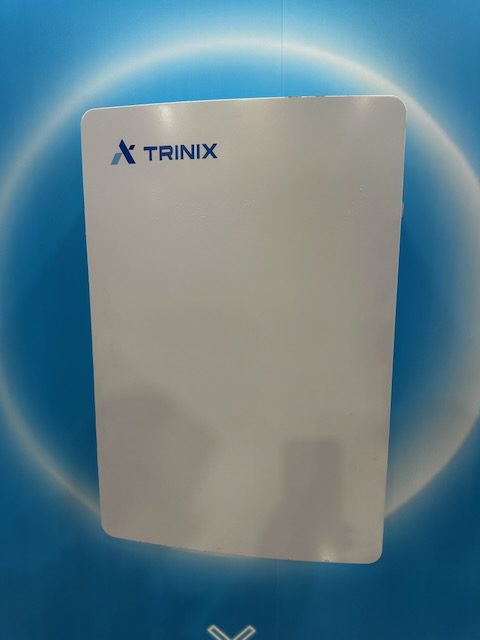
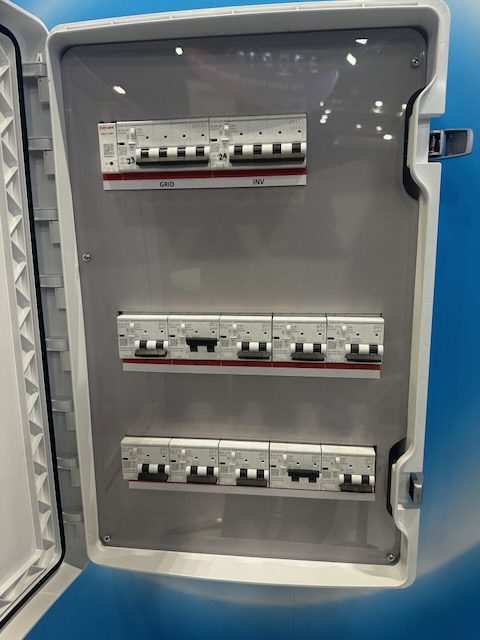
Every breaker is a wifi energy monitor.
The Most Exciting Thing Was Illegal
The Marstek Venus E 3.0 was the best thing I saw at Smart Energy 2026, and you cannot legally own one in Australia.
It’s a 5kWh home battery. 2.5kW output. And it plugs into a standard GPO. That’s it. No electrician, no switchboard work, no install cost. You plug it in, it charges, it discharges when you need it.
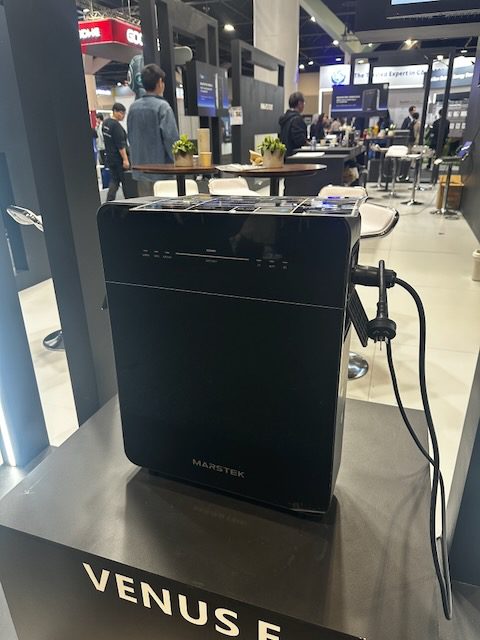
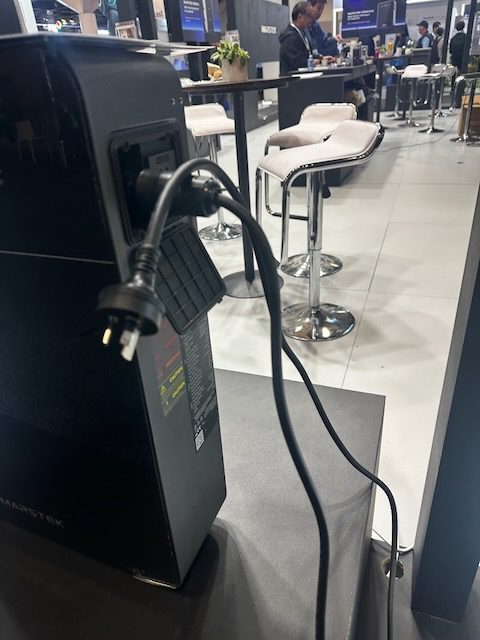
This is exactly what Australia’s 3 million renters need. No permission required from a landlord. No installation required. Charge it on your free solar hours. Use it at night. Take it with you when you move.
The reason it’s illegal is that Australian standards don’t yet recognise plug-in energy storage as a category. The safety pathway doesn’t exist. But they’re sold legally across much of Europe and the US for about AU$3,000.
Chris Bowen’s speech was a victory lap, and it was deserved. But if I were suggesting the next front, it would be this: create a pathway for plug-in battery storage. Fix the standards. Let renters participate in the energy transition they’re currently locked out of. The technology exists, it’s safe, and it’s sitting on a stand at the ICC in Sydney right now.
Smart Energy 2026 continues tomorrow. Max is still on holiday. I remain in Sydney. If anything exciting happens tomorrow I’ll write about it – otherwise I’ll have to publish Anthony banging on about conduit or stickers or Fox ESS cable covers.
 About Finn Peacock
 RSS - Posts





Love the reference to Barnaby Joyce’s liver, made me chuckle!
The plug-in battery sound amazing, why can’t Australian govt “recognise” Europe’s “tick” and allow it to be sold here. Surely if it’s good enough for Europe it’s good enough for here?
I think the main issue with plug-in batteries is their operation during a grid outage. I assume they need to shutdown because they don’t have gateway to isolate the grid from the house power. Secondly they would need to cope with whatever demand the house appliances are drawing at the time – likely more than 10A total.
If it shuts down I guess it could be unplugged from the house circuit and used to power critical appliances, like a V2L EV.
Their site notes, “Feed-in Regulation Compliance”. That probably means it shuts down when it loses it’s external reference voltage. The same as most/all microinverters. It will be interesting to see what they do in an overload state. They will llmit output, but how? A brownout?
I found myself nodding in agreement quite a lot reading this.
I am a big fan of Bluetti stuff. As an existing customer I could have got their whole house battery for an incredibly low price but as I already had a (Bluetti) solution and am still on the SA PFiT, I declined.
“Camping’ batteries could be a solution for renters. Most can be charged by solar and the grid and they come with 240V outlets to power a few appliances. Although even with three free hours of charging the economics probably wouldn’t stack up.
Great summary thanks.
LOVE the illegal battery, and your basic description of effectively how far “BEHIND” we are in some respects, when so many other places are using them with no drama, including friends of ours in Europe.
As you say, this would be perfect for renters and those maybe about to sell or move.
Australia needs to pull their respective fingers out and get with the program. Not everyone has or can have solar- another BIG group of people affected here are those living in units. This affects a growing number of people, who would LOVE something like this, to have a bit of energy redundancy and to avoid using power at peak times.
I dunno, I for one don’t like the idea of a decently sized battery sitting INSIDE my home. The market would flood with poorly executed models more akin to cheap e scooters. No way our fire fighting resources would want that extra burden and landlords would never allow it given the extra risk.
Finn Peacock: – “[Andrew Forrest] … expects the Strait of Hormuz to stay closed for the foreseeable future thanks to an unlimited supply of Iranian DIY drones making the whole exercise even more urgent. The miners relying on billions of litres of diesel to run operations over the coming years are screwed.”
I’d suggest they’ll be “screwed” in a matter of weeks (if not days)!
Dr. Chris Martinson, who produces a YouTube podcast channel Peak Prosperity, said:
“This is why your gasoline and diesel prices are going up because we’re running out of inventory. Why? Because we’re exporting it to the rest of the world to try and keep prices down”
https://youtu.be/sHxrf31l7f8?t=364
Dr. Martinson refers to a graph from JP Morgan which suggests global inventories could be at an “Operational Stress Level” by June & at an “Operational Floor Level” by September, at: https://youtu.be/sHxrf31l7f8?t=495
Perhaps US$200/barrel by Jun 2026, & much higher later?
Who is going to secure the rights to tax passage through the Straits of Hormuz waterway? And what will its real value be if the UAE build a pipeline to supply a terminal over which they have absolute control?
Opposition Minister Loopie wants the Federal Government to increase its reserve to 60 days, but failed to mention how much that would cost taxpayers. That is a lot of value sitting in a tank waiting for a supply crisis, so what would be the loss of opportunity cost?
What is the current deal where we purchased country-of-origin oil-washed petroleum products from friendly [some might say not-so-friendly] countries? Question: Name the country that has weaponised its export of petroleum.
Anthony: – “Who is going to secure the rights to tax passage through the Straits of Hormuz waterway?”
Iran has sought to tighten its grip over the Strait of Hormuz (SoH) by charging tolls on vessels to ensure safe passage, in conjunction with Iran’s Islamic Revolutionary Guard Corps.
https://www.reuters.com/world/middle-east/can-iran-legally-impose-tolls-strait-hormuz-2026-04-16/
Iran is reportedly charging up to $2 million per vessel for passage.
https://edition.cnn.com/2026/05/07/middleeast/iran-hormuz-rules-warime-gains-intl
Anthony: – “And what will its real value be if the UAE build a pipeline to supply a terminal over which they have absolute control?”
How long would it take to build alternate routes to avoid the SoH? Years? Pipelines can be disrupted/destroyed.
Amos Hochstein said: “…we’re going towards a cliff on oil and oil products by the end of this month.”
https://youtu.be/tOqBuGxULiU?t=489
Can we handle the pain coming soon?
So you support the view that there will be no regime change in Iran, and no negotiated settlement concerning who controls the Strait of Hormuz and on what terms and conditions. So the real issue is who in the future will prosecute the Tax.
Anthony: – “So you support the view that there will be no regime change in Iran, and no negotiated settlement concerning who controls the Strait of Hormuz and on what terms and conditions.”
I’m highlighting the inconvenient reality. It seems to me so far Iran can handle the pain from the economic sanctions, blockades & kinetic actions. The Iranian regime just needs to hang on a little longer until the global oil crisis really begins to hit hard, & the USA begins to feel much more economic pain, & many Americans begin questioning what President Trump has done to their lives & livelihoods.
Anthony: – “So the real issue is who in the future will prosecute the Tax.”
It seems at the moment Iran is attempting to impose “the Tax” through fear of the possibility of vessels transiting the SoH being hit/sunk by mines, kamikaze air/marine drones, missiles or small fast attack boats.
Mitigating the SoH chokepoint will take time that we just don’t have to avoid pain.
10.03 kW Enphase Solar. I installed a 13.6 kWh Battery in November 2025, and these are the imported billing kWh values:
Living in the tropics, Dec – Mar involved excessive use of air conditioning. Without the battery, our billable imports would have averaged 360 kWh per month.
Nov 2025 41 kWh
Dec 92 kWh
Jan 2026 130 kWh
Feb 131 kWh
Mar 143 kWh
Apr 60 kWh
May 12 kWh
From May through to November, our projected average billable kWh per month should be less than 100 kWh.
I am at the maximum allowable kW single phase so I do not appear to have a solution to eliminate grid imports and export enough power to offset the daily fixed fee.
13.6kwh battery is small. Its like buying a single cylinder vehicle. It lacks power. Its lacks size. It was cheap.
I will take a punt and say you saw a ad on facebook and liked that the offer was cheap. And didnt seek other quotes based on actual.power use data for a year.
Well, actually, battery size was dictated by our consumption profile and the fact that we could not increase solar production because we were at the max allowed size single phase.
Before installing the battery, the annualised 5 kW in the moment curtailment 750 kWh loss of opportunity.
Three-phase power, which would support up to a 30 kW system, could not be pulled through the existing conduit, so the cable alone was quoted at $3,500, with no work done in the meter box.
The free 3 Hr ToU tariff will not be available from Ergon because FY QLD Regional Power Prices are regulated by the Queensland Competition Authority, similar but not a Default Market Offer.
The YouTube Electric Viking has a lot to say about all manner of systems and suppliers. And I chose to work with RESINC based on what they offered.
Given that I am an asset-tested age pensioner, would you like me to post the financial increase in F/N pension expensing cash on the battery purchase ? My C/F ROI extraordinary.
Is that 10kw of panels or 10kw of inverter?
If the batteries are DC linked i would check your inverters rating for oversizing as some inverters allow 200% or more panel oversizing which will feed anything over the inverters rating into the battery.
10.03 Panel aggregated kW. Enphase Microinverter system mix of M, S and IQ7 inverters. AC off the roof, the battery is AC connected.
Forgot to mention but depending where you are you could look into negotiated connections with your electricity DNSP/retailer which can get you a higher inverter limit but will probably cost you most of your feed-in.
When i get my home’s system upgraded il be trying that as ergon last i looked has a weird 1-10kw and 30-100kw auto approval but 11-29kw is negotiated only.
Though as you go up you might want to check what your overhead/underground/etc line’s amperage rating is if the houses older as it becomes the main limit single phase.
The property was built in 2007 and I have not idea what the cable rating happens to be that connects the meter to the grid.
I was aware that Ergon might negotiate 11-29 kW, but at the end of the day, based on the available roof real estate, I would only be looking to increase my daily production by an average of 38 to 45 kWh per day.
So current production is 3.7 kWh per 1 kW of system, and increasing that to 45 kWh per day would require a 2 kW increase in system size, 4-5 panels. I am not sure I can purchase what is currently available from Enphase that would aggregate with what I already have. Type M, S and iQ7 with S cabling.
Would you like me to post what is involved in procedural and technical issues with Ergon to obtain their agreement to approve an 11-20 kW increase to a single-phase connection to the grid?
I wrote a financial analyser when I purchased my system way back in 2015.
The data it captures and retains validates trends such as panel degradation. In 6/2015, I was producing 4.3 kWh per 1 kW of system size; today it is 3.7 kWh. That represents a 14% loss of generation capacity spread over 10 years.
For recent installations of good-quality panels, the loss of capacity is estimated at 0.4%-0.6% per annum for older panels and about 1%+ per annum.
So the question for me now becomes: what is the ROC expensed to recover the value of the loss of power generated by the current system? Do I replace the system, upgrade the system or simply do nothing?
Some advertising suggests I should abandon the system and start over. I am not convinced that my system is still fit for purpose.
Anthony,
Are you, like me, almost tempted to upgrade when the system is just too “old hat”? Off-grid quickly tests fitness for purpose. In 2 years of BEV, HWS, HVAC, etc, there’s been no need to start the generator here. On-grid, is the FfP metric your grid imports? (Derisory FiT means that if yield is only reduced to zero exports, it is still fit enough, I figure.) Modest imports are just using the grid as a big battery – bad weather insurance, and short-term cheaper than an upgrade, I figure.
Then there’s the emissions footprint of new hardware, plus the recycling of the old. Maximising utilisation beforehand is meritorious. If the system was well sized, -14% production ought to be still fine on a daily basis?
The approximate annualised loss of value due to panel degradation is $162.00 per annum based on an export value of $0.06 per kWh. [2 kW x 3.7 kWh per day x $0.06 FIT kWh x 365 days = $162.00]
A 2 kW add-on estimated cost $2,500 – $4,000 lets say $3,000, then the payback would be 18 years. Even at $2,500, the payback would be 15 years, and when the value of FIT evaporates, there would be no payback.
If you had a 1.5-6 kW system and were thinking about adding a battery, then, depending on your consumption profile, upgrading or replacing the system to be less reliant on the grid might make financial sense.
I wanted a bigger inverter too for my four person household, but turns out I’m doing okay with the max of 10kW (grid size 50A – 45 year old house). For the last six months I only had to pay for 10kWh from the grid however have consumed 9820kWh of energy (running AC 24/7 for about four of those months). Before the battery in that same period previously I had consumed 7701kWh.
What makes it works is the 40kWh battery that prevents imports from the grid. If I went on my historical usage, the battery would pay for itself within 8-9 years, but now it looking more like 7 years assuming electricity prices don’t fall.
Scraping my old inverter and increasing my PV size to 17kW DC coupled will help too in winter months.
That renter’s portable battery goes well with Europe’s “balcony solar” – panels with microinverters, which also plug into a GPO. Hung on the balcony rail, they too come with on moving day. I figure that their anti-islanding detection is pretty fast, given the male plug.
Twiggy Forest’s popularity isn’t harmed by him targeting the diesel rebate cancellation to businesses with more than $50M turnover. That moves it from a road levy to a carbon tax. (Farmers still exempted – good as plantings are already down, and eating remains fashionable.)
Battery bias or inverter inadequacy?: A 50 kWh battery with tiny legacy 5 kW inverter won’t quite support 10 hrs at full output. While not mainstream, off-grid favours battery-heavy, as diesel for the generator grows scarcer. (Admittedly, I have only 46 kWh for 2 x 6 kW battery inverters,only one running on 80% of loads. And 30 kWh would actually do here, with no kids.)
The new scheme is superbly equitable – extra kWh fully privately funded.
The Marstek Venus E Gen 3.0 battery does look intriguing, not just for renters without solar, but for those who have smaller output solar systems that don’t justify the cost of a larger fixed battery installation.
As I read it, the smarts of the system will allow it to limit charging to power that would otherwise be exported to the grid. “With real-time smart meter integration and adaptive control, Venus E Gen 3.0 ensures no surplus solar energy is exported to the grid, making it ideal for areas with export restrictions or limited feed-in tariffs” That sounds like just what I need with a 3 kw inverter in not very solar blessed Tasmania. Your ballsy question to Bowen should have been what is he doing to fast track the introduction of standards to allow the use of plug-in batteries like this one.
And, as Erik mentioned, balcony solar panels. Already well-established in many European countries. Of course placing one’s 3kWh portable battery out on the balcony also reduces the concerns about a battery fire inside one’s house.
So, Standards Australia working party. Why not preempt the inevitable and get working on a proposal for an AS that covers secure mounting of solar panels to handrails [including wind-loading calculations] and details for these ‘balbatts’. [Yes, I’m claiming naming rights on that abbreviation 🙂 ]
Re the Noark Trinix switchboard, did they mention expected pricing?
I assume $$$ so wonder how is compares to upgrading your existing board with Shelby or Catch Connect using CT clamps?
Do you really need to monitor or manage (via HA) your GPO and lighting circuit breakers? Monitoring each breaker sound great but you’re mostly covered if just monitoring the EVCA, HVAC, HWS and/or pool pump?
You state “we need to get serious about efficiency and monitoring again”. Whilst true to an extent, what about an open protocol that allows more accessible energy management to the broader community? HA is great but far from mainstream so why cant an open protocol be adopted to allow these modern devices better talk to each other?
I’d also like to know how it stacks up against Basis and Span switchboards.
Maybe I was looking in the wrong place but the Trinix stuff didn’t seem to be on various regional Noark websites I looked at. Impending release maybe?
One can also hope there is a local api for push/polled data collection so you’re not tired to a (subscription) cloud service. I had been going to go down the Iottawatt route a few years back, but a move overseas saw me sell the device to a neighbour who still uses it, and now Iottawatts are no more. It’s handy to hear what other options are out there, even if they’re pricey ones aimed more at commercial or industrial uses.
> One stat he didn’t bring: how many of that 10 GWh are cheap, oversized, misconfigured 40-50kWh stacks with 5kW inverters that will almost never do a full cycle
I don’t understand why you think a 40-50kwh stack will never do a full cycle?
A small 6.6kw solar panel setup can do 30KW+ on a sunny day in summer, if a household doesn’t use all 30kwh overnight it’ll accumulate and the battery will naturally fill up or maybe they use more during the week and less on the weekend?
The other thing is that even in a scenario where they’re using so much power and generating so little solar that it never reaches 100%, isn’t this a good thing? It simply wears the battery less, less cycles, longer lifetime, so ultimately what’s the issue?
Outside of this love your work 🙂
Hi ikt,
A battery that doesn’t get to full charge regularly will suffer with drift.
The BMS counts kilowatt hours going in and out but needs a periodic reset, and the cells themselves need to be equalised with a full voltage, preferably sustained for a number of hours.
The battery industry is offering warnings.
https://www.linkedin.com/posts/simon-ceglinski_renewableenergy-batterystorage-solarenergy-activity-7360795588751249408-PTR2
Interesting, popped into AI and said 2 systems, in Melbourne, 6.6 and 10kw, 40kwh solar battery, winter, what to expect:
10kW system: Negligible extra degradation (~0.1–0.2% per winter). Safe for LiFePO4.
6.6kW system: Moderate extra degradation (~0.3–0.4% per winter). Still fine, but expect 1–2% more loss over 5–10 years.
I don’t think this will be a major concern outside of the very southern states BUT it definitely could be a concern if batteries end up going into super massive 80-100kwh+ territory, they’ll likely need an extra LED status or app warning to say: “it’s been 4 weeks since you were last at 100% battery charge, please charge to full now to ensure reliability” and then after 2 months it force charges from the grid say in the middle of the day
better the person copping a $10 electricity charge than losing $1000’s when the battery dies years earlier than expected
Solar and batteries are, in my view, primarily a home improvement decision rather than a business opportunity.
When comparing one refrigerator to another, where one costs less to operate, most people do not calculate every dollar of electricity savings over the appliance’s useful life.
The purchase is generally treated as an upfront household expense, with operating efficiency simply forming part of the buying decision.
I see solar and batteries in much the same way. The system is effectively fully expensed at the time of purchase, and the real question becomes whether that capital could be better used elsewhere.
A battery is ultimately no different in principle to other household infrastructure and appliances with finite operating lives and replacement cycles — such as refrigerators, washing machines, dishwashers, dryers, air conditioners, pool pumps, BEVs and hot water systems.