
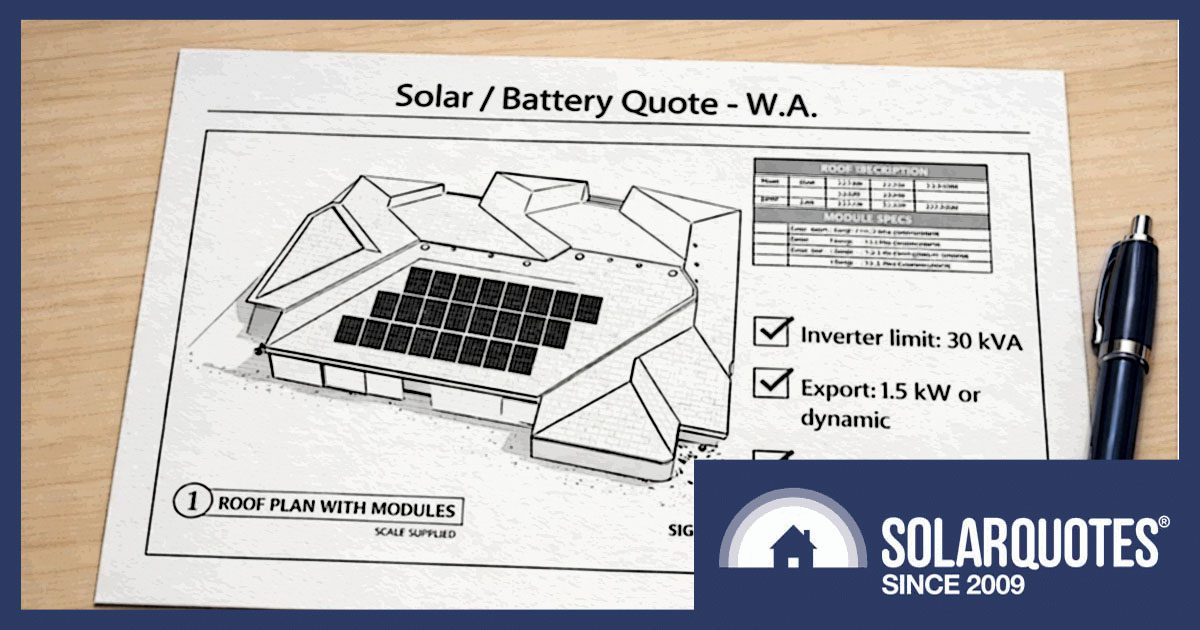
From 1 May 2026, new inverter rules apply to solar and battery systems connected to WA’s main electricity grid, managed by Western Power.
Your installer is responsible for making sure your system meets the technical requirements – that’s their job. But there are two things worth discussing with them: how your export limits are configured and whether your system has room to grow.
This guide covers what to look for under the new rules. It’s not general solar buying advice – it’s specifically about new design decisions that matter because of the new rules.
What Changes For New Installations?
The main change for new solar and battery systems in WA is that all inverter capacity is now counted as a single combined total under a 30 kVA1 limit. This affects how systems are designed from the outset, particularly where solar and battery inverters are installed together or where future expansion is being considered.
New systems must also meet updated export requirements, with either a fixed 1.5 kW export limit or remote export control under network management requirements set by Western Power.
What To Check Before Signing
System Size
If you’re getting quotes under the new rules, what matters is how your system’s total inverter capacity is counted. Under the 30 kVA aggregate limit, all inverter capacity on the property is added together, including both solar and battery inverters.
In AC-coupled designs, solar and battery systems use separate inverters, so each contributes to the total.
For example, a 3-phase 25 kW solar inverter2 would only leave 5 kW for the battery inverter. That would take 5 hours to charge a 25 kWh battery, no matter how strong the sun was shining.
In a DC-coupled hybrid system, both functions run through a single inverter, so a 25 kW hybrid inverter system would allow 25kW3 of solar panels and could charge a 25 kWh battery in one hour.
Export Limits
You should also confirm how export limits will be set up. Some systems will operate under a fixed 1.5 kW export cap, while others will use remote export control, where exports can be adjusted by the network depending on system conditions.
Fixed exports are easier to configure and understand, but flexible exports will export more, so they are more lucrative, as long as you are getting paid a feed-in tariff.
System Expansion
It’s also important to understand how much room your system leaves for future upgrades. Under the 30 kVA combined inverter limit, any additional inverter capacity – including a battery added later – still counts toward the same total allowance.
As noted earlier, AC-coupled systems use separate inverters for solar and batteries, so adding a battery later will use more of that available capacity. If most of it has already been used, there may be little room left without replacing existing equipment.
Systems built around a single hybrid inverter don’t require a second inverter for storage, which can make future expansion easier within the same overall limit. But you do need to be confident that compatible batteries will still be available when you are ready to buy them.
It is important to realise that the limit is not per-phase. If you’ve got 3-phase you are still limited to 30 kVA total.
Do Existing Solar Systems Need To Change?
Existing systems are not affected unless they are modified or upgraded, but any change – including adding battery capacity or increasing inverter size – will trigger reassessment under the updated 30 kVA combined inverter framework.
Avoiding Design Headaches Later
Getting the design decisions right at the quote stage – inverter sizing, export settings, and allowance for future expansion – is what helps avoid headaches later. Once installed under the 30 kVA framework, changes can be limited and may require redesign rather than simple upgrades. That’s why the detail in the initial quote matters just as much as the equipment itself.
More information on connection requirements and processes is available via the SolarQuotes WA solar connection rules and processes guide page.
For practical tips on assessing solar quotes, see our guide on getting and comparing solar quotes.
Footnotes
- A note on kVA vs kW
You’ll see inverters rated in kW (kilowatts) on spec sheets and kVA (kilovolt-amperes) in the network rules. For most home solar and battery inverters, the two numbers are close enough to treat as the same – a 10 kW inverter counts as 10 kVA under the 30 kVA limit.
The difference comes down to power quality. kW measures the useful power actually delivered, while kVA measures the total electrical load on the network, including any inefficiency caused by the way current and voltage interact. When power quality is perfect (power factor = 1), kW and kVA are identical. Modern grid-connected inverters are generally required to operate close to a power factor of 1, so in practice the gap is small – but the network rules use kVA because that’s what matters for grid capacity. ↩ - limited to 24kW AC due to a cap of 8kW per phase of concurrent generation on 3-phase ↩
- or more – battery inverters can be oversized more than solar inverters ↩
 About Kim Wainwright
 RSS - Posts





I think the feed in tariff (DEBS) rules still apply whereby an inverter size larger than 5kW is not eligible.
Begs the question, why would you export unless you keep the pre 1st July 2025 5kW maximum sized inverter.
Is there any benefit at all in having export limitation?
Most WA peeps don’t want to “help” the grid so zero export plz is the preferred option.
We’ve gone from years of maximum 5kW single phase inverters to suddenly 30kW.
As Pauline would say “please explain”?
There was an industry forum held a few months ago. The export question was asked multiple times in various formats.
Essentially they claim they are working on alternatives, but we should all jump on and export for free for the warm fuzzy feeling.
We have been at a 10kW Solar + 10kW BESS max 15kVa generation single phase for over a year. Its just been revised due to people not being understand how it was written.
This fails to mention an important limit that should be covered before people get too excited.
“Large Network”
” Single Phase – 15 kVA generation limit”
“3 Phase – 8 kVA/phase generation limit”
“4.3.2 The site generation limit for any combination of IES shall be the allowed maximum concurrent output level to the AC electrical installation from all inverter energy systems on the connection service.”
Generation limit is not export limit – its in house behind the meter.
Hi Darren. Good point — that’s the site generation limit in Western Power’s technical requirements, which caps total concurrent inverter output behind the meter (typically ~15 kVA single-phase / 8 kVA per phase three-phase). It operates alongside the 30 kVA inverter allowance and export limits, which were the focus of this article. Thanks for bringing it up.
Two questions, relating to a single phase connection (63A) on the SWIS grid.
1. What is the now maximum capacity for a primary hybrid inverter ; is it 10kW or 15kW; thence, also, what is the maximum inverter capacity for an All In One inverter/BESS system, such as the Goodwe and Sigenergy All In One systems?
2. Regarding the 30kW total generation capacity, how does this relate to the capacity of V2H connection of electric vehicles, and, similarly, to the HOEM V2HL (?) connection of V2L vehicles to household stuff?
Bret.
1) If you have deep pockets, you can install up to 30kVa on single phase but the generation limit of 15kVa applies so that will be all that you can produce on the AC Side. However it would allow a huge solar array of 60kW!
The distinction between types has been dropped.
For Sigenergy that would be several stacks with separate inverters linked.
In reality for grid connected I think you will find most will stop at 15kVa like I have.
2) See below, they are counted as a energy generating system – thus same limits technically apply.
basic-eg-connection-technical-requirements-2026.pdf
An EV and/or EVSE shall be considered a Basic EG System, where it is
a) capable of reverse power transfer; and
b) provides a supplementary supply to the electrical installation.
An EV or EVSE that is a basic EG system shall comply with all the Basic EG System connection technical requirements, AS/NZS 4777.1:2024 and AS/NZS 4777.2:2020.
“Some systems will operate under a fixed 1.5 kW export cap” …
As a Victorian, all I can say is Ouch, just ouch.
I assume “some” will be a very small minority, as if not what does it say about the stability of the WA network, or the potential conservatism of the DSNP?
Out of interest does anyone know if AMEO has ever looked at the business case of connecting the WA grid with the National one?
If your inverter is >5kW you are export capped at 1.5. Called synergy and my installer on this, as I don’t mind exporting the excess solar from a 15kW inverter (would be nice to get paid).
Comes down to “Table 4.3: Maximum System Capacities for Small network category” in western powers “Basic Embedded Generator (EG) Connection Technical Requirements”. See note 4. You have to have an “off-take agreement with their Authorised Agent” which it seems the synergy VPP doesn’t count as, and you don’t qualify for DEBS if your inverter is >5kW.
Hopefully things change on that front soon.
I tried finding the value I saw at one point but there is quite a substantial amount of people who didn’t get the state battery rebate and only used Federal.
This implies that they did not want to join the mandatory VPP and thus are on the 1.5kW export. Up to recently there was a nasty clause 3.3 that gave them permanent lifetime control.
As a few others have mentioned above 5kW inverter its pointless currently as no fit even during peak periods.
So the percentage of installations on a fixed 1.5kW export is probably quite high.