
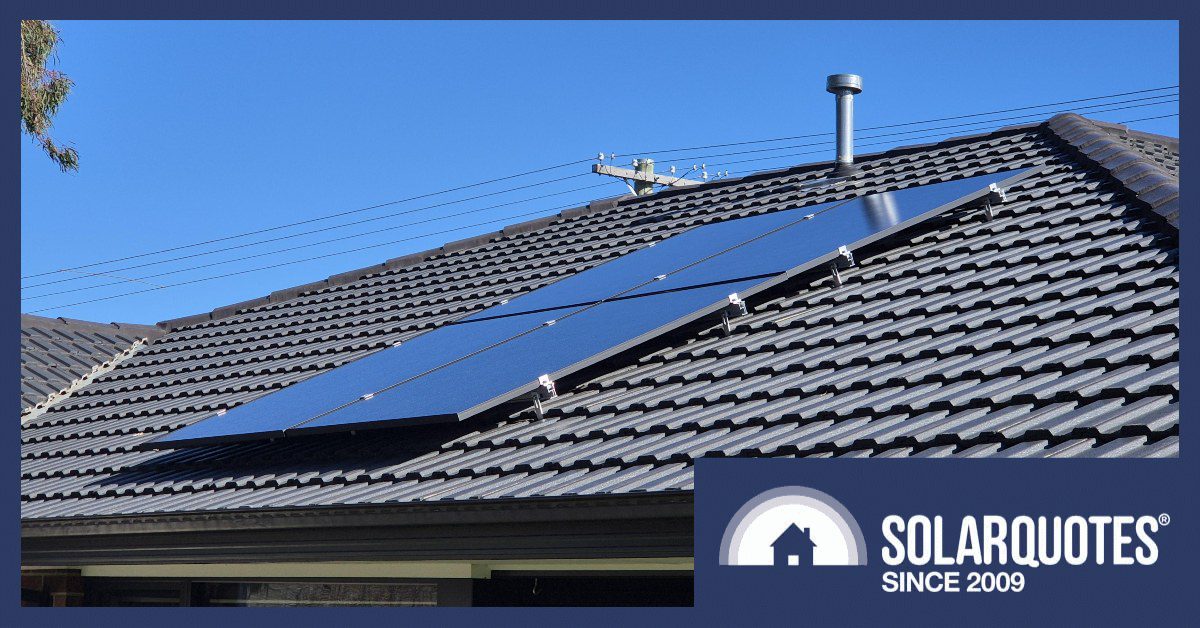
Solar panels installed by Limitless Energy.
When Australian households first started installing solar, there were almost no restrictions on how much energy they could export back to the grid, and they received up to 60c per kWh for exporting it. Fast forward to today, and we have millions of rooftop solar systems meeting more than 13% of the country’s electricity demand.
What Are Dynamic Connections For Solar?
Rooftop solar has brought significant financial savings to households and reduced our greenhouse gas emissions, helping Australia lead the way in consumer-driven clean energy transition.
However, it’s not without challenges, such as increased daytime energy exports that cause power to flow in reverse, raising network voltages that may curtail or trip PV systems and cause other power quality issues.
To manage this, the ‘dynamic connections’ concept was introduced and first implemented in South Australia. Also known as Dynamic Operating Envelopes (DOE) or Flexible Export Limits (FEL), they adjust the amount of solar exported in real-time, based on network conditions.
Stopping Highway Congestion
Perhaps an analogy is the ramp traffic signals, which allow only a certain number of cars to join the highway at a time when it is congested. But when there aren’t many cars or if the highway is large enough, the ramp signals won’t restrict the number of cars flowing into the highway.
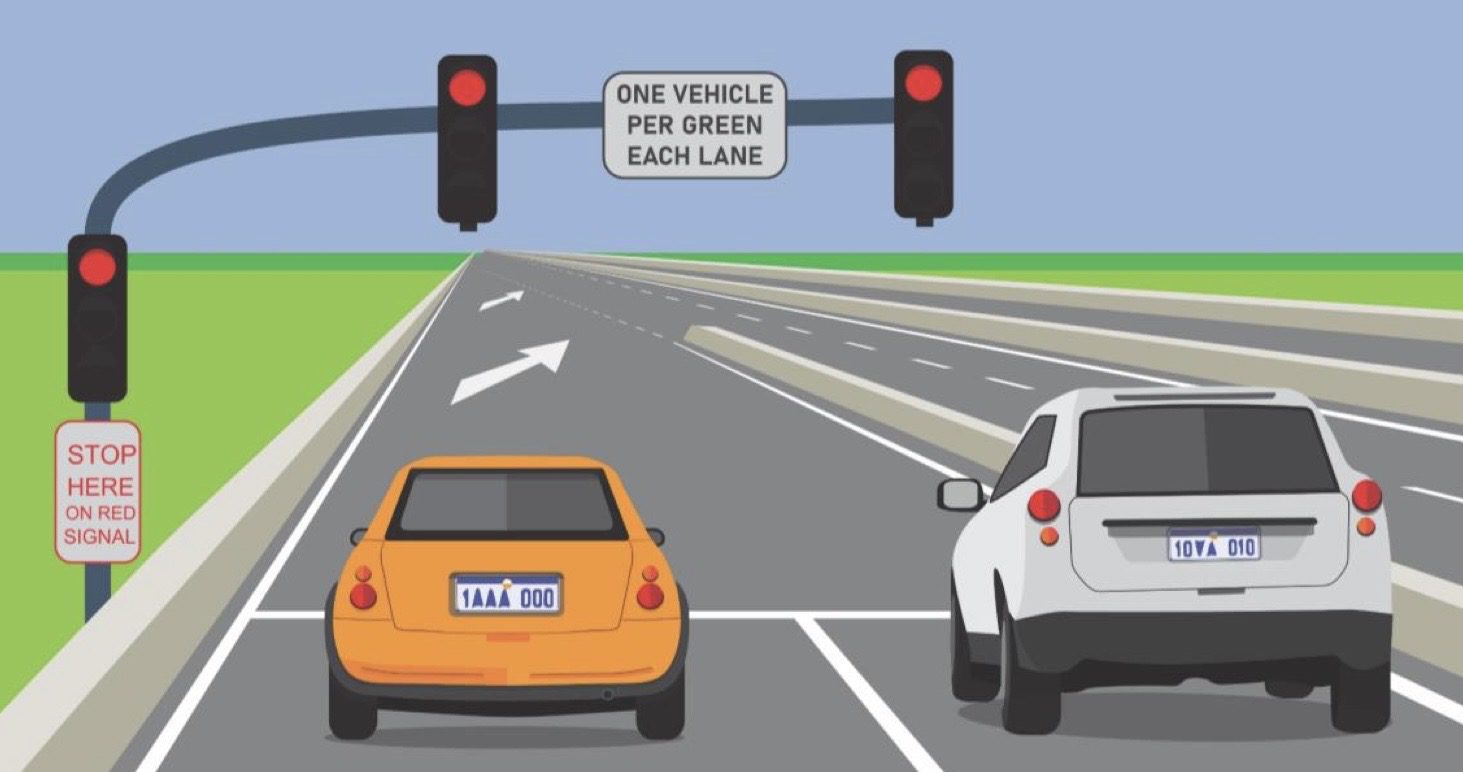
Credit: Mainroads WA
So, when there is too much solar export (cars) in certain parts of the network (highway), the operators may restrict the number of solar exports from each system.
This concept can also enable a more equitable allocation of solar exports, helping more people install rooftop solar systems and export their excess energy. Imagine all your neighbours had big solar systems, and when it is your turn to buy one, network companies may deny you any exports, as the highway is already congested and no more new cars are allowed. With dynamic connections, networks can regulate solar exports and allow more households to own solar.
Dynamic connections can also help completely stop solar export traffic in the event of a serious accident on the highway (network security and contingency events). This concept is known as the Emergency Backstop Mechanism.
Dynamic Connections Across Different States
So, what does it all mean for you as an existing or new owner of a solar?
As an example, if you live in South Australia and want a new solar system or to upgrade your existing system, the network (SAPN) will give you two options:
- You don’t participate in the dynamic connections program, and have a static export limit of 1.5 kW (so you can’t export more than this limit)
- You participate in the dynamic connections program and can export up to 10 kW of energy per phase, dynamically managed by the network company depending on the network conditions
According to data on new installations in South Australia, around 80% of households have opted in to the dynamic connections program since July 2023. If you bought a system before July 2023 or have another existing export control device, then dynamic connection rules won’t apply to you until you need to upgrade or buy a new system.
South Australia
- From July 2023, all new systems or upgrades require dynamic connections capability.
- Participating sites get up to 10 kW export limit per phase.
- Sites can opt out and have a 1.5 kW fixed static export limit.
- 80% of new installations have chosen dynamic connections up to date.
NSW & ACT
- NSW is planning to implement a similar strategy to South Australia, with the rollout expected this year.
- Participating sites are expected to get up to 10 kW of export, and non-participating sites get a static fixed export limit of 1.5 kW.
Victoria
- From March 2024, Solar Victoria required all new systems claiming the Victorian rebate to have dynamic capability
- New systems not claiming the Victorian rebate still need to have the Victorian backstop mechanism (VBM)
- Most sites with dynamic connections are still configured for a 5 kW static export limit per phase, but likely to move to dynamic exports in the future
Queensland
- From Feb 2023, all new sites >10 kVA are required to have a generation signalling device (GSD), but are not currently required to have dynamic connections capability.
- GSD is a mechanism used for the Emergency Backstop Mechanism (EBM).
- No state government or DNSP mandate on dynamic connections, households can choose static fixed export limits (1.5 kW or 5 kW) or participate in dynamic connections (up to 10 kW export).
Western Australia
- As of May 1, 2026, all new and upgraded systems are required to have dynamic connections capability.
- Participation is not mandatory; however, sites that don’t participate will have a smaller static export limit of 1.5 kW.
At the time of writing, I couldn’t find clear information on the implementation of dynamic connections in Tasmania and the Northern Territory.
However, in Tasmania, networks allow larger static export limits up to 10 kW. Considering the number of rooftop solar systems and the relatively low solar irradiance, dynamic connections may not be needed in Tasmania.
In the Northern Territory, there are existing static export limits such as 5 kW or 7 kW.
How Do Dynamic Connections Work?
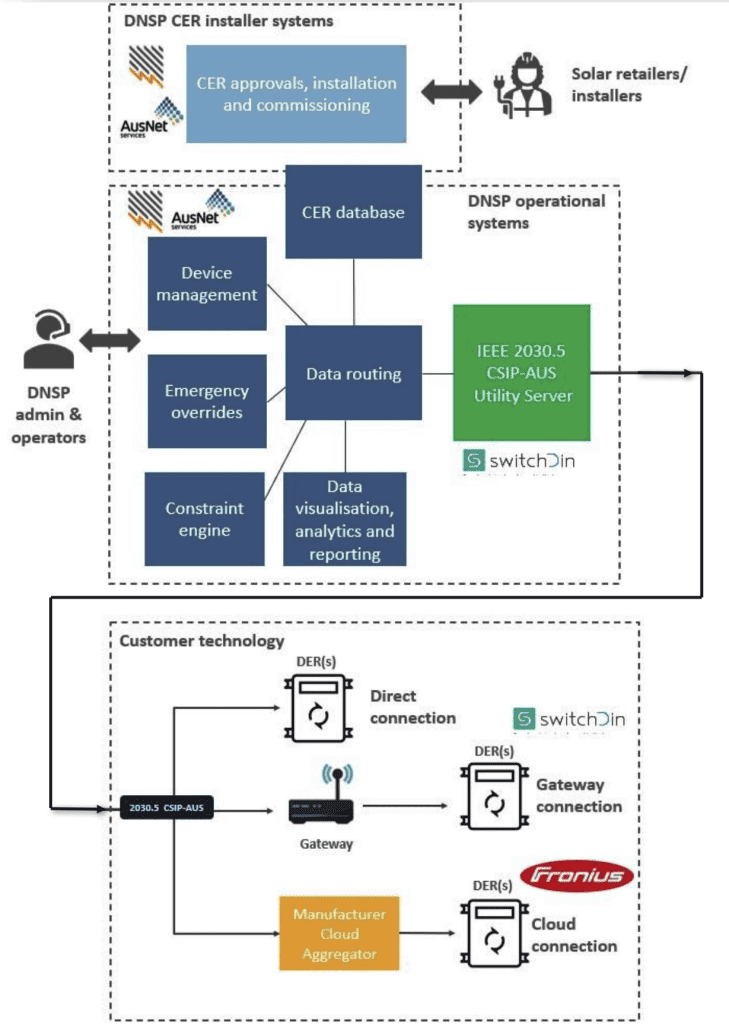
Dynamic connections will use the Common Smart Inverter Profile-Australia (CSIP-Aus) communication protocol, an implementation of the international standard IEEE 2030.5.
This standard enables inverters to send and receive signals to and from the network servers in a standardised format. There are three options for the communication between the inverters and network servers:
- Relevant agents: use a gateway device with an internet connection to communicate with network servers, and use the inverters’ Demand Response Mode (DRM) ports to control them.
- Direct connection: Network servers can communicate directly with the inverter over the internet using the CSIP-Aus communication protocol.
- Aggregator cloud (inverter manufacturer, retailer or energy company): Network servers communicate with the aggregator cloud servers via CSIP-Aus protocol, which then controls the inverters.
The figure below demonstrates these options (reference: South Australia Power Networks Flexible Exports Trial):
In some states, dynamic connections may increase installation costs if they require extra hardware or labour.
What About Dodgy Internet?
Some of you may be asking: all these options rely on internet connectivity, what happens if my internet connection is not reliable, or perhaps the site/inverter can’t be connected to the internet?
While the internet is down, the systems must revert to a default fallback option: a 1.5 kW static export limit.
If your system doesn’t have an internet connection, it will require the static export limit (remember, this applies only to new installations or upgrades).
How About Batteries?
Dynamic connections also apply to grid-connected battery systems. If you have a large enough battery, much of your excess solar generation will go to charge it, reducing exports; therefore, any static or dynamic export limit will have less impact.
For more solar news, subscribe to SolarQuotes’ free newsletter to get it emailed to your inbox each week.
 About Baran Yildiz
 RSS - Posts





great article, and for me in NSW with a new big battery, very timely decision by “the system” to vary the current max exports.
The last paragraph ssys that it will have little impact on those of us who have batteries.
I have to disagree as we will now be able to export 10kW at peak time and get a better return on investment ….which will help defray the predicted increase in poles and wires charges.
Bring it on.
The figure of 13% of energy produced via private PV may be a bit too low, at least if we look at the governments prediction of managing 92% of RE by 2030.
That optimistic prediction is assuming a 17% participation via private PV contributions according to an email I received from the CSIRO.
Last 12 months: rooftop solar contributed 13.4% of energy to the NEM: https://explore.openelectricity.org.au/energy/nem/?range=1y&interval=1w&view=discrete-time&group=Detailed
Technically true but pretty misleading. Looking at NEM yearly figures, weekly averages range from about 7% to just shy of 20%. And that generation is of course spread across the dawn to dusk window when solar, usually, provides some degree of power.
A power grid cannot be built upon averages however, it must be built on minimums, and consider edge cases. Coal for instance, using the same NEM yearly figures, supplied anywhere from 44% to about 58%, and yet daily figures show it supplied 33% to 77% of power, depending on hour.
Given coal is, relatively speaking, a stable and reliable form of power, determining solar capacity required to equal coal output over time is complex to outright impossible – ∞MWh of solar capacity will produce about 0 MWh at midnight.
Hi John,
The price of lithium batteries fell 99% since 2010.
Coal is promoted by immoral people seen at the bottom of the links below
Port Augusta had double average lung cancer rates.
Its the workers, nearby residents & kids downwind, they subsidise coal;
with their very lives.
https://www.adelaidenow.com.au/news/south-australia/port-augusta-is-sas-cancer-hotspot/news-story/d2ed7532527bf669df9666b933dc7cd9
https://www.amsj.com.au/black-lung-parliamentary-inquiry-kicks-off-today/
https://www.abc.net.au/news/2019-02-26/dozens-of-new-black-lung-cases-qld-advocates-say/10851482
https://www.qao.qld.gov.au/reports-resources/reports-parliament/addressing-mine-dust-lung-disease
https://www.newcastleherald.com.au/story/5950821/piper-backs-independent-review-of-damning-lake-macquarie-report/
https://www.abc.net.au/news/2019-03-11/crabs-lake-macquarie-nsw-contaminated-with-cadmium/10887750
https://electrek.co/2019/12/18/bob-murray-science-denial-instead-coal-workers-wages-bankrupt/
Could you explain when and if a static 1.5kw export would be better than a variable export, on say a 6.6kw pv array or a 13,2kw array?
If the FIT is zero it matters not as stated apart from possible installation costs,…when would installation costs be higher?
Looking forward in your crystal ball, can you see and advantage of one or the other that is not apparent now?
Tim, my take on Export limits is that when one considers the peak export happens between 10am & 2pm generally, it really matters to have generation optimised for the periods before & after the peak. I feel 30% facing East, & 70% west is good.
I feel the 1.5Kw/phase has one huge disadvantage for the grid: It will not allow real input into a PP relationship: 3Hx1,5Kw, when one could be feeding 20Kw to the grid & replacing Coal/gas generation. Perhaps what should happen is to allow the PP to sell the excess power over the 1.5kw limit: that would mean the householder can sell the excess, but the PP manager actually manage excess power to the grid because they will be selling into a wholesale market, so market conditions would dictate buying power from consumers. I feel this could be a win-win.
Help!
My grid operator (Endeavour, NSW) is switching to flexible exports as default connection for all new installations in July 2026.
I’m about to install a solar panel system with Fox ESS eq4800 battery and Fox KH 10kWh inverter. I asked my installer if it would be compatible with flexible exports and he wasn’t sure.
Apparently it requires Demand Response Mode and the following is stated on Endeavour website:
Inverters that are on the Clean Energy Council’s approved inverters list that have a Software Client (that is, a communication channel that is compliant to IEEE 2030.5 CSIP-AUS, either hosted locally on the inverter or a gateway device, or via a certified cloud connection to Endeavour Energy’s utility server) are eligible for flexible exports.
Can you help, would my inverter be compatible?
Hi Henry,
See that your machine is listed here :
https://cleanenergycouncil.org.au/industry-programs/products-program/inverters/approved-inverters-csip-aus-v1-2
Thanks for reply. The Fox ESS inverter doesn’t seem to be listed there yet BUT isn’t that the newest standards?
The Endeavour website mentions compatibility with “IEEE 2030.5 CSIP-AUS”, so where do I find out for that specifically or is that the same thing as v1.2 on the CEC website?