
 As the petrol crisis encourages more and more Australians to go electric, we’re increasingly seeing the rise of the two+ EV household. So how do you go about charging two cars?
There’s no straight answer to charging an EV because what works for you won’t always work for your neighbour.
However if Mum and Dad have both gone electric recently, it’s reasonable to ask how to manage fuelling everyone’s mobility. If employment, cheap electricity and after-school sport schedules aren’t very flexible, getting your car charged could be a challenge.
But there’s more than one way to skin a cat, and with any luck you won’t need to spend $1500+ to double up on the wiring.
Electric Vehicle Supply Equipment
In the eternal war of jargon against useful communication, the techno babblers have decided EVSE is how we should describe car-charging hardware. Common terminology might roll off the tongue better but “car charger” is so general it can become confusing.
In reality these things are a glorified extension cord, but if you’re new to electric vehicles, it might be worth reading some of our Frequently Answered Questions because we’ve been helping people and writing up the examples for years now.
There’s 3 basic types:
- The “granny charger” which just plugs into any one of a few million power points anywhere in the country.
They’re the slow but universal device that doesn’t always come as standard with your EV. - Type 2 AC charging which many people have at home or you’ll find in car parks for shops, wineries, motels etc.
They’re the medium speed “destination chargers” which you may need to bring your own cable to use. - DC chargers featuring a big heavy cable that’s always tethered to the station. Usually found in public fast chargers, these can put out enough electricity to power 20 houses at full load, which means you can be back on the highway in about 20 minutes. While smaller DC chargers are available, there’s seldom a good use case or budget for them at home.
Granny Is Good
Last I checked, the majority of Australians are applying the KISS principle1 to EV charging – they’re just using a standard power point.
Plugging in and trickling 2kW (or about 15km range per hour) appeals to tight arses like me and provided you’re not doing astronomical mileage, it works pretty well.
In the case of multiple cars, the challenge might be reaching the second car with the length of the car charging cable – using an extension cord isn’t out of the question, provided you’re careful.
You can also add a some basic smarts by switching the granny charger on or off using a timer to align with a “free hours” retail deal or a sunshine circuit to harvest solar. For a retiree or stay at home worker who does the school run, you’d need little else.
Proper Charging
A type 2 AC car charger is really what we should be aiming for in every driveway or daytime parking space.
- Reliable, fit for purpose, secure and weatherproof connections
- Properly controlled by the network for grid stability in times of emergency
- Automatically set to best use your own solar
Perhaps the best motivation for a proper AC charger is economic. It’s in your best interest to make use of whatever retail tariff you have available and having a charger you can program gives you the ultimate power.
As with granny chargers, one challenge with sharing a type 2 EVSE between multiple cars is that some with their own tethered cables aren’t long enough to reach the second car. Get an untethered EVSE so you can buy a charging cable long enough to reach both without having to pull cars in and out.
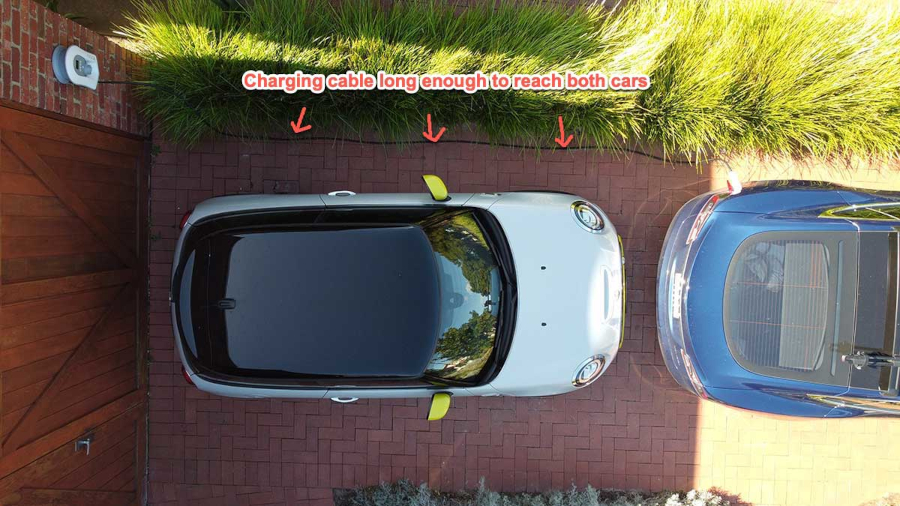
Having a cable long enough to reach both cars in a driveway is priceless.
Juicing The Grid
Before thinking about a second charger, you want to look at how much power you have available. Electric vehicles are the biggest load you’ll ever plug in at your place and they can tax the connection you have with the grid.
For example, 80% of Australia’s east coast has a single phase supply. While old houses may have only 32 Amps, or perhaps Victorian homes with a gas connection could be 40 Amps, the standard capacity is 63 Amps.
63 Amps multiplied by 230 Volts means your typical house has 14.5 kilowatts available, and two EVs could use all of that power, leaving nothing for the rest of the house.
Most EVs start at 7kW of charging capacity, and if you have 3 phase that can jump to 11kW or 22kW.
Sharing Your Power
Whether you have one EVSE or more, what you really need is smart hardware that dynamically controls charging power so you never overload a circuit. Or at very least a smart installer who can set the maximum charging rate with a hard limit.
“Powershare” is what it’s called in Tesla terminology. Imagine you’re cooking tea, air conditioning and charging your house battery, these could be 2kW + 2kW + 5kW loads respectively. Consumption (and possibly solar generation) would bounce around from minute to minute, but the EV charger needs to soak up what it can without going over 5.5kW and blowing the service fuse.
Sharing A Circuit
If you have an EV charger, using 10mm² cable or more, protected by a 40 Amp breaker, there’s some headroom in the circuit design to reliably run a 32 Amp/7kW EVSE.
You should be aware that many sparkies, and even massive hardware chains have underspecified 6mm² cable for this job, and it’s really sailing too close to the wind.
However the same sharing concept can be applied to give you two EV charging sockets on one 40 Amp rated sub circuit, and the advantage is of course a lower installation expense and better utility.
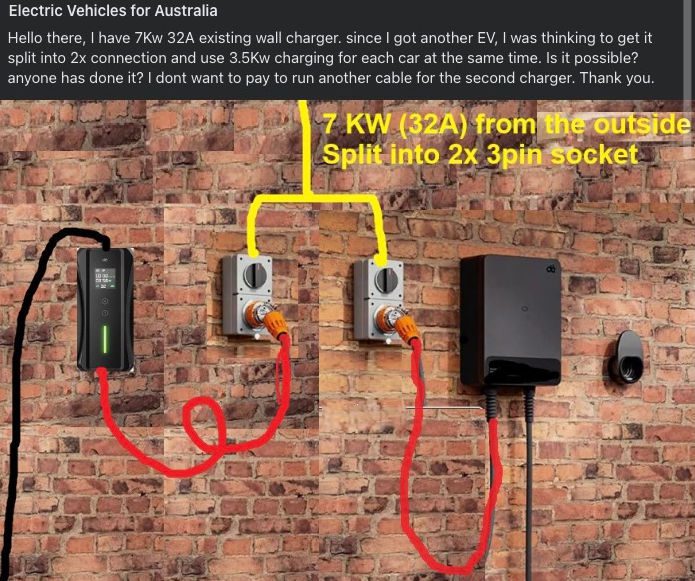
A post from the Electric Vehicles for Australia Facebook group offers an idea, but it would probably be best if each EVSE had their own circuit breaker in a small sub board enclosure, though industrial plugs make sense in some applications.
Most EV chargers I’ve dealt with can be dialed up or down to suit standard circuit ratings, ie 6, 10, 16, 20,25, or 32 Amps. So during commissioning you can choose a combination that keeps the total load below 40 Amps.
I always advise that the best EV charger is one that’s tied into your solar, or particularly your home battery system. Having it all under the same brand ecosystem and monitoring app gives you visibility plus the best chance of getting everything to play nicely together, because draining your home battery into the car isn’t usually the best outcome.
Weigh Up Speed, Convenience And Expense
If you have a small roof and an appetite to use cheap grid electricity through a limited time window, getting a 3 phase connection can be a great advantage. When the special 3 hours of power tariff is available, you want to be able to suck it down quickly, and the same principle applies to having a big solar power system. The old adage rings true, make hay while the sun shines.
Your EV might also make the choice for you; say you have a 3 phase supply:
- The BYD range generally has a single phase on board charger
– so Mum’s car could have 20 Amps (4.6kW) made available to it. - Dad’s 3 phase Cupra could be dialed down to 16 Amps
– across 3 phases that’s still a healthy 11kW
I’m great at spending your money, so of course I’ll recommend the best performance package. If you’re not so keen on overkill, but really value reliability, two EV charging sockets on the same supply, configured to share the available power, might just be the ticket to durability and domestic harmony, because nobody wants to be playing shuffle shenanigans in the driveway at midnight.
If you’re thinking of investing in a home EV charger, whether it’s your first or second, take a look at our dedicated home EV charging guide for some tips.
Footnotes
- KISS means Keep It Simple Stupid ↩
 About Anthony Bennett
 RSS - Posts






After a bit research, I have found you can get portable low amperage type 2 chargers, IE can run off standard 10 or 15 amp outlets. . Basically a granny charger that is smart and can be programmed / controlled from an app. This interests me as my primary charging method when I get my planned EV, as my detached garage only has a 36 amp board.
Many with a 15A GPO or two are likely to have them in the garage, for a welder, etc. Mine went between the garage doors, so can supply 3.6 kW to charge the little electric excavator (my 2nd BEV) in the left bay, while the Victron EVSE charges the MG4 on the right, both within 3m.
A 46 kWh house battery allows overnight charging of the mini excavator (18 kWh battery), even off-grid – needed as I’m burrowing through 1.7 km of 2-3m high weed scrub, 3m wide for fencing access, so the machine comes home well down each evening, like its 73 yo driver. (The MG4 charges during the day, as it’s stabled then.)
Needed the welder this week, though, to strengthen the 50 yo tandem trailer for hauling the 1.2t excavator back & forth. Loading popped another joint. 100% off-grid MIG welding & plasma cutting is climate resilience on a stick.
A 15A GPO + a 3.6 kW in-line charger is cheaper than a level2 EVSE, and a quite good 2nd unit. And if you already have the 15A GPO … 🙂
A combination of two “granny chargers” and one Type 2 suits us. When we have sufficient excess solar (going to grid) I try to charge at least one of the EVs via a 10A GPO. Otherwise I charge during off-peak times. It helps having a smart 240V outlet with sufficient capacity for hours of charging at 10A.
If a “fast” charge is needed I use the Type 2 charger (that is wired upstream so it doesn’t drain the Powerwall system). I can program timing/current via the car and/or the charger to take advantage of cheap rates as well as avoiding peak rates.
As I have mentioned in another blog, with trickle charging I don’t mind if the car draws some energy from the Powerwall, due to say passing clouds, provided the rest of the day is likely to be sunny.
It works with minimal automation.
Michael, I’m with you. “Surplus solar only” charger smarts is slower than charging at full whack on a cloudy day, and letting the battery fill the cloud gaps. The fuel cost saving of more than $1/kWh amply covers battery wear cost, around 5.8c/kWh in my case, if memory serves. Worse, the apex-backwards “smarts” fails to give the BEV as much range if the sun sets before it’s done.
My 46 kWh house battery has only done 89 cycles in 2 years anyway, so it’ll age out rather than wear out. Might as well use it. The cost is the same.
+1: we have a 7.2Kw ZJBeny OCPP on a 32A power outlet, & a 15A Granny charger on a separate 15A circuit. The OCPP charger is dialled down to available power. We are on a 2 phase supply, with 3 dwellings. Our battery manages grid spikes, but the chargers atm run from the grid side. Unfortunately, a re-jig for our new battery means the link cable for the chargers will be re-allocated to the SolarEdge inverter for PV management, so EV charging will then be totally managed by Home Assistant.
Query: is there an OCPP Granny charger available? (I know I could build/adapt one, but easier off the shelf.)
A trickle charge in North America is 80% of a 120 volt x 15 amp supply. About 1.44 KW, 7 KPH on it’s best day, and less than the battery heater needs, on a cold day.
You might read EV comments from the U.S. or Canada that charging from a wall plug takes forever, so you absolutely must have a 240 V circuit. Not forever, if you park in a warm garage and do less than 80 km a day in summer / 50 km in winter, you’d be fine.
It’s 22 C this 21st day of Spring, but Saturday’s forecast for Calgary, Alberta is for a high of -2 C, low of -7, and snow.
Randy,
You seem to have more Global Heating safety margin than most. We had 27°C the other day, half way through autumn, a frigid +14.5°C top soon following. That’s in coastal Gippsland, bottom end of mainland Australia.
The off-grid 27 kW solar array amply supplies room & water heating, cooking, 2 BEVs, welding & farm machine shop. Summer total overcast seems far more frequent than half a century ago, but autumn & winter clear up enough to outweigh lower sun angle, and 40° equator-ward panel tilt boosts winter yield.
As the world goes entirely electric, the higher energy flows will doubtless move 120Vac’s acute limitations to the history books. (Never made it here, thankfully.)
I’m hoping the El Niño / drought nexus breaks on increased global heating, as the prophesied imminent Super El Niño is otherwise a serious problem with fertiliser & ful shortage already promising reduced food supply. Current US drought is untimely, though. Interesting Times!
Erik Christiansen: – “I’m hoping the El Niño / drought nexus breaks on increased global heating…”
Planet Earth is currently heating at the rate of an energy equivalence of over 12 Hiroshima-magnitude nuclear bomb detonations per second (Hps), or over 1 million Hiroshima-magnitude nuclear bomb detonations per day. Oceans are currently heating at the rate of an energy equivalence of nearly 11 Hps.
https://climatecasino.substack.com/p/earth-is-heating-at-a-rate-of-over
While ever the Earth’s Energy Imbalance (EEI) remains in a net energy gain state, then planet Earth will continue to warm.
http://www.columbia.edu/~jeh1/mailings/2022/EarthEnergyImbalance.22December2022.pdf
NOAA’s National Weather Service Climate Prediction Center published on 9 Apr 2026 the latest “ENSO Strength Probabilities” forecast.
https://bsky.app/profile/climatecasino.net/post/3mj2yxkc45c2g
Will a strong El Niño drive the next Australian summer (i.e. 2026-27) to record hotter extremes?
Geoff: “Will a strong El Niño drive the next Australian summer (i.e. 2026-27) to record hotter extremes?”
Indubitably, if as strong as predicted, I would aver.
My point was that at higher average global temperature, higher evaporation rates cause higher precipitation, and we might cop enough of that here to keep the grass greener than in cooler El Niños. The current drought in Texas & California hints to me that things are not as they were, and all bets are off, including the inevitability of extreme drought here in a record El Niño.
It’d be kinda handy not to have reduced food production all over at the one time, as there’s enough supply uncertainty already, in all but sun and wind.
But will the record heat conditions and their consequences help slow learners realise the folly of building a $10B oil refinery for just a few years use before we cross +2°C, and its threat to life as we know it becomes even clearer?
Erik Christiansen: – “But will the record heat conditions and their consequences help slow learners realise the folly of building a $10B oil refinery for just a few years use before we cross +2°C, and its threat to life as we know it becomes even clearer?”
Where would sufficient quantities (i.e. 40+ years worth) of suitable crude oil come from to feed this proposed refinery?
Alison Reeve, energy expert from the Grattan Institute said:
“I mean, when you look at the proven and probable amounts of oil reserves that we’ve got at the moment, and when we also throw in what we call the contingent reserves, which are the ones which aren’t commercial, but we think we can get them out of the ground; you add all of those up, that’s about 2 years worth, right, of fuel. There just actually is not that much oil out there.”
https://youtu.be/1NBH_E9xIhw?t=485
No one seems to be asking: What’s the breakeven fuel prices for these proposed refinery & oil developments?
Australia maybe needs storage capacity more than anything. If the country had six months’ supply of diesel in storage instead of six weeks, no-one would be all that alarmed today.
In Alberta about 35 years ago, there was a sudden surplus of “winter” diesel that a refinery was practically giving away in the spring switchover. Farmers bought “400 barrel” oilfield tanks and some had cheap fuel for a couple years, then sold the clean empty tanks for more than they’d paid.
Burning fuel to get around within cities is just crazy. Maybe we need these high prices.
Geoff: “No one seems to be asking: What’s the breakeven fuel prices for these proposed refinery & oil developments?”
And as amortisation must be achieved in a decade, 15 years at the unlikely most, the resultant fuel price can only accelerate BEV adoption precipitously, hastening the end of ICEV production as that too becomes uneconomic due to the already dwindling global sales volumes falling off a cliff.
Yes, OK, the extant ICEV fleet is still large enough to support massive petrol sales longer, but it will be junked at a rapid rate, as escalating fossil fuel cost and diminishing supply make it increasingly painful to be driving obsolete technology, abandoned by everyone preferring lower cost and markedly superior driving comfort.
If you want to holiday in a caravan, hire one at destination – that saves the mad cost of buying one, then paying the crazy cost of towing the damn thing to hell and back. I’d spend the saving on a BEV with > 600 km range, still pricey … this year.
Randy Wester: – “Australia maybe needs storage capacity more than anything.”
Storage only delays the inevitable!
The Strait of Hormuz is closed (again). Since the Strait of Hormuz has been closed, 11-15 Mb/d (depending on various reports) of crude oil + condensate supply has evaporated from international markets. Pre-conflict, the world produced about 86 Mb/d of crude oil + lease condensate, of which only about 40 Mb/d was traded on international markets, while the remainder was consumed domestically by producer countries.]
Global fuel consumption continues, but afloat & onshore petroleum storages are being depleted at a rate of at least 8 Mb/d, perhaps more. Some estimates for global observable oil inventories (afloat & onshore) are now below 4,700 Mb. Global crude oil inventories haven’t been below about 4,400 Mb.
https://youtu.be/cGQVhnP0POE?t=201
The world will soon be forced to make do with substantially far less crude oil & petroleum fuels.
We still get the odd 40 C summer day around Medicine Hat. And -40 C winter nights occasionally. Manmade lakes and irrigation from mountain snow melt that let us grow trees, do moderate the extremes measured before 1900.
120 VAC outlets are not going away. Almost no appliance or power tool draws high current now that they’re rechargeable. USB-C is enough to charge a lot of them.
All our houses have 250 volt panels, the “120 volt” circuits are drawn off one side of a centre-tapped transformer, with the centre tap bonded to earth.
Our house has a 200 amp x 250 volt service, so theoretically with the right smart panel I could draw 80%, 40 KW. Add 20 KW of solar and a home battery, and 60 KW wouldn’t be impossible. Except the car’s limited to 12 KWAC.
But since I’m too cheap to call in an electrician and too lazy to learn how to do it properly myself, my car charges at 1,440 Watts, and the app says it’ll be at 80% from 40% in just 23 hours, 5 minutes.
Randy, sounds like you are in Ye Olde US of A, Here in Australia, we are governed by restrictions on what we can personally install. Our primary voltage is 230/240v. 3 Phase is 380/415v. Single phase is usually restricted to 68A maximum. When one gets big loads such as A/C, power management when you add EV charging becomes an issue.
Hi Doug,
Randy is our resident polite north american and we love his input. It’s a reminder that cold countries exist and some of them are forced to share infrastructure with the USA.
At least the yanks don’t turn up to the commonwealth games… 😉
Yep, in “sunny” Alberta Canada. And the snow is lessening, hopefully they’ll have rescued the rest of the people stranded along Hwy 93 to Fort MacMurray by now. 300 vehicles trapped in deep snow, with a couple tractor-trailers sideways across the road.
60 amp single phase service would be pre 1970 here, Plenty for a house with gas heat, hot water, clothes dryer, and stove. Air Conditioning was unheard of, not because it wasn’t 40 C in the shade, but because houses had basements to escape to in summer.
Yeah, we do residential, single-phase 250 volt, up to 400 amps for a larger house with electric heat. Almost no house here has 440 volt 3 phase, that’s for apartment buildings and commercial.
Remember when you’re trying to get a house down to 20 C and it’s 38 C outside, that’s an 18 degree difference. We’re trying to heat UP to 20 C and it’s -40 C out, that’s a 60 degree difference. We use electric engine heaters just to get a car up to freezing so it’ll start.
As far as storage &/or more refineries go, I feel it is a pity that the Govt has not wound back FF subsidies. If this money was re-distributed to FF replacement, we could have farms with their own generation & storage, then smaller robotised tractors working 24/7 (lower noise!) with interleaved charging. Excess farm power could be sold to the grid. A win-win situation.
Come to that, why is Australia not making Ammonia, a feedstock for fertiliser? In the current times that would be a good plan too. We have access to the rest of fertiliser feedstock, & at one time did make fertiliser (Urea).
Seems to me the ALP Govt is sitting on their hands!
Yeah… subsidies. If you call it a subsidy when everyone pays 52 cents a litre in fuel tax for roads, but farmers who use the fuel in a tractor off the road get that tax back, then there’s no discussing it rationally.
Small tractors running to and from the field works on a small farm that’s in one block. Any larger and you’ve got a heavy, autonomous, slow moving vehicle travelling for miles on public roads, using a big chunk of the energy just getting there and back, and somehow hooking up / unhooking from implements all by itself? It’s not going to happen, at least not soon. The economics and physics are against scaling machinery down. forty little tires cost more than four big ones, and it’s true for bearings, shafts, gears, motors, wires, etc. all the way through. And try to imagine something the size of a lawn tractor coping with ten-foot corn stalks.
Excess power sold to the grid… Sure, farmers do that now. and it’s worth what in mid-day now, 3 hours free?
I think one other consideration for getting the faster home chargers is the vehicle itself. On BYD vehicles they recommend once a week charging to 100% so battery management system can correctly balance cells. Then once every 3 to 6 months they want a below 10% to 100% charge to fully rebalance cells.
If you need to do the above with a 8A charger that comes with the car you’re going to be waiting a long time without use of your vehicle.
For us, the combination of the above + maximising solar and low cost rate periods meant it made a lot of sense to install a 7kW charger.
BTW: We use home assistant to control the charging so can balance with other household needs using the OCPP features of the charger.
Interesting Allan, think that’s for BMS calibration purposes too, so range estimating doesn’t get out of whack.
Same for Tesla LFP, though the X we are driving uses NCA and best kept around 80% for most driving.
As is fairly typical in Australia, workplaces and business more generally seem to be the slowest to lift their game. Most workers have very few options to charge while their car sits outside all day at work, or when they go shopping. A business with a bit of nous could even make money out of it.
Instead we’re having to subsidise households to install home batteries to use huge midday grid surpluses of an evening.
So I thought i would like a house battery to reduce the cost of purchased power, but it appears that it will take 14 yeas to pay back the cost at the rates the installers want,… but for a modest amount more I can buy a battery on wheels, which usually stays where i am using power at night, and during the day it can charge off my surplus rooftop PV even while the house is running timed appliances , hot water etc.
What will I need to operate this method, and is it more cost effective to not have a home battery at all and bear a small amount of purchased electricity each year, while using the car for backup and travel? Thoughts or examples where this will work?
Hi Tim,
If you get the right EV it’s simple enough and quite legal, but not 100% automated. You have to plug in the right lead to charge or discharge. We wrote up an example here under the name HOEM.
I think Kia have the highest output capacity with a 3.6kW onboard most models?
Otherwise there are proper bi-directional DC chargers coming to market which use an inverter on the wall, not on board the car. They’re a bit pricey and will need network approval but that’s where things are headed.
Search the blog for V2X, V2G or V2H
Question: Is it legal to plug a V2H into the Generator input of a Deye inverter?
I think it might not be, but cannot see a reason why? Of course, that would only be one direction, not V2G, which is bi-directional.
Hi Doug,
The issue is one outlined in AS4509 for memory, that is you’re not allowed to plug in a generator to a multitude inverter.
Rules say they must be hard wired, but it’s a rule that’s been routinely ignored for decades.
Reasoning is twofold. The generator must not have an MEN in parallel with the MEN in the switchboard. (You remove the link when hardwiring)
And the authorities don’t want any chance the multimode inverter might malfunction, leaving the pins of a caravan inlet socket as exposed live parts.
Some sparkies make isolating contactor setups and/or use special “touch proof” plugs which are a technical solution, but not strictly approved.
I suspect a type 2 AC charging lead tethered to your inverter system would be touchproof and quite safe, but the standard just doesn’t cover it.
Geoff: “Storage only delays the inevitable!” [fuel storage]
Well, we can see that, but can the pollies? A fair bunch of motorists will have to learn it by experience too, ‘cos it all came good again last century, dinnit?
Backed up wells bunging up, and redrilling probably becoming uneconomic as BEVs displace fossil motorists, and bombed refineries (Both Hormuz and Black Sea + Baltic, due to Ukraine’s 40% destruction of Russia’s exports – so far), may never be reinstated. The only profitable way forward for oil companies now is to run down existing oil infrastructure, with minimal maintenance expenditure, to milk the slow learners and impecunious who are slow to transition to electric mobility security and its growing cost savings.
Ostlers and wainwrights vanished overnight a century ago, and farriers support mostly vestigial hobby activities now. The EV transition seems slow so far, but the S-curve snaps over in the middle. Tractors will lag a bit, though.
Hi Eric,
I’ll argue that your loacal wainwright probably became a motor garage, and sold petrol from 4 gallon tins delivered in wooden boxes.
And the Ostlers probably learnt to wrangle tyres, because horse shoe nails made punctures a *very* common problem.
In any case changes are afoot I agree.
Yup. I’ve read that “motor spirits” were first bought at “drug stores” (chemists), when the first handful of motor cars ventured out across America. But volume rapidly created “gas” (petrol) stations. Those who stopped shovelling horse dung, and switched careers would have done best.
I champ at the bit, watching the hesitation this time round. The stakes are so much higher, the need for speed in dropping emissions seemingly forgotten as avoidable pressures lower living standards, needlessly reducing people’s ability to adapt as needed.
A 25% gas export tax could fund public chargers and BEV loans for the impecunious. We could ride out this tumultuous transition in a more effective and egalitarian way, if authorities did not so obstructively pander to foreign corporate greed.
Loans to truckers, to go BEV, could divert diesel to food production – at risk in coming months and years, as full fossil fuel supply may be gone forever. Govt admits to no long terms plans. That’s unwise.
Erik: “I champ at the bit, watching the hesitation this time round. The stakes are so much higher…”
Agreed, but for a different reason. Many of us have huge investments in ICE vehicles. From ‘daily drives’ to specialist vehicles fitted out for a particular use [campervans, mobile cranes, Limos… come to mind]. Then moving upwards to trucks both rigids and semis. There are megadollars invested here. Aside from them burning ‘dinosaur juice’ they are perfectly good vehicles. Perhaps only five years old. Ordinarily with another ten or so years life left in them.
I suppose we could go down the route the Septics did several years back to encourage their motorists into smaller ICE cars: “Cash for clunkers”. However we all know who is really paying for this largesse.
Clive W.: – “Aside from them burning ‘dinosaur juice’ they are perfectly good vehicles. Perhaps only five years old. Ordinarily with another ten or so years life left in them.”
What if petroleum fuels become scarce and unaffordable?
Evidence/data I see suggests to me the world has likely entered into a permanent post-peak oil supply paradigm.
https://www.solarquotes.com.au/blog/do-you-need-another-ev-charger/#comment-1734066
I’d suggest rising fuel prices and less fuel availability will make BEVs much more attractive, and ICEVs are at increasing risk of fast becoming scrap value only.
And burning more carbon-based substances is ‘civilisation suicide’!
https://www.ipcn.nsw.gov.au/sites/default/files/2026-02/Geoff_Miell-PresentationSlides-ChainValleyCollieryConsolidationProject%28SSD-17017460%29-20260216.pdf
Clive,
Janus has for some time been doing BEV conversions on diesel semitrailers. Their initial battery swapping station between Melbourne and Sydney has expanded to a network of half a dozen. Operator fuel savings are probably less than on a new Windrose or Tesla, due to swapping station costs, but truck capex is also much less. Either way, they cannot fail to eat the lunch of stragglers who still pay fossil fuel costs – transport margins are too tight for their survival.
NET (New Energy Transport) is building their own 5 MW charging station, cutting operating cost even further. Diesel trucking is a dead man walking. Give it 5 years? Wanna bet?
BEV cars are now around price parity, but a $24k Atto1 is, on average, *FREE* after 8 years, on fuel savings alone. What genius would buy the financial disaster that an ICEV has become?
Waiting a year to swap costs $3k+ in fuel savings, but BEV prices for more range & features are falling. Pick your sweet spot – while the petrol lasts.
In the long run, yes you could save some fuel by using more electric trucks on intra-city runs. And by switching to EV and plugin hybrid cars.
In the short run, about all you can do, is get everyone to slow down, maybe stay at home more, combine trips, car-pool, ride Transit if you can, keep the tire pressure up, etc. All the same stuff that was in the WWII pamphlets with the ration books.
Canada has a little spare export capacity on the TransMountain pipline, but it might not be much of the type of crude that Aus refiners can process, there won’t necessarily be enough loading capacity, and there’s not much extra diesel fuel sloshing around here in Canada, either. So getting more diesel to Australia from Canada might also take months.
We’re just getting into the planting season in Alberta, but there’s still snow on the ground from a three day snowstorm and it’s -3 C at noon in Calgary.
Hi Randy,
I saw some reportage recently that the mango Mussolini was bloviating about “hundreds of ships” headed across the world to buy US oil.
It’s a statement designed to make an uncritical audience feel good, but as usual it doesn’t pass even a cursory thought.
There simply isn’t 20% extra capacity doing nothing in the US.
Boats are designed for specific cargoes and routes, so forget panamax there are now two larger classes of crude carrier that can’t pass the Panama canal.
Many can’t access ports and need lighter vessels to ferry cargoes to & from them while they anchor off shore.
Refineries are designed for specific feedstock, plants designed for Arab crude can’t process Venezuelan.
Eg After the Exxon Valdez disaster, the boat was repaired but Alaskans refused it access to any port. No good for other routes it was then scrapped.
Trains are great but you need the right gauge rails.
Randy,
Last year’s tripling of the TransMountain pipline’s capacity to 890,000 bbl/day is being bought up hand over fist by SK and China, I hear – and yes, we probably can’t refine the heavy tar sand crude, anyway. But we can doubtless win a share of SK’s refined output, in exchange for our gas exports.
Dropping from 100 km/h to 90 reduces air drag by 33.1%. Deducting rolling friction, the net saving is still around a quarter – not to be sneezed at, I figure.
But BEV drivers are grinners. Bean counters plotting the years when Aussie EV sales crossed 100, 1,000, 10,000, 100,000, are predicting 80% of our car sales will be EV by 2029. Then we will nearly all be grinners, glad to be free of expensive obsolete technology.
Anthony Bennett: – “There simply isn’t 20% extra capacity doing nothing in the US.”
Indeed, the data is undeniable!
Per EIS, US crude oil + lease condensate production in Dec 2025 was 13,655 kb/d average.
https://www.eia.gov/international/data/world/petroleum-and-other-liquids/monthly-petroleum-and-other-liquids-production
Per EIS, US crude oil + products imports in Jan 2026 was 8,173 kb/d average.
https://www.eia.gov/dnav/pet/pet_move_impcus_a2_nus_ep00_im0_mbblpd_m.htm
The US can never be oil-independent because it will always need to import heavier oil to make diesel.
US crude + product exports hit record highs, with total outflows breaking 12.88 Mb/d in recent reports, driven by global demand.
https://think.ing.com/articles/the-commodities-feed-oil-moves-higher-as-peace-talks-fail-to-progress230426/
Meanwhile, US petroleum inventories are in decline. A continued reduction in US petroleum inventories is not sustainable long-term.
Randy,
It’s not just “intra-city runs”. Electric trucks now do single-charge 650 km inter-city runs with a 49 km gross load. Slow-learner diesel trucking operators will go bankrupt within the next ten years, if they don’t follow the high-capex/low-opex lead of fast learners like NET. There’s still time to switch, and e.g. Janus can convert a diesel burner to higher performing electric, where the vehicle is new enough to justify.
Diesel fuelled transport will be eliminated by then, not due to rational awareness of the civilisational damage done, but simply to stay in business. Electric transport is about to eat its lunch. The transitional capex will probably favour big operators through higher borrowing capacity, so small fry might like to jump asap, while diesel trucking rates still apply. It will become leaner, as fuel costs diminish.
It all appears to snap into place faster in retrospect than in prospect, so don’t blink.
Right, the U.S. needs to import heavy crude to give higher yields of diesel. And they get that oil from Canada and Mexico, not the Middle East.
Venezuela has a lot of heavy crude in the ground, but there’s als enough gold in the Earth’s core to cover the world’s land a half metre deep. The trick is to get it out of the ground yhough, eh?
We did a run down I15 through Montana and most of Utah today at the 129 KPH speed limit in a Tesla. The numbers of EVs increase the further south we go. The banks of Tesla chargers get larger and newer too.
The north-south diff is not a co-incidence. The first leg of the trip in Canada was 269 km at 100 KPH at -5 C in snow, and despite starting with 100% our “500 km” Model Y arrived with 7%.
The next leg was 216.2 km through Montana, and despite charging to 92% in 50 minutes at the previous stop, we arrived with 4%.
These machines perform very poorly in the cold, very well where it’s warm. We’ll see how trucks do when it’s not a secret.
Na+ batteries apparently do better than lithium chemistries in extreme cold. A few models now have them, and may be more serviceable in cold countries. Here in mainland Australia, you have to climb a mountain to find snow, so LFP is just great, at least until the elusive solid state batteries land on Earth, to provide a better option..
And 2/3 of the way through autumn, it was 23°C today, down from 27°C yesterday. Ten cloudless warm sunny days in a row now – not great for farming. The electric excavator was running its battery cooling fan flat out for half an hour after I stopped working.
At least a sluggish battery recovers in warmth. The shut-in oil wells and frozen Russian pipelines are never coming on-line again, and middle eastern wells will also be impaired. This last-hurrah oil profit gouge is a great way for oil companies to bow out – it’s their golden handshake.
The massive cost of new drilling and refinery construction cannot be recouped before ICEVs are no longer made.
An anecdote: When I bought my Atto3, we went for a trip thru Victoria in Sept last year. After driving an EV Kona for years, I was surprised by the difference in range with the cold: Charged at ~Seymour to about 250Kms range, thinking I would have plenty to get across to Ballarat: just made it! Almost negative range left. Now much more careful… (It was really cold then).
I live on N Coast NSW, so cold weather ia an anathema for me!
Randy Wester: – “Right, the U.S. needs to import heavy crude to give higher yields of diesel. And they get that oil from Canada and Mexico, not the Middle East.”
The USA can never be oil-independent.
Per EIA data, U.S. Total Crude Oil + Products Imports by Country of Origin, for Jan 2026, in thousand barrels per day (kb/d) average (for some specific jurisdictions):
All Countries: _ _ _ _ _ _ 8,173 _ 100%
Canada: _ _ _ _ _ _ _ _ _4,719 _ _ 57.7% share
Mexico: _ _ _ _ _ _ _ _ _ _ 463 _ _ _ 5.7%
Venezuela: _ _ _ _ _ _ _ _ 200 _ _ _ 2.4%
Persian Gulf: _ _ _ _ _ _ _ _817 _ _10.0%
_ Iraq: _ _ _ _ _ _ _ _ _ _ _ 344 _ _ 4.2%
_ Kuwait: _ _ _ _ _ _ _ _ _ _ 41 _ _ 0.5%
_ Saudi Arabia: _ _ _ _ _ _ 401 _ _ 4.9%
_ United Arab Emirates: _ _200 _ _ 2.4%
_ Bahrain: _ _ _ _ _ _ _ _ _ _ 2 _ below 0.1%
_ Qatar: _ _ _ _ _ _ _ _ _ _ _21 _ _0.3%
https://www.eia.gov/dnav/pet/pet_move_impcus_a2_nus_ep00_im0_mbblpd_m.htm
Some Saudi crude/products exported via Red Sea.
We have owned an ev for 3 years now, and have gotten by the whole time with a 10 amp charging cable plugged in to a standard 10 am power point, except for just a couple of longer trips where we needed to add some extra range via a DC fast charger to get back home. But recently we upgraded to a better “Granny” cable, one that lets us choose from 5 levels of charging rate, all the way up to the maximum 15 amps, and with an 8 metre cable instead of a 5, and this has made the charging process easier and quicker. We had to install a 15 amp power point, but luckity for us it was only a short cable run, and our son is an electician. But I think that for many EV owners, this set up would be adequate, especially to charge a 2nd EV in a 2 EV household, and would likely cost a lot less for an electrician to install that it would cost to have a dedicated AC home charger installed.
Your article is relevant and worth reading re different EV chargers but I don’t think you need to use words like Granny Chargers and examples implying a woman’s electric car can be charged more slowly. I assume you guys – and you all seem to be guys – can easily be more gender neutral in this day and age.
Hi Marilyn,
Point taken but please don’t assume “granny” is any sort of slight.
They’re some of the most powerful people that really need more recognition.
As for Mum’s car being charged slowly, I suspect you’ve taken the technical point about BYD cars only having single phase charging and assumed a common shorthand that Mum would be doing less mileage on the school run?
In reality Mum or Dad can drive any car these days.
+1 for above.
We have 2 of EVs. We have one 7.2Kw OCPP ZJBeny charger, & a 15a power outlet with a ´granny´ charger. We sometimes charge both cars together.
The only issue, as I have said before, is to make sure the 15a plugs do not overheat. If the plug is ring-retained, usually no problem, but the worst case is a charger hanging off the 3 pin plug: Always support the weight of the charger! I use a rope tied to a screw below the power point. Even 10a continuous at extended time can become hot: best to check an connections for heat after abt 1/2 hour on new connections, particularly when use is temporary. One does not want to leave a melted power outlet for the generous person who allows one to charge!
I have the Fronius watt pilot which is portable and have two 3 phase power points, but only wired as single phase- (max 7kW) onein the car port out the back, and the other out the front, a bit of versatility for my wife’s MG EV, but ready for a second EV.
This works well for my current electricity retailer-with free power between 11AM and 2PM- plus solar top-up. And overnight a cheap rate from midnight to 6AM- my wife does a lot of driving for work, so overnight charging is very practicable-getting the one EV has saved us so much money. Because we share it we have gone from filling one of our cars every week to just my Toyota hybrid Corolla once a month.
I’ve ordered that second EV, went for an AIOn- I was surprised they are throwing in an AC charger, capable of delivering up to 22 KW on 3-phase! The AIOn has take that much…..dilemma for me is do I want to pay the expense of wiring the house for 3-phase? I reckon so!
Another anecdote: We’ve arrived in La Quinta, California, and spent the day in 30 degree warmth after a 2 day, 2,500 km drive from Calgary, Alberta.
Back home the snow has mostly melted, except for snow drifts in the shade and the huge piles in parking lots. Everyone will be using heat in their homes every night, just as they have for 8 months since last September.
Here in California we see EVs everywhere. And while at home a hotel with even one charging cable is a bit rare, and charging station with 12 pedestals is huge, we’ve stopped at lots that had 42 pedestals, and hotels with 4, 11 KW AC cables, is common.
Solar and EVs are just getting going. And they’re so much easier, where it’s warm and sunny. But also usable wherever humans live.
Brilliant thanks Randy.
It’s great to get first hand feedback that’s not filtered by algorithms.
I hear some complaints from the yanks about charging infrastructure because many don’t have a driveway of their own to charge in, but it’s good to hear they’re getting on with it.
“Slow-learner diesel trucking operators will go bankrupt within the next ten years”
Certainly there will be changes. But the next thing you’ll see from high diesel prices is an end to diesel power generation, globally. (Except in the Arctic)
The great advantage of electrified vehicles, is regen braking. The great disadvantages are weight, short range, charging downtime, and the cost of infrastructure for high power charging.
So I’m thinking city driving. Deliveries during the day, Transit buses, etc. will out-compete long distance trucking for resources. And people in cities tend to vote clean air for themselves, so they do clean air mandates first.
Long distance transport in North America is by rail for bulk commodities, by truck for perishables. They’ll electrify the refrigeration trailers first, and recharge from the brakes.
On ABC Australia’s ‘Its the Economy Stupid’ this week, I think it was “Ben Potter – Contributing Editor at The Energy” who said that EV trucks are faster over the long haul and so cheaper (apart from the other reasons for being cheaper, like fewer mechanical parts = more reliable). Reason being when it comes to hill a lot of fully loaded diesel trucks struggle, but EV trucks can just power up them – less disruptive to other traffic and faster overall.