
 If you’re getting scalded by the water pouring out of your taps or suffering through underwhelmingly tepid showers, there’s a likely culprit: the tempering valve.
Why Are Your Taps Running Too Hot Or Cold?
Hot water storage systems are supposed to keep water at a temperature of at least 60C to prevent bacterial problems like legionella. However, this is a dangerously hot temperature to be coming out of the tap, where the water temperature shouldn’t exceed 50C.
A tempering valve or thermostatic mixing valve is supposed to mix cold water into the hot to ensure water streams out into your sink or bathtub at a temperature that doesn’t poach eggs.
If your water is running too hot or too cold across all your taps, your tempering valve may not have been set up correctly when the system was installed, or it may have malfunctioned.
If only one tap is having issues with temperature or pressure, it’s instead likely an issue with the tap itself or a localised blockage.
Painful Bills Replaced By Painful Showers
I recently switched from a gas hot water system over to a hot water heat pump. While it felt terrific to stop pouring money down the drain every gas bill (our solar means the heat pump is close to free to run), a new problem emerged: instead of burning gas, we were burning our skin.
I knew the situation was serious when my partner, who likes to shower at the approximate surface temperature of the sun, complained that the water was too hot even for her.
Fortunately, the cause was simple to diagnose and even simpler to fix. When our hot water heat pump had been installed, the tempering valve hadn’t been set up correctly.
What Is A Tempering Valve?
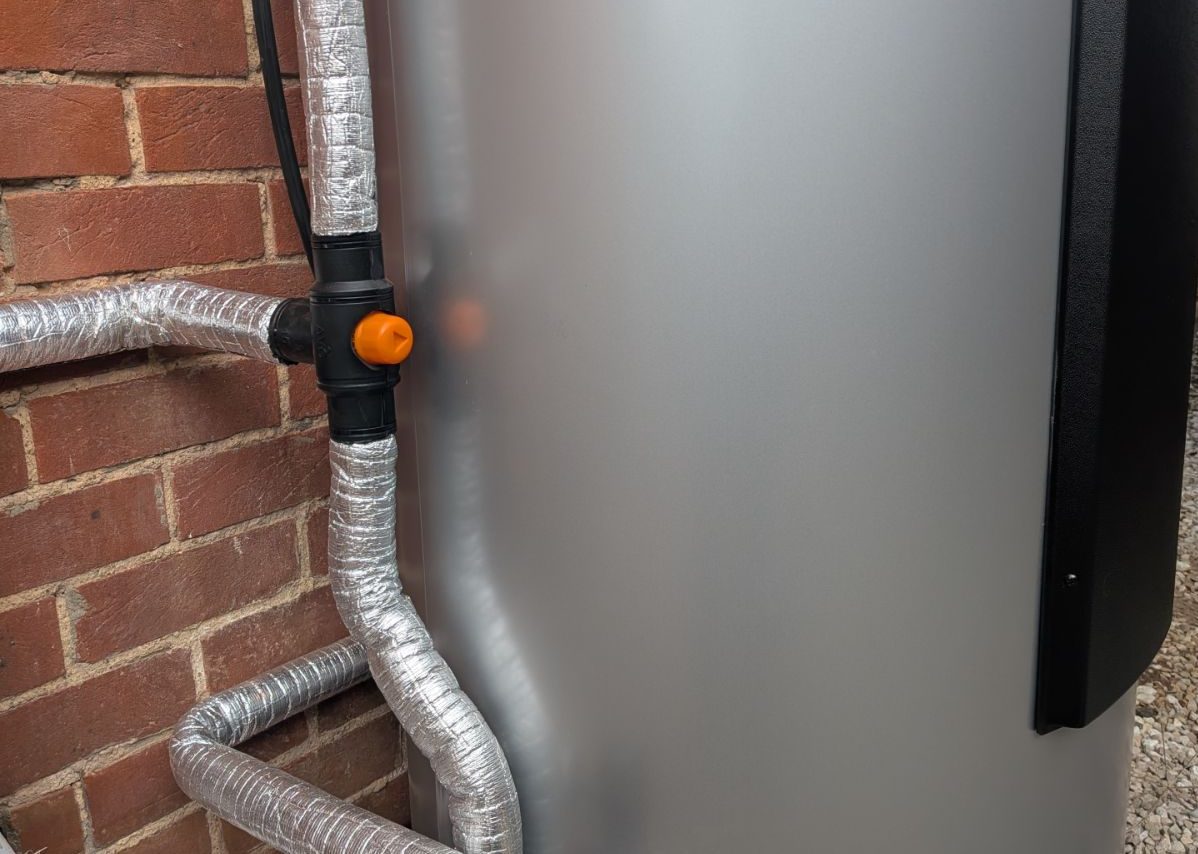
The tempering valve sits at the intersection of three pipes and features a coloured cap.
A tempering valve is a 3-way mixing valve which blends cold water in with the hot water coming out of your storage tank. It isn’t just important for hot water heat pumps – any kind of storage-based hot water system benefits from one.
Tempering valves should be tested once a year to make sure they’re still doing their job – run the hot water over a thermometer to check the water temperature doesn’t exceed 50C.
It is the cheapest and most common way to temper hot water in residential homes. Another alternative is a thermostatic mixing valve (TMV), which costs much more but works with greater accuracy through the use of a sensitive thermostatic element which expands and contracts in response to changes in water pressure or temperature.
TMVs are more common in commercial settings, and are mandatory in high risk facilities such as hospitals & childcare centres.
Although our issue was water running too hot, Tim Johnston, the founder of hot water heat pump installer Powrhouse, says the more common complaint is typically about the water running not quite hot enough.
“Most complaints we get are that it’s too cold, so the valve needs to be adjusted upwards. Most heat pumps are replacing 25-year-old gas systems that probably don’t have a tempering valve at all, and the customer is used to very hot water,” Tim says.
How To Adjust A Tempering Valve
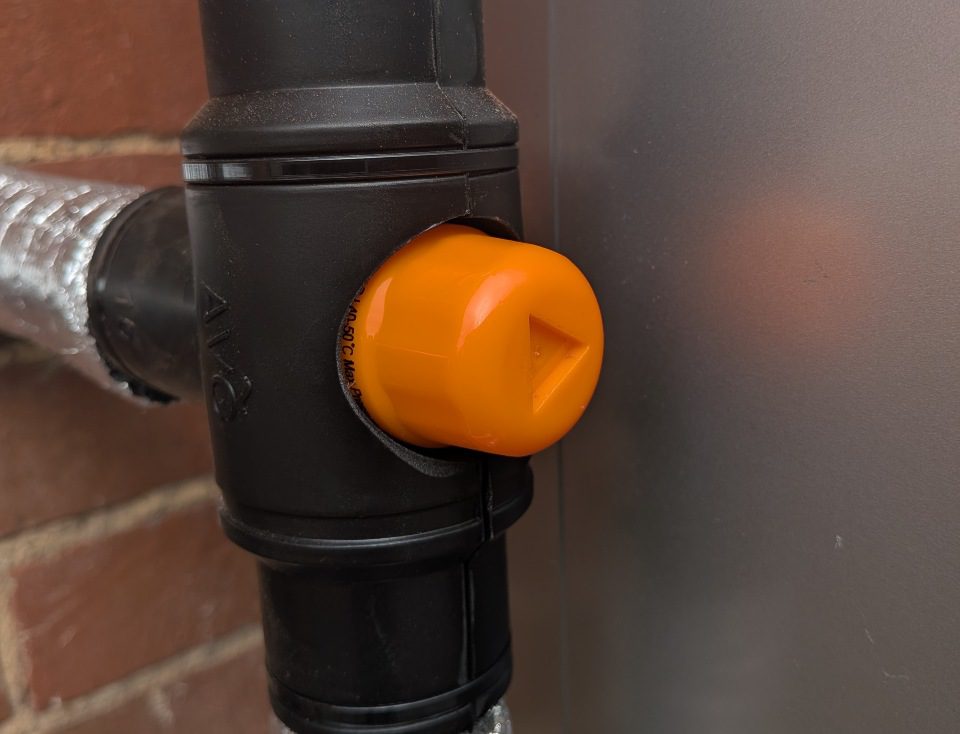
The tempering valve for my system has an orange cap, which is typical for hot water heat pumps.
Your tempering valve will be found at the intersection of piping beside your hot water system. It should have a protective plastic cap, with the colour dependent on what type of system you have – likely orange or yellow for solar hot water or heat pump systems, and blue/green/black for gas or resistive electric storage systems.
Take the cap of the valve off and turn it around so the triangle indent is facing inwards, and use that to turn the triangle-shaed valve towards the side marked C (for cold) to reduce the temperature or to the side marked H (for hot) to increase it.
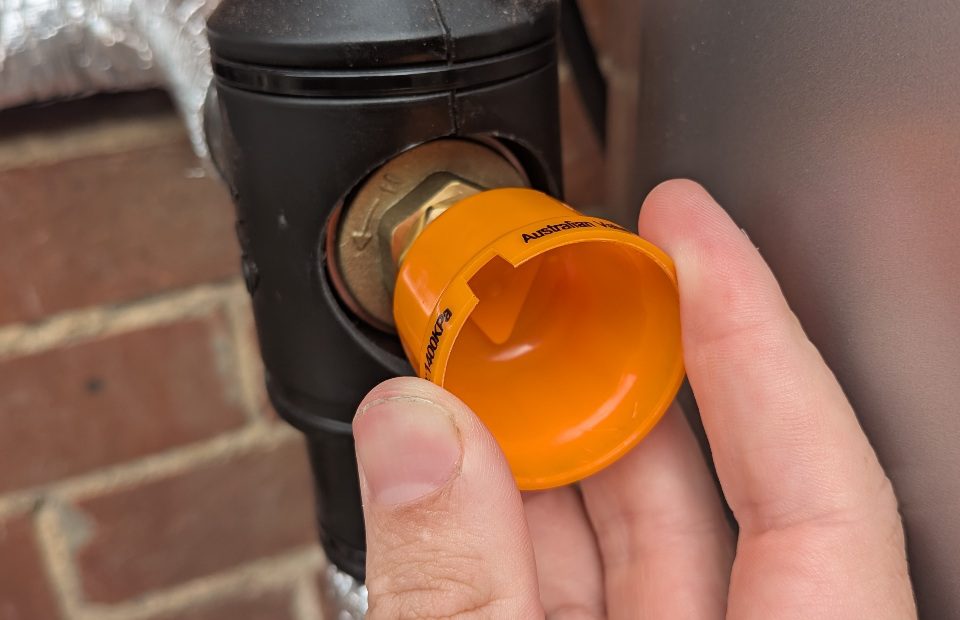
Using the cap to adjust the tempering valve.
You should reduce the temperature to 50 degrees in line with regulatory standards.
To confirm your water temperature, turn the hot water on at the tap, wait until it’s reached maximum heat levels, and run a thermometer under it. Go back to the tempering valve and adjust accordingly if it is still a little too hot or cold.
Regular Checks Of Your Tempering Valve
Once you’ve got it right, run a thermometer under a tap every 6-12 months to ensure the temperature is still consistent – this way you’ll spot if there’s been a tempering valve malfunction or some other issue.
During these periodic checks, also inspect for leaks, drips, signs of corrosion or unusual noises – these might indicate the valve needs to be cleaned or replaced.
Typically, a tempering valve needs replacment every 5 to 7 years, for which a professional plumber is best.
What About Your Hot Water System’s Temperature?
With our iStore hot water heat pump you can check what temperature a hot water heat pump is running at on the touchscreen, where you can also adjust the temperature. This might seem a more straightforward way to sort things out when the water is too hot or cold.
This however is the temperature of the water within the heat pump’s storage tank – as mentioned earlier, you actually want this at 60C or higher to kill off bacteria, and also to ensure the hot water stays hot for longer without constantly having to use more electricity to keep it warm.
So ensure the hot water system itself is set to at least 60C, and make the other adjustments at the tempering valve to cool the water to a more comfortable level.
For more on hot water systems, read our dedicated guide to hot water heat pumps.
 About Max Opray
 RSS - Posts





We replaced our tempering valve last year, 23 years in service, and it started to drip. Still worked fine – just the annoying drip which probably meant it wasn’t long before it became a bigger problem so we had a new one put in.
The plumber was very surprised we were still on the original valve.
I was unpleasantly surprised to find our local council then put their hand in my pocket, $30 compulsory fee for the plumber to register the change in the valve… they dont miss you…
Is it the law that hot water tanks need to be kept at 60 degrees?
I find that difficult to believe.
Heat Geek in the UK which is in a different jurisdiction suggests that 60 degree tank temperatures is required in commercial settings where there is the potential for stagnant (low or no turnover) water storage but not in residential settings.
Yes tanks should be boosted periodically to above 60 to sterilise against Legionella, but keeping the tank at a lower average temperature is more efficient. A hot water tank at 50 degrees has 20% less standing loses than at 60 degrees.
Also heat pumps are more efficient pushing the tank to a lower temperature due to the lower thermal lift that has to be done. The exception to this rule is CO2 heat pumps.
The heat geek blog source for this:
https://www.heatgeek.com/articles/legionella-and-water-temperature-what-you-need-to-know
Australian standards do stipulate that hot water tanks store water at at least 60C, yes
yes, Qld guide here, one would assume other states would publish similar docs.
https://www.hpw.qld.gov.au/__data/assets/pdf_file/0021/11379/installing-temperature-control-devices.pdf
A professional plumber to replace a tempering valve every 5-7years, there’s another 2 or 3 hundreds bucks down the drain and another reason on to the already other reasons for going resistive if you’re sending power back to the grid for peanuts !!
Peter you should have a tempering valve for any hot water storage system, including resistive.
Most people with resistive like the water hotter and regulate it with reqired cold later but if you want it cooler just set the thermostat at the reqired temperature !!
Thanks for your reply !! 👍
Peter Johnston: – “Most people with resistive like the water hotter and regulate it with reqired cold later but if you want it cooler just set the thermostat at the reqired temperature !!”
That attitude risks injury!
Per Australian Standards (AS/NZS 3500.4), hot water storage tanks must be set to a minimum of 60 °C to prevent the growth of Legionella bacteria. While stored at 60 °C or higher, a tempering valve must be installed to deliver water to sanitary fixtures (baths, showers, basins) at a maximum of 50 °C to prevent scalding.
The exception to the 50 °C temperature requirement are premises intended for children, the elderly or people with disabilities – such as early childhood centres, schools, nursing homes or similar facilities. These premises have a maximum hot water delivery temperature of 45 °C.
Hot water systems installed before 5 Aug 1998 are unlikely to be tempered.
https://www.vba.vic.gov.au/consumers/guides/hot-water-safety
it is a requirement for all hot water systems.
When designing my current house, I was moved to specify a tempering valve, not least because of the in-flue water heater on the wood heater. There’s nothing to stop that boiling the water in the HWS, which consequently must be vented. (I guess the plumber would have fitted one anyway, but it pays to keep on top of things.)
Another issue to be aware of is HW delivery failing due to clogged tempering valves.
A recent batch of resistive storage HWSs had sacrificial anodes that when far to reactive. This resulted in hydrogen gas coming out of taps and solid particles produced that clogged tempering valves.
We had to get HW directly via the release valve in a bucket until it was fixed!
I recently changed to a “3 for free” electricity plan which is sufficient time to heat my HWS to the set temperature (65C) in “electric” mode (ie. resistive heating) within the 3 free hours, whereas it takes much, much longer than the 3 free hours to do so in “heat pump” mode.
Will it damage the Heat Pump HWS if I just use it in “electric” mode ? Yes, it’s sort of silly to have a heap pump HWS and not use it in “heat pump” mode.
Would appreciate any thoughts, advice, suggestions. Thanks.