
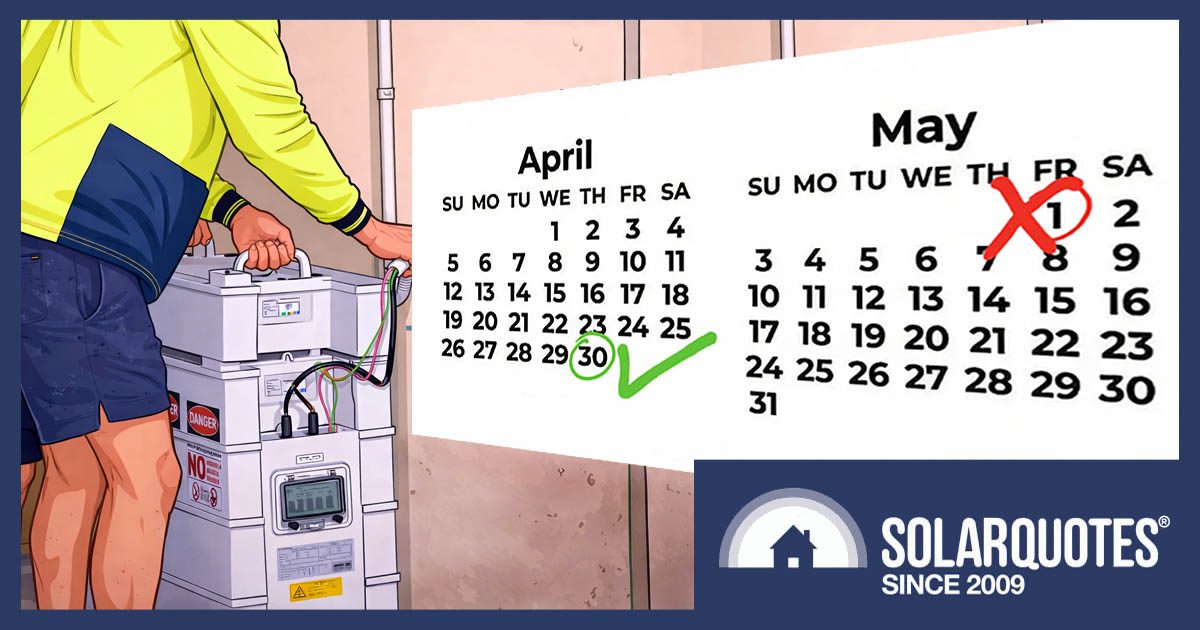
A rush to secure home battery systems ahead of the 1 May cutoff has left many customers dealing with delays that have pushed their installs past the deadline, raising questions about pricing and eligibility. If your system wasn’t fully commissioned by 30 April, you may now be working through what that means for your agreed price, your installation timeline, and any changes being proposed by your installer.
Installers are now operating under significant pressure, with shortages reported for some popular systems including GoodWe, Fox ESS and Sigenergy. As a result, jobs originally scheduled for April are increasingly rolling into May, with some customers being offered revised timelines or alternative equipment.
What Does Commissioned Before 1 May Mean?
The key date is commissioning, not when you signed the contract or paid a deposit. Under the program transition, systems typically need to be fully commissioned by 30 April to fall under the previous settings. From 1 May onward, installations are assessed under the new rules.
If your system wasn’t completed in time, it will usually fall under the post–1 May framework.
For most homeowners, though, the practical issue isn’t the policy detail — it’s whether the installer has delivered on what was agreed in writing.
Can My Installer Increase The Price Now?
In most cases, a signed fixed-price contract still stands even if the install is delayed. A delay alone is not usually enough to justify a price increase.
However, some contracts include clauses that allow changes in specific circumstances, such as equipment substitution or documented increases in supplier costs. This is why it’s important to go back to your original agreement rather than verbal explanations.
If you’re being asked to pay more, don’t agree on the spot. Request the change in writing and compare it directly to your contract before responding.
What If The Battery I Was Quoted Is No Longer Available?
Stock shortages are one of the main drivers of delays at present. In some cases, the originally quoted battery may no longer be available in time for installation.
If your installer offers an alternative system, treat it as a new decision rather than a routine swap. Even if it’s presented as a direct replacement, you should understand what is changing and whether the alternative is comparable in size, quality, and warranty.
If you’re after a second opinion on the alternative battery brands they’ve suggested, check out our home battery reviews.
You don’t need to rush the decision. It is reasonable to take time to review before agreeing.
What Consumer Protections Apply?
Australian Consumer Law still applies even in a high-demand market. Services must be provided with due care and skill, and within a reasonable time if no firm completion date was guaranteed.
While verbal assurances about timing or eligibility may feel important, it is usually the written contract that determines your rights if something changes.
In most cases, your protections come down to:
- What was confirmed in writing
- Whether price and scope were fixed
- Whether any variation clauses were clearly set out
If changes are being proposed, make sure everything is documented before you agree to anything. If you can’t reach agreement, escalate the matter through your state’s consumer protection agency. Independent legal advice may be appropriate before accepting revised terms.
What This Means For You Now
Once a delay has pushed your install past the cutoff, the focus shifts from expectations to documentation and contract terms.
Installers are under real pressure due to demand and supply constraints, but that does not automatically change what was originally agreed in writing. Your position ultimately comes down to your contract, including pricing, scope, and any permitted variations.
What If You Haven’t Got A Quote Yet
Batteries can still be worth it, but you’re likely best advised to avoid overly large systems going forward.
The rebate has dropped from $300 per kilowatt-hour (kWh) of battery capacity down to about $244 per kWh, but the bigger change is a new tiered system.
Only the first 14kWh of battery capacity gets the full value of the rebate, dropping to 60% for 15–28kWh, and 15% of 29–50kWh.
For more, read our dedicated explainer page on the federal battery rebate, and calculate how much you’ll now get off for your preferred battery using the federal battery rebate calculator.
 About Kim Wainwright
 RSS - Posts






Yeah, good luck trying to get them to honour the pre 1st May subsidy battery pricing. It would have been a pretty dim witted installer that didn’t have an out in the contract for that change.
If you missed out on buying those new plasma TVs for $5000! Just wait, they will sell better ones for a few hundred dollars! Don’t rush; the batteries that are out there are old stock. The new ones will be much better and cheaper.
My new house build is about to get to the point where I can see it completed within 3 months, and so I’ll be looking for a quote. Looking at the industry for some years, it appears to be changing quickly. What clauses in particular should a customer be looking at when signing a contract?
In my case I needed to pay the installer the full amount by the day of install. They sent me the rebate amount a few weeks later once they received it from the govt. The contract/quote indicated that the actual rebate amount might vary. This was finalised almost a year ago but I expect that many installers work this way – I would if it was my business, given the uncertainties of govt policy.
pls add
…. and equipment supply issues.
Does “commissioned” means passed inspection ? Inspection waiting time can be weeks or months.
Hi Sam. “Commissioned” means the system has been installed, switched on, and signed off by the installer — it doesn’t usually depend on when a separate inspection happens.