
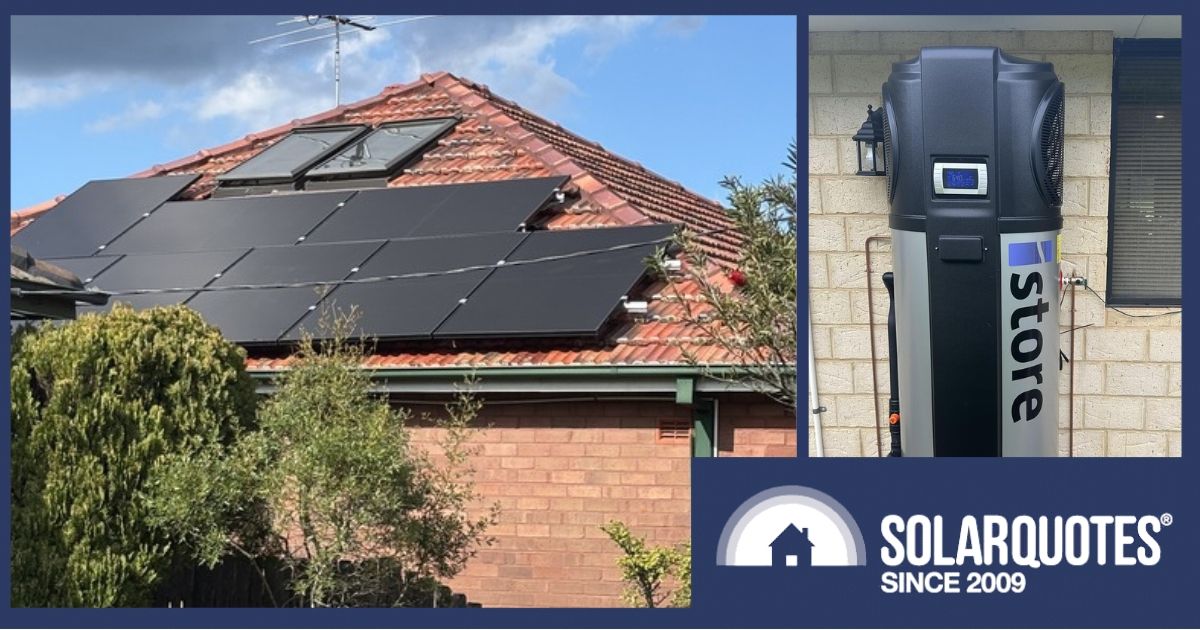
The NSW government is tightening access to its zero-interest energy loans program, with the program set to be available only to households earning $150,000 or less from November 10. It comes as the Victorian election heats up, with the Liberal opposition pledging to cancel an impending ban on gas connections for new homes.
NSW Tightens Its Zero-Interest Loans
The NSW Home Energy Saver program offers loans of up to $15,000 with no interest. You get up to 10 years to pay them back. The loans cover upgrades such as solar, batteries, heat pump hot water, and air conditioning.
From 10 November, only households earning $150,000 or less a year can apply. The old limit was $210,000. If you applied before 10 November, the old limit still applies to you. Victoria made the same cut to its Solar Homes rebates in July.
“We’ve seen enormous demand for these loans since they launched in June, with more than 15,000 households already approved,” NSW Energy Minister Penny Sharpe said.
Sharpe explained the change this way:
“We’re making changes to eligibility so the program is focused on helping low- and middle-income households overcome the upfront costs of these upgrades.”
Opinions are split. Rewiring Australia founder Saul Griffith says the new limit locks out about 400,000 NSW homes.
“These are nurses married to electricians, teachers married to tradies. They’re not rich, they’re stretched, and they were ready to go,” he said.
The Justice and Equity Centre sees it differently. Its Program Director for Water and Energy, Douglas McCloskey, welcomed the move to “focus on supporting the households who need it most to benefit from energy upgrades.”
You can check other eligibility requirements and find links about where to apply for a loan on the official NSW government page. Make sure to get an application in by November 10 if you are set to be excluded under the rule change.
The NSW government notes people ineligible for the program may remain eligible for alternative incentives – households can check their eligibility for other programs via the energy savings finder tool.
Victoria: Gas Rules On The Line
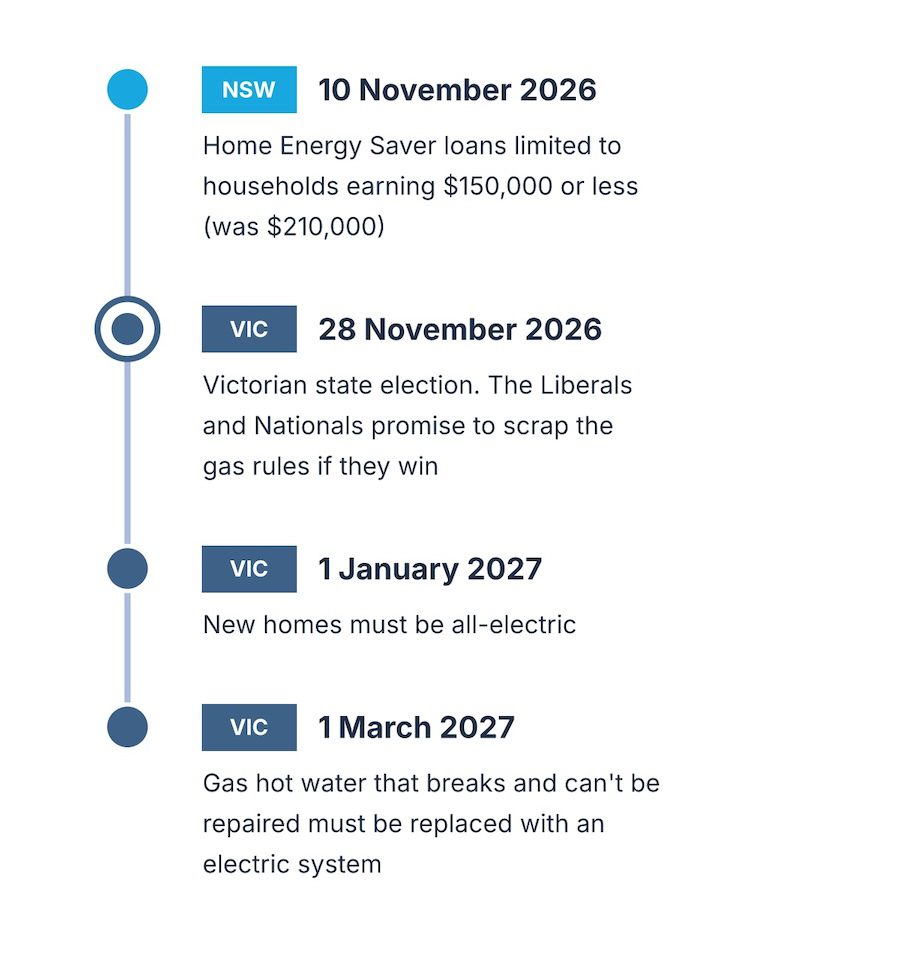
Key dates for home energy help and gas rules in NSW and Victoria. The Victorian dates for 2027 depend on the outcome of the 28 November election.
It comes as Victorians go to the polls on 28 November, with the future of the state’s plan for home electrification at stake.
Under the state Labor government’s current rules:
- From 1 January 2027, new homes must be all-electric.
- From 1 March 2027, if your gas hot water system breaks and can’t be repaired, you must replace it with an electric one, such as a heat pump.
- If you own your home, you can still replace a gas heater or cooktop with another gas one.
Opposition Leader Jess Wilson has promised to scrap these rules within 100 days if the Liberals and Nationals win. She said:
“Victorians should decide how they cook their meals, heat their homes and run their businesses”.
Victoria’s Energy Minister Jaclyn Symes defended the rules:
“By reducing demand for gas in households, we’re keeping down power bills and reserving supply for industry.”
Rewiring Australia has launched a petition campaign to defend the state Labor government’s gas connection phase-out plan, citing research that finds the average Victorian family saves around $1,220 a year by getting off gas and going electric – even without solar and including upfront costs.
To continue to follow these stories as they develop, subscribe to our free weekly newsletter.
 About Jacob Boyd
 RSS - Posts





If it really is cheaper to go electric over gas, there is no need for legislation, so what’s the petition really for?
Big Green wants to make sure the savings go in their pocket?
It’s quite common for people to act in a way that is not in their own best interest.
Do people realise that burning Gas inside your home is a health / asthma hazard?
It’s not just the unit cost of Gas vs Electricity – paying two daily supply charges costs more than just paying one supply charge.
It should be obvious that Gas is finite and going to get scarcer and more expensive over time, while renewable electricity is getting cheaper. What Gas we have should be kept e.g. as feedstock for manufacturing rather than just burnt for heat.
When replacing broken gas appliances – there are plumbers who just want to get in and out quickly and make $$$ on just replacing like with like. They won’t present all options to the customer – so how is the customer meant to make an informed decision??
Oh, and
As people progressively disconnect from Gas – the gas network maintenance cost will be spread over fewer and fewer customers.
This will be appear either as higher daily charge or higher /MJ charge.
This will cause more people to disconnect quicker – a death spiral.
Anyone with newish gas appliances will be caught between paying higher charges, or wasting money they unwisely spent on the appliances.
It’s hard not to politicise this topic but here goes:
It really annoys me that when we have a Victorian Labor government that doesn’t deserve to be re-elected due, in part, to all the alleged corruption on their watch, that the Liberal Party alternative ruin their chances by promoting such backwards policies as allowing gas back into new home builds.
Similar to the recent Federal election disaster with the Liberals promoting nuclear power. When will they learn from the ballot box that the vast majority of electors, of all political colours, want to move forward to cleaner energy sources?
Yup, Clive, we are caught upon the horns of the dilemma you describe. My first approximation of a possible resolution is to reason that presence of a Liberal Victorian government might encourage reelection of a federal government with a more rational climate/energy policy. (We like to hedge our bets in that regard.)
Climate retards in state government can do less harm than if given rope to commit national mischief, later. That leaves us free to whack the incumbents, always attractive after a number of terms, and probably well deserved … at least in the eyes of this now rural voter, dodging potholes on highways, while $15B was spent on yet another underground rail merry-go-round, good only for townfolk to travel in circles in greater numbers.
And I’m dark on the reported betrayal of the volunteer CFA, to unreasonably favour union cronies with power and resource diversion. That hurts out here.
If it makes government more accountable, then time to (reluctantly) flip?
No easy choice.
Victoria may be far enough south to weather global heating with significantly less impact than is beginning to become evident in Queensland. But now that +2.8°C, about 3 times the greatest climate excursion during the entire Holocene epoch, is locked in, even if all emissions reduction pledges were actually implemented, we will again be forced into a less hospitable postdiluvian world. Just more lethal this time.
But the emissions promises won’t be kept, as the ignorant fail to minimise their harmful behaviour, heedless of deferred consequences. So we’ll most likely hit +4°C, because of lack of resources to pull hundreds of billions of tons of CO₂ out of the atmosphere, at enormous energy cost, far far higher than the burning ever yielded. Moving London & New York uphill will use a lot of energy too.
But why must we wait for the slowest learners to wise up? (They pay for petrol/gas, then later pay tenfold to undo the harm. At least no petrol/gas cost here.)
Erik Christiansen: – “Victoria may be far enough south to weather global heating with significantly less impact than is beginning to become evident in Queensland.”
This animation shows regions (in purple) where the mean annual temperature exceeds 29 °C (i.e. unlivable) as global warming increases:
https://images.squarespace-cdn.com/content/v1/5bc6826490f904980a50659a/0105c0ea-c715-4925-97e3-c484b9e04380/HCN-FullSequence_c.gif?format=1500w
The global atmospheric CO₂ concentration has now exceeded 428 ppm.
https://gml.noaa.gov/ccgg/trends/gl_trend.html
Taking every GHG into account, the CO₂e in 2024 is about 540 ppm.
https://gml.noaa.gov/aggi/aggi.html
If you look back in Earth’s history, based on empirical evidence, there are two possible alternatives – either a Pliocene- or Miocene-like climate. https://youtu.be/QK2XLeGmHtE?t=1452
Will the current GHG emissions path lead us to a climate similar to the one 15 million years ago, or just 3 million years ago?
Geoff,
Re: animation: Even over +3°C, China seems to dodge the heat bullet to a surprising degree. That offers continued supply of high-tech goods we can’t make ourselves. And all but deep southern Europe fares similarly, preserving a principled population likely to favour stable international relations. While North America also does well, USA is of decreasing significance as a global citizen or technology provider.
Just as Lord Sandwich had absolutely nothing to do with creation of the sandwich, beyond asking for one while idling at the gambling table, it looks like it is climate-crime bystanders who will have their goose most thoroughly cooked as the heating peaks. Punishment of the innocent, yet again.
I’m losing hope that emissions reduction will be fast enough to avoid +4°C or more – feedbacks are creeping up behind our backs now. Post hoc atmospheric CO₂ extraction (100s of Billions of tons!) is utopian delusion. Ceasing emissions now is 100 times easier and cheaper.
Erik Christiansen: – “Re: animation: Even over +3°C, China seems to dodge the heat bullet to a surprising degree.”
But India, the Middle East, southern Asia, northern & central Africa, northern & central South America, Central America & Caribbean Islands, and northern Australia would become unlivable!
At a +2.7 °C GMSAT anomaly, that’s roughly where one-third (22-39%) of all people currently live.
https://globaia.org/habitability/
At a +2.7 °C GMSAT anomaly, at current rate of global warming (i.e. 0.35 °C/decade, per the 2026 paper by Foster + Rahmsdorf) likely by the 2050s, roughly one-fifth of Australia is likely to experience MATs above 29 °C. This level of sustained baseline heat drastically increases the number of days/year exceeding dangerous wet-bulb temperature thresholds, severely limiting outdoor labour & straining infrastructure.
In the last 5 years, 200 to 250 thousand people died in Europe from extreme heat: https://youtu.be/sw7Cy45R-KE?t=678
Having all electric appliances just doesn’t cut it when the power goes out. Having had 3 power interruptions in the past 12 months I had to rely on my lpg hot water system and gas cook top to be able to shower and cook meals. If I was relying on an all electric system I would have had to have cold showers in the middle of winter, and would have had to eat cold meals (think canned food).
My lpg instant gas hot water system is probably cheaper to run than an electric hot water system, because it doesn’t have to keep topping up the hot water as natural heat loss to the surrounding air rears its ugly head. Forget about installing a heat pump system when you live out of town, or live in a regional area, the “experts” who can fix these systems when a problem pops up are rarer than hens teeth, and who can afford tradie rates when you are retired and are on a limited budget.
Why would anyone want to put all of their eggs in one basket? The WEF agenda for all electric is criminal in my mind.
Gas is popular in my area, though I’m not sure if that’s to avoid reliance on electricity or just preference.
Those not wanting gas have the choice of going off-grid, though that often entails a fuel generator of some kind as backup, or a battery system large enough and capable of going off-grid should the power fail.
When you say heat pump are you meaning air conditioners in general, or ducted AC specifically? Support for ducted AC is far far more limited than for split systems, with some (all?) major brands not servicing outside capital cities and selected major urban areas. Of course if you live in the back of beyond, getting an electrician to service you split system might prove nigh on impossible, making it a do itself and try not to die job.
Daryl, I feel for you regarding reliable electric supply.
I lived in a ‘leafy’ suburb of Perth for several decades and we’d lose power to high winds on a fortnightly basis. Fortunately my suburb was chosen as the test case for retro-fitting underground power. Blackouts? Consigned to history 🙂
Perhaps a point-of-difference for a party that wants to win a state election:
1. Promise to speed up retro-undergrounding of power in Greater Melbourne and larger regional towns;
2. Introduce penalties for DNSPs and retailers every time they fail to achieve what they are paid to do – provide continuos power. This would be an incentive to both upgrade the infrastructure AND migrate to underground power. Pay the penaties in the form of refunds to their customers for the inconvenience.
Underground power. The standard In European cities for well over a century!
Daryl,
When our street in the Dandenongs was without electricity for 5 weeks, a few years ago, a camp stove provided hot food and coffee, and a wood heater gave warmth. But no hot showers in winter was not good. A kettle of hot water goes only so far, even mixed with cold.
But when the Longford gas plant outage left Melbourne without gas some years earlier, the shoe was on the other foot. With no gas connection to my house, the bloke from the gas company suggested: “Sell showers!” when he came knocking on doors.
The gas network will be shut down within a couple of decades, saving a lot of money, as we all unavoidably go electric, once it becomes the only option. I’m not sure that biogas would be an economically viable way to maintain bottled gas services – it wouldn’t be cheap.
COP31 is essentially admitting that we’ll top +2.8°C even if all commitments were met, but still pretending we won’t top +4°C as we fail to act fast enough. Expect +1.7°C this year, +2°C before 2035.
Erik Christiansen: – “Expect +1.7°C this year, +2°C before 2035.</i?"
The Climate Brink dashboard website currently suggests this year (i.e. 2026) is on track for +1.58 °C ±0.04 °C relative to the 1850-1900 reference baseline, using the Copernicus ERA5 dataset. As at 8 Nov 2026, there's a 14.9% probability that year-2026 would be warmer than year-2024 (currently the warmest year on record, at +1.60 °C).
https://dashboard.theclimatebrink.com/#global
The Climate Brink / Zeke Hausfather: Estimates the year-2027 temperature anomaly at a mean of +1.61 °C, with a full probabilistic range spanning 1.4 °C to 1.93 °C. There is a projected 85% chance that 2027 will become the warmest year on record.
https://www.theclimatebrink.com/p/higher-warming-predictions-for-2026
IF the rate of global warming continues to accelerate like it has been doing, THEN a long-term +2.0 °C GMSAT anomaly by year-2035 is plausible.
https://bsky.app/profile/climatecasino.net/post/3mzsngq5hg22d
When NSW announced their scheme they said there would also be $4,000 grants for low income earners coming “soon”. I have contacted them three times now to ask when “soon” might be, and each time have been told “soon” means “soon”. Which I assume is a weasel word for “no idea… maybe never”.
The grant is looking less and less likely since they seem to already be running out of money.
Hi Alan, I am aslo interested in the $4,000 Home Energy Saver Scheme Discount. The website doesn’t give a start date, just this nonsenes of ‘coming soon later in the year’ – the end of the year is fast approaching and still we wait for news that applications can now be made. If I didn’t know any better, the $4000 discount won’t be going ahead.