
NSW households earning up to $210,000 a year can now access interest-free loans of up to $15,000 for solar, batteries and a range of home energy upgrades, under a new $557 million state government program.
The Home Energy Saver program aims to reduce the upfront cost of home energy upgrades that can lower energy bills, improve comfort and support household electrification.
In addition to the loans, discounts of up to $4,000 will become available later in 2026 for lower-income households and eligible concession card holders.
What Is The Home Energy Saver Program?
The program offers eligible owner-occupiers and landlords access to zero-interest loans repayable over up to 10 years.
To qualify, borrowers must have a combined taxable household income of $210,000 or less, and own the property where the upgrade is being installed.
The NSW Government says the loans are expected to benefit more than 32,000 households.
“Every household that upgrades to more efficient technology is playing a part in NSW’s energy future. Making these technologies more accessible helps more households enjoy a cooler home in summer, a warmer home in winter, and smaller power bills every month,” said Penny Sharpe, NSW Minister for Climate Change and Energy.
What Can The Loans Be Used For?
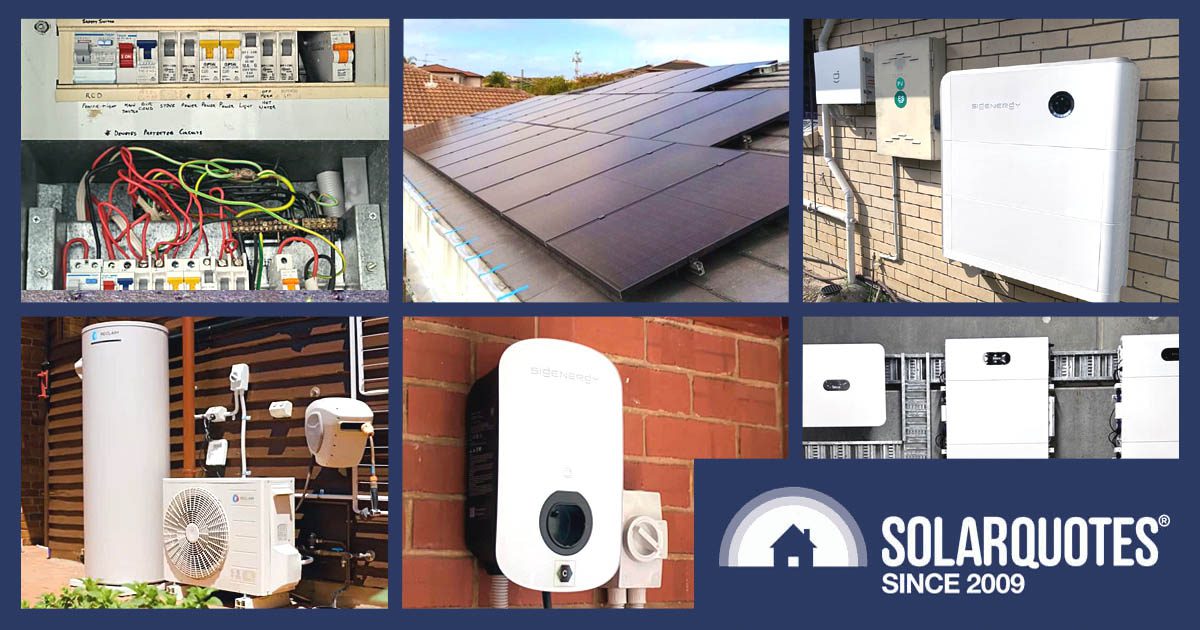
The loans can be used for a range of home electrification upgrades. We’ve included below a list of eligible upgrades, and linked to our explainer pages for each, so you can make an educated choice on the brand and size of system you need.
- Rooftop solar systems
- Home batteries
- Heat pump hot water systems
- Solar thermal hot water systems
- Reverse-cycle air conditioners
- Home EV chargers
- Induction cooktops
- Ceiling insulation
- Double glazing
- Draught-proofing
- Ceiling fans
- Switchboard upgrades
A Nationwide House Energy Rating Scheme (NatHERS) assessment can also be funded through the program.
The inclusion of switchboard upgrades may be particularly useful for households planning larger electrification projects, where upgrading an ageing switchboard can add significantly to the overall cost.
Program guidelines state that any applicable federal and NSW energy incentives must be applied before the loan amount is calculated, potentially reducing the amount households need to borrow.
Properties that are social or community housing, or used for short-stay accommodation, are ineligible for funding.
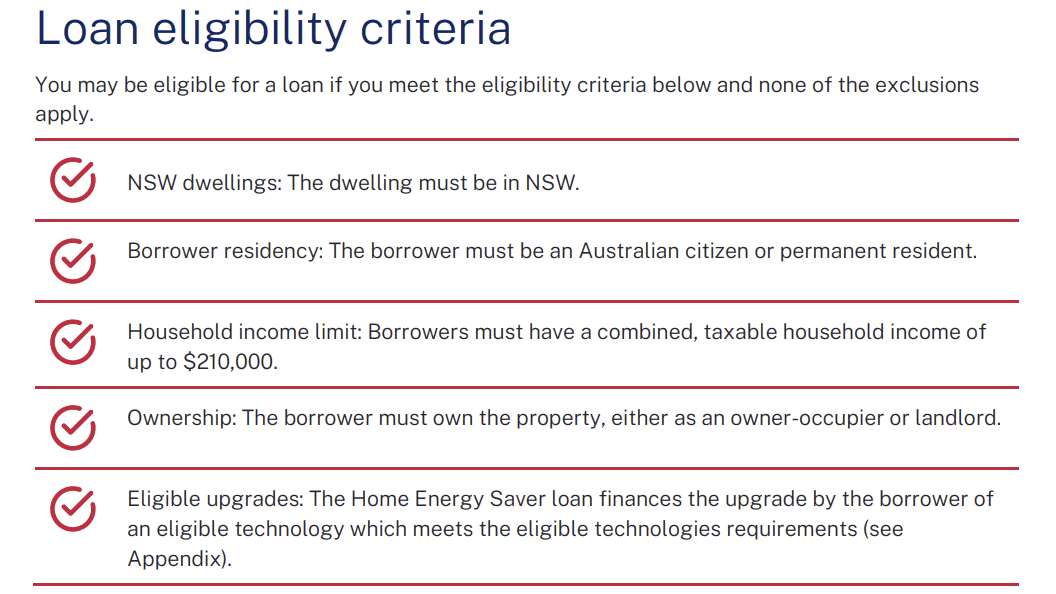
The NSW government’s guidelines for the scheme stipulate that if you meet the above criteria, you should be able to secure a loan.
Why Home Energy Saver Loans Matter
While the scheme doesn’t reduce the upfront cost of an upgrade, it allows eligible households to spread the cost over up to 10 years without paying interest.
SolarQuotes’ in-house factchecker, Ronald Brakels, believes the scheme could save borrowers thousands of dollars compared with a typical bank loan.
“If I wanted to borrow $15,000 for 10 years, which is the maximum amount and payback time under the scheme, then my bank would make me pay around $2,400 in interest in today’s money. So being able to borrow for 0% interest would save me thousands. But as a pillar of my society, my bank trusts me enough to let me borrow at a low rate. So the zero-interest loans can really shine for people who have less pillar-like characteristics,” Ronald said.
What About The $4,000 Discounts?
While the loans are available now, the discount component of the program is not expected to open until later in 2026.
The discounts will be available to households with a combined annual income of up to $80,000, or those with an eligible concession card.
Unlike the loan program, which is only available to property owners, renters will also be eligible for the discounts, provided they have their landlord’s permission to carry out the upgrade.
According to the NSW Government, households wanting to access both a discount and a loan for the same upgrade should apply for the discount first, then use the loan to cover any remaining costs.
How Do You Access The Home Energy Saver Scheme?
More information on the process is available NSW Government’s Home Energy Saver program website.
Applications are made through the two finance providers involved in the project – Brighte and Plenti, who will assess, approve and manage loans under the program, and accredit and onboard the installers delivering the work.
It is worth doing your homework on what home electrification upgrades you should actually get. Our solar and battery calculator, as well as our add battery calculator, will help crunch the numbers and compare the payback periods for different-sized systems.
 About Kim Wainwright
 RSS - Posts






Curious if an upgrade to 3-phase power would qualify as a ‘switchboard upgrade’. I got a quote to do that during the week, and it was close to $20,000 because they’d need to add a new pole in the street so as not to encroach upon the neighbour’s land with the new feed-in to the property.
Of course at $20,000 it’s probably a stupid upgrade to even think about, it’s never an economic upgrade, more a functionality one.
Hi Nick,
You’d certainly be changing the switchboard significantly.
Seeing as the aim of electrification is to do away with petrol, it would be hard to argue a 3phase upgrade isn’t part of our broader goals.
You simply need the capacity to electrify everything.
Nick,
If there’s a need to run 3-phase equipment, have you priced a 3-phase inverter & battery set-up? Charge it with solar & single-phase grid. If the battery’s a good size, it can do a lot of work, with peak loads exceeding the grid feed capacity. That can catch up later at lower power levels.
That also helps defeat max demand tariffs, as peak loads are powered behind the meter.
I’d do it with Victron battery inverters and some MPPTs, Anthony would use Selectronic, and there might even be a Sigenergy or other solution.
With the 3-phase isolated from the grid, it should also be free of DNSP inverter size restrictions? There would be two switchboards.
Hi Erik
I did look at that as an option, use a large battery as a behind the meter additional source. It’s still on the table as an idea! The main reason I wanted 3-phase was to be able to charge the EV and batteries simultaneously, for example on bad weather days or overnight, without running the 63A mains at maximum load for hours at a time.
We’re right on the limit of single-phase capacity, and while it all works, as an engineer I’m not particularly comfortable with running anything flat-out for extended periods. Feels like asking for trouble.
You’d be right Nick,
Melted service fuses are already becoming a much more common thing, where previously SAPN really didn’t encounter them, aside from premises with significant indoor gardening…
I believe one way those gardeners get found out, by tracking sudden surges in power use 🙂 I was a high school teacher once, and the school would benefit when the gardening gear was confiscated by police and donated to the local school for use in hydroponic gardening.
Yeah Nick,
In a former life I worked with a ceiling fixer who holidayed in the Netherlands because he was a keen indoor gardner.
The funny part was that once he got to talking to the Amsterdammers, he found they held Adelaidians in a similar high regard.
The authorities took to destroying hydroponic gear in SA because they kept finding police auction stickers on the equipment they confiscated.
There’s been a lot of other rule changes but I suspect with LED lighting and distributed generation (solar & battery) there’s less chance electricity meter data will expose hobbyists.
Electricians generally hate the industrial illicit gardeners though, they have a nasty habit of making incredibly dangerous modifications on mains wiring to steal electricity.
Things would be simpler if they just legalised, taxed & grew hemp for building materials & fibre.
Thanks! I’ll give it some thought. Apparently the ‘flying fox’ feed-in to my property for the single-phase connection isn’t permitted for three-phase by the distributor now, thus more work needed at the property entry point to make it compliant with 3-phase. There’s 3-phase in the street already, so that isn’t an issue. But needs a cherry-picker to do the work, and the new pole, for starters.
Which was a bummer, pushes it into the not cost-effective zone. But the functionality would be superb.
Hi Nick,
Sadly when the DNSP moves the goalposts it’s the “user pays” model which means you’re on the hook for meeting the new requirements.
Looking at plenti, and I’m guessing brighte would be the same, it looks like installers need NETCC Accreditation Certificate. Which I have trouble thinking of as a accreditation when it appears it is just a fee and most of the worst operators have it and have no trouble keeping it.
This is great, and I checked it out yesterday. The two companies that are handling the loans have ‘approved’ installers. When I went through the list and checked back here, only about two had reviews on SolarQuotes. I really don’t want to use one that isn’t a member here, as I want to research the company first. Do you think more installers will join up to the program?
There are some pretty unusual installers on their approved list. I found only two who have SolarQuotes reviews. Still early days; perhaps they will list more as time goes on.
I doubt that. Last year when I checked Commbank Low interest green loan, there were more Solarquotes installers in Brighte approved list. The thing is, they all quoted 20-30% more with Loan because Brighte takes a cut out of it, before interest, and I highly suspect this scheme would be the same. 20-30% higher price for “free” interest while rorting taxpayer money unfortunately. Also the reason why you see fewer Solarquotes installers than before.
I can not I see anything about off-grid homes being excluded?