
 SolarQuotes customer Louise Potgieter invested in a home battery system expecting to cut her bills down to size. She went on holiday, only to return to an unpleasantly large bill. She’s written about what happened, what to look out for, and how the right inverter paired with a 3 free hours of power plan solved the predicament.
Louise’s Story:
“The bill before our battery installation was $670 for the quarter. We bought an average of 17.62 kWh per day from the grid, and exported an average of 20.48 kWh per day.
When we first spoke with our installer, he asked if we needed the pool and shed backed up, but we decided backing up the house was enough. We picked the brand, 15kW inverter, 24kWh battery and to keep our legacy panels. We really didn’t discuss anything else other than timing.
Our system went into the garage, our installer made sure we had visibility on the monitoring app, then we left to go overseas. While friends were house-sitting for us, we watched the power consumption on the app from Mexico. Most days appeared self-sufficient, and on bad days, we imported <5 kWh from the grid. We were expecting the next quarterly bill would be low.
Imagine our shock, when the next account arrived virtually unchanged from the previous $670 bill.
Red Energy had us buying 1287 kWh and exporting 714 kWh, yet the solar monitoring reported 261 kWh purchased from the grid and 958 kWh exported over the same period.
In other words a 1000kWh understatement. Clearly something was amiss. After much forensic analysis and help from Community Groups and SolarQuotes, we found the installer had messed up the metering.
He installed the system so that it only saw the house demand, and not the pool or the shed. The footprint controlled by the power system as originally installed is shown by the yellow rectangle on the site plan below.”
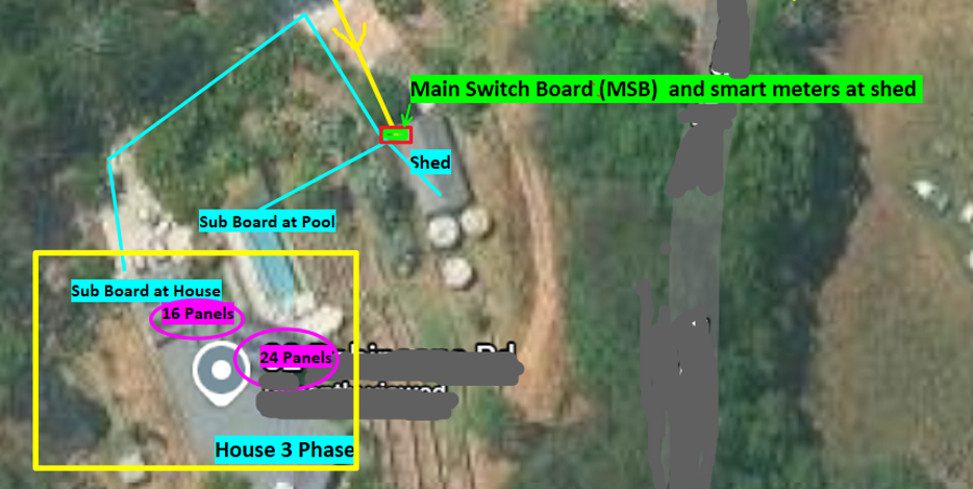
Only the house is visible to the power system.
“As initially set up, the only time the pool ran on excess solar was when all the house loads were covered, and the battery approached 100%. This might be after lunchtime, when the pump had already been running for hours, or there could be days when the battery soaked up all available solar.
Clearly, this wasn’t right, so the temporary fix was to feed the pump via an extension cord from the house, so the pool demand was factored into the HEMS.
The permanent fix was to move the gateway and monitor the incoming/outgoing power at the MSB. Fortunately we found a data cable that already ran from the shed to the garage saving a huge expense in trenching. Had we not found this, there may have been a wireless option to measure the mains supply, but the shed wouldn’t be backed up in an outage.
Now our system has the footprint below, and aligns perfectly with the utility billing app.”
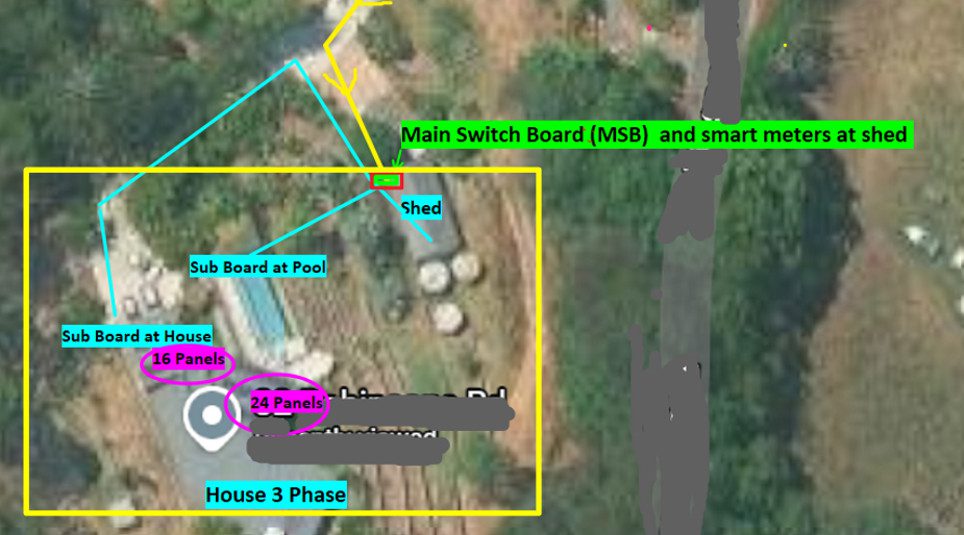
Now, everything is not just measured, but backed up too.
“Problems arise if the technology can’t ‘see’ all the power flowing to and from the grid.
This energy flow is measured by your inverter, either internally, with an external consumption meter/CT coil or often using a proprietary switchboard called a gateway. This is also where, during an outage, your system isolates the mains, so the lights stay on downstream of this point, but you aren’t trying to power the whole district upstream.
In most cases the inverter or gateway device will be right next to the Main Switch Board (MSB) where the utility meters are.
Be sure to ask your installer how they will measure power, at the MSB or wherever your existing solar inverter is. If they can’t explain how it works, you might find you’re one of the unsuspecting public having no idea why their systems don’t work. We were once there, too.”
Three Hours Of Free Power
“If, when we started this process, we knew what we know now, we would probably have put in bigger batteries to take advantage of the federal government rebate.
As it happens, the new Globird Zero Hero plan with its 3-hour free charging window has been our saviour, giving us full batteries at 2 pm every day. With this plan, we discharge our battery to 60% at 8 pm each day, which generally gives us enough power to get through to 11 am and the free charging window the next day. With this strategy, our average power cost is coming in at <$0.5/day, and so the payback on a bigger battery wouldn’t be there.
ZeroHero also pays a Feed in Tariff (FiT) of $0.15c/kWh for the first 10 kWh feed to the grid between 18.00 and 20.00, so sizing your batteries up to 10 kWh larger than your day to day demand, enables you to get a decent FiT whilst providing insurance for you to not have to pay peak rates when buying from the grid at times of high consumption.”
Inverter Size Is Crucial
“Like batteries, nobody complains their inverter is too big – it means faster charge and discharge to the grid.
Small inverter size limits the household load you can draw from the battery at any instant- anything more comes from the grid.
So if you have a single-phase 5 kW inverter and your household load is 10 kW, 5 kW will come from the grid, even if there is plenty of power in your battery to supply a big load. If you are on three-phase, the maximum load on any one phase is a third of the inverter capacity.
Which leads us to the surge rating. A motor such as a rainwater pump might use 0.4kW, but getting it started could demand up to 3.2kW ! On a single-phase 10kW inverter, this is no problem, but a 10kW three-phase inverter may struggle, which can be very disappointing.
Make sure you document with your installer exactly what you want reliably backed up.
Our installer recommended we install a 10 kW inverter, as he said this would be plenty to get the DC production from our solar panels into the battery. As we are on three phase, we sensibly upsized to 15 KW, to give us 5 kW/phase, at an incremental cost less than $1,200.
On days our battery is really depleted, we are able to fully charge to 24 kWh and satisfy our household load in two hours, leaving us an hour of the Zero Hero window unutilised. This will be helpful if we upgrade our batteries or add an electric car. If we had gone with a 10 kW inverter, it would have taken the full three hours to charge 30 kWh, and if our load was high, we would not have had full batteries at 2 pm.”
The Inverter Lets You See What’s Happening
“Systems installed today are so much more than the dumb inverters of yore. At the heart of your Home Eenergy Management System, the algorithm in the inverter manages solar and imported energy from the grid, when to export to the grid, when to draw from the battery and when to fill the battery.
The inverter talks to an app, so that any time, from anywhere in the world, you can see how your power is being managed. You could fill your batteries by downloading from the grid during “free” or “off peak” windows, and sell back to the grid during peak, and it’s the app which gives you the power to both see what’s going on, then change behaviour or the charging priorities to suit your preference.
Whether it’s incorporated inside the inverter or not, the gateway is the sentry to your property. It’s usually located at the MSB, and measures the power crossing your property boundary. During an outage, the gateway will isolate your property and provide backup power to preselected circuits for as long as the battery lasts.”
Retail Plans Come And Go
“Look at the retail plans and think about how you want to operate your system. Retail deals come and go, so aim for maximum flexibility with your system. Some people just want to set and forget, others treat energy trading as a new hobby.
Do you intend to use Amber to pay off their system in just a few years? Or join LocalVolts and sell power to your Mum for nothing? Join Facebook and Reddit community groups if you think trading power might be for you. You will need to size your batteries and inverter accordingly.”
From July 1, every energy retailer will be required to offer a 3 free hours of power plan in NSW, SA and SE Queensland, with Victoria to follow. If you’re planning to make the most of a plan like this by charging up a home battery, do your homework on what inverter to get with our deep dive guide to inverters, including recommended brands.
 About Anthony Bennett
 RSS - Posts






I’m going to be a pundit and try to predict the future:
The “3 free hours of power” scheme will run for a few years, and be wildly popular.
After a few years, it will be wound back to “1 free hour” or “weekends only” or such because it will be so popular, it will have achieved its goal of smoothing out the “duck curve”.
People who bought batteries and inverters on the premise that “3 free hours” would last forever, will be outraged. Everyone else will be “meh” even though the nation-level result will be fantastic (we smoothed out the duck curve).
Just my predictions?
Hi T,
I reckon the free hours will only be curtailed in winter. Will depend on how the electrification of transport goes.
Something I’d wished for more in hope than expectation was that they’d revisit feed-in tariffs, but in peak demand times. And that appears to be under discussion, which would be a fantastic shift.
Our Solar (10Kw ) plus Battery (22Kw) covers all our power. I pay about $15 for the Grid checking power used and $1.39 day supply charge . Can’t see how I can benefit from the 3hr free electricity , plus the daily charge is going up by 50c/day so my bill will increase by $45 per quarter . I wondered if setting my system to switch the house to Grid only for this 3hr window would work ?
If you’re already not using any grid power, then probably the other option is to export any surplus you have, maybe on a wholesale plan like Amber?
Hi Nick, why does my installer has the power to control my inverter/ battery, to help me to be able to take advantage of the 3h free, sometimes is busy and doesn’t respond to my messages, we paid for them, we should have control to manage it
If the grid checking power you mention is the handshake, you should change your meter compensation to between -25 to -50 depending on how many phases you have so that you have a constant trickle feed into the grid so you don’t import at all
Mosty likely there will be more people buying more solar, and that’ll tend to balance off the demand for “free solar” with more supply.
There won’t be a recurring free lunch forever, and maybe it’ll vary seaaonally. But the structure of the solar daily cyclical supply forever out of synch with daily cyclical demand will ensure there’s never an end to the electricity supply market.
In Canada we have had run-of-river hydro power for well over a century, and nuclear for a half century. The result is overnight rates in some regions that are close to free, except in winter when we need the most electricity at night.
Yes, it’ll be interesting to see how this plays out in the market. When it’s a monolithic utility supplying 10 million people in Quebec they might make more money with higher prices and more spill. But when it’s 3 million rooftop solar owners effectively bidding against each other, it’s a whole different animal.
I also think ‘aim for maximum efficiency that includes judicious use of the grid’ is a better overarching design principle than ‘avoid grid power’, which is a common obsession (not referring to this particular case).
The grid is a wonder of the world. Far too many people seem to come to renewable energy with a pre-existing political or psychological axe to grind.
I only see this becoming variable to match with actual excess generation (i.e. excess wind later on but no solar at noon) & software to forecast this will inform home and EV battery charging.
I don’t see the financial incentive to remove this scenario because if you can charge batteries for free/very cheaply regardless of actually having solar on your own roof this can save $ whilst also reducing the need for network upgrades…then add the catalyst of V2G so retailers/individuals can sell back to the grid later for elevated $ or just simply save and increase independence with V2H.
A Fronius Symo (three phase) Gen 24 inverter and BYD HVM 22.1kWhr battery behave a little differently than suggested at night on grid.
A load well above the 3.64kW on one phase will be supplied by the battery. The extra power is supplied by the grid at no cost on that phase as an equal amount is discharged to the grid on the other 2 phases.
I certainly wish I had been made aware of the off grid limit and the benefits of using a three phase AC unit prior to our install. A 15kw inverter would have been a “no brainer”.
Hi Matt,
Fronius have had a 12kW Gen24 on offer now for a while.
The larger Verto hybrids are now available too, but as usual everybody is waiting, waiting, waiting… for CEC approval.
… and to this site!
I’m glad the grid is there when I need it. My 10.5 kW / 25.6 kWh system has covered virtually 100% of my bills from installation on 1st October until maybe two weeks ago when a cloudy Perth June hit with full force. I’ve been pulling plenty of units from the grid since then. If I’d doubled the size of the battery I’d bought… I’d probably have pulled ever so slightly less.
Scott,
Generation trumps storage, especially in winter. My 27 kW of PV generates only 1 kW in deep overcast, but in exceeding the idle load, HWS off, no EV charging, it still usually ends the dismal day on 100% SoC. Off-grid, the 46 kWh battery is rarely below 90% SoC unless there are visitors in the old house, or I use it to charge the BEV.
And, at least for now, panels are cheaper than batteries, so it’s mostly a matter of finding enough roof. (South is not great (<20%) in winter.)
The north facing 11 kW array is tilted up 40° for greater winter yield, here at 38° south latitude.
I think the feeling of having an axe to grind will change as everyone will co-operate more by market forces creating opportunities (like residential storage creating reductions in peak evening load), and less by force of government. (like Net metering)
The brutal truth of all major change is that it is never community or market-led. Both of those are fictions. All change is always led. Globally with renewables that’s China, every ‘grassroots’ movement claiming to be behind any shift is piggybacking off China’s lead, making the technology affordable and scalable. Similarly Australia’s progress such as it is piggybacks off China, and domestically has been mostly driven firstly by government solar rebates and now government battery rebates.
Unfortunately I only found out the predicament I am in now after signing on the dotted line. Was sold a 5kW inverter with 42kW battery in a 3 phase house and now wishing I was given the option to upgrade to 15kW inverter. I am able to stay in credit but with a lot of hands on involvement by me watching house loads rather than setting and forgetting.
Hi Fred,
Who sold it to you?
I’d argue it’s not fit for purpose really.
Might be worth leaving a review?
A couple of ex-cricketers.
Yeah that’s a sad truth,
The used sportzball stars are apparently bereft of moral guidance. It makes me wonder why we, as a society, hold them in such high regard when almost nobody could name a great Australian scientist or author.
I kind of understand the notoriety of drinking 52 beers enroute to London but sport seems to lend credibility to cheats, sex abusers and idiots who p!ss in their own mouth.
Why do we accept financial advice from this industry?
Agree. I think professional sport as a whole is a misallocation of resources and seemingly a misallocation of admiration.
A 5kW inverter is not quite enough when you run a whole of house reverse cycle air con. As I was a novice on a steep learning curve, the penny hadn’t dropped that the air con system would at times draw above 5kW and draw the extra power from the grid despite power being available in the battery. Just a couple of simple questions from the provider would have got me to upgrade. Cynically, I think it’s more about keeping the system’s total price under control and capturing the sale.
Hi Rick,
Sadly I keep running into people who want backup and have the budget for it, but they are undersold or over promised. It ends up being pickle when you’ve blown the battery rebate on a huge battery and a 5kW inverter just isn’t enough to meet the expectations.
We signed up for Globird’s ZeroHero plan a couple of months ago and have gotten into a great schedule of allowing our battery to charge from the grid for free between 11am and 2pm and dumping enough charge from the battery into the grid at 6pm to break even with the daily service charge.
Unfortunately, Globird announced rate changes a few days ago so now they only offer 2c/kWh FiT from 4pm to 11pm (down from 5c) and 10c/kWh between 6pm and 9pm (down from 15c). They’ve also bumped up the daily service charge from $1.32 to $1.58. Now we need to export a lot more to balance the higher service charge at the lower overall rate. We’re pretty angry about that because we’re not sure if we’ll even have the excess battery charge to accomplish the great equalibrium we’re achieving now. The three hours of free power is still helping us charge our batteries on cloudy days though…
Enjoy! Victoria comes on board in October, well after our system is self sufficient until late May 2027!!!!