Don’t Make These Mistakes When Buying An EV Charger
By Finn Peacock – Chartered Electrical Engineer, Ex-CSIRO, Electric Car Owner & Founder of SolarQuotes.com.au
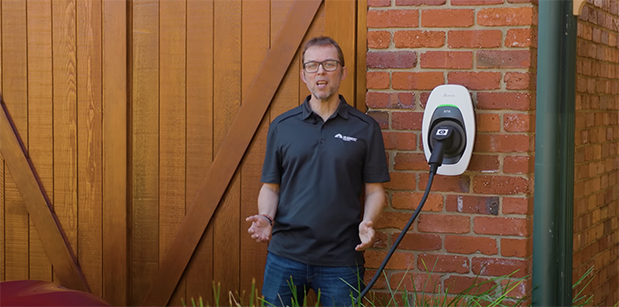
Me and my trust Delta EV charger
So you’ve just bought, or plan to buy, a shiny new electric car (AKA Electric Vehicle, or EV).
Great choice. But how will you charge it?
If you are like most new EV owners, you’ll also be considering a dedicated, hard-wired charger for your home.
And I’m guessing you’ll soon get overwhelmed by all the charger brands out there. You may also be daunted at the thought of finding an electrician with the experience to install and support the charger you choose.
Put it this way – I’m a Chartered Electrical Engineer who has designed control systems for nuclear power stations – and I made a dog’s breakfast of choosing an EV charger for my two electric cars!
But the good news is: I’ve made all the mistakes, so now you don’t have to.
I was initially going to call this post ‘7 mistakes Australians make when buying EV chargers’, but as I went through my list of shame – I ended up with 9 mistakes.
Mistake #1 – Thinking you will happily get by with the trickle charger that comes with your car.
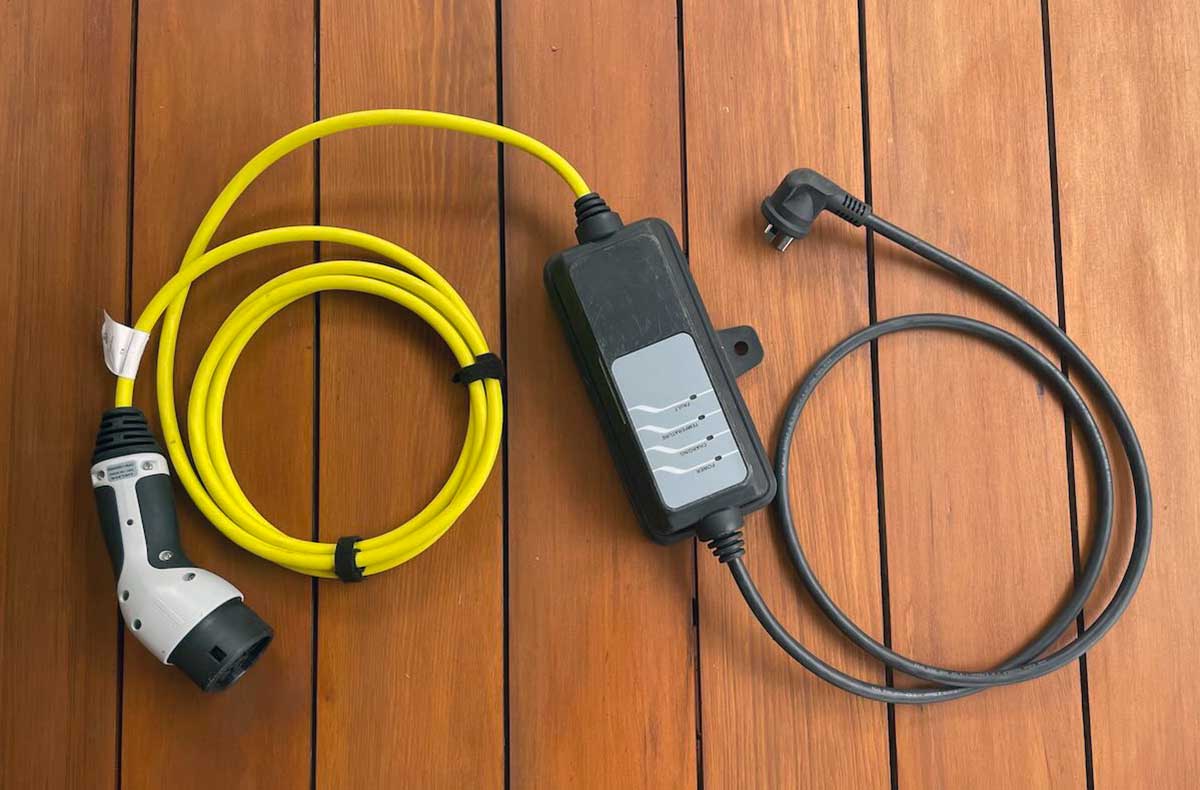
A typical mobile trickle charger that comes with most electric car models.
I’m nervous about putting this as Mistake #1.
I just know I’m gonna get roasted by lots of early-adopter electric car owners who will happily tell me how they’ve been happily trickle-charging their cars for the past decade.
They’ll tell me that a dedicated, fast charger is a waste of money when all you need is patience, forward planning, and a trickle charger plugged into a regular socket.
A charger that will recharge a modern, long-range electric car in…
…40 hours!
Well, I’m guessing you are not an early adopter that is happy to put up with such painfully slow charging.
You want a charger that can at least refill a long-range EV overnight. That means you can arrive home with a low charge and sleep safe, knowing that you’ll have a full battery when you wake.
And if you are a solar owner, I’ll bet you want a fast enough charger to take your surplus solar and push it into the car battery. Because energy from Australian rooftop solar is the cheapest energy in the world, and you want a charger that can take advantage of that.
Having said all that – there are some people that can get by with the trickle charger that came with their vehicle:
- Electric motorbike owners,
- Plug-in hybrid (PHEV) owners – with a petrol engine and a tiny battery
- Owners of small, low-range electric cars with small batteries
- EV advocates who have enough time, patience and planning prowess to get by with such slow home charging
If you are not on that list, don’t compromise your big investment in a state of the art EV by skimping on your home charging. Invest in a hard-wired home charger.
I spent a couple of months with only a mobile charger, and it was a pain in the bum. Don’t be like me; enjoy your new car to its full potential.
Mistake #2 – Spending big bucks on a smart charger when you don’t need the smarts.
So you’ve decided to invest in a home charger. There are dozens of models, from dumb to super smart. The smarter the EV charger, the more it costs. Be careful of spending big bucks on features that sound great in theory but you won’t use in practice.
Just one example: smart solar charging.
I made this mistake. I bought an EV charger with ‘smart solar charging’ back when I only had 6 kW of solar and a home battery. I liked the idea of plugging my car in and knowing it would only charge from surplus solar power.
Unfortunately, by the time my solar has powered my home appliances and charged my home battery, very few kWh of solar energy are left for the car. On a good day, the solar would add 30 km of range – on a bad day – i.e. overcast or winter – I’d get close to zero km added.
That was frustrating for me. When I plugged in, I just wanted it to charge a decent rate. And it was even more frustrating for my long-suffering wife, who is not a solar nerd.
I also changed to an electricity tariff that gives me really cheap electricity between 10 am and 3 pm.
Now, I have 20 kW of solar and bypass the solar smarts and simply ensure that my car charges as fast as possible between 10 am and 3 pm. If there is spare solar, that’s great – but when the car tops up from the grid – it’s no big deal – as it’s cheap electricity anyway (over 10x cheaper than driving on petrol).
I simply never use the solar smarts I paid for.
Mistake #3 Not Checking Cable Length Before You Buy
I didn’t think about charger cable length when I bought my charger. Unfortunately, that meant the cable I got was one metre too short to charge my car if it was parked behind my wife’s.
That wasn’t the end of the world – but it was a pain in the bum moving cars around just to get a charge.
I’ve since got a new charger with a longer cable that works well for us:
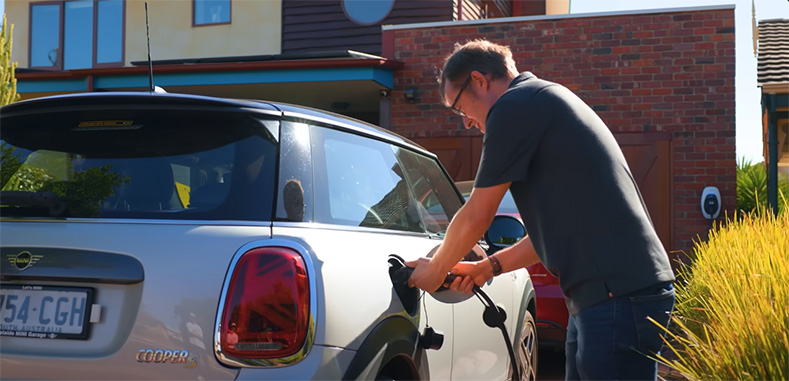
No problems charging two EVs in a long driveway thanks to my extra-long cable!
If the charger you want to buy does not come with a long enough cable, ask if there is an ‘untethered’ version. Most chargers have an untethered version, where you can BYO cable. Then you can jump online and buy a ‘Type 2 to Type 2’ charging cable long enough for your driveway.
Mistake #4 – Not thinking ahead when buying a charger
If you’re a two (or more) car household – it’s likely they’ll all be fully electric by the end of the decade. If you need to charge more than one car overnight, you’ll either need 2 chargers, or you’ll have to jump out of bed at midnight to swap the charging cable to the other car.
Your house supply may or may not be able to handle two chargers running simultaneously, so you may need a charger that can ‘load balance’ with another charger. Also, when your installer is quoting for running the cables for the first charger, consider running cables for a future charger at the same time to save money in the long term.
All these things are pretty technical, but they are worth discussing with a savvy installer who can ensure you are ready for multiple EVs in the future.
Mistake #5: Sourcing a charger yourself and having it installed by a local electrician.
This is a warranty nightmare waiting to happen.
Back when I had a Zappi charger, I needed to claim its warranty three times. Each time, the Aussie website I bought it from flicked me over to the UK-based manufacturer.
I managed to get replacements under warranty from them (2 chargers and one cable), but they just posted the hardware to me and made no effort to arrange the installation or cover its cost as per my rights under Australian Consumer Law.
Luckily, I have about 400 friends who are solar electricians. But I’m a bit unusual like that. Most people would have to pay for the re-installation and then argue their case for compensation from the retailer or manufacturer.
I should have bought the charger from the same company that did the installation. Under Australian Consumer Law, the company that takes your money for supply-and-install is ultimately responsible for all the warranties. So I could have just gone back to the installer when my charger failed, and they would have had to arrange a replacement and install it – saving me a whole load of hassle.
Buying the hardware from the same company that does the installation also means the manufacturer can’t blame the installer or vice versa, with you stuck in the middle. You just get it fixed. Also, that means that a local installer will only supply and install hardware that they are comfortable will easily outlast its warranty.
Mistake #6 – Not enough solar
Ten years ago, I was proud of my 6 kW system with 250 W panels. It almost filled my large, north-facing roof next to my solar hot water.
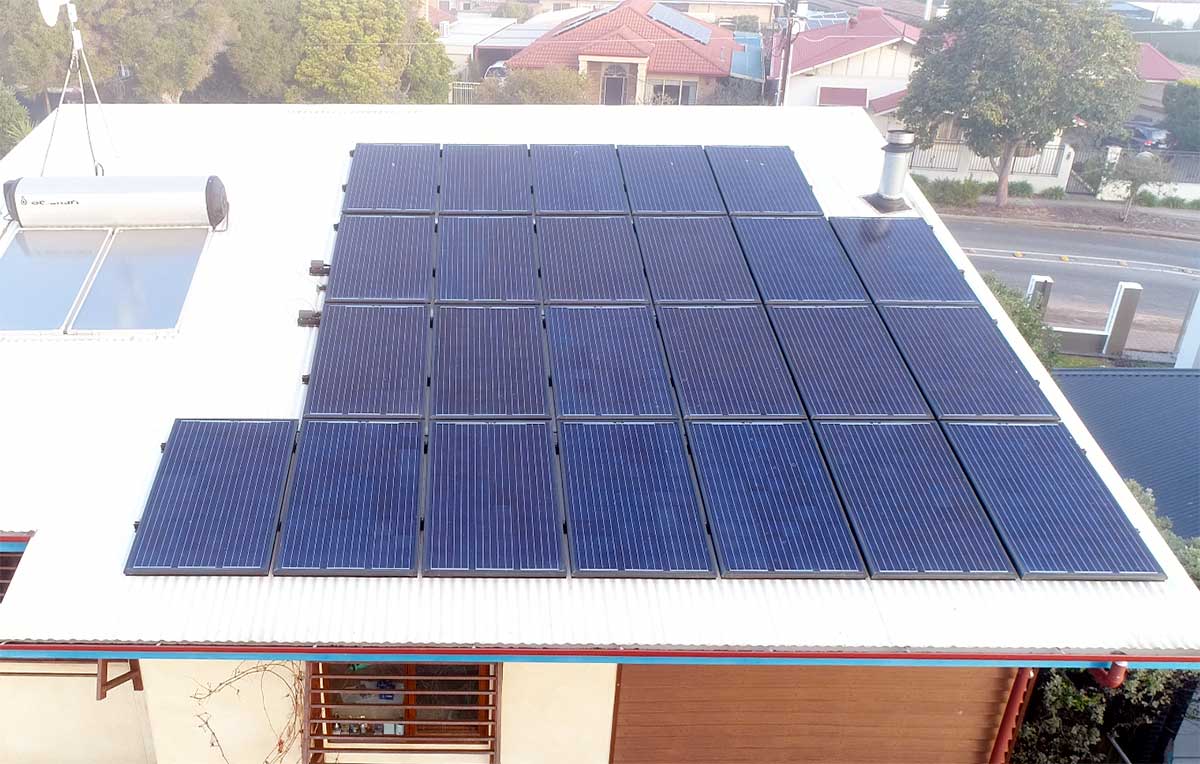
Today 6kW is considered small, and panels are typically 475W each.
When I got two electric cars; horror of horrors, I had to pay a few hundred dollars a quarter for electricity after a decade of credits!
I solved this problem by adding another 14 kW of solar to my roof, bringing me to a whopping 20 kW in total.
If you are buying solar today – or upgrading a smaller system – please size it appropriately.
Buying an electric car will significantly increase your electricity use. A typical Aussie home uses 20 kWh per day. An electric car typically has a 60 kWh battery.
Solar can offset most (or all) of the energy needed to charge your car – but only if your system is big enough.
Look to at least 13 kW, if possible.
This page goes through the state-based network rules around maximum system sizes allowed.
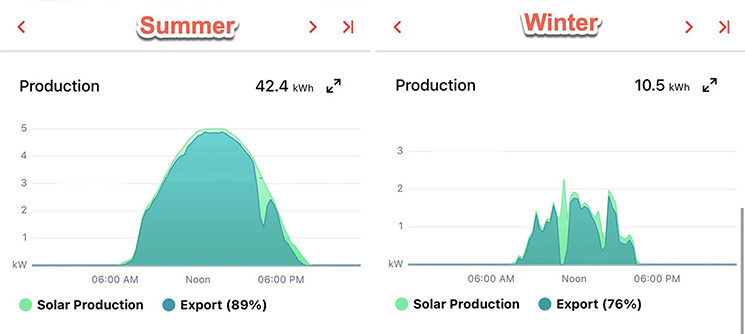
Keep in mind that your solar system, for a variety of reasons, will rarely produce its rated output, especially in winter.
Compare the output of a 6.6 kW system in the depths of winter compared to the height of summer:
Mistake #7 – Charging on the wrong electricity plan
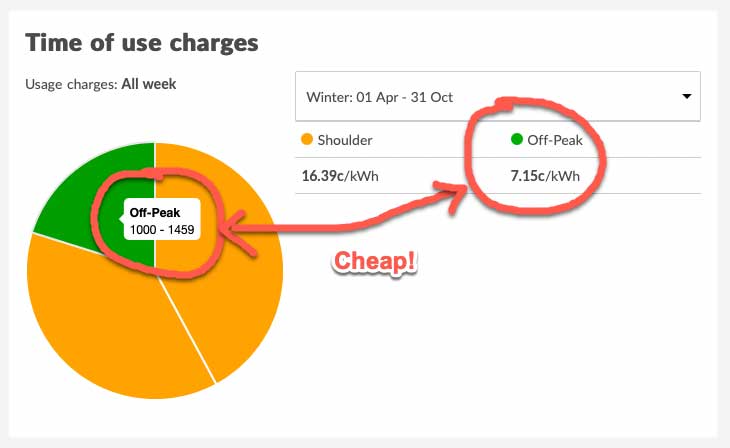
Example of a Time of Use Plus solar sponge tariff in SA
The plan you charge on matters as much as the charger you buy. Many homes are still on a ‘flat rate’ plan, where they pay the same price for electricity no matter the time of day. There are three cheaper ways to charge:
Time-of-use (ToU) tariffs charge different rates depending on the time of day. The off-peak rate overnight and/or in the middle of the day is typically at least half the flat rate, and often lower.
EV-specific plans go further again. Several retailers now sell tariffs built around a fixed cheap window, usually midnight to 6am, with charging rates in the single digits of cents per kWh. On some plans a full charge that would cost around $17 on a flat rate costs closer to $4. The trade-off is that the cheap window is usually offset by higher rates the rest of the day.
Free daytime power. Since 1 July 2026, retailers in NSW, South-East Queensland and South Australia have had to offer at least one ‘Solar Sharer’ plan giving three hours of free electricity in the middle of the day, capped at 24 kWh.
All three depend on hardware that can actually use the window. A 7kW charger puts roughly 40 kWh into the car across a six-hour overnight window, or around 20 kWh in a three-hour free block. A standard powerpoint delivers about a tenth of that, so most of the cheap hours go unused.
Mistake #8 – Draining a home battery to fill up your car battery
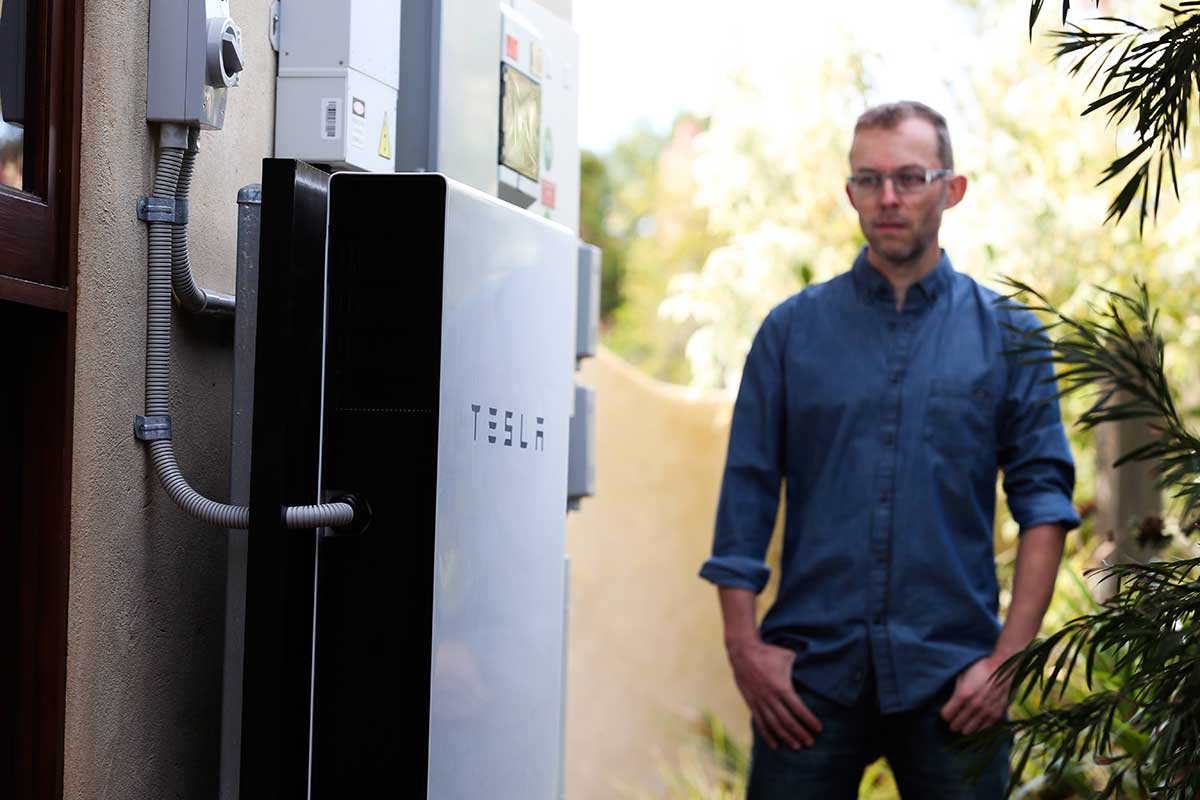
If you have a home battery and an EV, you’ll need to make sure you understand and plan for how they interact.
One thing you probably want to avoid is charging your EV with your home battery. This is a bad idea for a few reasons:
- The efficiency losses between solar > battery > EV means you’ll lose energy transferring between them
- Your home battery energy will usually be more valuable avoiding peak tariff periods or participating in a VPP than charging your car.
- The more often you drain your home battery, the quicker it will degrade.
But how can you control this?
The answer gets technical very quickly – and is best left for your installer to solve. Just remember, if you don’t want your home battery to discharge every time you charge your car (without enough solar generation to cover all the 7 kW+ of charger power), then get this in writing in the quote.
Mistake #9 – Installing a single-phase charger on a 3-phase supply.
A standard single-phase charger will work just fine on a home with a 3-phase supply.
But I’d argue that most 3-phase homes should take advantage of this and install a 3-phase charger.
It’s nice to have a 3-phase charger if you need the speed. And if you want to charge slower, 3-phase chargers can be throttled down.
If you are going to the expense of running cable and mounting an EV charger, it’s probably worth going 3-phase if you have the capacity.
The next step
So there you have it – the 9 mistakes you should avoid when buying an EV charger, based on my experience owning two electric cars for many years.
If you’ve recently bought, or plan to buy, an EV, I have a network of pre-vetted installers who can provide a quote for the supply & installation of a charger.
Simply hit the button below to be taken to my quote form:
Happy electric driving,
Finn Peacock, founder of SolarQuotes.com.au

About Finn Peacock
I’m a Chartered Electrical Engineer, solar and energy efficiency nut, electric car and e-bike owner, dad, and founder of SolarQuotes.com.au. My last “real job” was working for the CSIRO in their renewable energy division. Since 2009 more than one million Australians have used my site to get quotes for high quality PV systems from pre-vetted solar installers.