The Solar Panel Rebate: How Much You Get And Why It Changes
Last Updated: 10th Jul 2026
The Australian solar rebate is the main federal incentive that makes rooftop solar cheaper to install. It is not usually paid into your bank account. Instead, it is applied as an upfront discount that takes a chunk off the price of an eligible solar system.
The rebate has gradually reduced over the years as solar panels have become cheaper and more common. It is still worth thousands of dollars for many households, but the exact amount depends on your system size, location, installation date and the certificate price used in your quote.
In this guide, we’ll explain:
- How Does the Solar Panel Rebate Work?
- How Much Is The Solar Panel Rebate Worth In 2026?
- What Factors Affect The Solar Panel Rebate?
- When Does the Solar Panel Rebate End?
- Who Can Claim the Solar Panel Rebate?
- How to Claim the Solar Panel Rebate
- Is the Solar Rebate the Same As a Feed-in Tariff?
- Solar Rebate FAQs
- The Bottom Line
How Does the Solar Panel Rebate Work?
The solar rebate is the name most Australians use for the federal government incentive that reduces the upfront cost of installing solar.
So, strictly speaking, it isn’t a rebate in the traditional sense.
Under the Small-scale Renewable Energy Scheme (SRES), when you install an eligible solar system, it creates virtual certificates that have a dollar value, and that value is deducted from the price of your solar system.
Fossil fuel generators and other organisations purchase these certificates to meet their emission goals. Why would they do that? Well, to meet federally mandated standards.
So yes, the industry and most homeowners call it the “solar rebate” or “solar panel rebate“.
Either way, the practical result is the same: your solar system costs less upfront.
Here’s how the scheme works:
- The government creates virtual certificates called Renewable Energy Certificates (RECs).
- Fossil fuel generators and other companies meeting renewable energy goals buy these certificates.
- When you install an eligible solar panel system, it creates renewable energy certificates based on the system’s size, location and installation date.
- For residential solar panel systems, those certificates are called Small-scale Technology Certificates (STCs).
- Your installer purchases the STCs from you and applies their value as an upfront discount.
- Companies that burn fossil fuels buy these STCs to meet emission standards.
- The STC price moves with supply and demand, a bit like shares.
- If your installer processes the STCs for you, they may charge a small fee per certificate. This is usually already factored into the rebate shown on your quote.
- Almost all advertised solar prices already include the solar rebate.
The installer handles the admin, and you see the result as a lower system price.
How Much Is The Solar Panel Rebate Worth In 2026?
In 2026, the solar rebate is worth around $248 per kilowatt (kW) installed, based on an STC price of about $36 after fees.
For example, if you install a 10 kW solar system, the rebate is roughly:
10 kW x $248 = $2,480 off the upfront cost
The bigger the eligible system, the bigger the rebate, up to the scheme’s size limit.
These figures are estimates, not a fixed entitlement. The final solar panel rebate depends on your system size, location, installation date and the STC price used in your quote.
If you want to estimate the payback for your home, use our Solar Savings Calculator.
What Factors Affect The Solar Panel Rebate?
The solar rebate is not a fixed dollar amount. The final rebate amount depends on four main things:
- system size
- location
- installation date
- STC market price
Each one affects either how many STCs your system creates, or what those STCs are worth.
1. System size
Larger eligible systems create more STCs, which generally means a larger rebate.
The federal solar rebate is available for eligible solar systems up to 100 kW in capacity. For almost every Australian home, that’s a huge system. Even large residential installations are usually well below the limit.
If you’re installing a commercial solar system larger than 100 kW, it won’t qualify for STCs under the small-scale scheme.
2. Location
The size of your rebate also depends on where you live.
Australia is divided into STC zones based on how much solar energy systems are expected to generate in different parts of the country. After all, some parts of Australia are sunnier than others.
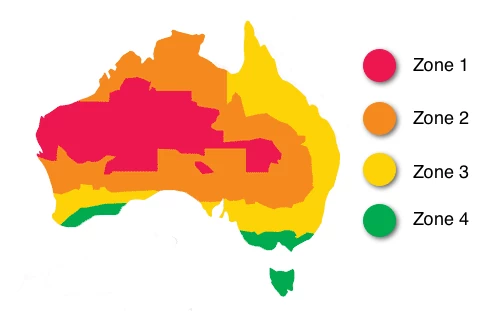
The lower the zone number, the more subsidy you get.
Here are some approximate STC values for a 10 kW solar system, based on a $36 STC price after fees:
- Zone 1: incentive = $2,920
- Zone 2: incentive = $2,740
- Zone 3: incentive = $2,480
- Zone 4: incentive = $2,120
This is why a 10 kW solar system in one part of Australia can receive a larger solar panel rebate than the same size system somewhere else.
3. Installation date
The rebate reduces slightly at the start of each year.
When the scheme was introduced, solar panels were much more expensive than they are today. The rebate was designed to help more Australians install solar while the industry got on its feet.
Fast forward to today and Australia has one of the highest rates of rooftop solar adoption in the world. As the cost of solar has fallen, the government has gradually reduced the level of support available.
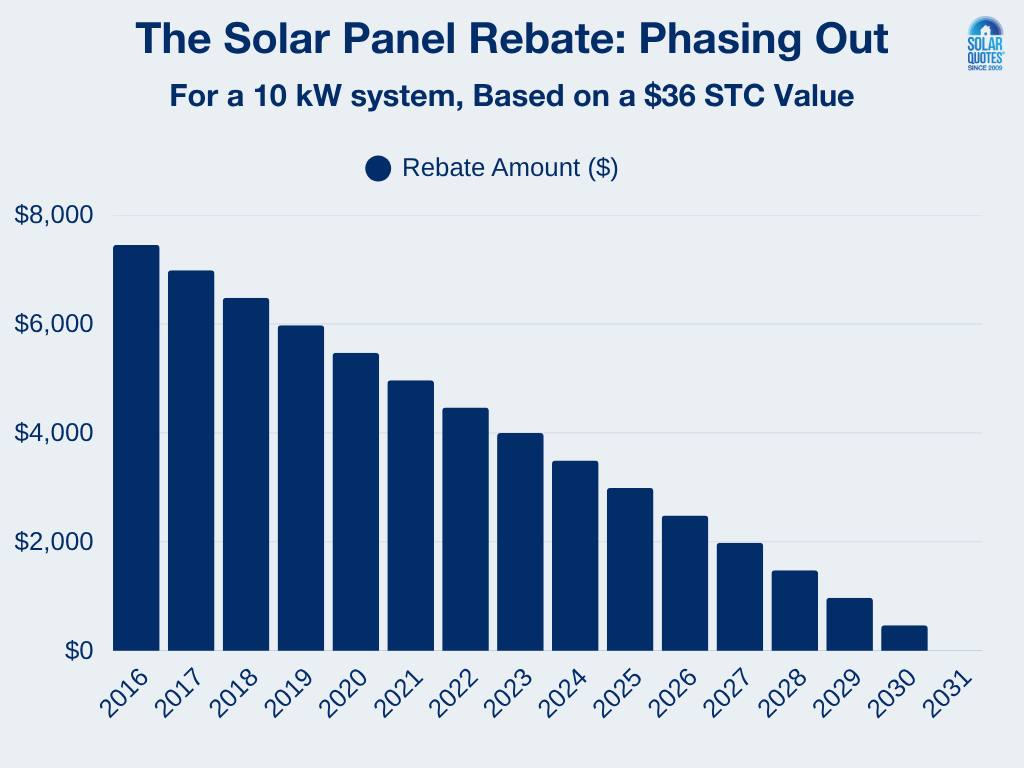
The solar rebate is phased out until it hits zero in 2031.
Every January, the number of STCs a new solar system can create is reduced.
Fewer STCs means a smaller rebate.
4. STC market price
The STC price can be anywhere from $0 to $40. By law, $40 is the maximum value an STC can reach.
At the moment, we’re using an average STC price of around $36 after fees, but that number can change.
If demand for solar suddenly increases, more STCs are created. When the supply of STCs rises too quickly, the STC price can fall. If the STC price falls, the rebate falls with it.
This is why the scheme is often described as self-regulating. If the market runs hot, the value of the incentive can reduce.
Some years back, when it looked like the government might scrap the scheme entirely, demand for solar installations surged and the STC price dropped to around $17.
If that happened again, the rebate on the same solar system could be much lower.
It’s unlikely to fall that far again, but it is possible. No one can pretend to know what the STC price will be next week or next year. The only certainty is that it can’t go higher than $40.
When Does the Solar Panel Rebate End?
Under current legislation, the solar panel rebate is scheduled to finish on 1 January 2031.
At this stage, there appears to be no danger of politicians ending it early.
But waiting still has a cost. Installing solar next year will almost always mean receiving a slightly smaller rebate than installing this year.
While the scheme is scheduled to continue until 2031, the dollar value of your rebate can still change before then because of annual reductions and STC price movements.
Who Can Claim the Solar Panel Rebate?
Most Australians installing a new solar panel system are eligible for the federal solar rebate.
Unlike some government incentives, it doesn’t matter how much you earn. The rebate is not means-tested.
What matters is whether your system meets the rules of the Small-scale Renewable Energy Scheme (SRES).
You’re eligible if:
- your solar system is installed in Australia
- the system is 100 kW or less
- it is designed and installed by an SAA-accredited professional
- it uses solar panels and inverters approved for use in Australia by the Clean Energy Council
- it meets the relevant Australian Standards
- it is a new, eligible solar installation
If you’re getting quotes from reputable installers, they’ll confirm your eligibility before you sign a contract.
How to Claim the Solar Panel Rebate
Fortunately, claiming the solar panel rebate is probably the easiest part of buying solar.
For most homeowners, there’s no separate government application, no office to visit and no mountain of paperwork.
Here’s how it usually works:
- Choose an eligible solar system.
- Accept a quote from an accredited installer.
- Sign a form assigning your STCs to the installer.
- Your installer claims the STCs on your behalf.
- The value of the certificates is deducted from the price of your solar system.
That’s why the rebate usually appears as a discount on your quote rather than money arriving in your bank account.
A good solar installer will also guarantee the value of your solar rebate when you sign up for a system.
That matters because STC prices can move. If your quote is based on one STC price and the market changes before installation, you don’t want to be left out of pocket.
A reputable installer should explain how they calculated the rebate and whether the quoted discount is locked in.
Is the Solar Rebate the Same As a Feed-in Tariff?
No. The solar rebate reduces the upfront cost of buying your solar system.
A feed-in tariff, or FiT, is different. It is a payment from your electricity retailer for excess solar energy your system exports to the grid.
They are both solar incentives, but they work in completely different ways:
- the rebate helps with the cost of buying the system
- the feed-in tariff helps pay you for exported solar energy after the system is installed
Solar Rebate FAQs
Is the solar rebate a cash payment?
No. The value of your STCs is deducted from the upfront cost of your solar system.
Does the solar rebate apply Australia-wide?
Yes. The Small-scale Renewable Energy Scheme is a federal government program available across Australia.
The value varies by location because different parts of Australia fall into different STC zones.
Can I claim the solar rebate more than once?
Yes, in some circumstances.
The rebate is not a once-in-a-lifetime benefit. It is attached to an eligible solar installation.
That means you may be entitled to receive STCs again if you’re installing solar on another property or replacing an existing system.
If you’re upgrading or expanding your current system, the rules can be more complicated. Your installer will be able to confirm what your project is eligible for.
Why do different solar installers show different rebate amounts?
Different installers may use slightly different STC prices when preparing quotes.
If two quotes show noticeably different rebate amounts for similar systems, ask each installer how they calculated the rebate and whether the rebate value is guaranteed when you sign.
The Bottom Line
The Australian government’s solar rebate is still one of the biggest reasons solar makes financial sense for so many households.
For a typical home, it can reduce the upfront cost of installing solar by thousands of dollars.
The exact amount depends on your system size, location, installation date and the current STC price.
If you’d like to know how much you could save, use our STC Calculator to estimate your rebate based on your postcode and system size.
If you like to have a better understanding of all the other costs that contribute to a solar system, you can read our solar panel cost guide.
But if you feel ready to maximise the solar panel rebate, you can request up to 3 quotes from solar installers we have vetted.