How does solar battery storage work?
A simple grid connected solar system does not need batteries to function.
If you think about it – it actually uses the grid as an infinitely large battery. If the solar panels on your roof are creating more power than is needed by your home, then the excess goes into the grid:
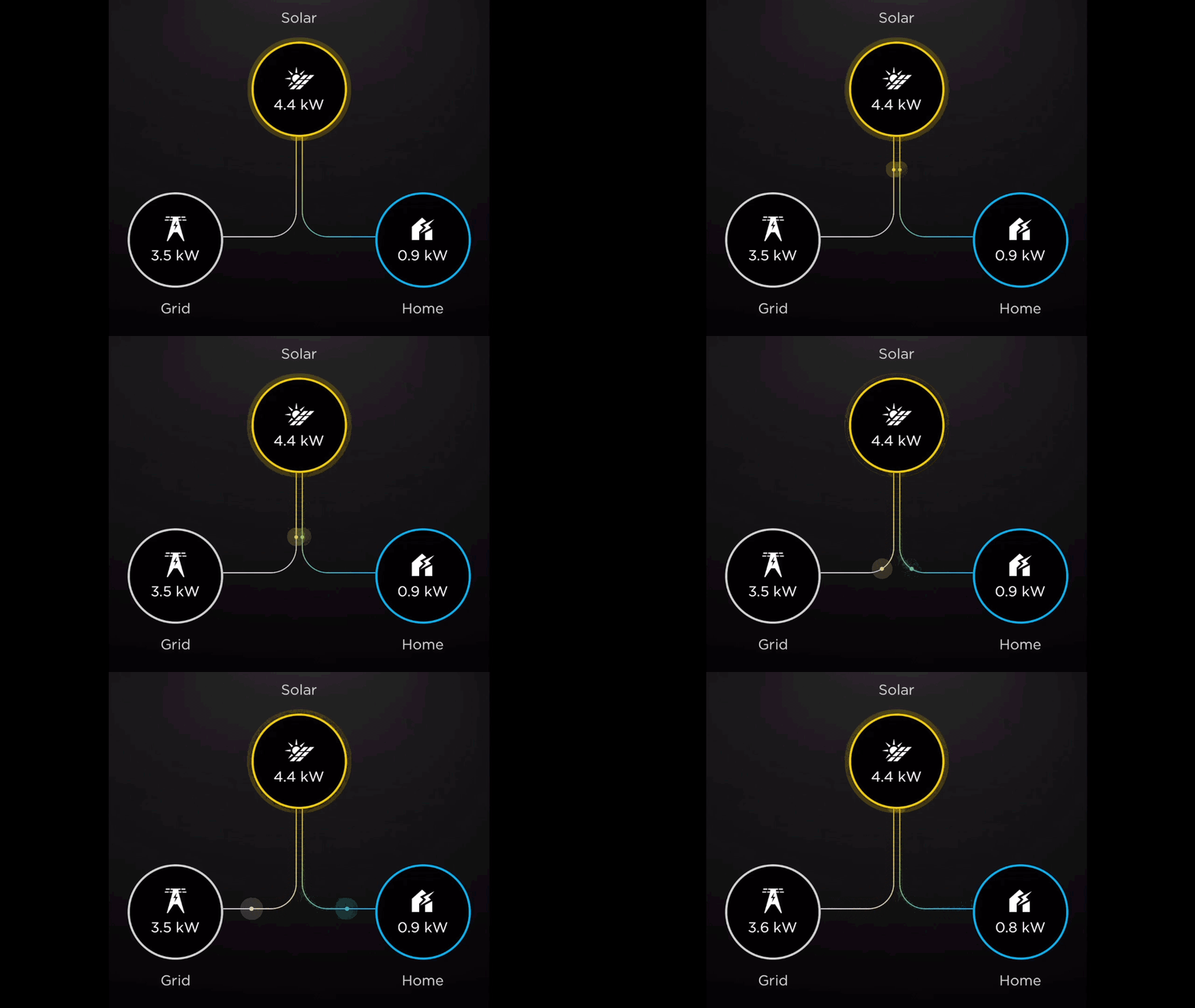
My home solar energy system is exporting surplus solar to the grid (a screen grab from the Tesla monitoring app)
Later, if your panels can’t produce enough electricity, energy is drawn from the grid to make up the difference:
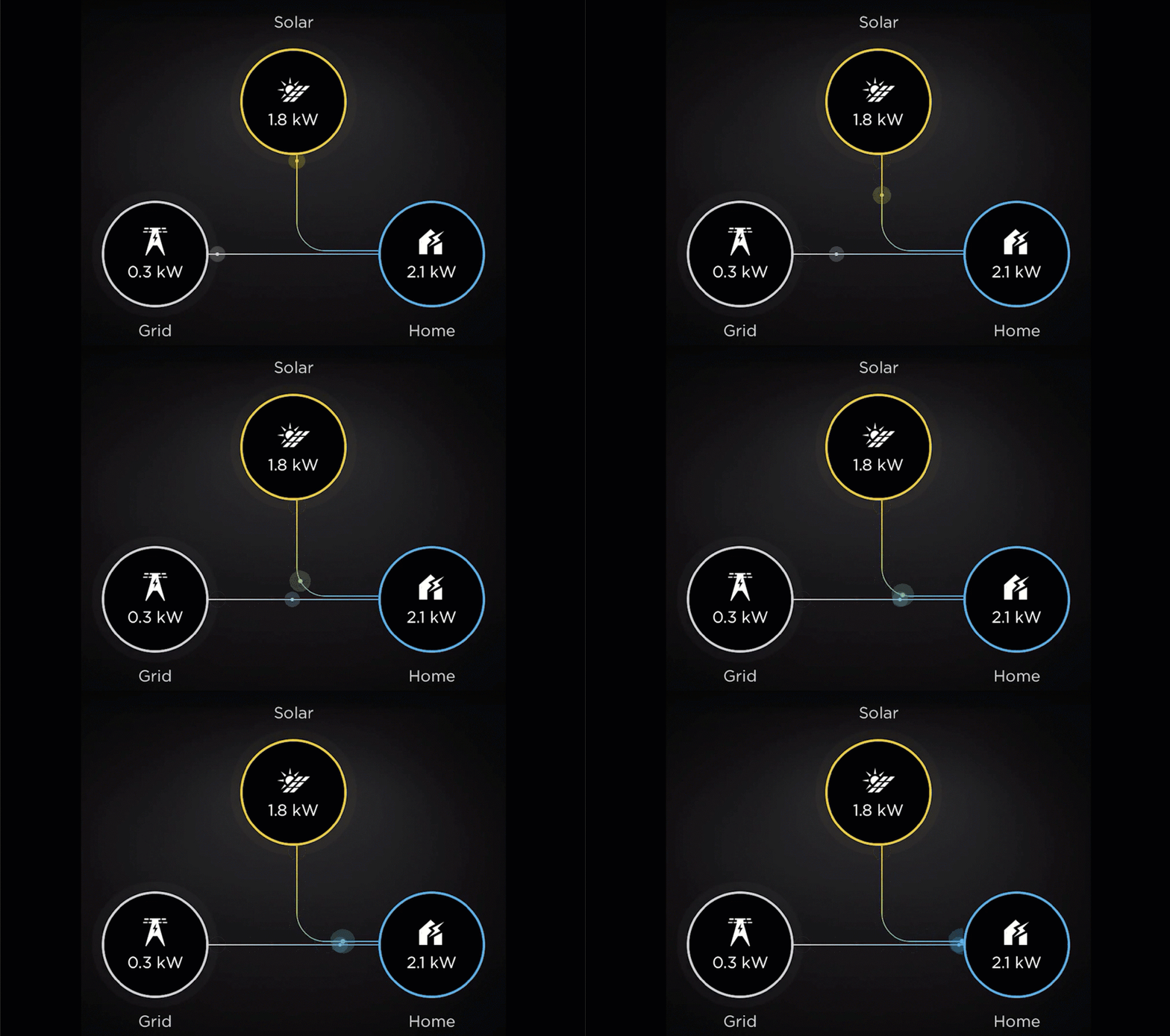
My home solar power system importing grid electricity because I’m not generating enough solar.
Three reasons you may want to add batteries to a grid connected solar system
Reason to add a battery #1) You don’t want to export all your surplus solar energy – you’d like to store it in a battery instead:
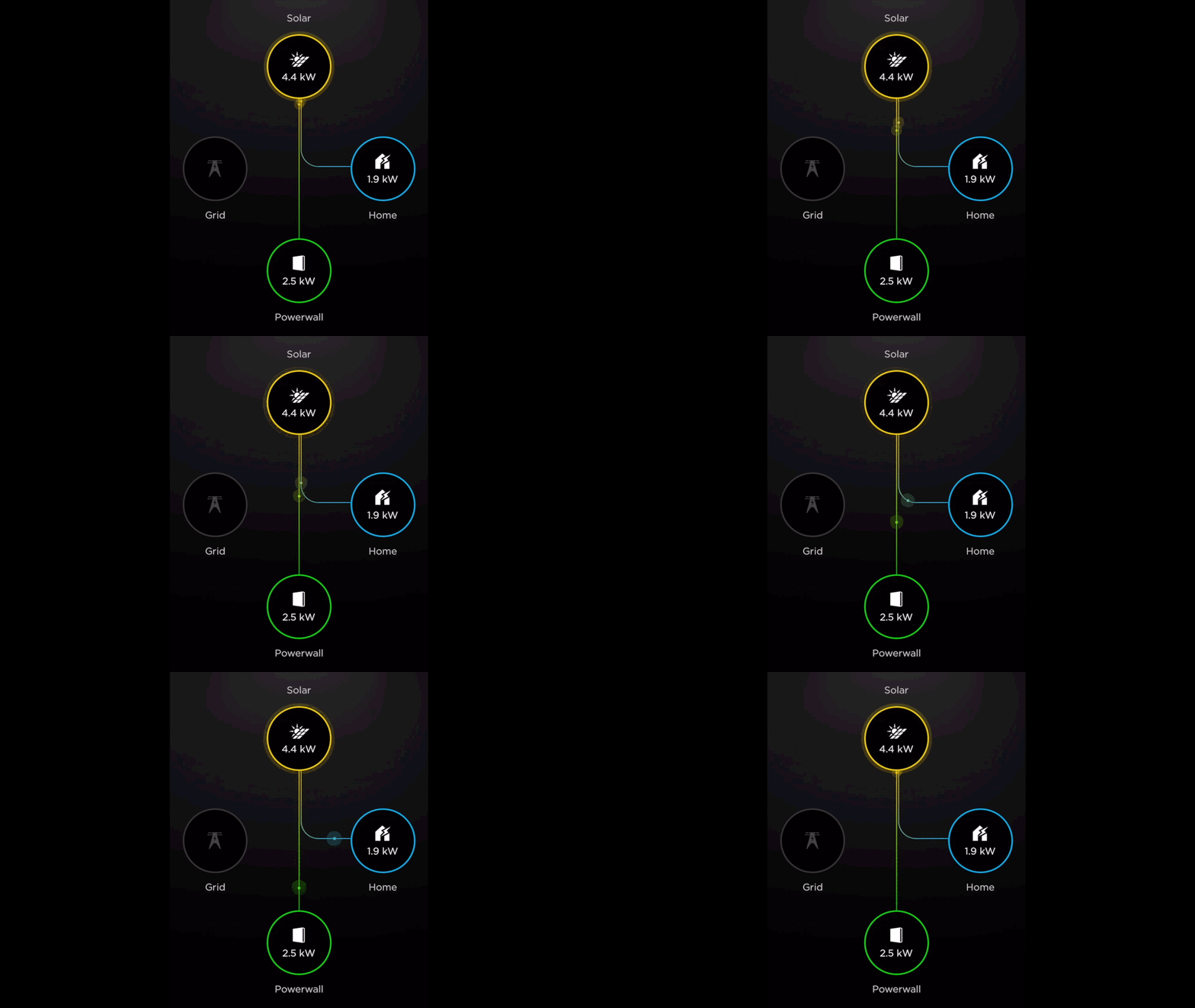
If you add a battery you can charge it with your surplus solar energy.
Storing excess solar energy in a bome battery is easy to do now thanks to falling prices and the federal battery rebate. A battery suitable for your circumstances can pay for itself in most of Australia, although it can be difficult in Victoria, and nearly impossible in Tasmania. To see how much (or how little) a battery can save, use our solar and battery calculator. Or if you have had a smart meter for 12 months or more, you can use our “Add a battery” calculator to get a precise estimate of how much a battery would have saved you.
Reason to add a battery #2) You want to have backup power available if the grid goes down.
A regular solar power system can’t power your home when the grid goes down, because – as we’ve just seen – the grid is required to either:
a) absorb surplus solar energy or
b) top-up insufficient solar.
But a good battery system will allow you to power some or all of your home if the grid goes down. So even if live somewhere it’s hard to make a battery pay for itself, such as Melbourne or Hobart, the advantages of having backup power may still make it worth your while.
Reason to add a battery #3) You want to make money by selling electricity to the grid.
Some electricity plans offer high feed-in tariffs in the evening, so it’s possible to make money by sending battery power into the grid at these times. It also may be possible to get an electricity plan that pays wholesale rates for electricity sent into the grid.
Another way to make money from a battery is by joining a VPP. This provides payments in return for allowing a VPP provider to sometimes use your battery to support the grid. Joining a VPP can be worthwhile, but it’s important to ensure its terms suit you.
A word of warning: Not every battery can provide backup power. Be sure you talk to your installer about how much back up power a battery can provide and exactly what circuits in your home will be backed up.
Why don’t all battery systems offer backup? Because leaving out backup makes the system cheaper and quicker to install.
The rest of this article will explain why battery systems with backup are different and more expensive than systems without backup.
Things will start getting a little geeky, so if you’d just like to learn more about batteries generally instead, head on over to my solar battery storage home page. It contains some good summary information and links to everything I think you need to know.
Let’s get started!
Solar battery storage system without backup (AKA hybrid solar without backup)
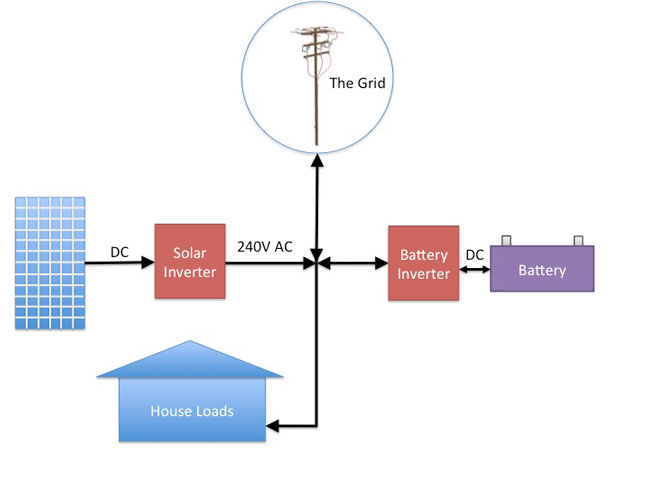 This is the simplest and cheapest type of solar plus storage system available. Electrically, it treats the battery pack like another solar panel array. So, the battery pack plugs straight into a spare input on your solar inverter.
All that is required for this battery integration is:
a) A battery pack with high voltage DC output and integrated charger.
b) A separate battery inverter or a hybrid solar + battery inverter. Both options will need to talk to the battery’s management system (BMS) so the battery is not overcharged.
c) A way to know how much electricity the home is currently importing or exporting – so the battery knows when it is a good time to charge (i.e. when there is spare solar energy) and when it is a good time to discharge (i.e. when there is not enough solar to power the nome).
As you can see – this should make for a relatively quick, cheap and easy installation.
A solar battery storage system with backup (AKA hybrid solar with backup)
This type of system is more expensive. I’ll go through how they work to give you an understanding of why that is so.
There are 2 main ways to skin this cat: AC coupling and DC coupling.
AC coupled systems use 230V AC to charge the batteries. This is the most common way to retrofit batteries to an existing solar system, because all solar inverters output 230V (including microinverters).
An AC coupled system will generally have 2 inverters, the existing solar inverter, and a battery inverter. The battery inverter controls the charging and discharging of the battery. It also monitors the grid connection, and if grid power fails, it switches almost instantly to battery (+solar) power so your lights won’t go out. The battery inverter may be a separate box, or it may be included in the battery box – the latter is known as an “all-in-one” system.
As well as an extra inverter, you may need to rewire your switchboard to separate out ‘essential circuits’ and ‘non-essential circuits’.
The typical Aussie home can pull a lot of power. If your A/C is going, your oven is on, and someone puts the kettle on for a nice cuppa, the peak draw could easily be 7-8kW. Normally, this will instantly overload a battery system that’s only designed to supply a continuous 5kW. If you want to back up your whole home, I recommend a battery system that can provide 10kW of power or more.
If you’re not getting a battery that can meet your highest usual power draw, while also storing enough energy to get you through a typical blackout, then you shouldn’t try to back up the entire home. The most important appliances such as the fridge and lights are generally wired into a separate ‘essential circuit’, and the stuff you can live without stays on the ‘non-essential’ circuit.
This keeps the battery pack cost down and lets your house run for a lot longer without the grid.
This block diagram shows how all this works:
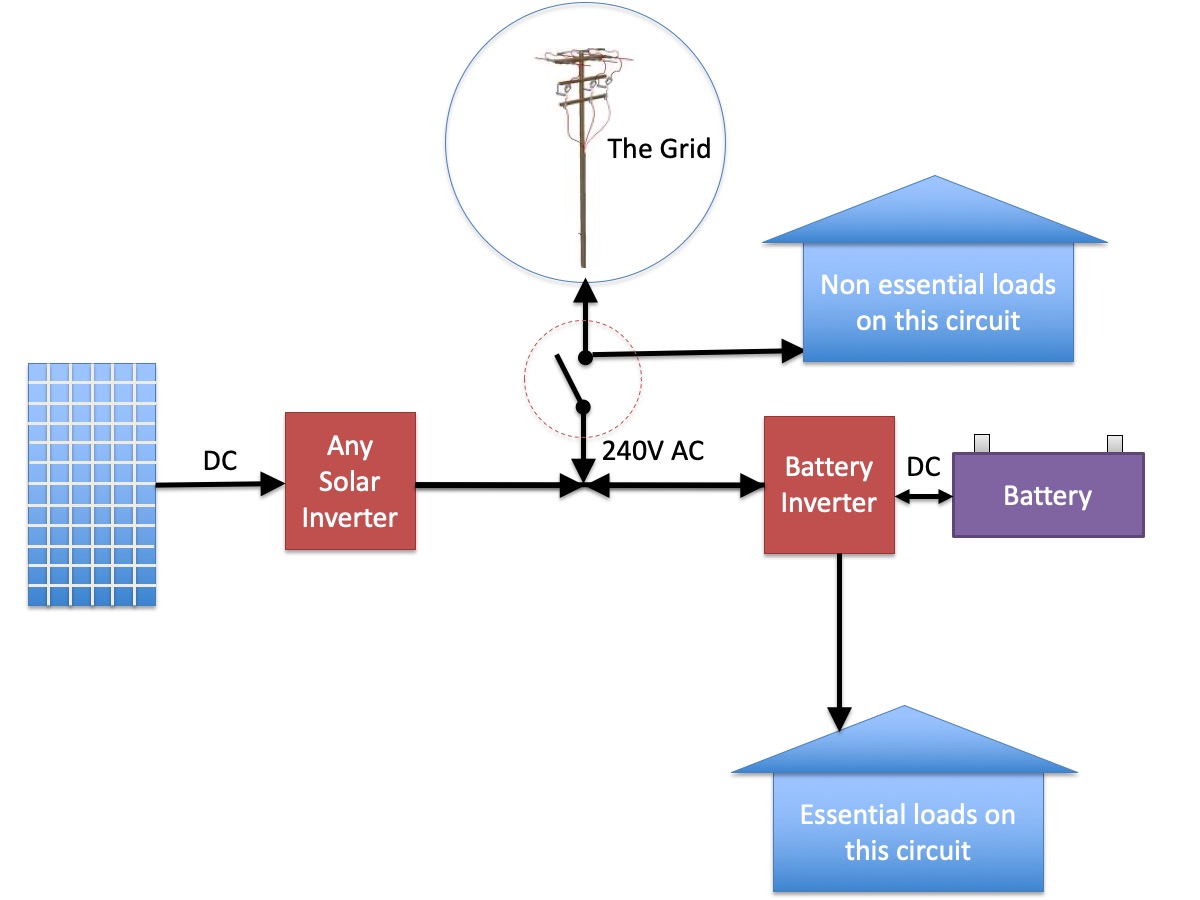
If your home can pull more power than your battery can provide, then you should have essential and non-essential circuits. The essential circuits are disconnected when the system isolates from the grid. The essential circuits remain backed up by your solar power system and battery.
As you can see, it is more involved than the design without backup. Here are the extra costs:
1) A special battery inverter that safely switches to solar and batteries if the grid goes down (or an all-in-one battery system that is more expensive than other storage solutions).
2) Modification of switchboard wiring to have a backed up ‘Essential AC Loads’ and a non backed up ‘Non-essential AC Loads’ circuit. Often the essential loads are put in a new switchboard altogether.
3) Enough batteries to cope with both the peak power of your chosen loads, and with enough energy storage to run as long as you specify without the grid. The typical Aussie home uses about 16kWh per day of electricity, so they’d probably need 7 kWh of storage at a minimum to last them through a blackout of more than a few hours. Because of the way the battery rebate works, I recommend most households get a minimum of around 14kWh of storage. The larger the battery, the more likely it is it will have sufficient energy when a blackout occurs.
Technical note: Imagine the system in the diagram above running without the grid (i.e. the switch is open). What happens when the batteries are full and the solar is generating more electricity than the house needs? Where does the excess solar electricity go? There is nowhere for it to go. Solar battery systems handle this problem one of two ways:
1) Totally disable the solar panels when the grid is disconnected.
2) Throttle the solar panels to produce no more power than can be used.
Some systems choose option 1. The problem there is that the solar panels cannot then charge the batteries when the grid is down. So your batteries will not get recharged in a blackout and may run flat before the grid comes back. Don’t buy a battery system that does this.
The better systems choose to throttle the solar down. They can do this in one of two ways.
a) They can talk to the solar inverter and ask it nicely. To do this the battery inverter needs to be compatible with the solar inverter. An example of this is a Fronius solar inverter and a Selectronic battery inverter.
b) The battery inverter can shift the frequency of the 230 VAC enough to shut down the solar inverter when required. All solar inverters are programmed to shut down at a certain frequency – so this works for any solar inverter. An example of this is the Tesla Powerwall.
One last thing – let’s talk about the elephant in the room. Namely – if you are going to get batteries why all this talk about being grid connected? Why not simply go off grid altogether? Read on.