V2G & Bidirectional EV Charging In Australia: Chargers, Cars & How It Works
Bidirectional EV charging is now legal in Australia, and the first certified chargers are already being installed in homes. That’s the good news. The downside is that most EV owners can’t just buy one and start exporting to the grid.
Table of Contents
- What Are V2G, V2H And V2L?
- How Bidirectional EV Charging Works
- Is V2G Available In Australia Yet?
- V2G Chargers Available In Australia
- V2G-Capable EVs Available In Australia
- Which Approvals Do You Need For V2G In Australia?
- Can V2G Replace A Home Battery?
- What You Can Do Today
What Are V2G, V2H And V2L?
You might have seen V2G, V2H, and V2L used as if they mean the same thing. They don’t, but people often mix them up. All three fall under the term V2X, or vehicle-to-everything. This simply means power can flow both ways between your car and something else, not just one way.
Vehicle-to-Load (V2L)
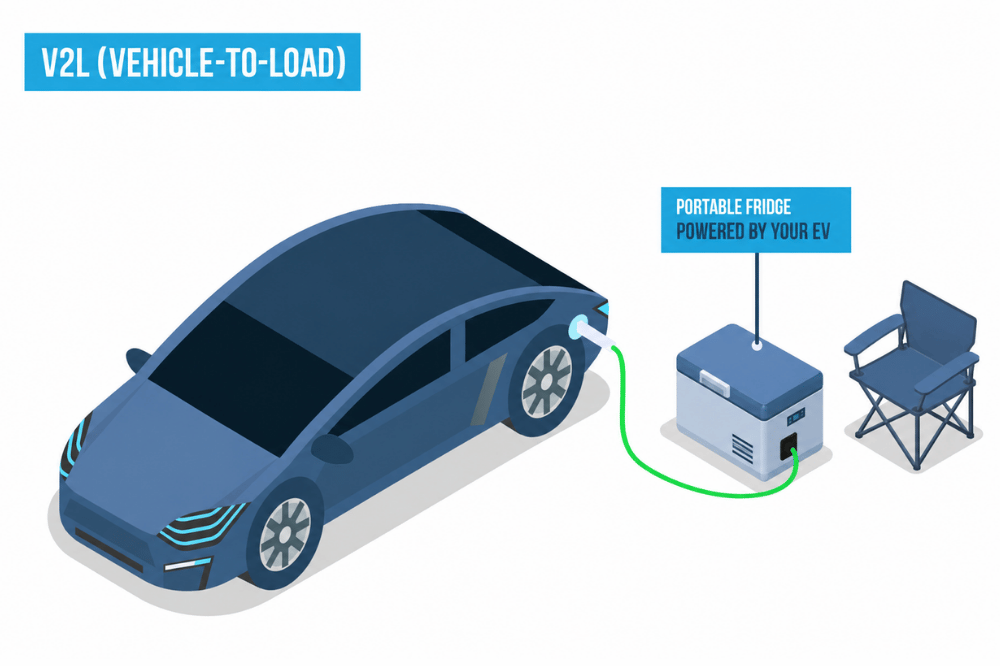
With V2L, your car can charge external appliances, which is great for camping.
This is the simplest option and the most widely available. You can plug an appliance into a socket in your car, or use an adapter, and the battery will power it directly. Many EVs sold in Australia already offer V2L. It’s useful for running a fridge while camping or keeping a few essentials going during a blackout. However, it won’t power your whole house. You’re limited to what the car’s onboard socket can provide, which is usually just a few kilowatts.
A few V2L EVs in Australia are the Genesis GV60 and Electrified GV70/G80, Hyundai Ioniq 5, Kia EV6 and Niro EV, and MG ZS EV. Other manufacturers are catching on too. This list is expanding.
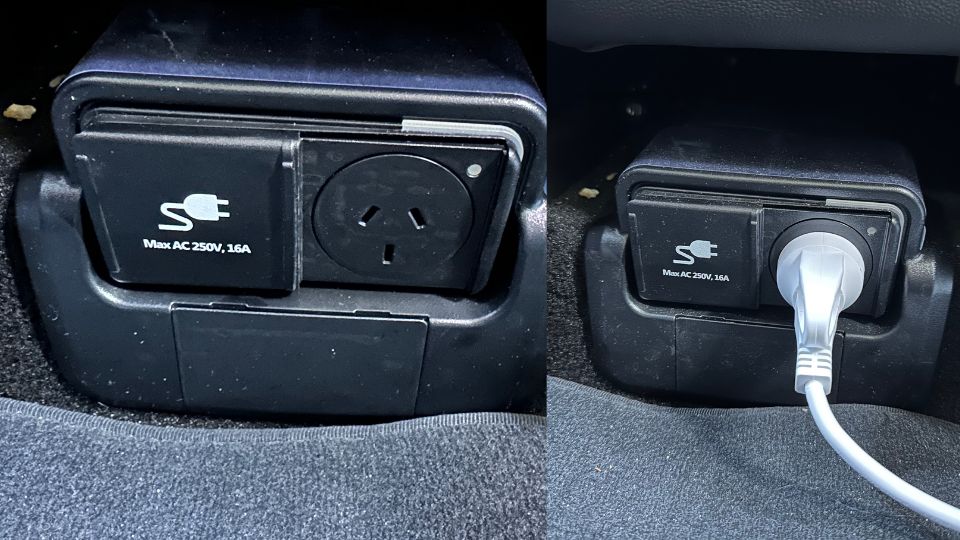
The Hyundai Ioniq 5 has a 250V, 16A power point under the middle backseat.
Vehicle-to-Home (V2H)
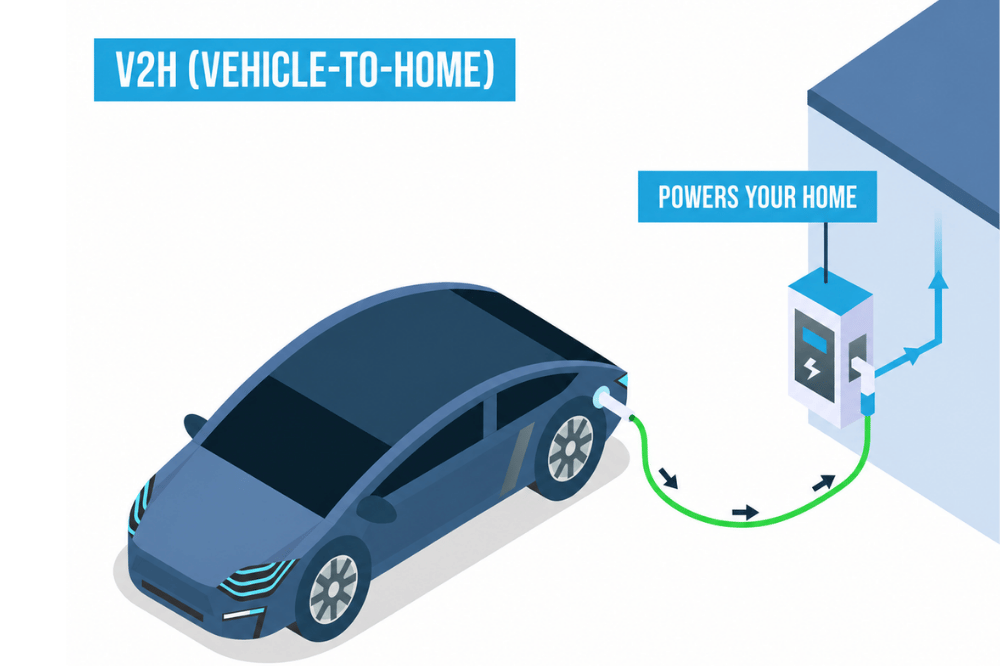
The car powers the whole home, acting as a home battery.
The technology lets you use your EV as a (very big) home battery system.
For some households, having an EV with V2H capabilities will do away with the need or desire to have a home battery. They’ll just use the car. This will most likely be the case where the car is at home most of the day, and the house has a rooftop solar power system.
V2H can be grid-forming, meaning it can operate when the grid is down and rooftop solar panels will continue to charge the EV. But backup capability depends on the bidirectional charger used.
When you consider the capacities of electric vehicle batteries and depending on a household’s energy consumption profile, V2H may turn out to be a much cheaper and more practical way of approaching home energy storage. Compared to home battery system pricing, kilowatt-hour for kilowatt-hour, it could be like paying for the EV battery and getting the rest of the car thrown in for free.
To do this, you need a compatible EV, a bidirectional charger, and an energy meter, all working together. The car alone isn’t enough.
Vehicle-to-Grid (V2G)
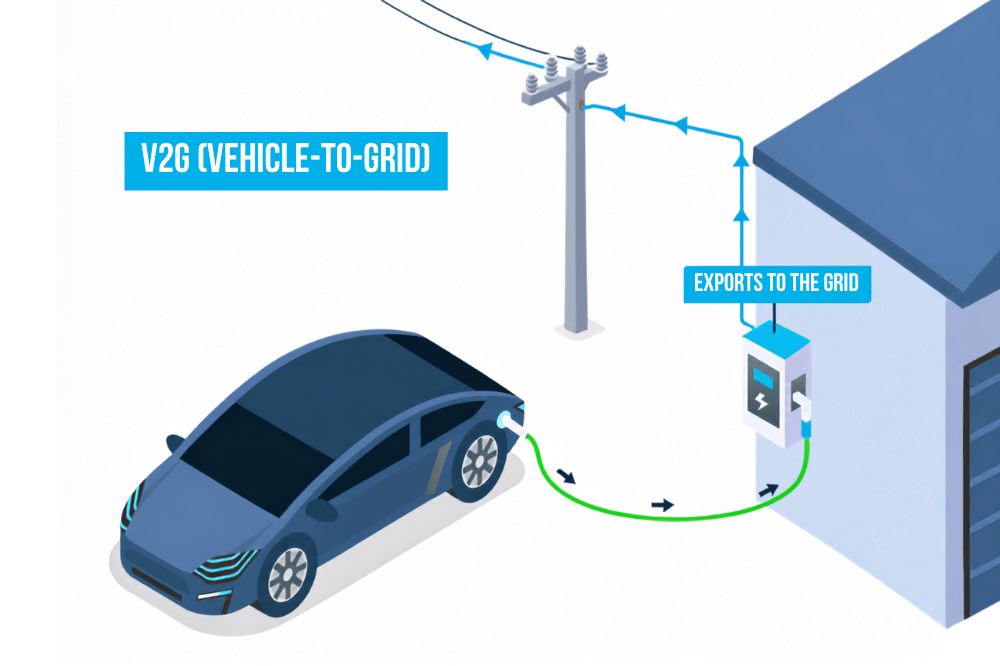
With V2G, a car can export excess energy through a capable charger.
V2G has been legal in Australia since 2024, though most owners can’t actually use it yet. There are many EVs being tested and certified for it now.
How Bidirectional EV Charging Works
A standard EV charger only works one way. It takes AC power from the grid or your solar system and converts it to DC to charge the battery. A bidirectional EV charger does both: it charges the car and can also send energy back out by converting DC back to AC.
Manufacturers build these chargers in two ways. DC-coupled chargers convert AC to DC inside the charger. This method is more efficient but needs more hardware and usually costs more.
AC-coupled bidirectional EV chargers use the car’s own onboard inverter. This makes the charger simpler and cheaper, but it means the carmaker has to make sure the inverter meets local requirements.
Is V2G Available In Australia Yet?
Technically, yes, but only in limited circumstances. V2G is possible in Australia today, but for most households it still isn’t something you can simply buy, install and start using.
South Australia is currently the furthest ahead. SA Power Networks allows compliant V2G systems to connect to its network outside of trials, provided the charger, car and installation meet its requirements. SAPN had already been the first to allow a bi-directional charger install a few years ago:
The bigger problem is that the rest of the market hasn’t quite caught up yet. V2G is stuck in a bit of a “chicken-and-egg” problem: car manufacturers are reluctant to fully support V2G until there are enough compatible bidirectional chargers available, while charger manufacturers have less incentive to bring products to Australia until there are enough compatible cars on the road.
That means getting V2G working still requires the right combination of EV, charger, network approval, software and, in many cases, a retailer or VPP that supports it. Those combinations are still rare.
For now, most Australian households getting hands-on experience with V2G are doing so through trials and controlled programs. The biggest is Amber Electric’s ARENA-backed V2G trial, which started with 50 households and is now being expanded to 1,000 V2G-enabled homes.
So V2G has moved beyond the experimental stage, but it hasn’t reached the point where it is an easy, off-the-shelf option for most EV owners.
V2G Chargers Available In Australia
Two of the bidirectional EV chargers available in Australia sit on our own EV charger comparison table:
- The StarCharge is listed as bidirectional on our comparison table, with its own warranty documentation describing it as a V2G DC wallbox.
- There’s a charger from Enphase that’s V2X capable once the software is unlocked.
Not all of the following other chargers we want to mention in this space are truly available yet. Some are still facing delays, certification, or only have a limited Australian release.
Other bidirectional chargers in the Australian market that are either available or in the process of getting approval are:
- InfyPower
- Sigenergy Sigen EV DC Charging Module
- StarCharge Halo
- T-Power V2G-AC22
- V2Grid Numbat
- Zaptec Go 2
A V2G charger is more than a normal EV charger. Because it can send power back into the grid, it also performs, or works with, an inverter function. That’s why approved V2G equipment appears on the Clean Energy Council’s inverter list.
V2G-Capable EVs Available In Australia
The following EV manufacturers offer V2G:
- BYD
- Cupra
- Hyundai
- Kia
- Nissan
- Zeekr
Of them, the Nissan Leaf, the Mitsubishi Outlander, the Mitsubishi Eclipse Cross, and the Kia EV9 are currently V2G capable.
As trials of the technology roll out, the other manufacturers are catching up. BYD vehicles are testing with Amber Energy, and the Cupra Born is bidirectional-ready but awaiting Australian certification.
Many modern CCS2-equiped EVs from brands like Hyundai, Kia, and BYD have bidirectional capabilities abroad but local manufacturing and grid compliance are still being sorted.
It’s worth checking our comparison table for the latest updates before making a decision, as this part of the EV charger market changes quickly.
Which Approvals Do You Need For V2G In Australia?
Setting up V2G at your home requires more approvals than installing a standard charger. Four things need to come together:
- Clean Energy Council certification is required for the charger hardware itself. It’s what separates a genuinely approved product from something still in trials.
- You need network approval for any device that exports power to the grid.
- Retailer or VPP participation is how you get paid. Without it, a V2G-capable setup can still charge and discharge for your EV, but it won’t earn anything from the grid. Our Virtual Power Plants guide explains how these programs work.
- Your EV’s warranty. Even if you have a certified charger and network approval, using V2G on a car that isn’t approved by the manufacturer can risk your warranty. Always check with the manufacturer directly instead of assuming compatibility means approval.
Can V2G Replace A Home Battery?
When you compare them by kilowatt-hour, EV batteries are cheaper than dedicated home batteries. If your car is parked at home most of the day with solar panels, it can do much of what a home battery does.
There are some important caveats, though. V2G alone won’t keep your home running during a blackout because it’s not grid-forming. When the grid goes down, your export capability stops too, just like a standard solar inverter.
Only V2H, with the right charger, can actually back up your home.
There’s also the issue of battery wear from extra cycling. Some manufacturers are still discussing this while others already have clear terms about battery degradation in their warranty terms.
Lithium-ion batteries degrade over time. It’s just the technology. These batteries lose their energy capacity, and some faster than others. But EV battery manufacturers have had a great deal of practice in building vehicle energy storage that lasts.
As well as battery pack quality, how much of an impact using V2L, V2H or V2G will have on battery life will depend on how hard, how long, and how often you (or the grid) utilise it. EV batteries are already far cheaper than home battery storage, and that trend will likely continue for the foreseeable future.
EV makers may be fussy about what bi-directional chargers will be permitted for use with their cars while under warranty. As well as keeping EV warranty in terms of chargers in mind, you should also take a close look at an electric vehicle’s warranty to determine how utilising V2, V2H or V2G may affect it.
By the time a new EV purchased today will need its battery pack replaced, it should be a cheap exercise compared to replacing a home battery. And a home battery won’t get you to the supermarket, your place of work, favourite camping site, or tow your boat/trailer.
But, as explained above, this will only become a realistic option for most households once bidirectional charging is mainstream. Nobody knows when that’ll be. Meanwhile, home batteries are proven, widely available storage solutions today.
What You Can Do Today
If you’re shopping for an EV and bidirectional charging is important to you, check the manufacturer’s official position on V2G or V2H for that specific model.
If you already own a compatible EV, the practical route today is to use a certified charger, a network-approved installer, and, if you want to get paid for exporting, a retailer or VPP program.
And if bidirectional charging isn’t the main reason you’re considering an EV, don’t let it delay the decision. Pairing a standard home charger with solar and off-peak charging already delivers most of the savings most households are after. V2G is a genuine bonus on the horizon, not something you need today to make an EV worthwhile.
Compare EV chargers or get quotes from trusted installers if you’re ready to take the next step.