How The Photovoltaic Effect Works
By Finn Peacock, Chartered Electrical Engineer, Fact Checked By Ronald Brakels
(the magic that makes solar panels work)
The photovoltaic effect is the fancy name given to the phenomenon of converting light to electricity in a conventional solar panel.
Electricity is simply a flow of electrons running around a closed circuit. So how do we create a flow of electrons using a solar PV panel and sunshine?
The internal workings of solar panels are quite complex, but I’ll have a go at explaining. Don’t worry too much if you don’t understand the next paragraph!
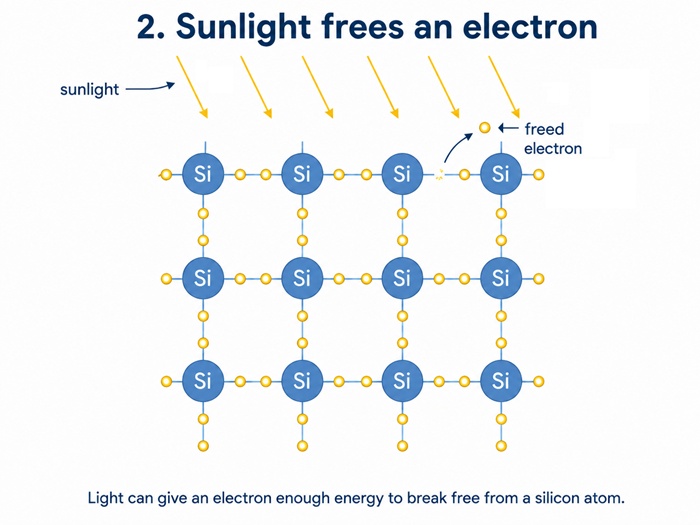
Sunlight photons hit silicon atoms in solar cells, potentially knocking electrons loose. This creates a free electron not attached to a specific silicon atom and the “hole” where it used to be. The cell is designed to have an internal electric field that separates the electrons and holes towards opposite sides. If these sides are connected with a circuit, electrons will flow through it, creating an electric current that can be used to provide power. This conversion of light energy into electrical current is called the photovoltaic effect.
If you are like me and learn by pictures, then the following diagrams illustrating the PV effect may make more sense:
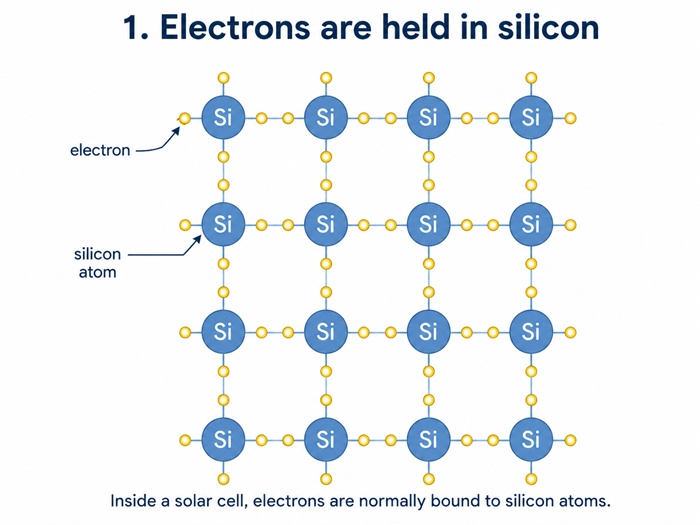
1) The atoms in the silicon crystals in the solar PV panels are surrounded by electrons:
2) Sunlight falls on the crystals of silicon and “electrons” are ejected:
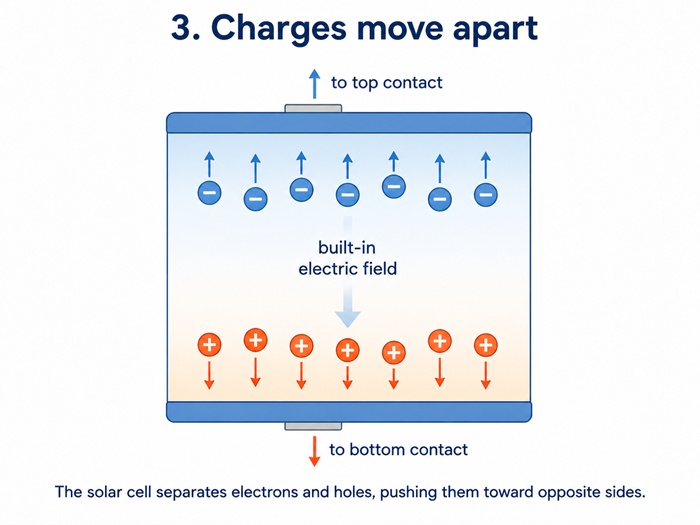
3) Because the top and bottom of the cell contain trace amounts of different elements, it creates an internal electrical field that draws positive and negative charges to opposite sides.
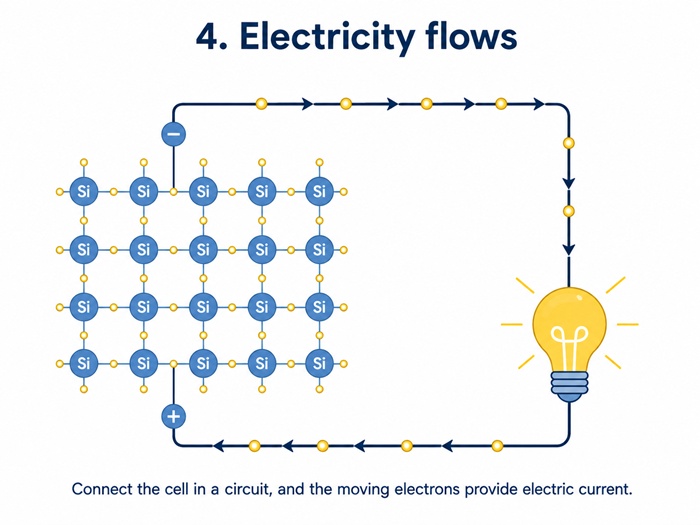
4) Connecting the opposite surfaces of a solar cell with wire creates a circuit that electrons flow through. This flow of current can be used to provide electrical power:
.. and that is my best effort at explaining how the solar panels on your roof take sunlight in and spit electricity out through the photovoltaic effect. How did I do? If you’re interested in learning more about modules, read my article on how solar panels work.
From the solar panels, heavy-duty wires capture the electricity and feed into a box of electronics called an ‘inverter’.
The solar inverter’s primary purpose is to convert Direct Current (DC) into 230V Alternating Current (AC) electricity that is compatible with both your household appliances and the electricity grid.
Any of the electricity transmitted by the inverter that is not used by your house and gadgets will, by the natural forces of physics, flow through your meter and out into the wider world via the mains electricity grid.