How Long Do Solar Panels Last? Degradation Rates Compared
Last Updated: 29th Jul 2026 Fact-checked by Ronald Brakels
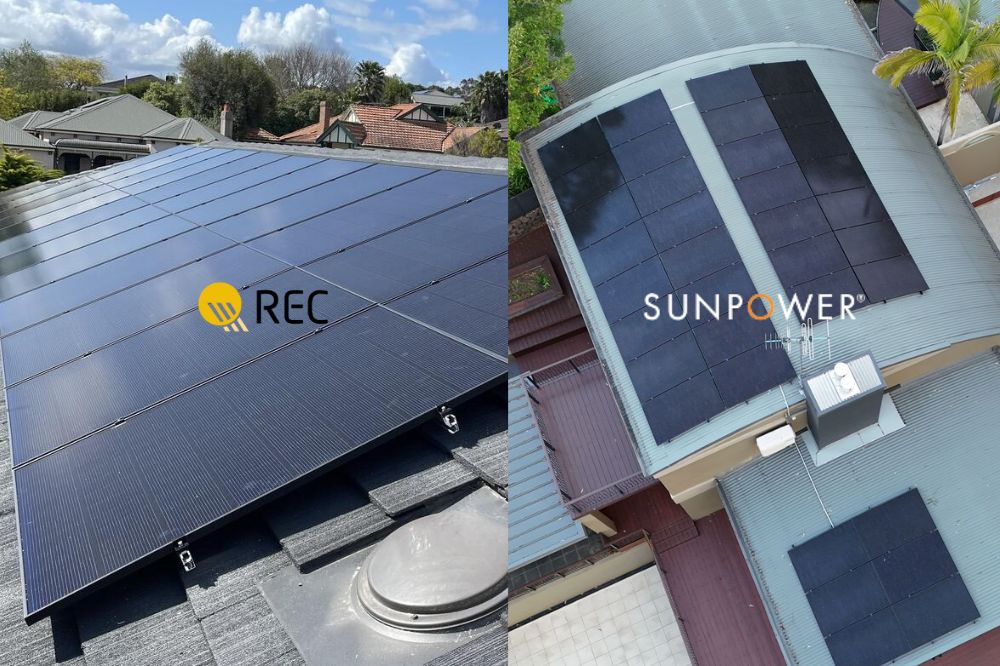
Solar panel degradation is a slow decline in panel performance over time. But for decent quality panels, it’s very slow. If you have quality panels on your roof, you can expect them to last for decades with only minor losses in power output. Degradation rates these days are so low that, so long as quality panels are used, it’s no longer something most homeowners need to worry about. But choosing panels with a lower degradation rate can still help, as it affects your system’s lifetime energy yield and long-term savings.
Solar panels come with performance warranties that promise they won’t lose capacity faster than a specified degradation rate. This is separate from their product warranties that cover defects. These warranties normally last for 25 or 30 years.
The table below shows how different brands compare on degradation rates and long-term output.
Solar Panel Degradation Rates
Here’s a table showing the maximum amount of degradation different panels’ performance warranties allow after the first one or two years. The degradation rate, for example, “0.35% per year” is a percentage of the panel’s original capacity.
| Panel | Manufacturer | Product Name | Degradation rate ▼ | Power Output Warranted at 25 Years | Approx. Cost per Panel (AUD) |
|---|---|---|---|---|---|

| SunPower Maxeon 3 (black) | 0.25% per year | 92% | $200 | |
|
| SunPower Maxeon 3 | 0.25% per year | 92% | $190 | |

| REC Alpha Pure-RX | 0.25% per year | 92% | $280 | |
|
| REC Alpha Pure-R | 0.25% per year | 92% | $255 | |

| Aiko Neostar 2S+ | 0.35% per year | 90.6% | $159 | |
|
| Aiko Neostar 3S | 0.35% per year | 90.6% | $215 | |
|
| Aiko Neostar 3P | 0.35% per year | 90.6% | $220 | |
|
| Aiko Neostar 2P | 0.35% per year | 90.6% | $149 | |

| Longi Hi-MO X10 Explorer | 0.35% per year | 88.9% | $175 | |

| Phono Solar Quasar | 0.35% per year | 90% | $175 | |
|
| Phono Solar Helios Clear | 0.375% per year | 90% | $200 | |

| Solahart Silhouette series | 0.4% per year | 89.4% | $165 | |
|
| Solahart SunCell series | 0.4% per year | 89.4% | $140 | |

| Canadian Solar Inc TOPHiKu 6 | 0.4% per year | 92.4% | $130 | |

| Trina Solar Vertex S+ (475W) | 0.4% per year | 89.4% | $150 | |
|
| SunPower P7 | 0.4% per year | 89.4% | $145 | |

| Jinko Solar Tiger Neo III | 0.4% per year | 89.4% | $175 | |

| JA Solar Deep Blue 4.0 Pro | 0.4% per year | 89.4% | $155 | |

| TW MNH-48HE | 0.4% per year | 87.4% | $120 | |
|
| TWMNH-48HD | 0.4% per year | 87.4% | $100 | |

| Tindo Walara | 0.4% per year | 87.4% | $191 | |

| Suntech Ultra V Pro (N-type) 440W | 0.4% per year | 89.4% | $130 | |
|
| Suntech Ultra V Pro (N-type) 415W | 0.4% per year | 89.4% | $130 | |
|
| Suntech Ultra V Pro (P-type) | 0.4% per year | 89.4% | $120 | |

| Winaico WST-NGX-D3 | 0.4% per year | 89.4% | $198 | |

| Risen TOPCon | 0.4% per year | 89.4% | $140 | |

| SolarEdge Smart Panel | 0.55% per year | 84.8% | $207 | |
|
| Risen Titan S (440W) | 0.55% per year | 84.8% | $135 |


The very best panels only lose up to 0.25% per year, while the worst on the list only loses up to 0.55% per year.
Table of Contents
- The Lowest Degradation Solar Panels
- What Is A Good Degradation Rate for a Solar Panel?
- Year 1 vs. Years 2–25: Why the First Year’s Drop Is Bigger
- What Causes Solar Panel Degradation?
- Why Degradation Matters Over Time
- Are the Slowest-Degrading Panels Always the Best?
- Related Guides and Resources
What Is A Good Degradation Rate for a Solar Panel?
If your panels are from a decent manufacturer, you can expect a warranted annual degradation rate of 0.4% or less.
While the maximum warranted loss for most panels now going on Australian roofs is 0.4%, you can do a little better by getting Aiko panels, which claim 0.35%, and if you’re willing to pay for a premium panel such as REC or SunPower Maxeon, they promise 0.25%.
Solar panel degradation is getting better all the time. Five years ago, 0.7% per year was typical, and there will probably be further improvements in the future.
Year 1 vs. Years 2–25: Why the First Year’s Drop Is Bigger
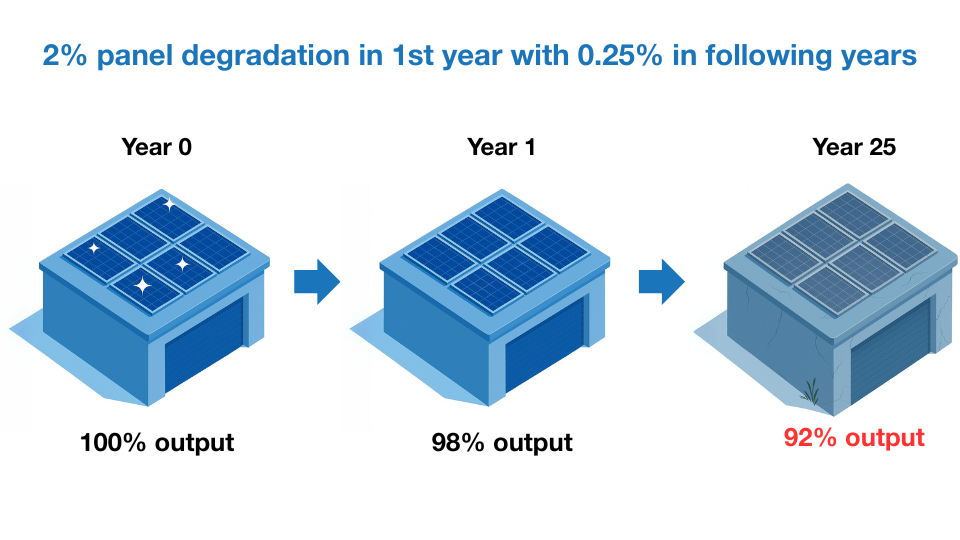
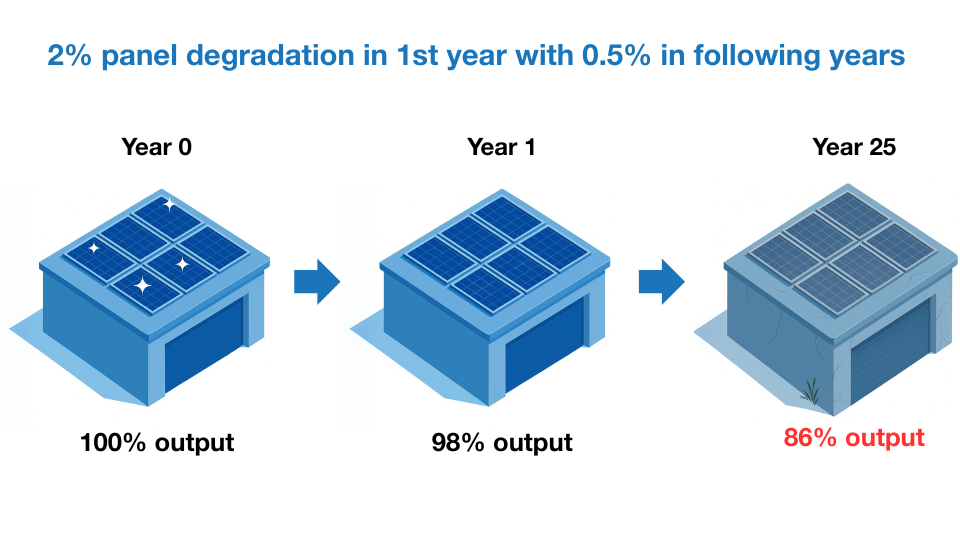
Panels’ performance warranties allow for a steeper output drop in their first year. This is usually either 1% or 2%, but for some panels it’s 1.5%.
This is mainly due to Light-Induced Degradation (LID), which affects panels during their first day or two in sunlight, but then stops. How bad it is depends on the type of panel.
- P-type panels, which were common but are now rare, typically allow 2% degradation in their first year to account for LID.
- N-type panels, which are the most common type used on rooftops, are mostly immune to LID and typically allow for 1% degradation in their first year or sometimes 1.5%.
So while a panel can take a small hit to output in its first year, you can expect the deterioration in subsequent years to be very gradual.
What Causes Solar Panel Degradation?
Being exposed to the elements is a tough life. Solar panels expand and contract with changes in temperature, are flexed by wind, soaked by rain, and possibly pounded by hail. This results in the build-up of what starts as very minor damage over the years, which can include microcracks in solar cells and damage to solder joins. Both problems can reduce current flow. Well-made panels with lower rates of degradation are better able to resist these effects and so build up damage at a slower rate.
Why Degradation Matters Over Time
The losses build up and affect your system’s lifetime energy yield. If you choose a premium panel with a performance warranty that allows 1% degradation in the first year and 0.25% in subsequent years, and it degrades at the maximum allowed rate, it will have 92% of its original power output after 25 years.
If you instead used a panel with a performance warranty that allows 2% degradation in the first year and 0.5% in subsequent years, and it degrades at the maximum allowed rate, it will have 86% of its maximum power output after 25 years.
The increased rate of degradation results in the second panel producing 4.2% less energy over 25 years. Because the energy loss gets worse over time, half of it occurs after year 17.
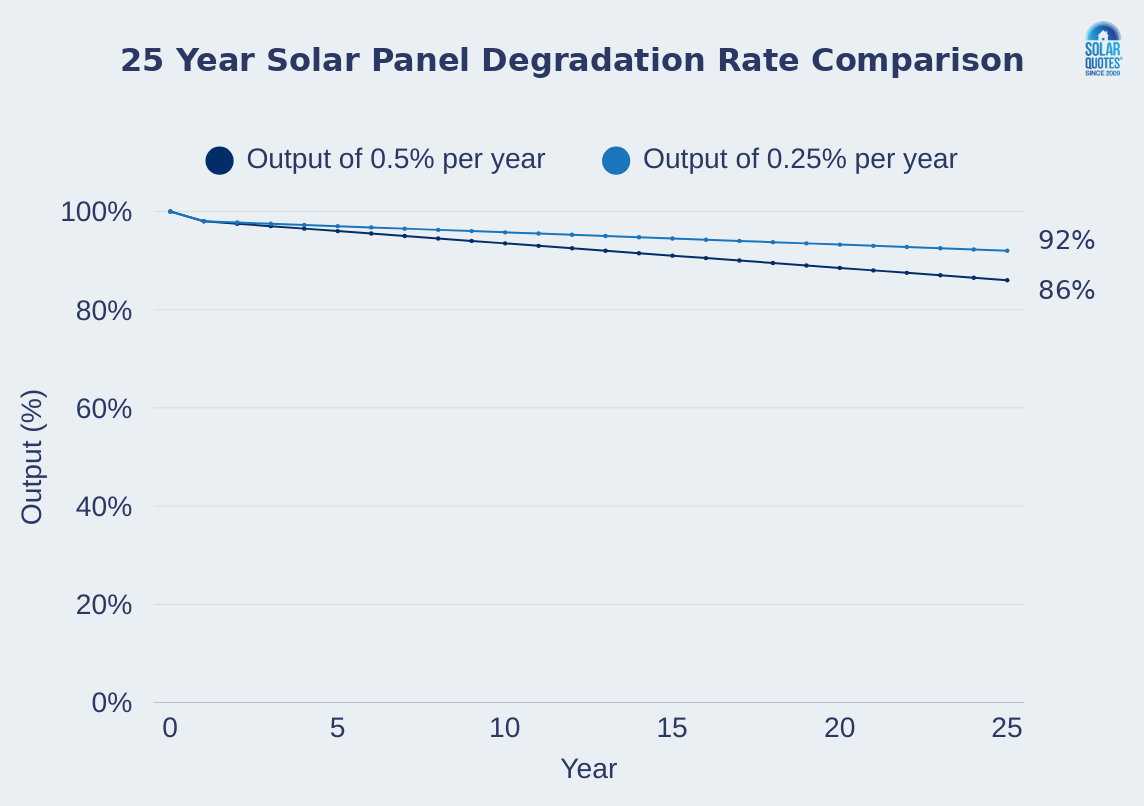
Panels rarely degrade at their maximum allowed rate, so the difference between panels is likely to be even less than what the above graph shows. While having a degradation rate of 0.25% rather than 0.5% does make a difference, it doesn’t make a large one, especially over the first 10-15 years.
Are the Slowest-Degrading Panels Always the Best?
All else equal, the lower the warranted degradation rate, the better. But things aren’t always equal and lower degradation panels can cost more. If you want the lowest warranted degradation rates, you’ll have to pay more for a REC or SunPower Maxeon panels, and you may not consider the modest expected improvement in energy production worth the extra cost.
How Much Can Slower-Degrading Panels Save You?
Let’s compare two 10 kW systems, one consisting of typical panels and one consisting of premium panels:
| Typical Panel | Premium Panel | |
|---|---|---|
| Degradation in year 1 | 2% | 1% |
| Degradation afterwards | 0.4% per year | 0.25% per year |
| Total energy over 25 years | ~340,000 kWh | ~350,000 kWh |
| Estimated savings | $34,000 | $35,000 |
In 25 years, the premium panel system saves you about $1,000. Because it takes time for the effects of degradation to build up, most of the savings occur later in the panel’s life:
| Years Passed | Cumulative Extra Savings (Premium vs. Typical) |
|---|---|
| year 5 | $95 |
| year 10 | $245 |
| year 15 | $450 |
| year 20 | $710 |
| year 25 | $1,020 |
| year 30 | $1,390 |
| year 35 | $1,810 |
| year 40 | $2,290 |
In the first 20 years, the premium panel system will only save you around $700 more in electricity savings than the typical panel system. However, in the next 20 years, they save an additional $1,600.
Note: I have assumed the maximum degradation that performance warranties allow, but most manufacturers include a safety buffer. So the actual real-world savings are likely to be less.
The takeaway
- If you’re only planning to stay in your home 10 years or less, premium panels are hard to justify on low degradation alone.
- If you’re in it for the long haul — or want a system that might still be working in 40 years — it’s worth considering the slowest-degrading panels from reputable brands.
Related Guides and Resources
- Solar Panel Comparison Table: Compare specs, prices, and warranties of Australian solar panels by degradation rate, efficiency, cost and more.
- Top 10 Best Solar Panel Brands: Find out which are the best-rated solar panel brands according to Aussies.
- Solar Panel Reviews: Independent reviews and customer ratings for dozens of panel brands available in Australia.
- Most Efficient Solar Panels: Learn about the highest efficiency panels on the market today.
- Best Solar Panels in 2026: Insights from Aussie installers on top panel brands for performance, reliability and value.
- Beginner’s Guide to Solar Panels : Everything you need to know about buying and installing solar panels in Australia.