
I get a lot of emails from people asking “Which is the most efficient solar panel on the market?”.
Last time I checked, the awesomely awesome Sanyo HIT 195DA3 (note: now manufactured under the Panasonic brand) laid claim to the most efficient panels in production at a whopping 20.5% panel efficiency!
(And before you SunPower fans swamp me with emails – yes, I understand that this is including light coming into the back side of the panel, which is would require special mounting – see the pic below. On a typical roof, the Sunpower E20 327W will be the most efficient at 20.4% panel efficiency)
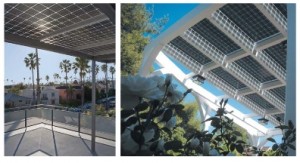
An example of Sanyo HIT solar panel mounting to maximise efficiency.
But whilst solar panel manufacturers like SunPower and Sanyo battle it out for the “most efficient panel” gong, the question we really need to ask is: “Is the most efficient panel the best option for your roof?”.
And the answer is, “Not Necessarily…”
Don’t get me wrong – here are the advantages of going with a super-efficient panel:
If the panel manufacturer can make a solar panel that is so efficient, they must know what they are doing! The quality of the panel should be excellent, and it should last a long time. A panel that has 18%+ module efficiency is highly unlikely to be made in a dodgy factory in China in an attempt to cash in on the Aussie Solar Boom.
The more efficient the panel, the smaller the panel needs to be to generate the same power. So you’ll be able to fit a bigger solar system on your roof.
And here are some reasons why the most efficient solar panel may not be the right choice for you:
If you make the most efficient solar panels on the planet, you are gonna charge a premium for them (I know I would)! So you will likely end up paying more cash for the same size of system. If your main priority is to get the most electricity from your panels for the least cash outlay, then the number you should probably be looking at is “$ per kWh per year”.
How to work out “$ per kWh per year”
1. Get a quote (or three) for the size of solar power system you are interested in.
2. Make sure you get an “estimated annual electricity output (kWh)” in writing from each supplier. (If they refuse then run, don’t walk to another supplier)
3. Divide the cost of the system (fully installed, with new metering and connected to the grid) by the kWh number provided.
e.g. if you are quoted for a 1.5kW system at $4500 out of pocket, which is estimated to produce 2409kWh per year, then you are paying $4500/2409 = $1.79 per kWh – in the first year.
This gives you a number that can help you compare costs, and can be useful, but this method also comes with a big flashing warning:
“This number will give you the best value system ONLY if you can be confident that the panels and inverter are going to last and that they will be installed well…”
Basically, if the deal seems too cheap to be true, it probably is… I personally wouldn’t go near a $499 1.5kW special with a barge pole.
To sort the cheap-and-nasties from the systems which are genuinely a good deal use the list of questions here.
 About Finn Peacock
 RSS - Posts





Hi Finn
How do you respond to the suggestion that AC panels are the way of the future and all the DC panels, no matter if they are the ‘best of show’ are basically dinosaurs compared with the AC panels now becoming available?
Thanks for you consideration.
Hi Peter,
I think that AC Solar Panels are the way of the future for small (less than 20kW) installations.
However it is not the DC Solar Panels that will become obsolete for small installations, because an AC Solar Panel is simply a DC panel with a micro inverter attached. It is the sub 20kW centralised inverters that may become obsolete. I hope SMA is developing micro inverters!
The reason I think that larger installations will stay with DC panels for some time is that if you have an installation with thousands of micro inverters, the chances of an inverter failing increases proportionally with the amount of micro inverters installed. It is a lot cheaper to replace one inverter every few years than be replacing a few micro inverters every week!
Hi Finn I have a nroof facing South which still gets sun all thru the year. What percentage efficiency loss could I expect from the angle of inclination.
Geoff
HI Geoff,
I’m not certain where you live but in Adelaide, compared to a North Facing Roof at the ideal angle of 30° here is the power you can expect to get:
Flat 87%
10° 81%
20° 74%
30° 64%
40° 55%
50° 47%
60° 39%
70° 32%
80° 27%
Vert 25%
For example if your South facing roof is 30° from horizontal, you will get 64% of the power compared to a North facing roof at 30°.
If your roof is 50° and South facing you will only get 47% of the power compared to a North facing roof at 30°.
As you can see – you want the roof to be as flat as possible if it is facing South!
Finn
Hello Finn.
Just now decipehring quotes for a 5kw system. In your article “How Important Is Efficiency When Choosing A Solar Panel?” do you mean “Cell efficiency” or Module efficiency? I’m looking at Suntellite 195w as a choice. Their specs show 17.3% cell efficiency and 14.5% module efficiency. Are these figures OK relative to other quite good panels?
Philip
Hi Philip,
I’m talking about module efficiency. I’ve updated the post to make it clearer! Thanks for the great question!
I’m not familiar with Suntellite panels – I can’t even find them on the CEC approved solar panel list. Do they go by another name? 14.5 module efficiency is about average for mono crystalline panels.
Hope That Helps,
Finn
Need to install a unit capable of supplying 1.5 KW / 220 volts ; so the kit should include the panels;
inverter and……batteries? and …
will a solar tracker (sun follower) be needed with a solar panel and what would it cost for a unit
capable of supporting the weight of a 17-18% efficiency panel?
Also I stay near Darwin and the sun is pretty strong here; does this improve the power output?
Could you provide the cost of each of the items required?
HI Sunil,
The extra power (i.e. revenue) tracker will not be worth it compared to the cost of the tracking hardware and its maintenance.
Jaycar sell everything you need for a 1.5kW off grid system except the panel racking for about $11,000:
http://jaycar.com.au/pt_packs_offgrid.asp
Hope That Helps,
Finn
How about the brand and model /efficiency/ and size of the panel and inverter ?
What battery is it lead-acid?
Also is it possible that it is an online/ offline combo ? i.e. when power consumption is below
1.5 kw then the solar panel is supplying power, and when it is above 1.5 kw the solar panel
saves it to a battery.
Is there any more eco friendly system of storage than a battery and its cost effectiveness?
I have been sitting and waiting to jump in but with so many variables and uncertainties I am still sitting and waiting trying to make up my mind.. LOL
On of the variables that lurks in the back of the brain is:
My roof would allow me to mount panels on the North, South and West… In my limited capacity as a logical thinker I consider that if I was to put a few panels on the East side to catch the morning light/sun then the majority of panels on the North to really pump the input with a few panels on the West side to enable to catch that long lingering afternoon sun. That proposition seems a great way to utilise all my roof space and because panel prices are dropping it would be cost effective. My house is is Central Victoria around Castlemain…
I will jump in one day…. when I feel comfortable with what is being offered.
In the meantime I have purchased 2 panels to support some older deep cycle batteries which I will use for lighting as well as a modem, VOIP telephone and server, so with a power failure we will still have comms and lights…
Our cooking and hot water is all gas which for me is a nice balance..
I suck up all the information you put out. Thank you
Hi
I am trying to get a comparison on Suntellite inverter 1.5 unit
regards Arthur
Hi Finn
I have 1KW of panels on my roof (5 x Suntech STP200s – 18/ub) with a 2.5kW (year 2008 model) Latronics inverter. Problem is that the inverter is not very flexible and I can not get the right panels to install another string of panels to use the maximum capacity of the inverter. Someone has told me to get a new ‘dual’ (two inverters in one) inverter so that I can add another string of panels without having to match voltage etc.. Does this make sense and if so what 2.5kW (this is the maximum I can use under the buyback scheme) dual inverter would you recommend?
Be careful you don’t lose your feed in tariff by upgrading your inverter:
http://solarquotes.com.au/systems/upgrade
It is probably actually cheaper to get a whole new solar system installed next to your existing one, and that may not affect your FiT depending on which state you are in:
http://www.solarquotes.com.au/systems/feed-in-tariffs/
Update your page, Finn. The E20 327W SunPower panels have been in Australia for around 18 months!
Updated – thanks. Please bear in mind this blog post was written in 2011!
Sir,
I want to know,
1) If I install a 5 kw solar system at my roof, can I run two air conditioners of 1.5 kw each with 10 batteries of 12volt , 200 Amp, all the day time(8-9 hours) when the sun light charging the battries as well as running air conditioners at the same time and after sun set 5-6 hours by batteries ?
Kindly reply at my e-mail
Thanking you.
Regards
RKAgrawal
I have an Inverter solar system of 2KWp that I use to power lights, TV and a Fridge of about 230W. Surprisingly, when i use power from the grid, my fridge takes minimum of 6 hours to cool and ice is formed but with solar energy even at 12 hour ice may not be seen even when the system is fully charged. Why so..?