
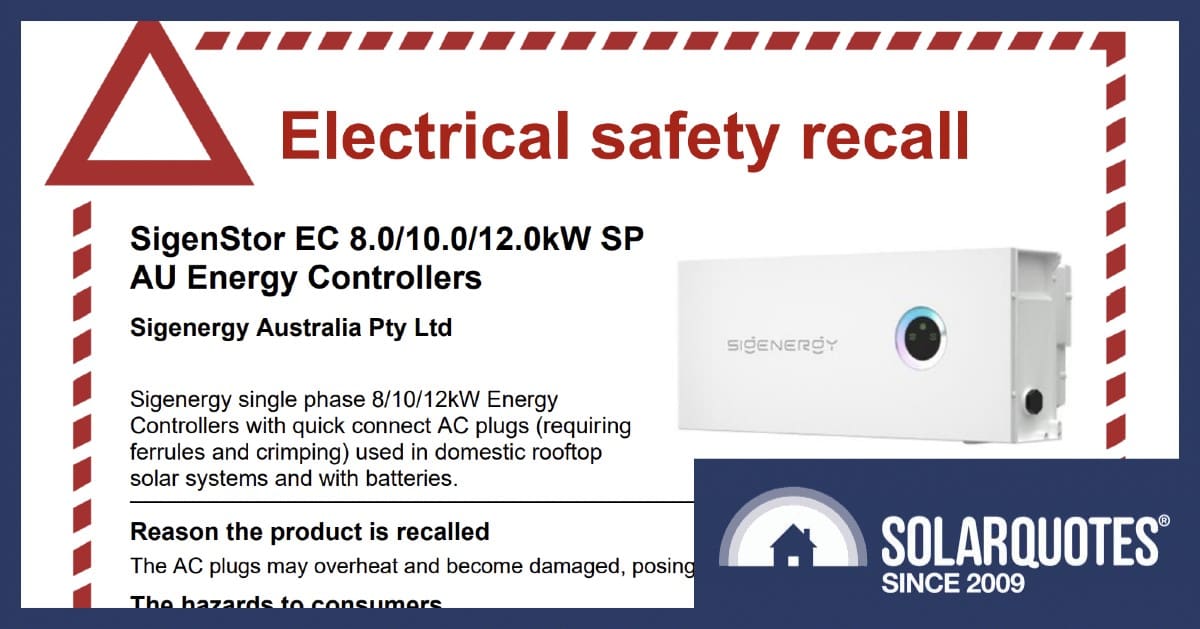
The Australian Competition and Consumer Commission (ACCC) has published a recall notice for some Sigenergy inverters due to overheating issues that melted plugs and caused a small fire, as first reported by SolarQuotes.
Why Are Sigenergy Inverters Being Recalled?
The ACCC has coordinated with Sigenergy to publish a voluntary electrical safety recall of the company’s single phase 8/10/12kW energy controllers that include quick connect AC plugs requiring ferrules and crimping.
In the recall advertisement the regulatory body warns:
“The AC plugs may overheat and become damaged, posing a risk of fire … if an overheating AC plug should lead to a fire, it could result in property damage, serious injury or death. Incidents have occurred. No property damage, injuries or death have been reported.”
Only founded in 2022, Sigenergy has quickly risen to become one of the biggest home energy brands in Australia, impressing both customers and installers with a feature-laden modular system that enjoys overwhelmingly positive reviews.
It hasn’t taken long however for Sigenergy’s systems to reveal significant issues, with an unknown number of SigenStor EC inverters overheating, leading to a spate of melted plugs and a small fire.
That fire was safely contained to the inverter, and it is important to note that fires related to home batteries are exceedingly rare.
What Should Affected Customers Do?
The ACCC has a recommended plan of action for those affected:
“1. Consumers should ensure their systems are connected to the internet so they can receive a firmware update. This allows Sigenergy to update and monitor each system proactively and temporarily reduce the AC output if the product is operating at sustained full load. This prevents the AC plug from overheating and becoming damaged. All affected products that are online have already received the firmware update.
2. Consumers will receive a free replacement product that has an updated AC plug. Consumers will be contacted by their retailer or Sigenergy Australia service partner to arrange replacements.
3. Sigenergy will also provide affected customers with an additional 2-year warranty on the product.
SolarQuotes Suspends Recommendation Of Sigenergy
Any technology can suffer problems, but the important thing is how a brand responds to issues, and we have concerns about how Sigenergy has handled this issue and what customers experiences will be like during this recall process.
To their credit Sigenergy appear to be proactive about addressing the technical issues themselves, including an offer to replace affected single-phase 8/10/12kW inverters with the an updated version which “reduces the chance of installation error and potential issues with the AC plug”.
It is in their lack of communication to the public, installers and most importantly their own customers that we feel Sigenergy has fallen short however.
There have been murmurings about these issues for some time – and issues with how the company responds to criticism for even longer – and there is evidence Sigenergy was aware enough of the problem over a month ago to be taking action to address it, without any broader communication to customers.
For weeks we’ve tried to get answers out of Sigenergy, and when they eventually responded the company demanded we hold off on covering it as they said they could not disclose anything due to regulatory requirements.
Only when we committed to publishing even without their input did they provide a late response – their first public communication on the matter, and in which they laid all blame at the feet of installers.
Even if it is found to be true that the issues only occured to due installers not following instructions – a claim disputed by multiple reputable electricians – products should be designed in a way that ensures they work when installed in real-world conditions. Sigenergy is suffering this issue while other brands don’t appear to be.
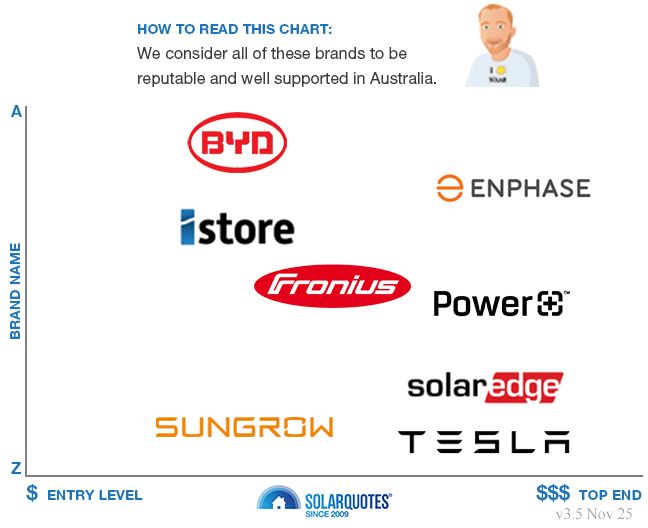
SolarQuotes’ recommended brands chart for solar batteries no longer features Sigenergy.
Customers Left In The Dark
To minimise overheating risks, Sigenergy throttled its single phase 8/10/12kW inverters – a sensible precaution, but one implemented without notifying affected customers that their systems would be running at reduced capacity. Multiple customers say their attempts to post about the issue to the company’s official Facebook page for end users were not approved.
Factoring all this in, SolarQuotes has removed Sigenergy from our recommended brands chart for now as we monitor how the company responds to this issue (including release of detail on how many incidents Sigenergy is aware of and greater transparency in general).
“We’ve taken Sigenergy off our recommended battery chart for now. The recent plug and terminal issues raise concerns we can’t ignore, especially given our exposure through the Good Installer Guarantee. We want to see the problem fully understood, fixed and proven in the field before we consider putting them back, and this could take months. Our golden rule is only to recommend products we’d be comfortable installing for our own grandma, and at the moment the situation still leaves a question mark over Sigenergy,” says SolarQuotes General Manager Trevor Glen.
Installers Not Happy
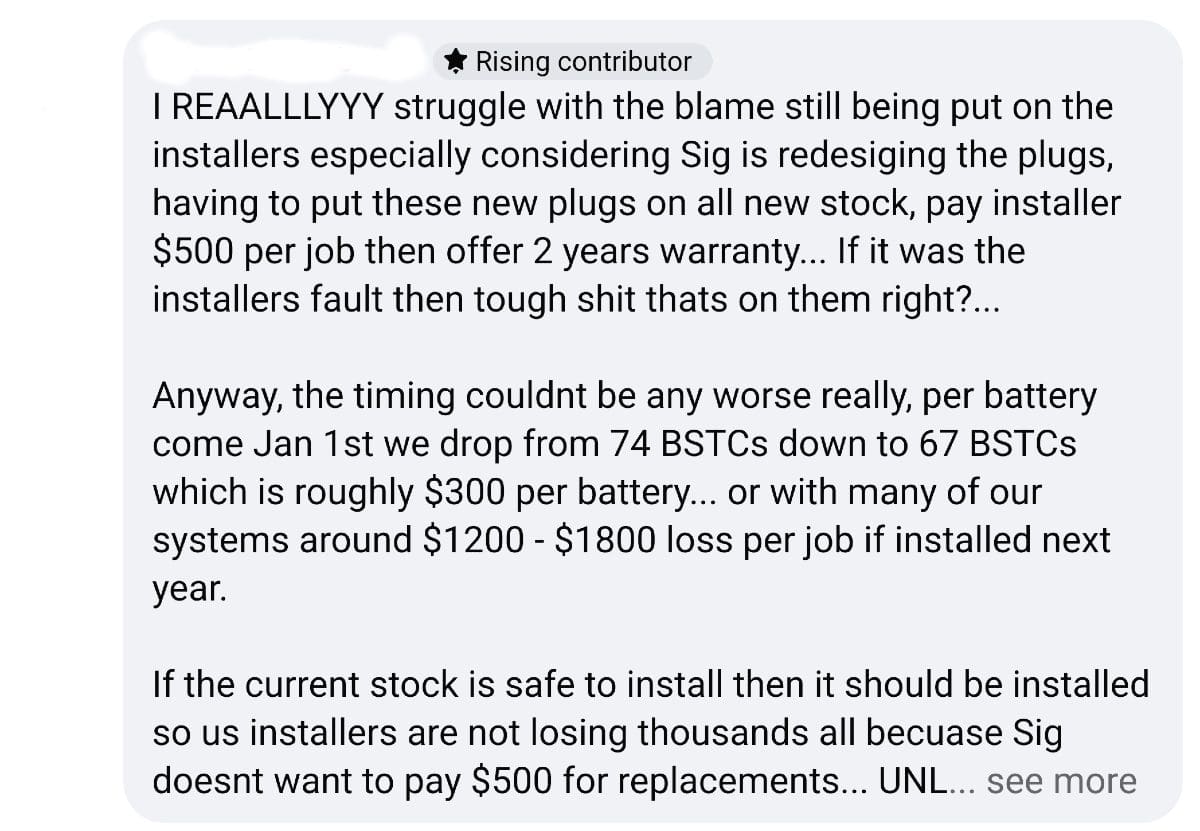
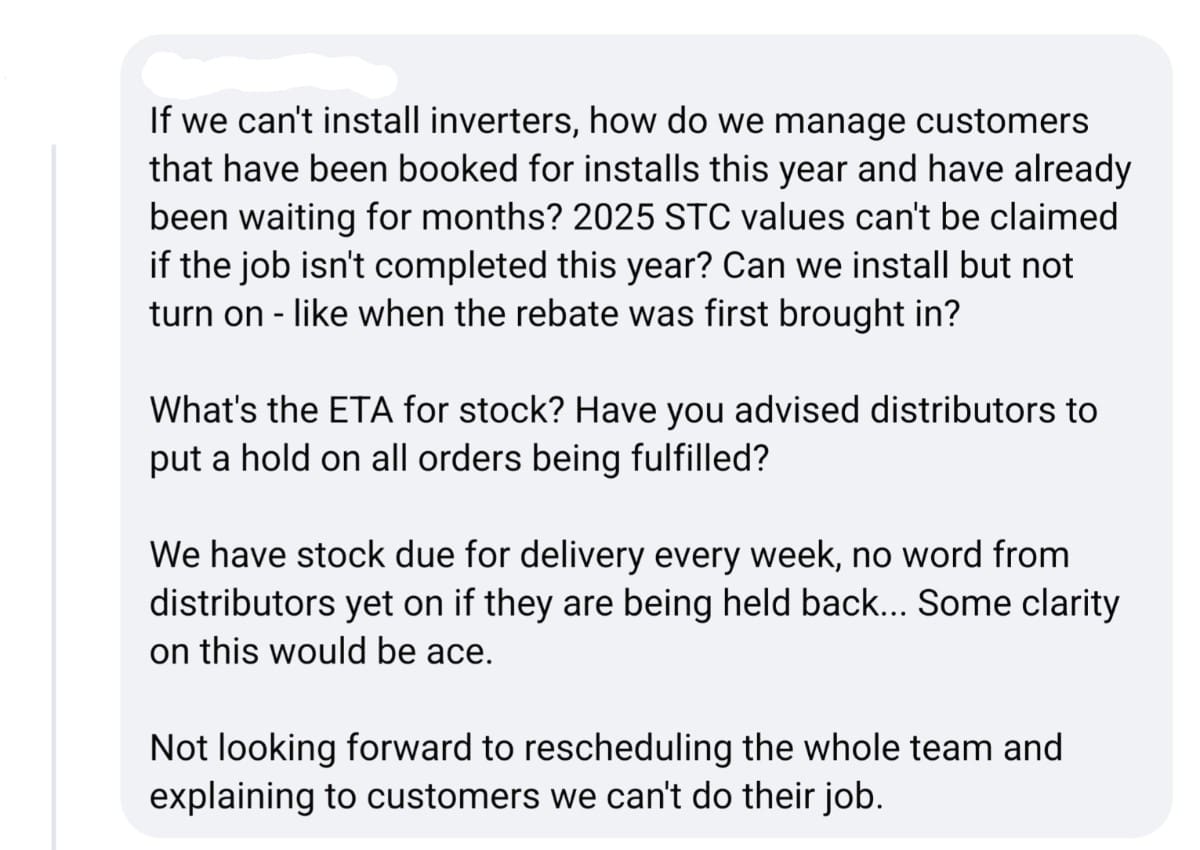
Installers are as confused about Sigenergy’s plan for the affected inverters as customers are.
It isn’t just customers left in the lurch, with installers not thrilled about being lumped with all the blame for overheating issues, and with all the headaches of rolling out replacements at a critically busy time for them and just before the federal battery rebate drops in value at the end of the year. SolarQuotes’ in-house installer Anthony Bennett says:
“Many installers are relieved something is being done but are even more anxious about the details. Offering a $500 ‘subsidy’ for warranty work appears generous at first blush but some describe it as a gift voucher from The Reject Shop – just what you want for Christmas. As the rush toward year’s end and changes in battery rebate closes in, there’s palpable anger even from Sig’s ardent supporters. Existing stock has been deemed unuseable as of November 18th, so they have to delay jobs, disappoint customers and potentially wear thousands of dollars in rebate changes. The total lack of transparancy from Sigenergy has been a disaster, and still needs improvement as nobody knows when replacement stock is arriving.”
What Are Some Sigenergy Alternatives?
There are plenty of other battery brands we recommend including Sungrow and Enphase. Check out our home battery guide for a full breakdown, and report on your own experiences with Sigenergy on their battery review page and their inverter review page.
 About Max Opray
 RSS - Posts






Wow, just wow. I was in the process of finalising a decision on getting a Sigenergy battery system based on all the reviews and SQ recommendation. So glad it happened before I locked myself into a world of hurt.
Now I have to start the process all over again….
No need,
Just tell your installer you want a reliable and safe solution.
Fronius, Istore, Sungrow, any of those will do
My oh my, reaching with this spin marketing of and from the uninformed, nothing unsafe about Sigenergy. We installed a new 10S inverter already, first one today, and have 3 next week. How’s them apples, commendable turnaround for any Inverter manufacturer to resolve and mitigate.
Tesla had bigger issues look it up and took longer to solve yet here we are… actual fires and not related to poor installation practices in any way.
Be nicer if you took your facts from Clean Energy Council or SAA directly without spin ambiguity etc. We have been installing Sigenergy since they landed in Australia to Sigenergy Installer training requirements, using common sense and not undersizing cable, no poor as terminations or bending said cable beyond what it should be which causes what, look it up, causes…
$500 for under an hour labour onsite is a massive win for any electrician, scoff at what holy moley clearly you not familiar with the other manufacturers lowball warranty moneys, seriously.
Hi Neil,
The thing is Sig knew they had a problem on their hands at least 11 weeks ago and they’ve done everything possible to avoid telling us about it.
After we exposed the issue, they followed with announcing a plan themselves, the bold text in the notice was “THIS IS NOT A RECALL” but crucuially it still didn’t detail when new stock would arrive. How’s them apples? Well the new units must have been in production for some time if they’re arriving already.
I understand they’re doing what they can, but the way they’ve gone about it has incinerated a lot of trust and goodwill.
You can’t keep blaming the installers and you certainly can’t repeatedly call the problem “minor” when people are deploying fire extinguishers and calling 000.
The only incineration of trust is what you are creating in the market which is quite obvious more of hit peace given you still place Tesla where you do given actual fires and actual history of failures and actual history of poor warranty support and turnaround with Tesla.
While the design needed improvement, they may well have been altering the design already as a plan but given we already have the new ones in hand and can already install and they will take full responsibility to replace these without argument that is a win and an unprecedented fast turnaround. Lets not push aside that Fronius, SMA, SolarEdge, ABB, Qcells have all had either product failures, shoddy warranty support, slow replacement, low ball warranty payments and Tesla is one of the worst offenders for a more serious battery design, manufacturing failure and then taking forever and a day to replace under warranty to this very day, the irony. Lets review feelings and bias and do what’s right for the industry
Hi Neil,
I’m glad you’re passionate about the industry, I have been for 17 years now.
All manufacturers have problems. However we’ve made sure recalls for Growatt & GoodWe were known. We’ve examined AlphaESS, we’ve forced Trina to honour the warranty for panels.
The difference with Tesla’s battery problem is as soon as they knew it, they ran them flat, turned them off and notified the customers. That’s gold standard if you ask me.
However designing an AC connection is not rocket science, nor is understanding local electrical standards.
And knowing you have a problem for 12 weeks before being forced to admit it publicly isn’t “proactive” or just poor form, it’s dangerous.
Contractors must learn about high current connections, quality of work and function over form.
Manufacturers must not try to control the story, when they’re opaque, it always proves a fiasco.
Fast turnaround simply confirms they’ve been keeping secrets.
It’s about time we saw some numbers published.
I too had a solar & battery quote with a Sigenergy inverter and battery.
I sent my installer to be an email about this and received the following response –
“ Yeah it’s just a plug at the back which needs to be crimped properly by the instllallers. This has been rectified with a brand new plug that doesn’t need to be crimped and is pre done (it’s the 3 phase plug design which has had zero issues
Much better and all there inverters are getting changed over to this which is what will be installed at your place. “
Thanks Ann, I got a similar response from the new quote companies. I’m either being quoted for Sig with a “It’s all fine now. Don’t worry” or I get a 30min diatribe of how customers shouldn’t believe the hype and go for something cheaper like SolaX to maximise my returns.
To me the sales techniques are feeling like when I went to buy a new car. Every salesman hyped up their brand and rubbished the competition. You ultimately have to ignore what the installers say and do your own research.
Ultimately, as a result of this experience I’ve decided trust no one and ended my search. While I was initially excited to get with the battery hype, after this experience I’ve realised it just doesn’t make financial sense for me to fork out up to $17,000 for a 24kWh battery system with a payback period of 14 years given my apparently low use of electrickery. Good luck.
Even after all this, the fan boys and girls, and sigenergy social media sanitisers are flat out praising how proactive the company is in this recall.
The sad thing is if they work at it, before long SQ might be the bad guys for publishing the first blog.
Damn, quite the blow for sigenergy, I recommended them to someone just recently.
“products should be designed in a way that ensures they work when installed in real-world conditions”
I agree that it is likely a product design issue we are seeing here, but let’s try to avoid statements like this that really don’t have much meaning or are ambiguous.
I think what you are possibly trying to suggest is that installation instructions need to be practically able to be complied with? For example if there is not enough space to terminate the required cable size.
Well done SQ team for trying to keep Sigenergy accountable. Crazy that they risk losing confidence in their brand by stone walling their customers, installers and public by denying’anything to see here’. Those types of tactics don’t work anymore.
I am one of those affected customers!
I don’t see the reason for such a beat up.
They have proactively and quickly installed software to manage the POTENTIAL fault until the units can be replaced. They have also added two years of warranty to the inverters.
It’s almost like installers who are not on the Sigen band wagon are proactively bagging them because they have taken a lot of market share in a small amount of time.
Im totally impressed with mine and, the way Sig have addressed the problem in a short period of time.
Hi Dale,
At least one installer I spoke to had his first failure 11 weeks ago and Sig told him what model it was before he’d finished explaining the issue. ie They were well aware this was a problem 3 months ago and have spent the time since trying to minimise, spin and blame others for a fundamentally flawed design.
Apparently replacement stock is arriving next week, a detail they’ve shared with some wholesalers but not us. Hundreds/thousands of new inverters don’t just fall from the sky, so once again it proves they’ve been planning a response and keeping people in the dark about it.
Hi Anthony,
Wouldnt a new design require a new CEC approval regardless of how small the change?
According to the CEC, Sigenergy submitted a component change request for a new OT terminal-style AC connection design for all affected CEC listed products, and following checks on all required documentation including certification this component change was approved.
I concur Dale.
I’m 2 months in and happy with 3 Phase, 40kwh battery.
A load of people joining the pile on saying “I told you so”. Was there similar bashing with Tesla Power Wall 2 issues (I assume people see this as a leading brand?) LG batteries?
5 years from now, IF this is the “worst” that Sigenergy has had gone wrong, will those people change their minds and think they were too quick to shoot their mouths off?
Of course, if there’s further issues (which are, relatively speaking, swept under the carpet) then continued heckling might be warranted.
A first misstep doesn’t mean you’re a failure.
Hopefully they learn from the communications piece.
But throttling back to mitigate risk. Tick.
Extending warranty on affected units. Tick.
Getting new parts in fairly quickly. Tick.
Maybe the could have paid installers more to replace. Maybe those installers are regretting recommending the units at the top of their lungs.
But as a customer, it’s mainly the comms that need to improve
Overall I’m very happy with the product, however management have stuffed up with their response to this issue.
My inverter was derated two weeks ago (I noticed it was drawing from the grid when the inverter loads went above 8kW). I received my first comms from Sigenergy on Wednesday this week downplaying the derating and blaming installers.
If a company is going to change the product specifications for the worse they need to notify the consumer at the exact same time. This is why people are wary of internet connected appliances. This time it was done for safety reasons (fair enough if not for the smoke and mirrors), next time… I’ve lost trust in the brand.
The fact that it has come to a compulsory recall by the ACCC, rather than a voluntary one, also speaks to the attitude of the company.
Honestly it is all just a really bad look, I am so glad i didn’t go with them myself.
Hi Andrew – Sigenergy have been coordinating with the ACCC with this and there’s no indication its been ordered by the relevant government minister, which is what a compulsary recall would entail. We’ve updated to avoid any confusion there.
Please.
This is just semantics. Sigenergy have been at pains to make it not be a recall and spin it a different way blaming installers for as long as they could get away with. But they have run out of runway with that approach, because spin will only get you so far. I assume it is only “voluntary”, because they know it would have been mandator if they did not do that, and this is the best they can get.
They know it is not just an installer issue (though no doubt there would be bad installs). Notice in the actual recall notice, no mention of installers, and only them acknowledging issues with the plugs.
I’m not attempting to defend Sigenergy here, just spelling out the difference between the different types of recalls – appreciate your points here, and I think our article is pretty clear on the questions around Sigenergy blaming this solely on installers.
cheers Max,
thanks for the clarification.
Interesting. I’m on the list to get a Signenergy 10kw SP inverter installed shortly. Does this mean that I can write to the rebatey people to ask for exemption the rebate decrease in 2026 due to supply pause from ACCC?
I don’t like my chances.
But making a shift to another vendor so close to installation won’t look good, or I will be up for another $1000 on my install when it pushes out to 2026 awaiting the updated inverter.
given our exposure through the Good Installer Guarantee.
What are the implications of this? Will the Guarantee apply for systems installed prior to the removal of SigEnergy from the recommended battery chart? Or is it just future installs?
The Guarantee will apply for all systems installed before the removal of Sigenergy from the recommended battery chart. However, we encourage anyone who used SolarQuotes to get quotes and installed a Sigenergy to let us know if they are having any issues.
First year of installs started well, then crashed and burned as the reality hits.
We haven’t even had the first wave of failures yet due to the Aussie summer.
I don’t feel sorry for the installers who jumped ship from one brand to another without a second thought. You are all a glutton for punishment after years and years of seeing the same history repeat itself.
However I feel sorry for the average homeowner who doesn’t really know or understand anything about solar and batteries, just wanted a system that worked, was within their budget and worked well.
Sigenergy system owner, 3 x 8kwh + 10kw inverter, installed March 2025.
All seems fine with the system, exporting 30~50kw per day, but our consumption is low at this time of the year.
Haven’t seen any notable changes, although not sure what to look for.
Sigenergy have sent email, text, and app notifications about the issue.
No indication of replacement timeline as yet.
Installer is coming to inspect system shortly.
Mine was meant to inspect yesterday but cancelled whilst awaiting stock of the redesigned model, which according to ‘lore’ is arriving with distributors next week.
I see a lot of varied opinions here, and quite often very polarised ones.
I am very happy with the product and when people were sprouting 13kWh batteries along came this innovative design offering affordably and storage at scale.
Yea there are growing pains but that happens with all emerging companies. Whilst frustrating my focus is on how the company reacted and owned the mistake.
This is where I am a little more sceptical. If they learned about this so recently how can they have a redesign already about to arrive at distributors? They clearly knew some time back and were making changes to address the issue, likely though at their discretion.
They went quiet, said nothing until a fire occured generating interest and comments within the community. They then tried to put a spin on it.
That’s poor form. Period.
Thanks for the balanced comment Downunder
I understand they’re working to fix the problem.
The thing is Sig knew they had a problem on their hands at least 11 weeks ago and they’ve done everything possible to avoid telling us about it.
As you note, it’s poor form.
Just a short note to share that user feedback on the MySigen app has similarly been deleted. The censorship is a little disappointing and I believe only deepens the “made in China” stigma in our country.
Nevertheless our Sigenstore (3p, not impacted by the present recall) is working fine 2 months post-install.
How common is the use of bootlace ferrules in Australia in domestic construction. Ie how many electricians would have proper terminal crimps in their everyday kit and how often would they actually use bootlace ferrules
Had to research this, and it’s not easy to find with regard to Australia Also lots of referrals to crimping with pliers which would be bad practice in butt terminals
If not used routinely is the case then specifying uncommon usage and equip would appear to be asking for trouble.
Hi John,
Ferrules are common where flexible multi strand cable is used and as I understand it that’s more prevalent overseas.
However much of Australia is wired up with 7 strand cable, which is more robust when you’re dealing with tunnel terminals and screws that bite into the copper. The other factor is that 7 strand is stiff and difficult to work with when you’re using 16mm² cross section.
Ferrules contain small strands and prevent screws cutting them, so using them on a 7 strand cable is a bit pointless when the tunnel terminal should alreday be 80% or more filled with copper.
At the end of the day the plug obviously isn’t rated for the job, no matter how your connect it.
It’s a bit like putting a standard towbar with 50mm ball coupling on a heavy rigid truck. It might say 3500kg but you shouldn’t tow a semi trailer with it.
I am not a Solar installer, but have used ferrules in terminations (as a Biomed Tech pre retirement).
Any crimp termination (including ferrules) is designed to be crimped tight to exclude oxygen from the termination. If the crimp is performed with a decent crimper with formers, on the correct cable size & terminal, the crimp should be tight enough to exclude the oxygen.
Dirty cable or dirty terminals might stop the clean copper to copper (low resistance) connection.
Yes, ferrules are used on low current connections with small cables to stop screws cutting the cable but high current ferrules are a different animal. I am not sure what Sig supplies, but I would expect a robust ferrule that can be tightly crimped. This ferrule can be tightly screwed into the connector to also exclude ogygen (ie good clean copper or plated to copper connection).
Thanks Doug,
That’s well put and it’s something I don’t think electricians are well trained in unless they get a particularly good TAFE or trades supervision.
The images I’ve seen show Sig are supplying lightweight ferrules for multi strand cable. The pictures of poorly crimped ferrules using random pliers show these aren’t anything like what’s needed to compress and make a solid mass out of a 7 strand cable.
This is why they’re moving to a lug terminal which is pressed; hydraulically or with a double action bolt cutter style tool.
Sig could explain this in their supplementary documentation, but they didn’t.
Thanks for raising it though, I’ll put that into another article I’m sure.
Thanks Anthony.
I have worked on a lot of equipment over my working life, from one of the first robots in Australia in the early 1980s, up to a lightning generator used for testing undersea cable repeaters (millions of volts!).
My last 15 years of work was as Biomed support at a public health network. Yet I still cannot legally install a power point, or install a Solar PV system. I personally feel the Australian system is overly restrictive & there should be a mechanism to install & have the job professionally checked (as should be done on ALL solar pv installations, I feel.)
That 22% failure rate is too high!
Hi Doug,
I’ve heard claims that the failure rate is 100% if you get really anal about the labelling requirements, but I still have to guide people through a shutdown procedure because the labels are full of jargon… more to come on that.
Another thing to add to the list, I’ve had a Sigenergy 40kWh install for 3 months now, I’ve never had so many issues with the Wi-Fi connectivity aspect. It will go offline for hours, even after changing it over to a dedicated 2.4kWh network. It might be fine for 5 days, then be offline like it has the last 2 evenings for me, which means I can’t control my ACEV Charger as I purchased this with the battery.
I’ve raised this with my installer who has said he now has multiple customers with similar issues, Sigenergy are refusing to acknowledge they have an issue.
Even in the Sigenergy Facebook group with 13K members, the general response is Wi-Fi is unstable you need to hardwire, what a load of rubbish!
Am in the same boat, both with the replacement inverter coming (mine is a 12kW SP with 48kWh stack) AND with the constant wifi issues going offline.
Blaming the installer or customer is poor form, period.
So many variables when dealing with an issue that may or may not be a network issue. If you have a mesh wireless network, find your Signergy device in it and disable the mesh connection (eg force it to connect to one device). Your mileage may vary.
How’s wifi signal on your phone when you are next to the Sigenergy stack?
If I were you, I’d run a physical Ethernet cable from my wifi router to the Sigenstor to see how that goes. Or get a wifi repeater if they are really far apart.
I honestly think the coverage is a bit harsh , considering how good the product really is….this isn’t a Takata airbag!
If it is installer or a design issue they have to replicate the fault to warrant the response they will take and these things take time
For the amount of inverters out there vs the failures I think it’s pretty minimal
Yes it’s bad timing with the rebate side of things but that issue should be delt with better by the government considering it only gave the public 6 months to get the max rebate on offer
The government should be honouring the full rebate of invoices are partially or fully paid because there is no doubt going to be stock issues within the next few weeks and if the terms and conditions aren’t set right by the installer they will potentially lose thousands
I’m glad I went with Sig and if I was affected by the issue I would be fine because my installer is great and will handle it
Oh come on Troy – read all the info, this could have been so disastrous and houses burned down and people really hard to think of what may have happened if ACCC didn’t jump in – absolutely terribly on Sigenergy- 3 month and still installing ——how lucky they are that no is dead 😵
No chance you would be accepting the inverter is potentially going to overheat and burn (regardless of your confidence in installer). Obviously you are three phase or lesser than 8kW single phase, but to say they’ve handled this well is a gross understatement.
Don’t talk about the government honouring rebates when the companies selling these products should be confident they are sound for installation, nevertheless that Sig has been hiding the data for close to three months. The ACCC and government has every right to deny and postpone installation when their name is on it.
My oh my, reaching with this spin marketing of and from the uninformed, nothing unsafe about Sigenergy. We installed a new 10S inverter already, first one today, and have 3 next week. How’s them apples, commendable turnaround for any Inverter manufacturer to resolve and mitigate.
Tesla had bigger issues look it up and took longer to solve yet here we are… actual fires and not related to poor installation practices in any way.
Be nicer if you took your facts from Clean Energy Council or SAA directly without spin ambiguity etc. We have been installing Sigenergy since they landed in Australia to Sigenergy Installer training requirements, using common sense and not undersizing cable, no poor as terminations or bending said cable beyond what it should be which causes what, look it up, causes…
$500 for under an hour labour onsite is a massive win for any electrician, scoff at what holy moley clearly you not familiar with the other manufacturers lowball warranty moneys, seriously.
Not true Neil- sigenergy tried to keep it quite and fix it without the public knowing until it became bigger than Ben Hur. Powerwall jumped straight onto theirs and discharged the batteries until replacement. Whereas sigenergy just throttled theirs and as the reports indicated they didn’t even let the people know.
Sigenergy instead of stopping installation they send out memo to you installers on best practice but obviously that didn’t work did it – ie a total recall which means that the installers were either terrible installers or there was an inherent defect with the product.
So which is it for you Neil- you or the product???
We don’t have any issues with any of our installs at all, comparing Tesla’s actual battery manufacturing issue to a inverter termination issue is chalk and cheese.
Tesla’s had actual events and thermal runaway is the worst outcome for any battery.
What has happened here is while Sigenergy’s engineers and the relevant Govt departments and bodies were investigating SQ jumped the gun and sensationalised to the 9th without giving or getting finalised feedback from relevant bodies or Sigenergy and have capitalised on driving clicks and every manufacturer that has felt the market share loss to Sigenergy is now dropping comments everywhere they can. Now SQ are all of a sudden experts that supposedly new this all along all after the fact is a joke for anyone with a decent operational prefrontal cortex. To the contrary I have been in this industry for a very long time and have never seen a company move as fast to create a resolution all while working with ACCC and CEC and other to rectify
Neil – we make no apology for prioritising Sigenergy’s customers and installers over their comms strategy.
Is it installer error? Is it sub-optimal plug design? Probably both.
Considering 22% of systems inspected by the Clean Energy Regulator are rated sub-standard or unsafe, it’s really not hard to believe installer error played a part in the plugs that did melt.
Take the #1 selling battery in Australia and multiply the number of installs by 22% and you have a lot of SigEnergy systems potentially not installed well. So a voluntary recall is a sensible choice for SigEnergy to make.
Personally, I think they’ve dealt with it quite well.
– Free inverter replacements.
– New inverters arriving in a few weeks.
– Slight power output limiting as a precaution in the meantime.
– Free 2-year warranty extension.
– $500 paid to installers to replace inverters (more than what other manufacturers pay for warranty work)
– If installers are fully-booked out doing installs, they can handball the inverter replacements to Omnidian (a solar service company with dedicated Service Technicians
Did you read the comment “by having inverters ready to replace existing” that they haven’t been denying the issues for months? How can you say they’ve handled this well. The censorship of comments alone should be raising the hairs on the back of your neck.
$500 to installers to replace inverters during the largest recent boom in the solar industry is great, but you’re assuming that most have gone through a reputable installer and not just the cheapest quote for the “best” product. I’d love to see how many systems are not fixed under warranty because the cheapest installer has gone bust. Nor that a large majority of systems are no longer connected to the internet for this supposed hot fix.
“by having inverters ready to replace existing” that they haven’t been denying the issues for months?”
You mean investigating the issue. They can’t deny or confirm an issue and its cause until it’s been investigated.
And I don’t blame them for moderating comments while they investigate.
Otherwise you have competitors screenshotting online comments and using it to spread FUD. Which is unfair & damaging to the brand if it turns out to be installer error, not product fault.
I am going to have mine sigenergy battery and inverter installed on 24/11 but informed today there’s recall , so they can’t install it. it’s illegal.
I was quoted/paid deposit for Telsa powerwall3 at the end of July.
and then got told Telsa is not going to be on the synergy Supported Solutions List for getting WA rebate in September, so I changed to Sigenergy.
Feel like I shall move to other brand to avod the possible drama,
maybe Sungrow or Fronius ?
Hi Oren,
Fronius have a great solution for WA working up a specific package with the network people where the rules have previously been quite draconian.
The support is seccond to none in my opinion.
Hi Anthony,
Thanks for the feedback.
My current solar inverter is Fronius one,
and been serving us well for last 5 years.
I contacted my solar installer, and they still highly recommend Sigenergy,
I might just ask for a quote for Fronuis and if it’s an option for me to change to Fronuis.
have just had a sigenergy system installed, how do I check to see whether the installation has been done correctly ?
Hi John,
As an end user you can’t really inspect it. Removing the plug and disassembling it enough to see the crimps & screw connection is licensed electrical work.
What you can do is pop the cover off the top LHS corner of the unit, it slides up before coming away.
Ideally the installer showed you this as it;s a legal requrement that you can access the DC isolator without using tools.
Observe if the big fat AC cable is bent sharply where it goes into the plug. Best practice is to route it through the cover.
Aside from that, consult your moniotoring app for a notification, or your emails. You might contact your installer and ask them, however Sig themselves are swamped and not able to answer many calls to my knowledge.
This image shows how the bend in the cable might look.
Just wanted to say a big thankyou to SolarQuotes.
12kWh SP inverter with 48kWh stack.
I noticed when importing from the grid at 12kW it on multiple times tripped the grid connection on the same day, both at about the 35m mark. Something was wrong but I didnt know what. I’d been emailing the installer but it didn’t seem super urgent.
Then along came the SQ blog post, which I put 2+2 to equal 5, and then forwarded that to my installer seeking an immediate inspection. That gor people moving, and I assume a lot of calls or attempted calls to Will Hall asking why the installer was being blamed, to eventually SigEnergy coming clear and implementing a fix.
It all wouldn’t have happened or would have occured much slower if not for the SQ post.
Transparency and resulting accountability seems to be a critical checks and balance requirement to avoid corporate greed.
Thank you SQ.
Im unsure what to do now. The two quotes I received this week, from the installers sent to me by SQ, all quoted Sigenergy. The other options they gave didn’t allow for full home back up which is something we need.
Do I get new quotes now? Will the recommendations still be for installers using Sig?
Hi Frank,
You can contact your installers and see what they can offer, or we might be able to find another?
If Sig stock isn’t available in time, it may be cost effective to get an install this year using Fronius or Tesla, before the incentives drop somewhat on Jan 1st.
I believe Tesla have plenty of stock.
Or you could opt for a Sungrow or cheaper GoodWe?
Some wholesalers are offering two 5kW Sig units in place of a 10kW, which might also be an option.
Stock levels may decide for you at this time of year.
We limited our installs of this product and sold a few in the earlier months. Some time back we made the decision to let this product play out, as we considered 100’s in the field potentially too risky and focused on Powerwall. We are voluntarily inspecting the few systems we have installed and found this issue may not be limited to the 8-12kW EC, witnessing the same issue on a 6kW unit. I would encourage inspection of all deployed EC. The newer design EC we replaced this week was manufactured some time ago.
I have found over the last 14 years new manufacturers always have issues, it’s inevitable and in this case with little to no real world testing it’s almost a certainty. We usually don’t capitulate to the product hype like we did initially this time around, we were cautious with Tesla only taking in on in 2019, 2nd gen gateway/battery. I feel for the guys that have installed dozens of these as I believe we are about to see problems arise this summer with other EC models as well.
Hi Matt,
Can you tell how old the warranty replacement unit is? It’s obvious that new stock doesn’t just fall from the sky so I’m wondering how long they have been making the new design of single phase termination, in order to be delivering significant(?) numbers of new units in the week following a recall notice.
These were dated the 13/10
If the AC plug is such a concern and the design isn’t suitable and this issue is widespread, why wasn’t this identified during the certification process? Yes Sigenergy’s comms need to improve, but shouldn’t we be looking at how this so called “terrible design” got approved in the first place?
Certification generally is a box ticking process. Long gone are the days of local actual certification: usually certification is an acceptance of off-shore certification. (My experience is now dated, but based on Medical device standards & certification).
In my experience the importers are required to certify that the appliance complies, usually by using a local certifier that really just checks the documentation is in order. Usually devices are certified to a known international standard. There may be cases where certification requires local testing to suit local standards but Australian standards usually reference international standards anyway. Our market is so internationally small that we are unlikely to get a device modified for local use. Firmware may be locally modified if required, but generally no hardware modifications.
Hi Doug,
The CEC claim they buy units off the shelf to do random checks about all they really do is check the paperwork presented to them.
Provided you pass the stringent cheques, CEC approval only takes 3 months.
That’s 12 weeks; for a desktop review.
I’ll let you decide if that’s reasonable.
I hope the cheques are metaphorical! Usually probably only cash \ table!
Thats the problem with spellcheckers…
Merry Christmas All. May your spend be on Energy efficiency!
very TIC, Doug
Does anyone had experience with the three phase 24kv? I’m about to install one in coming weeks and wondering if the same issue applies?? Appreciate if anyone has some insight? Thanks
What are Sigenergy going to have to do to get back on the Solarquotes recommended brands list ?
Hi Robert,
They would need to be a lot more transparent to begin with.
Complaints continue to be delayed or denied on their socials, confusion reigns about the replacement of inverters which are still melting plugs.
New stock is being delivered for new installs, while recall replacements are still outstanding.
None of it is a good look.
I agree with Anthony above: “New stock is being delivered for new installs, while recall replacements are still outstanding.”
It appears that Sig Australia is delaying replacing the recalled units until there is an actual failure (waiting for 2+ months now for replacement). We have had ongoing circuit breaker tripping, ultimately leading to the combustion of the AC Plug (assumed) which left a smoke cloud and brought down the entire system.
Sig Aus would have reports about these problems from their app monitoring capabilities, but chose not to replace my unit until complete failure. There should also be a Sig Australia tracking system by S/N for status of replacements of recalled units. SigAust apparently does not issue a “work order” allowing the installer to obtain a replacement until failure occurs. Even after a work order from Sig Aust is issued, it is unclear if they demand their intermediaries (Sig Aust suppliers to the installers) aren’t required to make recall a priority.