

Are the authorities running Australia’s main grid quietly out to ruin us all? Certainly seems they are.
Read on as I explain the lunacy – there’s a proposal on the table that could restructure how we all pay for electricity. They want us all to pay more in fixed charges.
The Australian Electricity Market Commission is the body charged with making up the rules and they’re calling for submissions on the change, as part of electricity pricing reforms included in a recent draft review. Trust me this is not good news for consumers.
The Shift To Fixed Charges
The proposed new rule change will shift more of your bill into fixed charges. That means you would pay more just for being connected, even if you use less power, even if you’ve insulated your house, even if you’ve spent thousands on solar and a battery, even if you are doing everything right.
If this change goes ahead:
- Solar and battery homes could pay $400–$680 more per year;
- Clean energy systems will take longer to pay for themselves;
- Low-use households will be hit hardest.
If you live in a small home, an apartment, or you simply use very little power, you may end up paying more per unit of energy than someone who runs ducted air con all summer.
It’s simply perverse. It tells people that saving energy does not save as much money as it should.
We Have Always Paid Two Ways
There’s a fee for access to the grid, and then there’s a charge for the energy you use. It’s not unlike driving, where private motor vehicles pay one way and heavy transport pays differently.
- In a light vehicle (4.5 tonnes max) you pay registration for access to the network, and then fuel excise (supposedly) funds the maintenance of the roads according to how many kilometres you drive. Fuel is the major cost, so you have an incentive to ride your bike.
- In a truck you pay much higher registration costs. Truckies are buying the right to have more wheels, 6 or 9 Tonnes per axle in fact. More weight means more wear, on roads that have to be better built to withstand the load.
Right now, most homes pay low fixed daily charges, while charges for power used are relatively high. The more kilowatt hours you use, the more you pay. If you install solar, cut your usage, or add a battery, your bill falls because you buy less from the grid.
Industrial Customers Get The Other Deal
Big users pay for the load they can put on the grid, or size of the wires. It’s called a demand charge, so if you have a petrol station, supermarket or nursing home, you’re paying for a big fat connection to feed you power, but the actual cost of the units you’re guzzling is relatively low.
Demand charges can be a trap. Years ago they only applied to industrial users, so a winery which only uses bulk power for crushing season would be crippled with year long contracts for a couple months peak use.
While networks have moved to setting the demand charges each month, they’ve also managed to have rules changed so this pricing model can be applied to small customers. That horse bolted years ago.
If you’re subject to demand charges under your retail bill, you could be stung for an expensive month, because just one day you had a party, simultaneously air conditioning, cooking and drying the clothes for that kid that fell in the pond…
Lowering Demand Is Good
Some operatives whinge that solar customers put expense on the grid, but that’s only because there needs to be some smarter hardware to control the network. What they ignore is that solar behind the meter lowers grid demand. The poles and wires need not be as big so we don’t have to go around gold plating the infrastructure to make sure things don’t melt in a heatwave.
As the wholesale price of power has risen, commercial users have moved to solar because solar is cheaper AND it can reduce their demand as well. In fact Chadstone shopping center has a shipping container sized battery just to lop the peak off their bill.
The thing is that networks hate that too. They don’t get paid for shifting electricity per se, they’d rather build big expensive assets because they get paid a regulated fixed amount, based on the value of the network assets. Gold plating means they get paid more, so having an engaged consumer with efficient habits and solar to back them up is really bad for business.
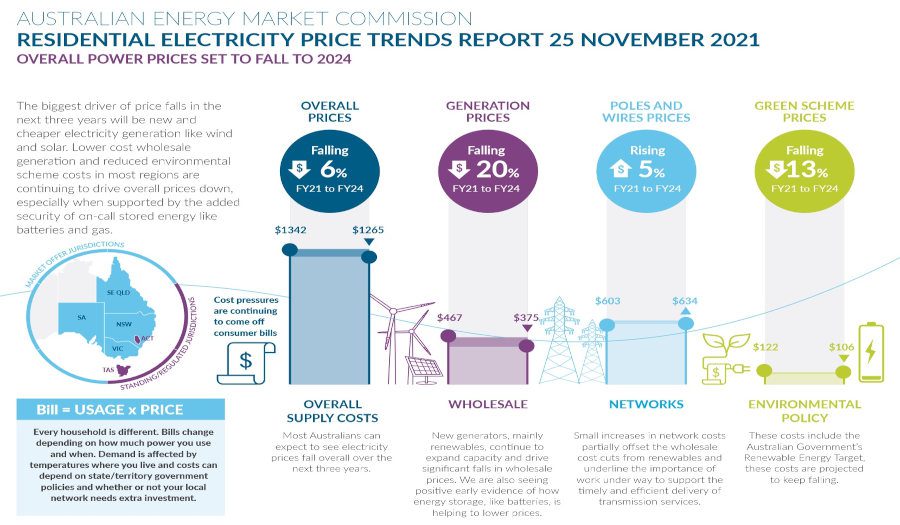
AEMC has plenty of history to refer to so we can see who”s got their hand out for more.
The Business Is Broken
When the government owned the network, there was a steam engine at the hub and spokes delivering electricity to you. As soon as solar hit the market, you had some choice on where to buy your power. Thankfully, the authorities didn’t see the threat emerging. They didn’t try throwing up rules and obstructions because solar was too expensive and would never work, bless them.
Now we have some jurisdictions where fully half the customers have solar, whole states run off it during the day and cheap batteries are causing consumers to just vanish. It’s almost as dramatic as exploding a steam turbine.
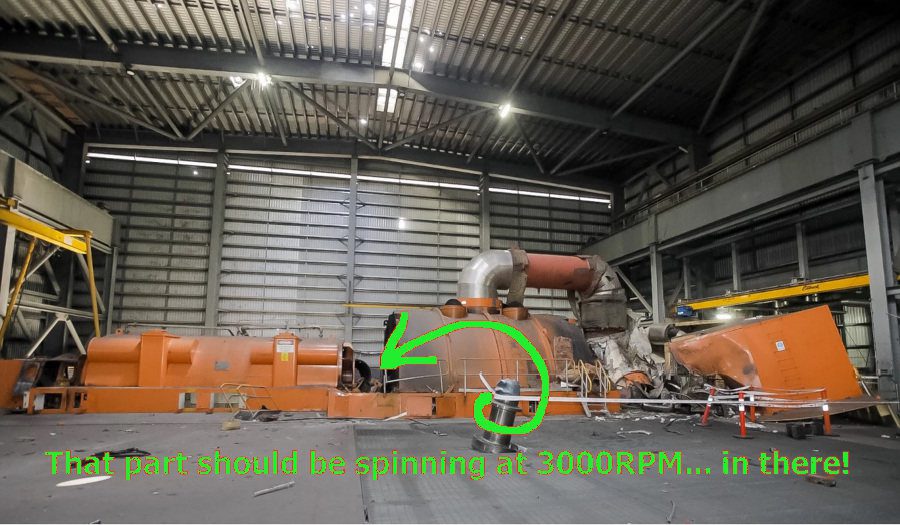
The remains of “reliable coal” at Calide in Qld. otherwise known as the longest unplanned outage on the NEM.
Solar Systems Will Wither
If more of the bill becomes fixed, the payback on smaller or older solar systems stretches out.
That matters. It’s a classic unintended consequence.
Many homes installed 1.5kW or 3kW systems a decade ago. They are simple, they work, and they still cut bills. But if savings shrink, fewer people will bother maintaining them. Some won’t replace ageing inverters. Others won’t upgrade at all.
Over time, thousands of small systems will quietly drop off, effectively laying waste to the STC subsidy paid for the glass on the roof too.
That’s not just bad for those homes. It denies the broader grid a steady stream of clean energy generated right where it is used. Rooftop solar reduces strain on poles and wires, especially in the middle of the day when demand used to spike.
Small systems might look minor on their own. Together, they are a power station spread across the suburbs.
The Battery Boom Needs More Generation
At the same time as large-scale wind and solar face delays, the big gentailers are racing to build large batteries.
Why? Because batteries are fast to approve and quick to build. Compared to a wind farm and a new transmission line, a battery is simple, but a battery does not generate energy. It just time shifts it.
As more and more large batteries come online, they will be scrabbling for cheap clean generation to charge from. Without enough new wind and solar, batteries end up charging from whatever is available. This could extend the short term profits of fossil fuels while continuing to fundamentally undercut them.
In other words, we can’t build storage without also building supply, and we can’t afford to weaken rooftop solar at the same time large projects are being held up.
All this will lead to is a disorderly transition, unexpected closures, subsidies for clapped out plants and maybe even the rolling blackout scenario that seems to be a wet dream for those who’ve always denied the need for change.
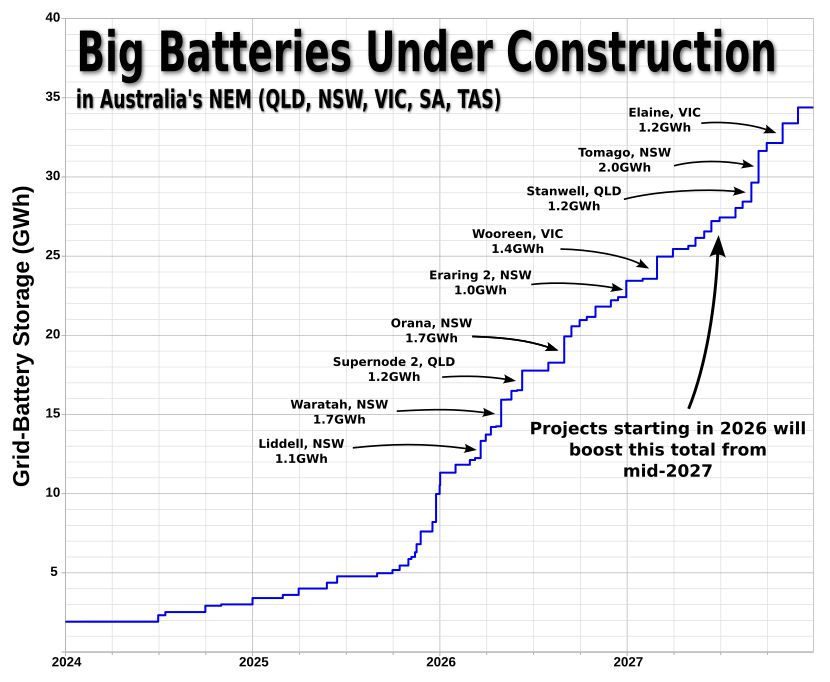
Liddel is at the bottom of this list and it’s something like 560% more powerful with 865% more storage than the “World’s Biggest Battery” they started with in South Australia.
This Change Will Push People Off Grid
The solar installation industry will continue going gangbusters, because those who can afford it will be more likely to “go off grid” with publicly subsidised batteries that are no longer helping the broader community.
We’ve explained before this is a terrible outcome, because the wealthy suburbanites choosing to disconnect won’t be helping to pay for the mains running past their house – they’ll be paying even more for diesel generators to keep the heating on overnight.
While those who don’t own a roof, or rely on a pension, will have no choice at all.
Have Your Say Today
This proposal is open for public comment.
If you have solar.
If you are thinking about solar.
If you use very little power.
If you care about keeping bills fair.
Now is the time to speak up.
👉 Submit a comment here
Select:
• Market review submission
• EPR0097 Electricity pricing for a consumer-driven future
You can also read more via the Smart Energy Council here.
This change could tilt the playing field away anyone who’s invested and done the right thing.
A fair grid should reward people who use less and generate clean power, not punish them for it.
Have your say while you still can.
If you want some inspiration, here’s what I’m planning to tell them:
“I oppose the proposed increase to fixed electricity charges under EPR0097.
Increasing the fixed portion of bills will unfairly penalise households that use less electricity and those who have invested in rooftop solar and batteries. These households have reduced demand on the grid and made significant private investments to support Australia’s clean energy transition. They should not be worse off because of it.
Higher fixed charges reduce the financial benefit of saving energy. That weakens the incentive for households to install solar, maintain or upgrade older systems, add batteries, or improve energy efficiency. Over time, this risks slowing the growth of distributed clean energy that supports the grid, especially during daytime peaks.
Small and low-use households will be hit hardest. A pricing structure that shifts more costs into fixed charges disproportionately affects pensioners, renters, apartment dwellers and energy-conscious families.
There is also a serious long-term risk. If fixed charges continue to rise, households who can afford solar, batteries and backup systems will increasingly consider leaving the grid altogether. That would shrink the customer base that pays for shared network costs, pushing prices even higher for those who cannot afford to disconnect. This creates a two-tier system and undermines the idea of electricity as an essential service.
Electricity networks are natural monopolies and a critical public good. Many Australians already question whether privatisation has delivered lower prices or better outcomes. Even the ACCC has raised concerns about how privatised electricity has failed consumers and the broader economy. Pricing reforms should strengthen trust in the system, not weaken it.
At a time when large-scale renewable and transmission projects face delays, locally generated energy in cities and towns is more important than ever. Rooftop solar is not marginal — it is a core part of Australia’s electricity supply. Pricing reforms should encourage participation, not discourage it.
I urge the AEMC to protect fair usage-based pricing and maintain strong incentives for households to reduce demand and invest in clean energy.
Please reject changes that increase fixed charges at the expense of equity, efficiency and long-term grid stability.”
 About Anthony Bennett
 RSS - Posts





Looks like someone is doing their best to protect their vested interests as far as I am concerned.
Do you mean SQ, or someone else?
Submission placed
Being implied is that existing profits being made by the wholesalers isn’t sufficient. So what is the AEMC saying is the required profit or return on shareholders funds.As an aside, why isn’t it required that that wholesalers annual profit and return on shareholders funds be publicly listed and published by AEMC anyway?
Thanks for letting us know. Submission entered.
Not sure we can hold out against the corporations in our world. I hope we can.
I encourage any of your readers to do it. Even copy and paste and make a couple of changes.
AI also does a very good job of summarising for a submission ‘-)
yeah, thanks Anthony, i had my say, and i even kept it pleasant.
One has to be careful, in normal times such a move by government at state or federal level would be political suicide, but with the LNP being less popular than Pauline Hanson, the Labor party might just think it has more than enough of a lead in the polls to risk such a move a couple of years out from an election.
Who or what does AEMC represent? Its behavior over the years shows consumers are not given much consideration in its deliberations. This is probably its most anti-consumer proposal so far, depending on the level of the impost, and who would trust that level to commence or remain at a reasonable level.
You can bet your last panel that the Libs will be denigrating solar as a failed mistake if this happens.
Then they will push Nuclear and a reliable cheap (!) replacement.
And hey presto! The higert fixed charges will pay for it!
I predicted this some time ago. In ACT we went through same thing with water supply a couple of decades ago. Our household had invested in water efficient, not just energy efficient, devices (washer, dishwasher shower heads, etc). But it became irrelevant when the government-owned Icon Water [who coincidentally has substantial stake in both ACTEWAGL retailer and Evo Energy wholesaler] went through farcical public consultation and changed to supply charging. Our supply charge is now more than half our water bill and we have no real incentive to reduce water consumption. On the plus side, in effect it made actual water usage quite cheap and our gardens have never looked better.
On the water front, in WA the supply charge went through the roof – seemingly without consultation. One recent $400 account saw $39 of it as actual water consumption! If power goes the same way, we will also be being penalised for generating green energy. Astounding.
FTR, I have already made a submission, days ago.
It would be interesting to read what the Honourable Chris Minns has submitted to this enquiry, given his role as representing us, the voters!
So on that note, should we not copy in his electoral office and / or his ministerial office with our submissions to this gov’t authority. Wish I had thought to do so when making mine.
Fraternally,
Phill
Federal Members is where we need to send this.
Labor has a good chance of losing the next Federal election, IF the Libs tout nuclear as a cheap reliable alternative. Plays right into the hands of the greedy.
And, they can boast how they were right all along, and solar was an expensive failed experiment.
You inspired me to write my own submission. Thank you for your article.
Wow. Thanks Anthony.
Submission lodged.
I included:
“These changes are likely to force me, and my solar panels and battery off-grid.
At present, I feed most of the energy I generate into the grid to power other households. And much of what I feed in is done during peak consumption times by discharging 50 my battery then.
“
Comment submitted.
I actually thought this increase in supply charges would be retailer’s response to being made to provide a 3 hour free window. Never expected it to be the overall response from the industry. But then again, the retailers could just be leaning on the AEMC to pre-emptively do their job for them so they aren’t all branded evil corp.
Copy and pasted your submission draft! Thanks for all your effort on this. It is a major issue and its resolution in the affirmative would significantly damage the roll out of renewable energy.
If too many consumers go down the ‘off grid’ path to avoid these higher fixed supply charges, I can see GovCo changing to an electricity rates system, much like water rates. So we’ll pay simply because electricity is available in our street in spite of not being connected to it.
Hi Clive,
You could well be right.
The sewer stops the neighbours defecating in the yard and from making you ill, the roads allow an ambulance to reach you in time of need, and the electrcity grid is what powers the shops which distribute the food.
At some point they may have to grasp the nettle and renationalise this public good. The ACCC has already told us privatisation is a failure, and that was 10 years ago.
In the current issue of Renew magazine, there is an article pushing for prosumer access to on-grid local/regional energy trading, without incurring the higher transmission costs of long-distance distribution. That would increase competition in energy supply, but would do nothing to mitigate higher daily charges.
As essential grid investment ramps up, repayment of borrowing costs becomes a growing consumption-independent fixed overhead, most accurately reflected in daily charges, not the price of their excess supply of energy that they don’t know how to get rid of, at least in the middle of the day.
Let’s not forget that arbitrarily inflating the price of electricity improves the viability of coal burning, so cooks our future. If the fixed charge only goes to capital cost & grid maintenance, then it more quickly ejects fossil burning planet destroyers. That has my vote. Sorry.
A grid-proximity levy does seem the most probable outcome, perhaps within a decade.
I am off grid for water & sewerage in regional NSW. We don’t pay water rates, but we pay a service to regularly monitor our Biocycle sewerage treatment. Every 5-10 years these need cleaning out, so that’s another cost. However the water is recycled onto the garden.
Council also get their cut by insisting on an inspection of your system every 3 years for which they charge $30-50.
When the house was built, there were large upfront costs to putting in a 100,000 litre concrete water tank & the Biocycle. Add a water pump, which needs replacing every 5-10 years and filters etc. which need maintaining. However these are compulsory costs to living on rural land. We may be financially ahead after 30 yrs, however soon may have to look at replacing the concrete water tank at todays costs! It seems like the costs are still high off grid, but the water we drink is beautiful filtered rainwater.
Varian,
I just have six 32,700 L polyethylene tanks, for a 200,000L water reserve. At around $4k per tank, the cost is reasonable. I keep one as personal fire fighting reserve, in addition to the metal 10,000L tank required for the CFA.
However, if your concrete tank is merely leaking there might be two life-extending remedies:
1) A chemical treatment that i saw advertised some years ago.
2) A plastic liner.
Our rainwater has been unfiltered these last 62 years – just a strainer to keep the leaves and possums out.
I agree, Clive. Its a serious risk. I wonder what Chris Bowen has to say about this.
I’m going to present a counterpoint (even though I agree with most of what is here).
It is that a 1.5-3kW PV system isn’t really meeting house needs for most of the day, the capacity just isn’t there. When the house isn’t conditioning etc, it pushes some kW out to grid and the effect compounds – however, the moment aircons and cooking etc begin the solar is far from sufficient, leading to grid demand. Now, higher electricity prices have meant that many of these households actually hang on to their gas connections! Oddly true for SA, the state with the most renewable grid in the country is still net adding gas connections to households while the rest of the country is net removing gas connections. Let that sink in: SA households are the worst right now for keeping (and adding new) gas connections. That is policy failure, the effect of high consumption charges influencing consumer behaviour.
I hope that higher fixed charges are not punitive & encourage greater electrification for all.
Hi PX,
It would help if SAGov wasn’t a wholly owned subsiduary of SANTOS, willing to pass the most draconian anti protest laws in the country, in less than 24 hours, after people disrupted the traffic out the front of the fossil extraction industry conference.
Fun Fact:
Treasurer, Transport and Energy Minister Tom Koutsantonis had a chief of staff move on to the private sector, he became head of government relations at SANTOS. Same bloke is also the premier’s brother…
Oh yes, none of that is hidden from us SA people.
What I am really pondering is that with changes like these, would it rather benefit lower income households by providing predictable bills that make it an obvious decision to cut the gas connection off. Notwithstanding SANTOS’ pseudo ownership of the political system here, simple economics would rule against maintaining a dirty gas supply if you already pay for an electricity supply.
At some stage though, electricity ought to be made predictable for the average consumer, it is far too complicated to look at a bill these days – the current model is inherently broken by the series of bandaids holding it together. When the charge for energy is such a tiny % of the total, tariffs ought to reflect this in an equitable way. So much to be said.
Always love the discourse here and the good work of your team.
Neil
I have been debating for a while to make up my mind about having the system set to zero export. There are comments that there is too much electricity being fed into the grid. I do not want to be part of the problem.
Hi Agner,
Exports are what drives the investment in grid scale batteries and make midday the new off peak.
Think of your solar as the energy that makes coal unviable, and keep plugging it into the grid to accelerate the coal industry demise.
They’ve got off scott free with decades of pollution, time they were retired.
(different Scott)
Thanks for the prompt Anthony, I’ve also made a submission.
Simply vote for independents.
One other aspect is that in heat waves, solar roof panels reduce the need to import power (heat) into cities.
I have put in a submission from myself and my small business, plus my family members have also put submissions in. The more negative submissions received the harder it will be for this to go through.
I really doubt the Government would proceed with this change. It would be political suicide
I get your point Agber and certaunly agree, exports durimg the middle of the day when the grid is overloaded shoukd Amber, if the grid is over supplied. Whe FiT is negative, Amber software blocks exporting, when it works. We can also manually stop exporting. I make sure I’m using as much of my own generated power as possible, hot water system is on, heater or aircon is on depending on season, EV is charging at highest possible setting, and i manually reduce inverter export out put to zero.
If the FiT is more than zero, then the energy suppliers are asking for more energy to be sent to the grid. If i have excess I export it, albeit if the FiT is less than 5c-10c I would charge EV first though. During peak consumption the FiT can be between 10c and $20 /kwh. The highest I have earned in one peak period is over $100. This is a rare example of win:win. The grid needs energy, I can provide it from a zero emissions source and be paid for it. Obviously, at $20/kwh the suppliers are desparate
Anthony, your points are spot on about the increasing population of big batteries needing power to charge them. I was watching the grid supply in WA recently and after one very hot day followed by serval fairly hot days with light cloud about. If you look at the attachments below you can see clearly where the daily battery energy feed into the grid simply stops for 5 days.
I took screen shots of the event but cannot seem to post them? The real irony was that our Premier and his Offsider were busily releasing pictures and a spin piece in the West Australian Newspaper of the big batteries a couple of days after the very hot day when the batteries were not actually working.
Our useless local newspaper does not see it as a newsworthy event when the population is being misled too much like hard work I guess for them.
Is the old charging model still viable, as solar & wind dominate generation?
1) The sun wantonly spills as much free energy into space in a second as all nations combined produce in 650 millennia. Thus, after amortisation & maintenance, energy unit cost is zero.
2) Solar panels are now so cheap that the major impediment to energy profligacy is the grid, as solar & battery roll-outs dominate.
3) Distribution is the bottleneck. Its capital cost is of similar benefit to all who choose to remain connected. (But the sun does that too – given batteries)
4) Batteries have cut peak demand, saving billions in grid costs, but reduced consumption = reduced grid income, so feathers need to be plucked where they can be found. Higher daily charges spread the pain to escaping prosumers, seemingly postponing the death spiral. But does it?.
5) CEZs becoming microgrids can clip the grid’s wings, short of going off-grid.
Diversity = energy democracy = economic efficiency. The past is gone.
Unfortuntely the ACCC doesn’t have the power it needs to do the job us public thinks it can do.
Witness Coles vs ACCC… (Did I get that the wrong way round? I don’t think so). Coles see the currect petty issue as being a chance to discredit the ACCC once and for all.
Copied and submitted Anthony, when will the cost increases ever end? Can’t afford to go off grid and shouldn’t be coerced to…. we scrimp and save and are diligent energy users but the greed we are coping from all sides if living is mind boggling.
Random thought, if the AEMC is planning on doubling or tripling supply charges, what impact will that have on government budgets, specifically the subsidies paid to those on concession cards, or pensions or whatever?
These are the people who can least afford a $500 increase, or whatever rise it may be, so without increased government support they risk facing homelessness, or spending their food money on electricity and relying on charity for food – those not already doing so that is.
More unintended consequences?
“Hmm. We’re having trouble finding that site.”
Overloaded or turned off, maybe time to submit just ran out (was close of submissions end of business today ?).
I lodged a submission 16/2/26 7:55am
“While we endeavour to have regard to submissions received after the closing date, we cannot guarantee they will be given equal consideration to on-time submissions. If you wish to make a late submission to a project that is not appearing on the below drop-down list, please visit the project page and contact the project leader via the button on the left hand side.”
https://www.aemc.gov.au/contact-us/lodge-submission
Objection sent.
Seriously now thinking to turn solar array to zero export, increase battery size and go off grid while/if I still can. I’m fairly well self sufficient now except for around 10 weeks in winter due to the jungle next door (40mt high trees).
Origin and AGL making ludicrous profits (check out their CEO’s salary packages as well) and yet they still want more and all the Government bleating to go green, save the environment, use less power is all a mute point if this is allowed to go through.
I’m not wealthy. I invested heavily in solar and a battery because I believed in the transition; resilience, independence, and contributing back to the grid. For two years it felt worth it.
Now it feels like we were sold a story.
We’re encouraged to spend thousands to be “independent,” yet we pay rising fixed charges for power we barely use, export energy at shrinking (soon negative?) FiTs, and get hit with demand charges that act like traps.
One quarter I was charged around $70 for a single 4kW spike in one 30 minute window during a storm, the only meaningful grid use all quarter. That wiped out months of careful management and turned savings into stress.
That’s not cost reflective pricing. It’s punishment for participating, and it’s pushing people away from the very transition we’re sold to support.
If this continues, going off grid won’t be ideological, it’ll be rational.
No. Your solar system wouldn’t work without a grid connection. You are paying for a benefit. We all have to pay for our infrastructure to be maintained.
70% of electricity costs are maintaining and building the grid, not generation.
You seem to overlook the fundamental issue that the person you responded to cited.
For many of us, this was a huge investment of funds and effort. We are not rich by any means, but decided that it was worth doing because no one expected someone to come along and effectively change the rules so much that we would never have made that sacrifice.
You imply that the existence of a grid regardless of if it is used 3% of time or 100% is just as important.. perhaps you should rethink that claim as it’s clearly ignoring the reality that demand on the grid is greatly reduced for anyone who provides 97% of their own daily power requirement ….
Supply charges are 40% of the bill, in the past the generation has always been close to population centers, so the grid was smaller.
Now with renewables spread out all over the country thousands of kilometers of transmission lines are being built to gather it all and deliver to population centers, this will result in higher supply charges.
Generation makes up about 12% of the cost of electricity, renewable generation is cheaper, say 6% but you have to add in a heap more of the 40%.
Then you have to add the cost of storage (batteries, pumped hydro) and backup generation.
With a $400 to $700 negative impact on a solar and battery household if the AEMC proposal is adopted, it’s making me wonder if adding storage now to my rooftop generation is a good decision.
Many small businesses including farms historically have more than one meter as this was required by regulation. The proposal to increase supply charges will adversly impact many small businesses such as my small farm which has a separate meter for woolshed. It is used for shearing or crutching about 5 or 6 times per year. The actual amount of electricity used is very small (a few Kwh). However, the quarterly supply charge is about the same as for the house meter. When the Kennet govt. in Victoria promised to reduce electricity prices, that was achieved largely by increasing the supply charge and reducing the usage charge. Those, such as farmers, with multiple meters ended up paying more for their electricity usage.
Will WA be included in this review?
I have been beating this drum since the middle of last year. While dreaming about a solar upgrade and associated 20kWh battery. This scenerio was one of my “what if?” questions.
At last, some traction!
Here’s my take on the hidden agenda:
What will happen is the demand on the old-style centralised model of power stations will increase markedly. So we will need more of them.
That will be around the time for a Federal election, wherein the right wing will be again, advancing the advantages of NUCLEAR.
Simple enough for the public to understand. “Nuclear is simple, cost effective (now) and reliable”.
Then the running down of the “Costly useless solar experiment”
Every house with a disused solar system up on that roof will be ridiculed. Moot testimony to the failure of the whole costly idea!
Lets hope the powers that be can see where this will go. But maybe they know that already?
Second comment:
This goes beyond the energy regulator.
Please contact your Federal Local Member. They need to at least BE AWARE of the seriousness of this charade. They (particularly Labor MP’s) need to be aware of what tis could lead to, and how to avoid it.
I have just installed a 32 kWh battery to my existing solar system and I had feared that something like this may happen. I have submitted my submission to the AEMC. I thank Anthony and solar quotes for putting up this artical.
Thanks for this timely article, I will be adding my submission. As previously mentioned, this has already happened with the water supply – no point trying to save water, as the real cost is in the supply / sewerage. This just penalizes people with solar and batteries, despite them effectively donating their energy to the grid
Yes there’s a reason for that! Like the electricity grid the real cost is just in maintaining the network and its associated infrastructure.
Sorry but it makes sense to charge for the infrastructure to be there and be maintained rather than charging per unit of use. It unfairly targets lower income households. Obviously some metric to account for size of house is also needed but to a lesser extent.
You know that 70% of all energy costs is maintaining the grid and not generation right? This will only increase.
Despite the deadline being last, the website seemed to accept my submission
I didn’t hear anything about this until now.. what a kick in the guts
Anthony, as with all the other Solar Quotes bloggers you’re not looking at this in the big picture.
The grid needs a massive amount of investment of infrastructure to electrify everything. Unless you have an Off Grid System, even solar owners with large batteries are still supported by the grid network and your solar system simply wouldn’t work without the grid. Given the households that can truly afford large solar battery systems are firmly in the Upper Middle Class – Upper Class of all wage earners do you really expect the public to subsidise this massive infrastructure upgrade unfairly at lower income earners?
As with most policy debates, for me its squarely centred around fiscal policy, we need massive tax changes in this country to tax assets properly and let the highest income earners pay more. Once we have that policy, theres no need to increase daily use charges. a fixed rate supply idea makes more sense to me than charging per unit. Your bias is strongly evident here.
Hi Lu,
The electricity market is broken and needs reform. Monopolies aren’t good places for “markets” with a profit motive.
Compare Medicare in Australia with a single payer PBS who can negotiate price, to the US where the benign hand of the free market is basically safari hunting the middle class & skinning them for their life savings.
The ACCC told us privatisation has failed. Arguably, the entire retail industry, adds/marketing/management, call centres & the churn of customers spending hours changing plans achieves precisely nothing.
We need a price incentive to save energy, because profligate waste will only drive more spending to meet peak demand.
Perhaps a “thin pipe” model where you pay for 1.5kW or a 15kW supply depending on your demand would help.
Having set people up to invest, moving the goalposts now will only torch trust in institutions and aid regressive populists.
The infrastructure should be nationalised and maintained as a public good.