
 Sweltering through a heatwave and desperate for a new air conditioner? Don’t rush into a decision before working out what size of unit you need – otherwise you’ll be blowing all your cold cash on hot air.
Does Air Conditioner Size Matter?
If a reverse-cycle air conditioner is too small, it may struggle to adequately cool or heat a room. Even if it can achieve the desired temperature, the unit may take a long time to get there and be stuck in overdrive, devouring excess electricity. Go too big however, then not only will the owner spend more money than needed on the purchase and running costs, but the unit will undertake frequent short cycles and struggle to maintain the desired temperature, running too hot or cold.
Split Systems Or Ducted?
The first question to resolve is how many rooms require cooling. Individual reverse-cycle split systems are significantly more efficient for a single room, but if you require more than two systems across a property than ducted central systems are worth considering.
Tim Johnston, the founder of Victoria-based installer Powrhouse, believes both types of system have their place.
“My general rule of thumb is splits for a small house, ducted for a large house. Ducted for a small house is probably overkill, but if you flip it the other way, split systems for a large house might need six different units. That’s a lot of hardware and can be expensive, where ducted can be more effective,” Johnston says.
Other installers spoken to by SolarQuotes agree that split systems are typically more efficient, but warn that (unless opting for a multi-head split system) each has an outdoor and indoor unit, which can be unsightly when there’s lots of different rooms that require heating and cooling.
There’s also the option of multi-head splits – read more about the benefits and downsides of splits and ducted here.
How Big Is The Space?
The size of the space that requires air conditioning is unsurprisingly the most important factor. Johnston says that for rooms where reverse-cycle heating is the priority, an additional kW of capacity for every ten square metres of space serves as a rough yardstick. This includes not just the length and width of a room – vertical space is as significant as horizontal, so factor in how high the ceilings are.
For rooms in which cooling is most important, an additional 1kW beyond that should be added to the total capacity (that’s overall – not for every ten square metres).
So, for example, factoring in size alone a small 25m2 bedroom needs a 2-3kW system, while a large 60m2 lounge requires 6-7kW.
In the case of a central ducted or multi-split system servicing multiple rooms, add together the total space to get an indicator of the required system size.
Is The Room Well Insulated?
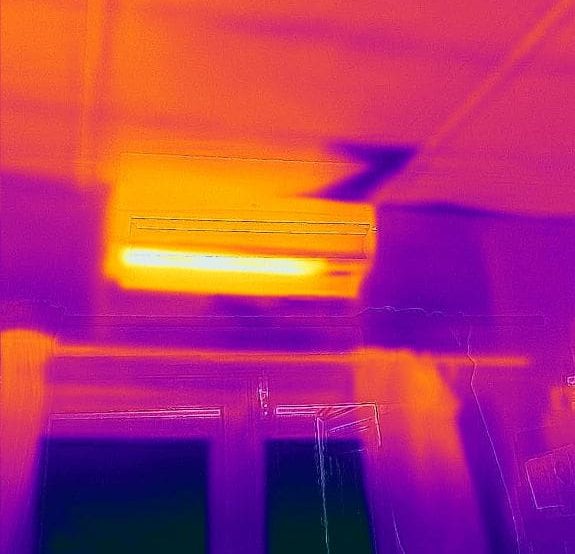
Heating or cooling from a reverse cycle air conditioner can be easily lost to glass doors or windows.
A space that is well-insulated isn’t going to require as powerful an air conditioner as an area with poor insulation. A sun room for instance might need excess heating and cooling capacity to cope with the extra heat transfer of expansive windows. In this case it might be more prudent to invest in a larger air conditioner than try to properly insulate a sunroom with all that glass.
In many situations however a leaky room isn’t so much a case for a larger air conditioner as it is a case for better insulation – particularly in ceilings.
“My recommendation wouldn’t be to get a bigger unit because of crap insulation – just get some better insulation. If you don’t have any, than your heating and cooling system simply won’t be as effective,” says Johnston.
What Is The Room Used For?
In addition to the size and insulation of the space, also important is how many people are in it. The occupancy rate of a property is relevant, as is the question of how many people are likely to be in a given room at once.
“The use of a room, say a kitchen and you’ve got lots of family members around, there’s a lot of body heat in that, so kitchen areas might require more cooling,” Johnston cautions.
Kitchens can create additional challenges through the heat generated by cooking, which is just one example of a room with unique internal heat loads.
What Is The Local Climate Like?
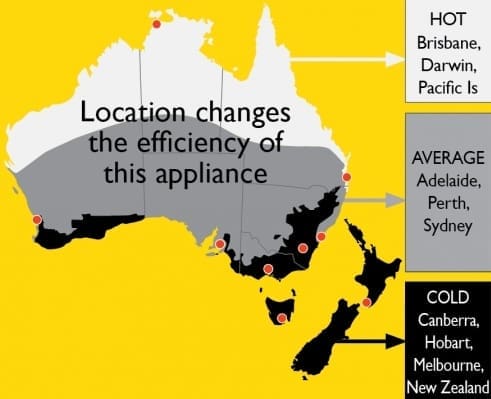
Different efficiency zones across Australia.
Another key factor is the weather conditions the space is subject to. Rooms of identical dimensions, occupants and insulation levels are going to need different air conditioner capacity for the muggy heat of Darwin compared to a room located in the hot dry summers and frosty cold winters of the Adelaide Hills. This can also influence other details of the air conditioning system, such as ducts that are appropriately insulated for cool conditions.
In addition to the local climate, there is the specific orientation of the space to consider: is that sunroom orientated to the north and bathed in plentiful winter sun? Is that kitchen located under the shade of a large tree?
How Do You Account For All These Factors?
While calculating the size of each room is straightforward enough, translating insulation quality, room uses, and local climate conditions into air conditioner capacity involves a lot more arithmetic.
A raft of calculators are available online to help with this problem, including many offered by air conditioning brands, although there is obviously a conflict of interest in trusting a company to tell you how much money to spend on their products.
For a more impartial assessment, the Australian Institute of Refrigeration, Air Conditioning and Heating offers calculators for both heating load and cooling load.
To fill these in, you’ll need to have measured up the spaces that require air conditioning, and to understand the building and insulation materials used in the room/s.
The other option of course is a trusted professional: get a well-reviewed installer in to provide an expert opinion on what size system is best – just make sure they undertake a site assessment so that big tree by the kitchen is factored into the assessment.
To browse system specs and sizes, check out our air conditioning comparison table, while to read our verdicts on each major brand, take a look at our air conditioner reviews hub.
 About Max Opray
 RSS - Posts






One thing often forgotten with Ducted systems is the heat/cool loss in the roofspace. The roof space is a hostile environment & quite often gets really hot/cold.
The trick is to ensure that the cobtractor covers the ducting with at least the same amount of insulation as is in the ceiling. The Ducting insulation is inadequate.
Passive houses generally get around this by running MVHR ducting in a false ceiling cavity that is on the living side of the house insulation.
On 4 Jan 2020, Penrith Lakes, NSW, experienced a record maximum temperature of 48.9 °C. On that day, Penrith was the hottest place on Earth and set a new record for the Sydney basin.
https://www.bom.gov.au/climate/current/month/nsw/archive/202001.sydney.shtml#recordsTmaxDailyHigh
But according to a SMH article published on 5 Oct 2020 by Angus Thompson:
https://www.smh.com.au/national/nsw/the-sydney-suburbs-that-hit-50c-last-summer-20201002-p561by.html
Which air con units can handle 48+ °C extremes?
Short cycling of a big aircon ought to be a “last century” issue? Modern inverter units proportionally handle load – running longer cycles at e.g. 0.6kW on my 3.5kW unit – with less temperature overshoot to boot.
In my experience, high power is only needed for draughty uninsulated legacy homes. Here, a 7 kW unit in a single glazed draughty uninsulated 35 m² lounge in the old house handles cold Victorian winters and 43°C scorchers with aplomb.
In the 6-stars new build, double glazing & insulation allowed 0.74 kW x 4 = 3kW thermal of aircon to make 72 m² too cold for me in 42°C yesterday. In winter, I have stopped lighting the wood heater, as pressing the RCAC button is too easy, and does it all.
Last night, after the 42°C day, the 3.5 kW split pushed cool air around two corners, through a doorway, for easy sleeping in the bedroom.
Airflow is through the galley kitchen, around a corner, 10m to me on the sofa, for less chill draught. But I wear a fat jacket to cope.
P.S. A second 3.5 kW split unit cools the 32 m² main workshop, plus a second same size workshop, leading off it, when the interconnecting door is opened. These are only single glazed, but with well insulated walls and ceilings. The 64m² is usually taken down to 20°C by the small unit, despite the four inverters and substantial battery in there. Ample eaves are the only shading – apart from almost full coverage by solar panels on the roof.
Long story short – even single glazing is manageable with a modest aircon, if the area is reasonably airtight and heavily insulated, in both walls and ceiling. (Well, here in Gippsland, anyway. Dunno about up north, or the outback.)
In contrast, the uninsulated uncooled garage is cooking today. Wouldn’t put inverters or batteries in there. Insulating my roller doors would be difficult; panel doors would be easier. (If you haven’t built yours yet.)
Oh-oh, better put out water for the blue-tongue which ran into the clutter there. I’ll do it now.
We’ve found splits to be great, have 4 of them at virtually 4 points of an X on the home footprint, internals about 180m2 in area.
They’ve been added at various times in our 40 years of building the place in the mid 80’s, insulation is excellent, laminated glass in larger extension glass walling, heavy drapes etc.
Through this little bit of heat in Adelaide past couple of days and next 2 days, we’ve had 2 of them on at diagonal points, other room doors closed, forcing air to a middle meeting point, covers 2 x 30m2 rooms (one bedroom with split going, and large dining), large kitchen, hallway, small office, other good sized master bedroom with 2nd split on.
Even yesterday in just under 43c temps, inside was a nice 25c, solar easily powering the slightly under 1.8kw draw when both cooling.
We left them on right through the night (it was still 40c at 2100), but the 6.5hrs of exorbitant 53c peak was offset quite well by the 8c rate for 6hrs midnight to 0600.
Battery under consideration.
The site’s 1000 character limiter function appears to be broken. Repeated post attempts with reported 2, then 3, character headroom are triggering blocking. A 19 character reserve was finally accepted, above.
Conciseness is next to godliness, admittedly, but a limiter which fibs is an irritation, not least after the third time around the loop, with < 997 characters reported the whole time.
It may be that an initial overrun has the page counting unaccepted & undisplayed blindly typed characters, instead of hard limiting input. (Finn can explain control system hard saturation, I'm sure.) In any event, the hysteresis after overflow is not reflected in the character count reporting, making recovery more difficult, as in any open loop system.
Iv previously experienced that its your name being counted in the character limit.
——
For the article one other thing you should remember to take into account is the design/shape of the room.
The result of a dodgy builder on one part of the house has me in a 2.5m wide 5m long room which combined with the usual heat here has a 7kw cooling system struggle to keep it cool. And limited reasonable improvements.
The biggest improvements were shutters on the windows and a small adjustable roof mounted fan in the corner to improve airflow.
Though adding a Solar AC/DC air conditioner to the lounge has also helped as during the day the rest of the house being cooler does reduce the load a bit.
Just a note that – unsurprisingly – if your house is well designed for seasonal shading, is insulated and sealed the calculators above will way oversize your system. In that case looking at what you currently use for heating and calculating a kW equivalent might be more useful.
E.g for our 8* design house in the ACT (with an insulation job that has some flaws, and then the plumber happened, but which is blower door tested and quite airtight), the heating calculator suggests 9.2kW for an open plan kitchen/dining/living + connected study, which is 4x more than currently used. For cooling it suggests 6.2kW when currently we use none, though shaving a degree or two off on the worst days would be nice. The current heatwave will be the toughest test yet and I would guess as little as a kW or two of cooling would shave a few degrees off the whole house.
I take it your house has an MVHR to cycle the air? One issue with Air tight houses is the air needs to be mechanically changed. Good to see people doing Blower door tests on new homes, but Air quality must also be considered.
No it doesn’t. It is a solar passive design and while fairly airtight it isn’t quite to the level where you definitely want mechanical ventilation. All the bathroom and WC extraction fans have run on timers and that combined with the rangehood while cooking and the natural leakage seems to suffice. That said if I had a do-over I’d go down the MVHR route.
I agree. Based on your comments, you could consider setting up a home assaitant system & track the CO2 in various parts of the house. High CO2 has been linked to issues with sleeping. You may be able to control the extraction in the Kitchen & bathroom, & introduce controllable ventilation to the bedrooms & living spaces controlled by Home assistant by switching e-switches & monitoring CO2.
Of course, the advantage of MVHR is air changes also exchange energy reducing the need to heat/cool. It may be possible to install an MVHR as a retrofit. The ducting is 70 or 90mm OD from memory (could be hidden with a bit of thought), Usually on a PassivHaus, the ducts are in a false ceiling cavity, so inside the house envelope. 3 air changes/hour seems to be optimum.
I feel your email shows a failing in the Australian Building standards: When buildings are designed to be leak-proof, there needs to be careful design of the Air change system, which seems to be not always given consideration..
To gain Passivhaus certification you need to reach air tightness of 0.6 ACH or lower.
Hi Martin,
You’re right about passivhaus but I believe the average new Australian house would score about 15 ACH… they’re glorified tents.
hi!
you mention that ceiling height is important but quote areas as sq. metres. why not get people to use cubic metres. the maths is not hard!
chris
I am desperate for help/ answers. About 5 years ago we wanted aircon for 3 std sized upstairs bedrooms. Not knowing much we went to a well known, reputable company and ended up with possibly the worst ducted system on the planet. 2 zones (main bed and other 2 beds), no remote, a controller that is harder to program than the space shuttle, a thermostat located outside of the bedrooms which makes it useless, a sleep function that is set at 6 hrs! The main benefit of this system is that it is so hard to use we barely have it on, so have probably saved money. I don’t want to mention any names, but SAMSUNG, I’ve tried to find out if we can get the controller replaced to at least make it more functional, but no-one has been able to help. We are at the point of starting over, but I’m wondering what happens re the big holes in our ceilings for the outlets and intake. Can they be reused if we replace the system, or would they need to be patched. Same for the ducting etc.
Peter,
if I were in yr situation, I would gather all the info on the system (Model #, specs, etc). You may be able to update/upgrade the controller, & perhap s even get app control. The other possibility is to is Home Assistant: google Home Assistant & the model of the A/C system or controller. It may be possible to control the system with Home assistant which is an Open-source microcomputer control system.
Yes, the ducting can probably be re-used. I would check if the duct was properly insulated However it seems a waste to scrap a perfectly good system that may be able to updated.
Thanks for your reply Doug, I found it really hard to find a company that would even talk to me about replacing the controller. Put in a few online enquiries got one or two replies, spoke to a couple of people. It made sense to me that you should be able to simply replace it with something a bit more modern and useful (what happens if it breaks or someone takes to it with a hammer etc), and I have seen adds for wifi based applications etc. But to date have not had any luck. Happy to pay so we get a workable solution, but no one seems interested in taking my money. Hence being at the nuclear option stage of starting again.