
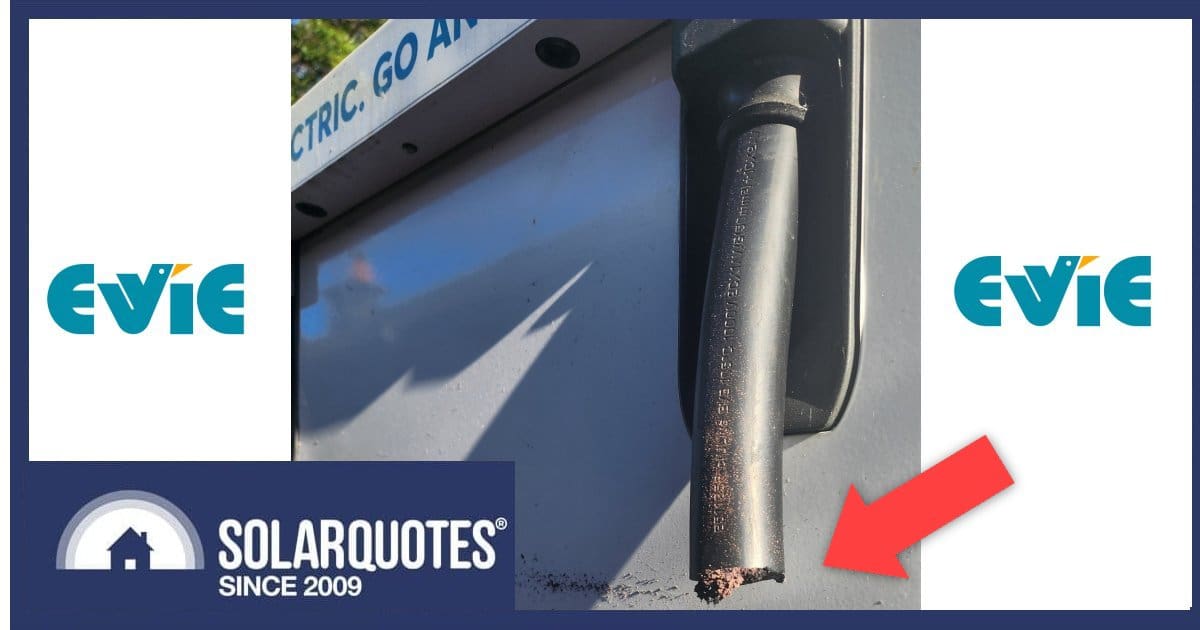
EV charger cable theft, rampant overseas, is starting to make its presence felt more among Australian charging network providers. Evie Networks is taking action.
What’s Happening With Evie Networks’ Chargers?
The firm posted on Facebook earlier this week that a “small number” of its charging sites in Dandenong in Victoria had been interfered with. Charging cables at the sites had been cut and stolen; likely for the copper they contain.
According to Evie Networks:
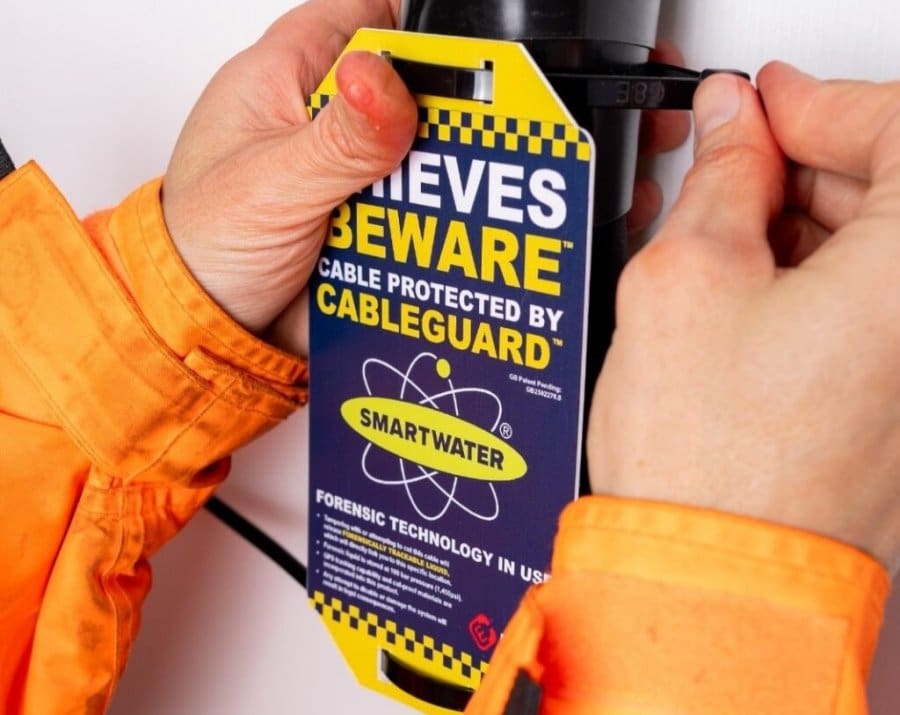
“Making sure chargers are available when drivers arrive is what matters most to us. So, we’ve looked at what’s worked overseas and are now trialling cable guard technology at a handful of sites — a protective mesh designed to help prevent damage and reduce downtime. We’re also working closely with authorities and industry partners to tackle the issue. So if you notice cables looking a little different at some chargers, this is why.”
The Dandenong incident likely isn’t the first for the firm if they have already done the groundwork and are trialing a solution; unless Evie cast their eyes overseas and anticipated what’s coming.
What Is CableGuard?
CableGuard consists of a reinforced patented sleeve with an internal forensic liquid system.
Cutting resistance has been tested across multiple tools, cable types and site conditions. The results indicate an increase in the time and effort required. Still, there might be damage done.
CableGuard can also be supplied with forensic liquid tracing that marks suspects, tools and vehicles with a unique forensic identifier
“This capability is widely used in UK security strategies and has contributed to over 1,000 convictions,” says the firm.
There also appears to be a ‘secret’ product for higher risk or internationally affected sites designed to disrupt attack attempts, increase confusion in thieves and support better operator response. What those features are, CableGuard isn’t saying as details are shared privately with customers in order to “maintain security through obscurity”. Whether Evie Networks has opted for these extra bells and buzzers isn’t clear.
CableGuard is available from Formula Space, which says it has grown from a specialist signage provider into the UK’s leading single-source partner for EV charging environments.
Formula Space stated it was proud to be working alongside Evie Networks.
“With two trial sites now live, these installations mark an important first move in protecting charger uptime, reducing disruption for drivers, and safeguarding critical charging infrastructure,” the firm said. “Early learnings from the trial will inform a wider rollout, with further protection planned across Evie’s network as the programme scales.”
CableGuard was recognised at the 2025 EV Infrastructure & Energy (aka by coincidence – EVie) Awards for innovation and industry impact in protecting EV charging infrastructure; taking out the ‘Best New Product’ Award.
How Bad Is The Charging Cable Theft Problem Elsewhere?
Various reports quoting this paywalled article on Automotive News paints a frightening picture from just one provider.
Electrify America saw 130 cables stolen from January to May 2024, up from 125 charging cables stolen across 2023; with Washington, Nevada and California being hotspots for theft. And there have been other incidents since, including this one.
It’s not clear what action, if any, has been taken by Electrify America to better secure their cables and what their experience was like last year.
Sacramento’s Electric Vehicle Charging Association says more than 20% of U.S. charging stations have been subject to vandalism, including copper theft.
It’s also becoming an increasing problem in other countries including Germany and the UK. Germany’s EnBW experienced more than 900 cases of cable theft at over 130 locations last year to October; costing the company several million euros.
Copper Prices Fuelling Theft
Like silver, copper has been having quite a few moments, attracting high prices.
This COMEX copper price history graph from MacroTrends tells the story. The price shown is in U.S. Dollars per pound.

But cable copper theft isn’t what you’d call easy or big money. It’s not just a matter of stripping the outer layer to get at the copper within. There are smaller wires inside also coated with tough insulation that is difficult to remove.
Many thieves may not be aware of this and by the time they discover the effort involved, the damage is already done.
Back in 2024 when that Automotive News article was published, EV cable copper theft wasn’t as prevalent in Australia compared to other nations, and it was actually described as “exceedingly rare”. The major issue back then was mindless vandalism. With that continuing and now copper theft becoming a growing issue, providers have quite a challenge on their hands.
What About Home Charging Cables?
I haven’t heard of a lot of theft in Australia (yet), but charging cables used at home left in sight of the street could be a tempting target too. These cables aren’t cheap. A decent quality Type 2 EV charging cable I was looking at yesterday that was just 5 metres long cost $169. You don’t need too many of those disappearing for it to start really eating into home EV charging savings.
Theft could be an increased risk especially for chargers using untethered cables that cannot be locked into the device body when not in use — no cable cutters required for theft. When buying an untethered charger, it’s a feature to look for. On the plus side, it’s easy to stash these cables somewhere safe when not in use.
By the way, if you need advice on which cable to get, see our home EV charging cable guide.
 About Michael Bloch
 RSS - Posts






Interesting, generally the way copper theft is usually countered is to just not use copper.
Is there a reason they dont use aluminium for EV charger cable? seems to work perfectly fine to get the power to the charging station…
That of course doesn’t deter the thieves who can’t read the “this cable is made from aluminium” labels… Recent incident in north Queensland where the idiots cut up fibre optic cable being a good example of the intelligence level of your average copper thief…
Wouldn’t it be much easier to introduce and enforce scrap yard laws? That wouldn’t just take care of this problem but also curb all other copper theft.
It’s just shipped overseas, like most stolen and stripped cars, parts, and sometimes whole vehicles.
Docos on youtube on the South African stolen copper wire ‘industry’, almost all of that is sent to China, the biggest consumer of copper in the world.
The front line theives make very little, risk their lives ripping out live wiring, including buried high volatage cable.
Sorry to read copper theft has ‘progressed’ to EV charging stations.
Why not build the charging ‘bowsers’ with a recessed socket and have EV owners bring their own cable?
Eventually EV manufacturers could incorporate the cable/plug into the car on a retracting mechanism.
Hi Clive,
Many stations are what they call destination chargers and only offer 7 to 22kW AC. They’re the same as what you’d install at home and many are “untethered” so you can BYO cable to suit your car.
For faster charging you need DC, with higher rated cable which is heavy, harder to roll up and best connected permanently to a station.
When charge rates get really fast, the cables will actually have liquid cooling, without which you’d struggle to pick them up.
Of course liquid cooling, with seals, pumps, coolant etc., is a pretty complex system which would be difficult to maintain.
Aluminium cables might help because they’re lighter and lower value, albeit prone to fatigue.
Public housing and a universal basic income that makes theft unnecessary would be a better solution all round.
Gudday Anthony,
I have never studied the anatomy of an EV charging cable. I wasn’t aware of the liquid cooling. Given that, as mentioned above:
“CableGuard can also be supplied with forensic liquid tracing that marks suspects, tools and vehicles with a unique forensic identifier”
Perhaps the liquid cooling could be achieved with the forensic liquid? Maybe use fluorescent dye, a bit like floor safes with powder that stains the thief?
I’m not convinced better living standards will stop copper theft. I expect it’s a ‘high’ for the offenders just like graffiti vandals. Or those who throw rocks to smash glass windows in vacant buildings. No monetary return in either case.
Perhaps make the cable retract into the housing when not in use. Could still attack it when plugged into a car but more likely to have someone around to disturb them. Retracted, the unit would have some tamper settings that alert police etc.
The other issue is poorly located charging stations tucked away down the back just perfect for thieves.
>Why not build the charging ‘bowsers’ with a recessed socket and have EV owners bring their own cable?
The cable required for fast chargers is too big and heavy to easily manage, plus it would take up a lot of space in the car. The Type 2 cables supplied with many cars for AC charging carry relatively low currents, so the copper cable diameter is much smaller, and lighter weight.
A security camera (monitored) on a pole might help deter some thieves.
Terrible to see this coming more into the country, although copper theft of plumbing materials on building sites has been an issue for many years.
South Africa is well known for its copper wiring thefts, they even dig up, cut and drag away huge underground high voltage cable, and again when new cable is laid, it can be taken again overnight.
Traffic lights, home wiring, nothing is left if it’s accessible.
Almost ALL the copper wiring thefts in South Africa are sent to China for recycling into their endless thirst for the materials.
I’d think the only solution is a lower value conductor alloy. Maybe a mix of aluminium, lead, tin, maybe some thorium and cadmium. Enough low level radiation and toxicity to make it a liability to the recipient.
Or we go to magnetic chargers embedded o
In the road, or batteery swapping?
This is happening a lot in Canada, in Moose Jaw ot eas -47 C last night incl wind chill. We cam’t allow this critical infrastructure to be drstroyed.
Don’t try and tell me that the cable thief packs the cable and posts it to China
and waits for his money while he sits at home smoking pot or whatever thieves do in their spare time.
Businesses that pay for something that is obviously stolen should be charged also.
Speaking as an old Telecom Technician, often when new telephone cables were ploughed into the ground, the ends were left to overlap to allow the joint to be made. Many times when the jointer turned up the overlaps were gone, so two cable pits and joints had to be made. Stealing copper is not new.