
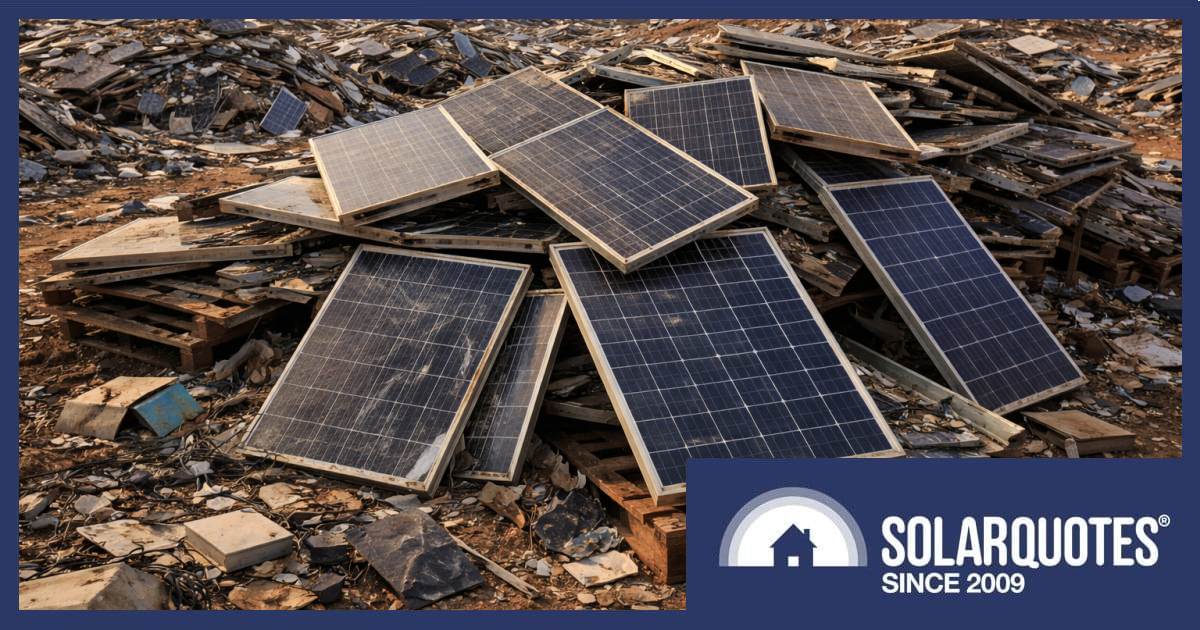
On Friday afternoon, the Albanese Government announced millions of dollars to deliver and support a long-awaited National Solar Panel Recycling Pilot.
How Will The National Solar Panel Recycling Pilot Operate?
The Albanese Government will invest $24.7 million over three years to divert end-of-life solar panels from landfill to facilities that will recover valuable materials such as copper, silver and aluminium. This initiative will include establishing up to 100 pilot collection sites nationwide.
An Administrator for the Pilot will be appointed soon; with collection services starting as soon as practicable thereafter.
The announcement was very light on specifics about how, what, when and where; but the Smart Energy Council (SEC) seems to have more information.
The SEC says the pilot will directly inform the development of a permanent scheme. It will test various transport options and consult with recyclers on identifying and solving practical challenges, and gather important national data on costs of recycling across different regions.
The Smart Energy Council says that the program is a result of dozens of organisations calling for a national and mandatory solar panel stewardship scheme last year, and is an essential next step to building on successful Queensland pilots.
“By standing together, we have ensured that the federal government recognizes the urgent need for a sustainable, circular solution for end-of-life solar PV panels.”
Councils Applaud Pilot
Solar PV waste has increasingly become a headache for Australian councils in terms of taking up space in landfills; where permitted. So, it’s no surprise the Australian Local Government Association (ALGA) welcomed the announcement.
“Councils play a critical frontline role in waste and resource recovery, managing a large number of waste facilities across the country,” said ALGA President, Matt Burnett. “Any national approach to decreasing the quantities of waste going to landfill or stockpiled helps manage the current unsustainable pressures on councils.”
Productivity Commission Pushes PV Recycling Opportunity
Coinciding with the announcement, a Productivity Commission (PC) report was also released Friday, looking at opportunities in Australia’s circular economy to improve materials productivity and efficiency while also benefiting the economy and the environment.
One of the focus issues in the report is waste from electronic products such as solar PV systems and EV batteries creating challenges for resource recovery and environmental management.
“Australia’s solar boom is projected to generate an 18-fold increase in PV waste from 2019 to 2030 as existing stock comes to the end of its useful life,” states the Commission. “Because of their bulky nature and the high costs associated with recycling (including specialised handling and infrastructure) or proper disposal, solar PV system and EV battery waste is often stockpiled or illegally dumped or exported to other countries.”
But it’s not just panels reaching the end of their expected service life that are of concern. Poor quality panels are failing early, and many with years of energy generation left in them are being ditched during system upgrades.
The Productivity Commission’s related recommendation:
“Recommendation 5.2
Establish a national product stewardship scheme for small-scale solar photovoltaic (PV) systems and investigate a national product stewardship scheme for electric vehicle (EV) batteries.”
According to a joint ministerial press release, only 17 per cent of solar panels are being recycled currently. Increasing this could create up to $7.3 billion in benefits as a result of reduced waste and reuse of materials.
“By turning old solar panels into valuable resources, this scheme will create more local jobs, and power a future made in Australia, enticing greater investment in our booming solar industry,” said Minister for Climate Change and Energy, Chris Bowen.
Finally, Progress On PV Panel Recycling
In 2021, the solar industry was put on notice by the then-Morrison Government that an industry-led nationwide stewardship scheme design must be finalised by June 2022. The Clean Energy Council (CEC) challenged the government, stating it had worked to develop a comprehensive, nationwide plan over the previous year, but that the Federal Government had “walked away” from the collaboration.
In the years since, there have been various proposals and opinions from government departments on a national scheme; but no real action on their part — until now.
On a related note, we recently reported University of Newcastle researchers have developed a more efficient method for the recovery of high-grade silver from end-of-life solar panels.
 About Michael Bloch
 RSS - Posts






When i know my panel need recycle? Get yearly statistics and compare it?
Garfield,
Panels only require upgrading when there is something like a bad hailstorm (causing microcracks in the PV cells), or an inverter failure that often means the PV panels require upgrading due to updated Standards compliance.
The first failure usually only degrades performance (but is covered by house insurance), The second is your cost, but rebates are available for the new system.
My system has panel level monitoring & I have a few cracked PV cells in some panels. They are still generating at ~70%. PV panels have a life of at least 25 years, so no real worries. My system is approaching 10 years old.
No gov.t rebates should be happening at all.if this is the cheapest form of energy then let the market decide.
Hi Philip,
Have you noticed the recycling efforts the coal industry has made for the 12,000,000 tonnes of flyash coming from power plants in Australia every year?
Truth is that what they’ve tried so far has failed but that doesn’t mean coal miners aren’t still getting black lung or that it’s safe to eat the mud crabs out of Lake Macquarie either.
The fossil industry is heavily subsidised by being able to offload its true costs.
Like the 10 cent container recycle plan there needs to be an incentive to recycle panels. Last week a house in my street was demolished with the 13 panels on the roof just being torn apart with the rest of the building.
Container deposit schemes are principally about litter reduction with recycling being a secondary concern and theres a pretty strong belief in some sectors that 10c is not enough of an incentive. Theres also have a very short time between the fee falling due from the supplier and the incentive payment to the redeemer which helps with cashflow and scheme budgetting. With panels there should ideally be decades before a panel should be recycled so the redemption model has issues, and the people who are impacted by a recycling scheme should also be a much smaller section of the community. A better model may be a levy on every panel sold which is then pooled to fund the scheme operation, with legal requirements to recycle panels and penalties if they arent. All panels sold need to be approved anyway so the infrastructure is already largely in place to make it hard to avoid the levy.
Definitely agree Andrew that an Industry wide scheme is required for used solar panels.
Paintback has been operating successfully providing a network of approved collection ponts for surplus paint. Similarly for motor oil disposal.
My disappointment comes from the years of delay from when a new technology product enters the market to when end of life disposal becomes a headache due to not being considered upfront.
Circular Australia is helping to address this challenge. Look for circularity precincts in your local area.
Forced disposal to recyclers should be mandated on installers. And accepted at no charge through waste centres like all recycling waste.
a 3 year pilot? Seems rather lengthy, surely 6 months would be enough to know if it was feasible?
Going to be an awful lot of panels still going to landfill while await the outcome of a 3 year pilot…. the squeaky wheel nicely kicked down the road until well after the next election cycle though…
Yes a lot of solar panels are going to land fill.we are destroying the earth to save the atmosphere.
If this is a co-regulatory scheme, the cost will be borne by the manufacturer and taxpayer. Let’s see how many scheme participants rort the system over time.
As example, The NTCRS (National TV and Computer Recycling Scheme) remains an administrative scheme that has been rorted as most government schemes are. Plenty of cases in AU and NZ of dumping “post-reimbursement” under NTCRS.
Particularly with the current price of silver, it should be economical to strip old panels.