
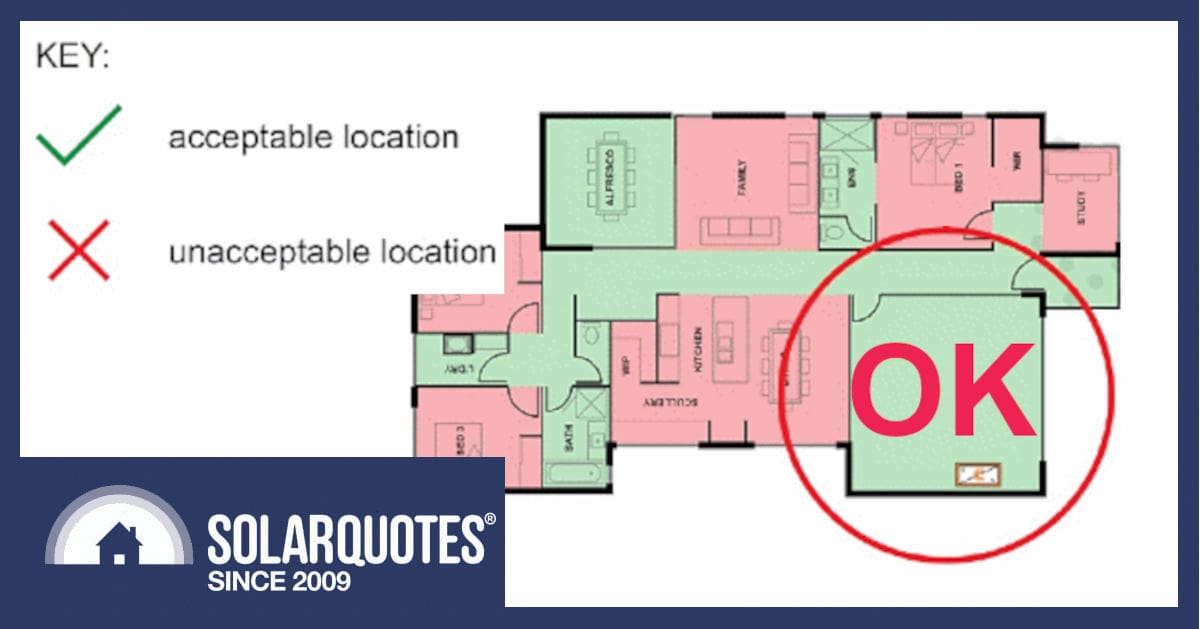
Good news for battery customers in New South Wales – you can now join the rest of the country, installing battery systems within 600mm of garage door openings and other similar applications.
What exactly does this mean? Simply that NSW has now adopted the pragmatic approach everyone else takes to interpreting the rules.
Can You Install A Battery Near A Garage Door?
The basic principle behind what we’re explaining today is this; if there’s a fire, you don’t want it blocking an escape route from a building.
The rule says batteries cannot be installed within 600mm of a doorway, which makes some sense when you’re dealing with a personal access door that is around 800mm, or an additional 25% wider than the specified clearance.
However, for years now, customers in NSW have not been allowed to install a battery within 600mm of a garage door. The state authorities were blind to the fact a garage door might be 450% wider.
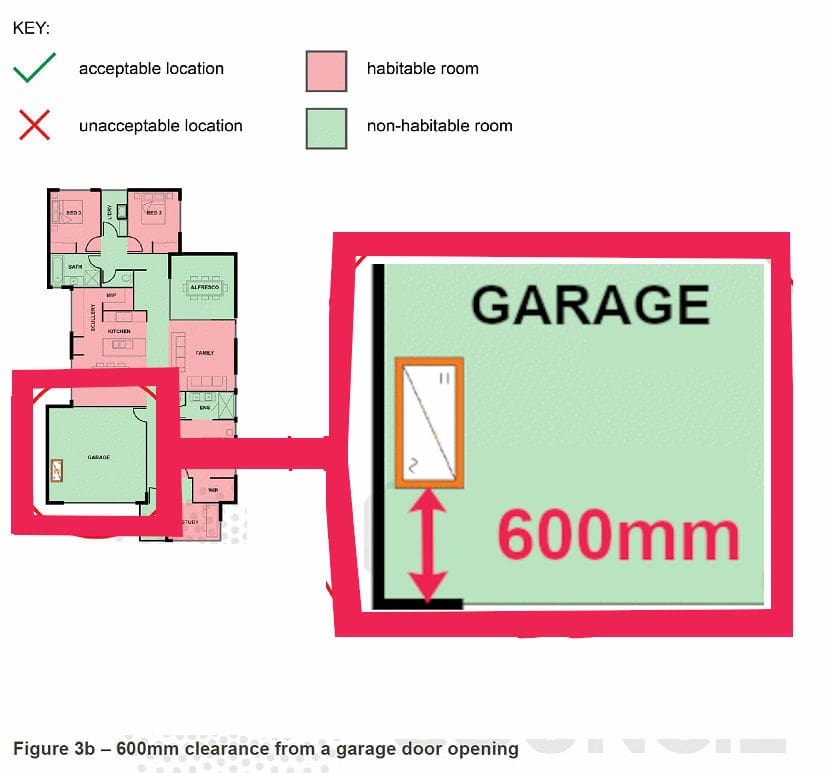
It seems the CEC specifically enlarged the most ridiculous part and NSW took the bait.
While every other Australian jurisdiction said yeah, 600mm is irrelevant when you can get 2, 3 or 5 metres away from the hazard. NSW said a door is a door and an exit is an exit. Reasoning didn’t come into the equation.
Rules Is Rules
It is not without reason that some people think Australia is a nanny state of regulation and red tape but we’re happy to report at least some of the apron strings have been loosened recently in an amendment to battery safety rules.
There are some pretty strict standards dictating just where you can install a home battery system, and for good reason. While battery fires are vanishingly small in number, like any flame in a building full of plastic, modern house fires are difficult to control and emit toxic smoke.
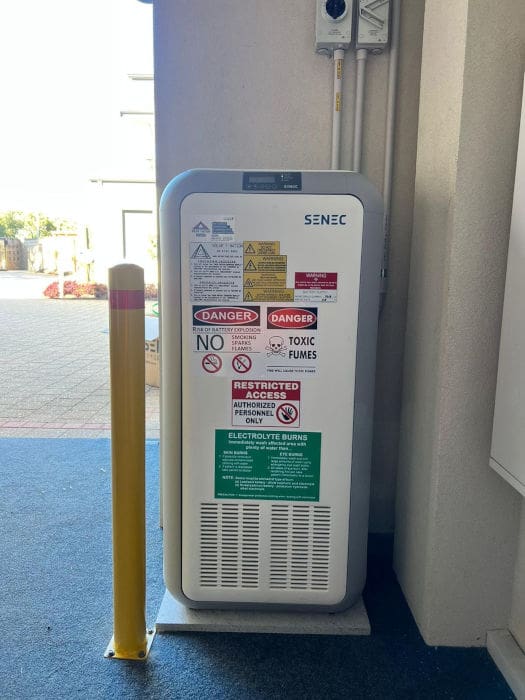
Despite the bollard, until now, this wasn’t a compliant install position in NSW.
We’ve explained before that the rules can make it hard to find a compliant location for battery installation. Many of them disappear if you’re 300mm from a wall, but if you’re really worried, an enclosure completely separate from the house might be the best plan.
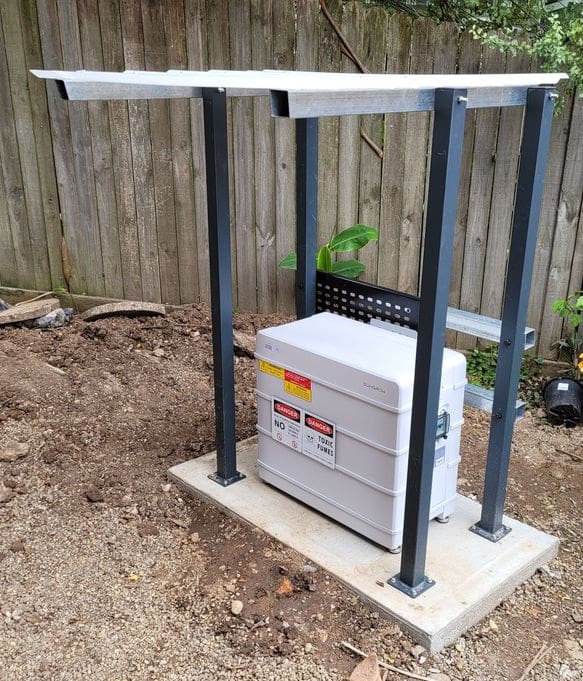
Once cladding is installed around 3 sides, this little kiosk will afford excellent protection to the battery, well away from the house.
Going In The Garage
In many instances it makes perfectly good sense to put your solar equipment in the garage, not least of which being you may have an EV to charge, so wiring up to a solar sub board reduces expense and increases efficiency. Regardless though, the same reasons apply for keeping your car in there. Many people lament that cars, whether they’re full of flammable fossils or massive EV batteries, seem to have far fewer rules to comply with when parked in your garage.
It’s protected from the elements, which helps with:
- aesthetic aging;
- potential damage that’s outside of warranty;
- degraded performance at high temperature;
- derated charging at low temperatures;
- less chance of pestilence (geckos that jam up fans, ants which can ruin electronics).
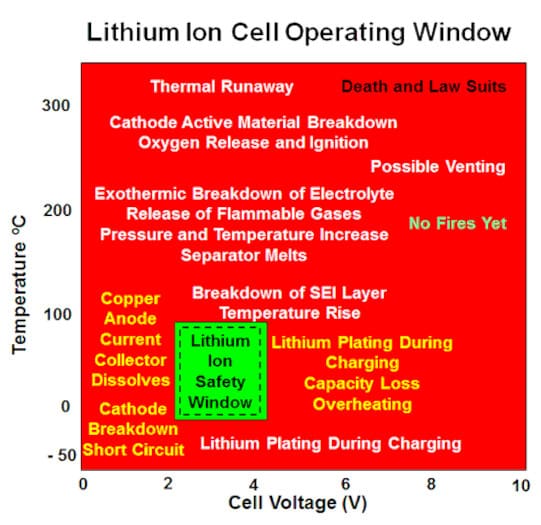
Unlike a lazy old bucket full of lead and acid, Lithium batteries are a bit fussier about charge rate and temperature, all of which is controlled by a Battery Management System.
Plus there’s a better chance you’ll see a winking light that could indicate a fault, because let’s face it, not everybody checks their solar energy monitoring app when they wake up every morning.
For All The Pedants
Though the standards have now been updated, we must remember that the previous version was followed most piously by NSW – all other states went down a different path. A garage door is an exit, so it requires a clearance. Unless you can argue with a straight face that a garage door was not an exit?
NSW Department Of Fair Trading representatives on social media have indicated that state authorities are aware of the new standards change and are inspecting in accordance with those changes, and the install will be acceptable as long as distances are respected in accordance with these updated standards.
Amended Standards Are Out Now
There are quite a few changes which installers must make themselves aware of in the latest battery safety rule tweaks.
We’ll update you on the changes to how and when they might affect your battery installation as the information comes to hand, and more importantly, how people interpret it.
At the end of the day this situation has come about because of semantics about language and how one department chose to read the rules literally instead of sensibly.
However for now this one detail is a victory worth celebrating.
For more on home battery installs in garages, read my recent piece on whether bollards provide sufficient protection.
 About Anthony Bennett
 RSS - Posts






yeah, nah, as a regulator / inspector it is your job to interpret rules literally, it is the politicians job to make sure the rules are fit for purpose and make sense.
Do you think those politicians would back you when you are sitting in the hot seat in the coroners court and the bloke in the black robe asked you why you approved an installation that clearly did not meet what the written law was? Whether it makes sense or not has no bearing on that conversation at all.
Conversely it is the industries job to comply, but also to point out the stupidity of things to politicians and ask to have the laws / regulations fixed, but good luck with that.
I have to agree Andrew. As a retired law enforcement officer my job was to enforce the letter of the law, regardless of my personal feelings. Interpretation of the law and making precedent is for the courts to decide and for politicians to change/modify the law when that interpretation does not meet the community’s expectations. We can’t have law enforcement inconsistently applying their own personal interpretation to legislation. Otherwise you end up with chaos and law suits.
absolutely!
It’s crazy that in so many different areas (NOT just electrical installations) we have different rules in different states.
I guess it could be worse- like the USofA with sooo many states and different rules, for nearly everything, each time you cross a state line.
People forget, or dont understand, Australia is only a Federation, The Australian Government is not “in charge” of the States.
The states rule themselves except for some external powers, and some powers they believe better controlled uniformly (such as taxation) they have ceded to a central federal government to manage on their behalf.
I’ve got a question about “habitable rooms”: What if it’s in a unit and backyard isn’t an option, so the garage is the only choice. The back half of the garage above is a bathroom however the front half is a bedroom.
Going off the rules – would it be deemed “safe” if the battery is mounted up against the back wall? For an added safety feature – could replace the gyprock wall and ceiling in that section with fibro-cement panels.
Get a quote and see what someone qualified might decide for you, then try another for further opinions, consider cooling etc as well as fire safety plus make sure your neighbors are happy
Installer told me that my garage wall, (behind one part is habitable and one part that is not), only if we install on the part that has the “habitable “ part behind it do we need to line with cement sheet first. Not sure about clearances tho.
We put our battery in the garage under a habitable room and the clearance needed to be 900mm from the top of the battery to the garage ceiling. I think if cement sheeting was installed the required clearance would have reduced maybe to 600 mm?)
My installer has said it should be an external garage wall. But I do not see anything in the rules that stops the wall being between 2 garages. I think that rule is to stop it being a wall between the garage and living area, am I correct?