
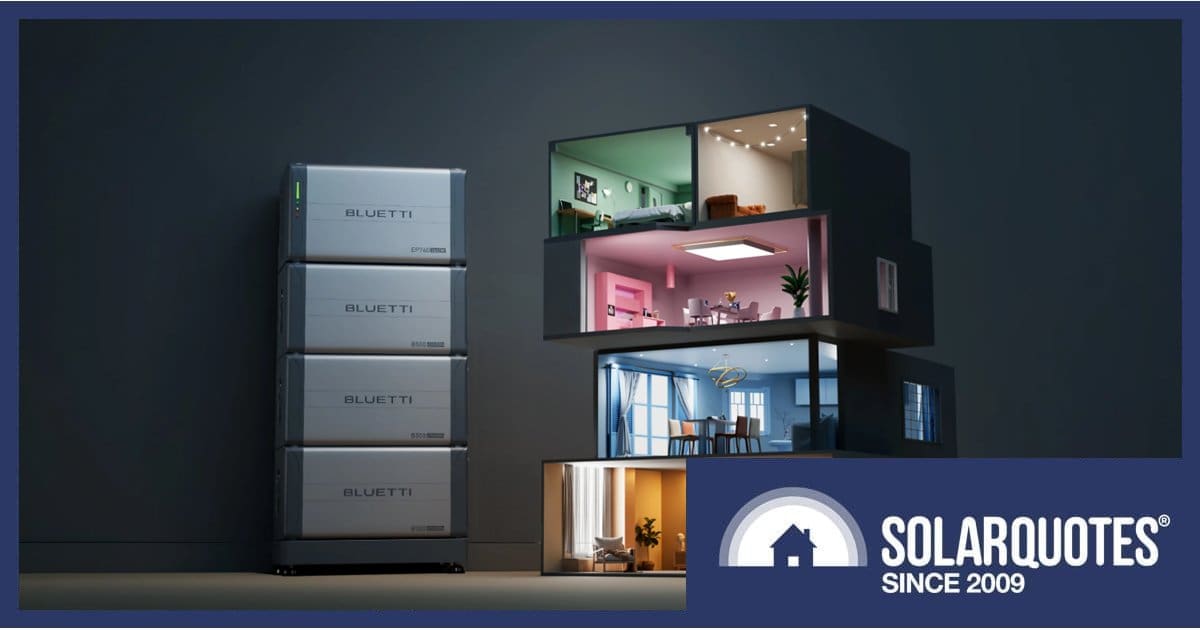
Best known in Australia for its off-grid/camping solar and energy storage solutions, Bluetti has expanded into grid-connected home batteries. So, is the EP760 any good?
Bluetti was founded in 2019 in Nevada, USA, but manufactures in China. After attracting USD $6.7M on the crowdfunding platform Indiegogo, its product range kicked off in 2020 with the AC200 – a 2 kWh battery featuring all sorts of outlets and solar panel support.
Thanks to media coverage, lots of advertising, a referral program and the addition of a bunch of products including folding solar panel kits, Bluetti has become a fairly well known name here among campers and off-gridders; although reviews from customers vary. Now the company is looking to break into the home battery market.
Introducing The Bluetti EP760
The EP760 is presented by Bluetti as a “single phase hybrid all in one residential energy storage system”. The modular battery system consists of the EP760 hybrid inverter capable of up to 7.6kW output ….
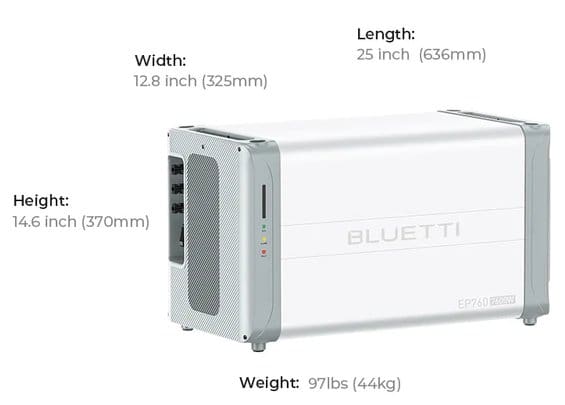
… and stackable B500 batteries based on LiFePO₄ chemistry that are 4.96 kWh capacity each.
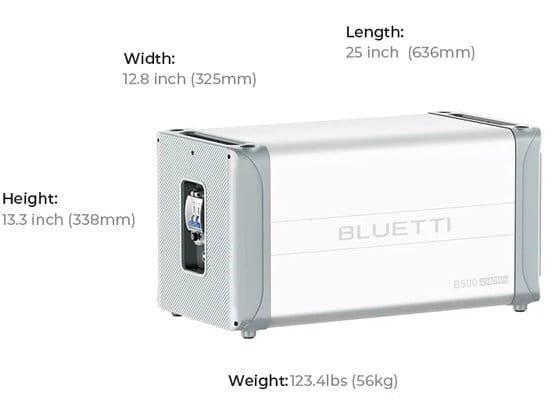
A basic arrangement offers 9.9 kWh capacity (2 battery modules is the minimum), expandable to 19.8kWh (4 battery modules maximum). However, the Depth of Discharge (DoD) is noted as 90%; meaning the usable capacity of the 9.9 kWh configuration would be about 8.9 kWh as I understand it.
Bluetti says in the event of a power outage, the EP760 can switch from grid power to battery power in less than 10 milliseconds. It has 3 MPPT channels, capable of supporting up to three 3kW strings of solar panels. I noticed its working temperature range is -20℃~40℃, which could present some issues in toasty regions in terms of warranty should things go pear-shaped1.
We’ve been assured the EP760 is “built to last and comes with a no-hassle 10-year warranty”; but that remains to be seen. The warranty document I saw only covers the inverter; and there are a couple of gotchas in that – including only 2 years warranty on fans and WiFi modules.
Is The EP760 System Approved For Use In Australia?
Well, here’s the thing. The EP760 hybrid inverter has been listed on the CEC approved inverter list since late last month. It’s easy to miss as it’s not under the Bluetti name, but instead under Shenzhen PowerOak Newener CO LTD.
However, the B500 modules don’t appear to be on the CEC approved battery list; but Bluetti’s web site at the time of writing indicates they are. Perhaps like the inverter, the B500 module is under another manufacturer name.
—
UPDATE June 9, 2024: The B500 modules were listed on the CEC’s approved battery list on on May 27, 2024 – 7 days after this article was originally published.
—-
The EP760 hybrid inverter specifications sheet also notes:
“It is only compatibility [sic] with the B500 BESS and must work with it.”
Not being on the approved battery list would exclude it from some state-based incentive programs. Network operators also require batteries meet certain standards, which typically align with CEC approval, so you’d need to check carefully there (and it’s wise to check with your insurer too). Some installers may refuse to work with a battery that isn’t CEC listed, and the warranty documentation states it must be installed by Bluetti certified installers.
How Much Does The EP760 Battery Cost?
The following prices are for hardware only. Installation of home batteries generally costs around $1,500 extra for a simple job, but it varies wildly depending on the installation scenario and installer.
- EP760 + 2*B500 (9.9 kWh) – $11,999
- EP760 + 3*B500 (14.88 kWh) – $16,998
- EP760 + 4*B500 (19.84 kWh) – $21,997
Just as a comparison, a Tesla Powerwall 2 with 13.5 kWh usable capacity costs around $12,100 currently for the hardware, which includes the Tesla Gateway. That would be equivalent to the 14.88 kWh EP760 with DoD taken into account, and the EP760 is nearly $5,000 more. However, the EP760 offers up to 7.6kW power output (assumed continuous), while the Powerwall 2 is 7kW peak / 5kW continuous2.
While we haven’t yet added the Bluetti EP760 to the SQ web site, you can find more info here. Compare specs and pricing with other residential energy storage solutions available in Australia using SolarQuotes’ home battery comparison table; along with learning everything you need to know about buying solar batteries.
Footnotes
- Update: June 9, 2024. While the battery manual indicates a working temperature range of -20℃~40℃ and ambient temperature range -20℃~50℃, an inverter warranty exclusion states where “The maximum temperature of the environment where the Products are located is above 40℃ for more than 5 hours at a time.” It also notes an exclusion where “The Products are installed indoors within 1km of the coastline or outdoors within 2km of the coastline.” Potential buyers should check the warranty documentation for other exclusions, of which there are quite a few. ↩
- Powerwall 3 boasts more power, and may be around the same price. ↩
 About Michael Bloch
 RSS - Posts






Ehh, new comer no brand but with higher price than the established Powerwall .. why would anyone choose this?
Bluetti are well established in this sector, albeit these batteries are a new offering but I have a Bluetti for camping and it hasn’t missed a beat. I for one will be seriously considering the Bluetti when we are ready to go ahead with our solar installation. The modular system really appeals to me.
And thanks for this article. I requested this a few weeks back
It includes 3 MPPT, allowing 3 strings of DC coupled panels, upto 500V, with 3000W output per string. So throw ten 470W Jinko panels on each string for a total 14.1KW rating, 9KW continuous generation for charging the battery, running load or (does it do export to the grid)?
It is more of a competitor for the upcoming Powerwall 3 unit than the current Powerwall 2 currently on sale.
At $10K with 3 B500 batteries and 13.5Kwh usable battery, during the kickstarter early bird sale last year I was very interested, but they were not CEC approved back then.
Hi, just wondering if this system can be used offgrid? We have no access to grid power at all but can’t find any info to say you can install without grid, like their other products TIA
Don’t buy, can’t find an installer in a metropolitan area. Mine is just sitting here in the box. Customer service are little to no help.
I’ve just asked them about the warranty policy and their customer support said that they warrant 3.65MWh/kWh for 10 years and SOH should be atleast 70%. However I couldn’t find any official documentation on this. I think this is pretty solid given that similar Sungrow package (lower power output and only 2 MPPTs) is around the same price.
I’m also keen to know if anyone in Sydney can recommend an installer that works with Bluetti
My understanding is the Bluetti EP760 is an all-in-one unit? It’s listed on the battery comparison page that it’s not an all-in-on unit.
I simply want to store our excess solar electricity rather than send it to the grid at such pitiful pricing. Our 10kWh panels with Enphase IQ7A generate 240v excess electricity most days.
Bluetti seems to be one of the simplest to setup, 240v in & 240v out. Ecoflow have something similar but not in Australia.
All the quotes from suppliers fall short, ‘just buy the battery’, no detailed explanation on how it will function. DIY battery is in EU and UK but not in Australia.
With an Enphase system [AC off the roof], you will need an AC-coupled battery, such as a FranklinWH. The Tesla PW 3 is primarily designed to be a DC-coupled battery.
The round-trip efficiency for an AC-coupled battery is about 85%-90% [my experience], and for a DC-coupled battery, 90%+, depending on factors like temperature range that affect the battery. Round-trip efficiency is attributed to the always-on Inverter that converts AC to DC to AC [AC Coupled or DC to AC [DC Coupled].
In my view, it is less about the battery and more about the functionality of the battery operating system. Does it support time-of-use [ToU] tariffs, the three-free-hour time period, dispatchable power arrangements, including VPP automatic switching during a power outage, portable generator connectivity, and comprehensive reporting, not forgetting warranty?
The question you have to answer is what you propose to purchase fit for your purpose?
Ta. Selling a battery seems more important than providing a solution. Only one retailer went to the trouble of working through our situation, advising our consumption/battery is marginal. In Mar 2026 used 258.27kWh ($155.16), sent 923.04 kWh ($27.69) to the grid. Bring back the analogue meter;).
None of the quotes explored the AC coupled battery functionality. They all want to replace the Enphase combiner/gateway with their devices.
Personally I would like to have an Enphase 10kW battery for consistency. But only one retailer quoted and the installed price for 5kW was silly, even with the rebate.
It would be useful to have a checklist of questions to ask of retailers..
Location: Far North Queensland. I installed a 6 kW Enphase system with Trina Panels and M215-E inverters in 2015, upgraded it to 8 kW with S270 Inverters in 2018, then to 10.03 kW with S270LN-IQ7-RMA Inverters in 2020 [Ttotal 36 Panels, a mix of NE, NW and SW orientation]. No degradation in performance, consistently producing 3.7 to 4.0 kWh per 1 kW of system size per day. In Nov 2025, I installed a FranklinWH 13.6 kWh battery, which works perfectly with the existing Enphase System. The company I used was RESINC.
Enphase batteries have backward compatibility issues with the older class of micro inverters and that is why I did not want to go with their product which would have required me to upgrade the solar system I had on the roof.
The FranklinWH [not an endorsement you pay your money and take your chances] seemed like a good solution. I am not in the business of recommending any hardware. I can only share my experience, which may not be yours.
I’m on the edge of committing to the Bluetti EP760 29kW, they are holding the price for a month after 1 May as getting an installer is impossible given installer demand. Deposit now install later and if installer advises not possible refund deposit.
I also like the transparency of their pricing model compared to other battery providers. When I compare the quotes they are cheaper than most.
Ecoflow is the other brand I am looking at, but their battery & system component mix is not quite clear.
It seems the major differences is in the details of how an installation will function once installed.