

With huge numbers of new home batteries sweating through their first Australian summer, temperature has risen to be an issue worth investigating.
Are there some simple solutions to keeping your solar battery and inverter cool? Read on for answers.
What Does Heat Do To Home Batteries?
In short, heat kills electronics and batteries alike.
The lore in electronics engineering says that running 10ºC too hot will halve the life of equipment, especially for components like capacitors and semiconductors, which power handling equipment like inverters and DC-DC converters are packed full of.
This principle is based on the Arrhenius equation, which describes how chemical reaction rates increase with temperature. For many electronic devices, operating at a temperature 10°C over the design specification can roughly halve expected lifespan, while lowering the temperature by 10°C can double it.
Applied to chemical energy storage like batteries, excess temperature ends up with the electrolyte eating the cathode inside the cells. They live hot and die young.
Install Your Battery In The Right Place
The simplest and best way to keep your battery cool is to install it in the right place to begin with. My usual recommendation is to put it inside a cool garage rather than outdoors in the baking sun. In fact radiant heat from direct sun exposure can void your warranty.
Of course the rules and practicalities mean that’s not always possible – your garage might not have space, it might be in the wrong spot, or it might not exist at all.
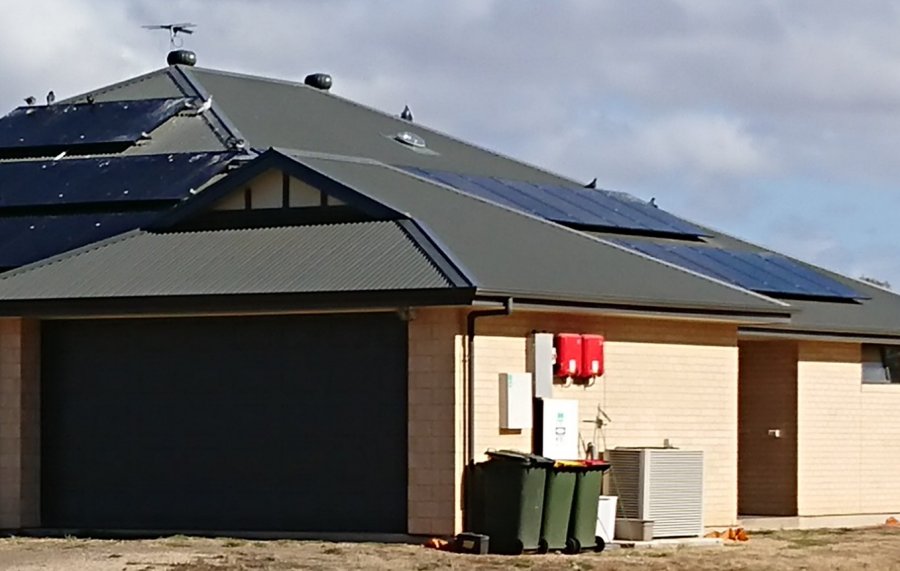
They were so close to the right place but this desperately needs a curtain dropped in front of the expensive electrical hardware.
I’m A Fanboi
Another important factor is getting the right gear – does your battery or inverter feature active cooling?
Fronius have been famous for fan noise since releasing the SnapIn-verter in 2014 and despite others marketing against them with passive aggression and heavy heat sinks, the Gen24 that came to Australia 6 years later had a bigger, better quieter fan.
Tesla took a similar approach even further with the Powerwall 1 in 2015 having liquid cooling to carry heat from an internal DC-DC inverter, and the battery cells, out to a fan forced radiator. It’s the same concept and even the same hoses used on a combustion engine car.
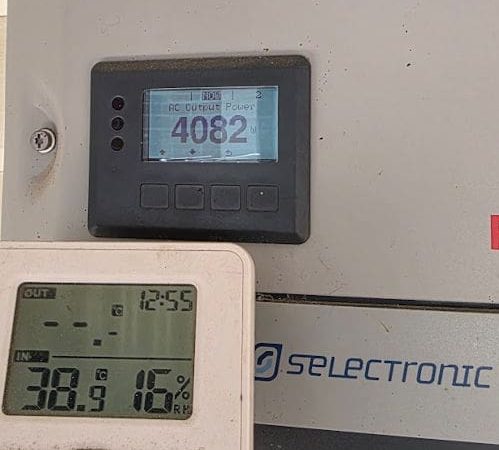
Near 1pm it was 39ºC in the shade and this 4kW Fronius was running flat chat.
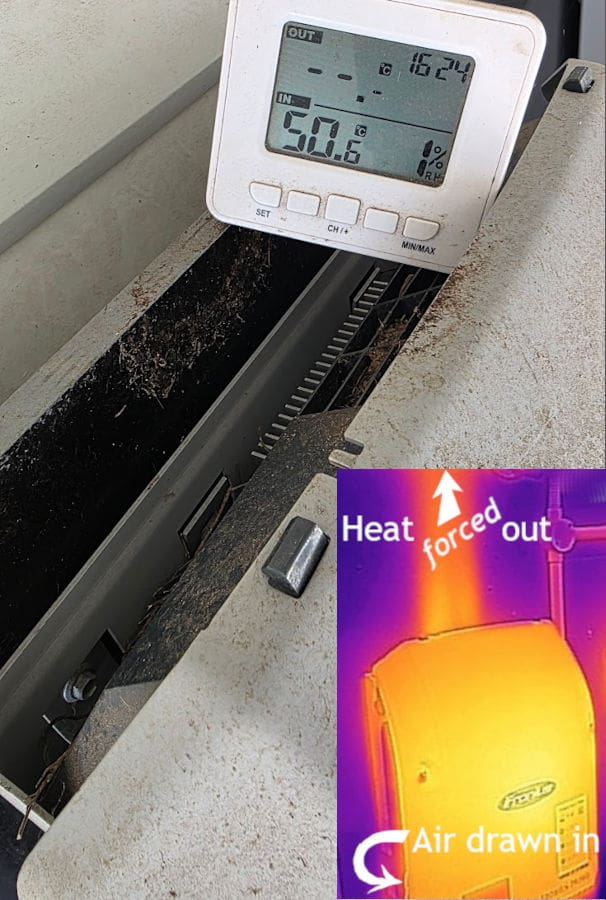
An additional 10ºC blown off the heat sink for the same 4kW Fronius.
Cheaper batteries were simply glued to a big piece of aluminium, but I know from first hand experience, some didn’t perform to specification even when they were new.
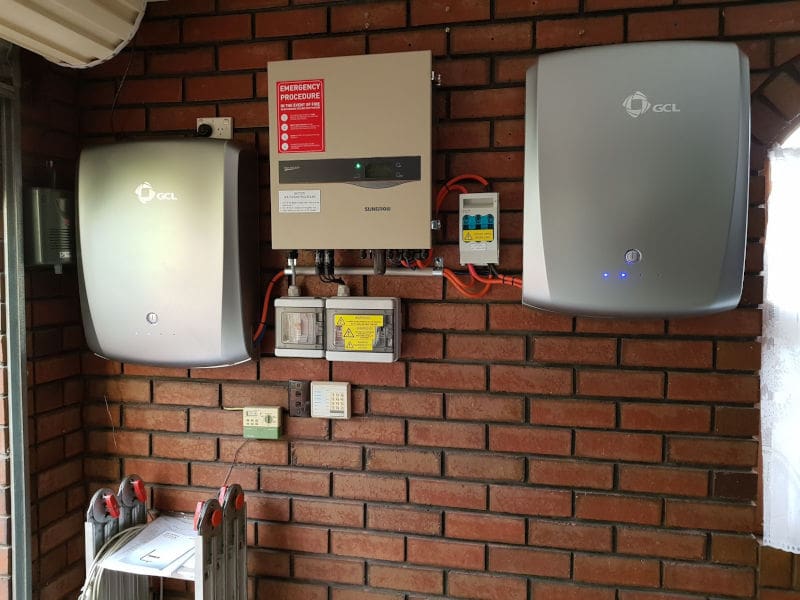
This early adopter found his GCL battery didn’t meet its specified data in its first year. Rather than replace it under warranty, they just gave him a second one and had me install it.
Monitoring Offers Insight
If you do have to install your battery outside, how do you determine if it is actually overheating?
Solar monitoring platforms will help you here, providing insights about individual battery voltages and component temperatures. Not all of them offer all the information to the end user, but when you ring up for technical support, the manufacturer often has deeper access to very specific information – including if a battery gets too hot or too cold.
It’s why a lack of good internet access will shorten your battery warranty in many cases.
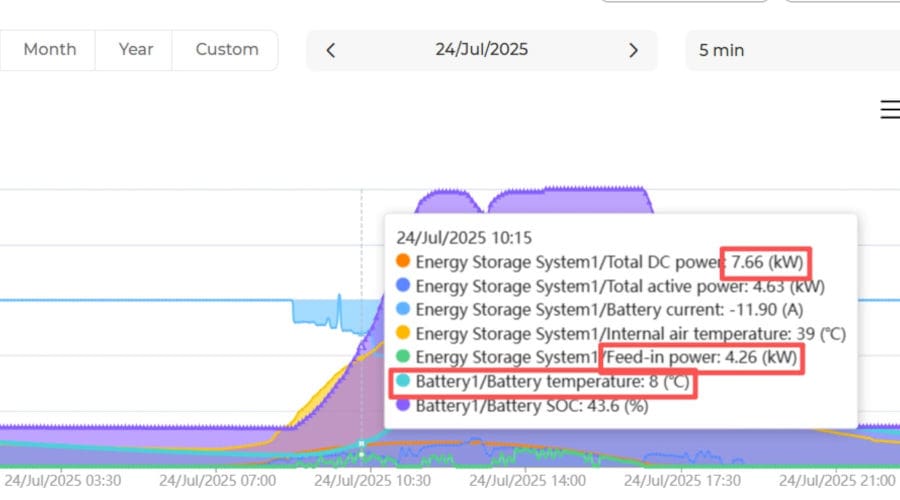
This Sungrow graph came to us after a complaint about excess electricity being exported to the grid instead of charging the battery. There wasn’t a fault, but the low temperature caused the BMS to protect the battery by limiting the charge rate.
It’s worth looking into your brand of system to see what data they offer, and whether temperature is really a concern.
Battery modules with a layer of internal electronics for DC-DC conversion are becoming more popular, so there’s certainly potential for waste heat to be generated.
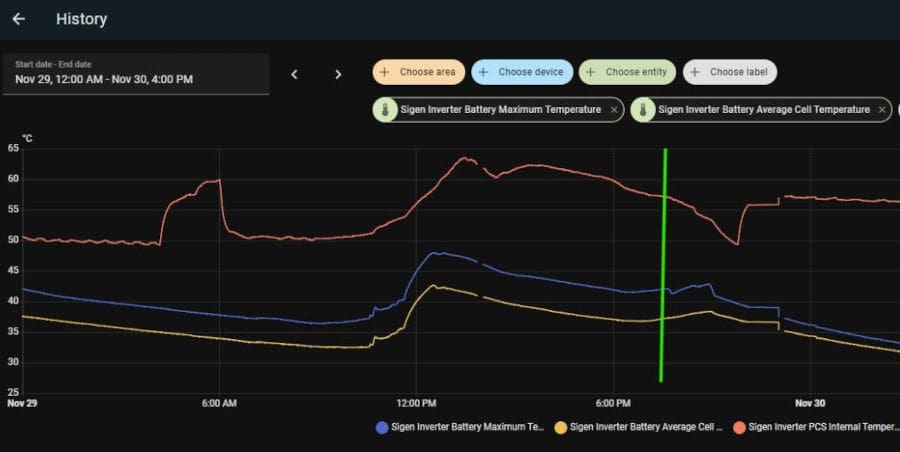
Batteries running at 45ºC and inverters over 60ºC wouldn’t make me comfortable
The Simple Solution
So many batteries installed outside are on the wall, under an eave, beside the fence – it’s almost criminal they’re not better protected.
Many years ago I was a one man band, installing venerable SMA SunnyBoy 5000TL inverters and thanks must go to my old mate Orge for demonstrating the idea shown below.
Electrically the ideal place for the inverter was next to the switchboard, but being on the northern wall was a terrible idea for sun exposure. With display screens that would prove to be sun sensitive, it was a good job we made a shelter for it.
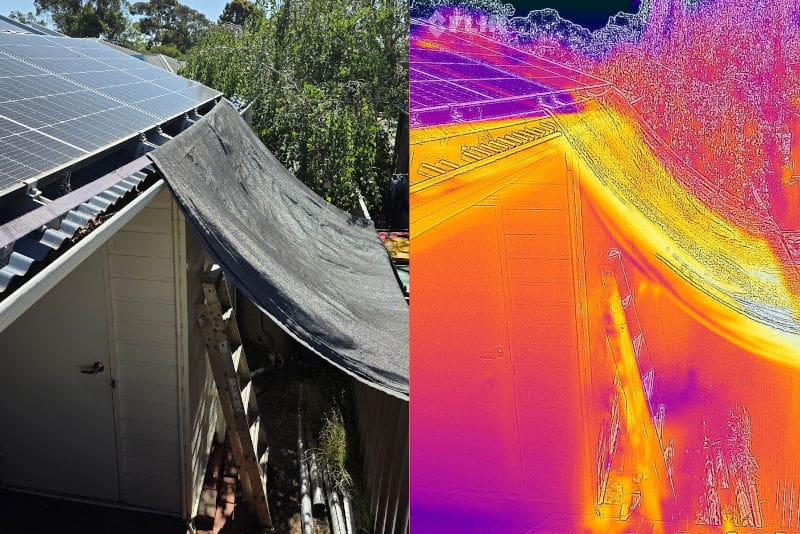
By late afternoon, the sun was coming in sideways and the aluminium ladder was picking up temperature. However the wall was still just as cool as the door under the verandah.
Shadecloth Offers More Than Shade
Keeping the weather off means simply stopping rainstrike makes a difference.
However the main benefit of shade is a 10ºC drop in temperature.
As a one time renter, using 3 large shade sails and some tile mounting brackets for solar arrays, I took this principle to cooling the whole western wall of a shitty, uninsulated brick veneer house, and it worked admirably.
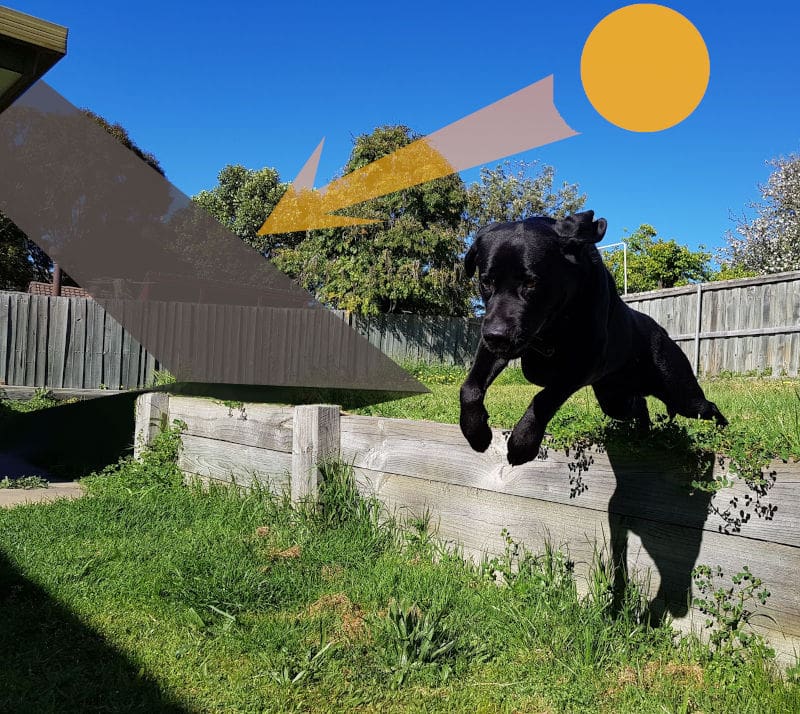
This image was taken in the morning, but by afternoon the sun would bake the western wall. Sadly I’ve lost the actual photo but this explains how the dog ended up walking onto the roof.
Proving A Concept
For this post I have simply strung a ratchet tie down strap between the “L feet” that anchor my solar array to the roof.
It’s a rough replica but for a permanent solution you could ask your solar installer to fit two brackets and a 3 metre length of rail. Perhaps screw anchors to the underside of your eaves, or fix with rivets to a metal fascia.
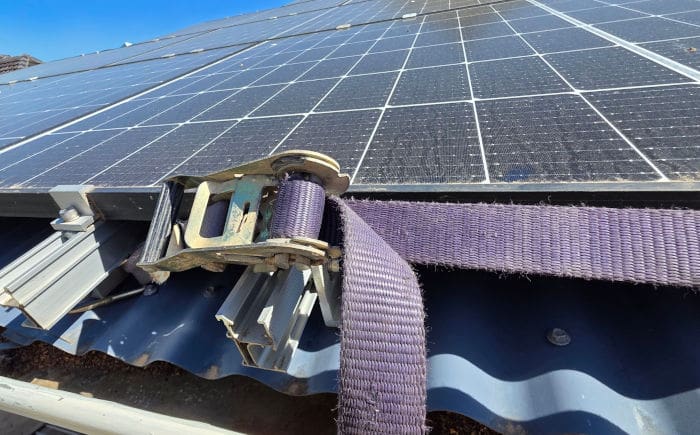
Be careful with ratchet straps, they can rip things apart.
Pull a 3m square shade sale around this strap/rail and then use your choice of rope, trampoline spring, turnbuckle, ratchet strap or shock cord to secure the loose ends, either to the fence or the ground.
Voilà, you have a generous sized weather screen for your expensive equipment which doesn’t impede cooling airflow but offers 10 times broader protection than a cheap awning.
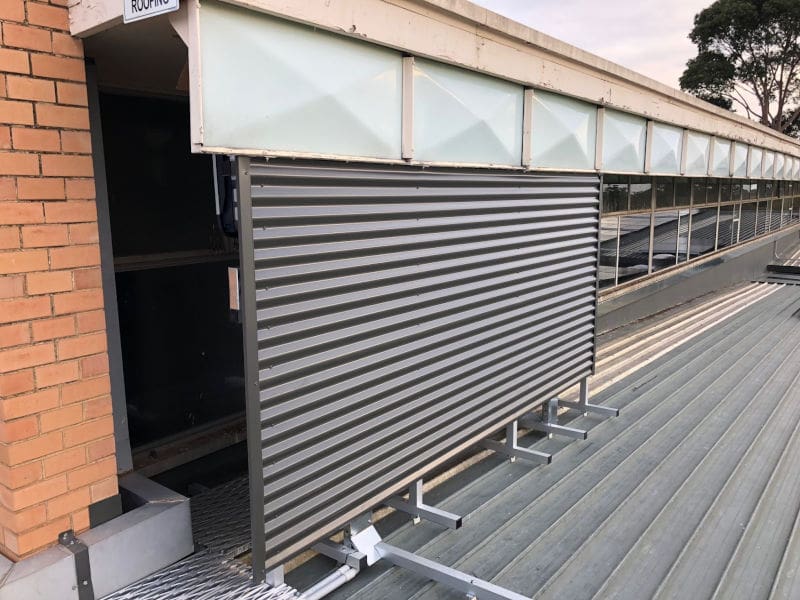
This school building had a nice big eave to hide four inverters. We added horizontal corrugated iron to completely block the northern sun, but shadecloth would suffice.
Tune in for more solutions as we explore this subject further in the coming weeks.
For more on home batteries, read our dedicated explainer page covering the essential details.
 About Anthony Bennett
 RSS - Posts





We lost 2 inverters over 10 years because of heat and direct sunlight. Even with a shade installed over the area after the first one died. The area where the meter is located is an oven. Concrete and brick walls on 3 sides.
The poor things didn’t stand a chance.
Now with all the inverter/battery in the garage, I’ve set up a high tech cooling solution…..A pedestal fan from Kmart! 🤣🤦♂️
did the same myself. mistral fan on a stand $29.00 at bunnings 23/1/2026
I have recently experienced days over 30 degrees C. The solar inverter/battery charger is a 6 kW SOFAR unit that apparently can pass up to 9kW of energy, and with nearly 12 kW of panels can easily maintain maximum solar through-put.
I noticed that the unit was making loud and worrying noises so on investigation I found that the case was so hot you could not put your hand on the case without some pain. The unit is fully shaded from the sun under a carport open on 3 sides and cross ventilated. So my take on the problem suggested the system was woefully under designed with an inverter that was too small for the installed panel capacity.
SOFAR tech support said 70 degrees on the inverter board was OK and not sufficient to trigger a reduction in through-put. This product is not suitable for our climate-full stop!, and pushing the output will result in serious degradation in the warranty lifespan My fix was to use a server fan unit over the vertical vents, with a 17/20 degree drop. OK?
Hi Brian,
Some years back SoFar had a recall for a software safety update and they put yellow temperature warning stickers on them at the same time.
Their current approach to warranty is to offer a full replacement unit if they can’t fix it remotely in under a week, at least that’s not woeful.
However I think you have the best approach. I’ve seen a few people get themselves a plug in timer or thermostat and simply point a desk fan at their inverter, while others grab a small solar panel and run a computer fan.
Yesterday’s heat really tested my cooling fans. I think we only got to 43 degrees, but as the temp stayed extremely high I ran the fans through the night as at 10pm the inverter was still too hot to leave it uncooled. I have another cooling fan set up, but this time with 12 watt fans x 3 doing at least 400 CFM. I hope this is better. Future mods will include 50 degree c n/c thermostat instead of manual intervention. i still recon the SOFAR unit is not fit for purpose, and the spec of 1x 6kw unit that can overload to 9 kW throughput is too much of an ask. 2x 5kW units would have been more logical, but my relationship with the installers is kaput due to being overcharged for the job. i pushed back and now we are at a stalemate. By the way, the software language has gone from English to Spanish, go figure that.
I am about to have a Goodwe 24 kWh battery installed. Options are south facing brick wall near the meter box, or garage on the other side of the house, which would require 20 m of cabling. The installer wants to go with the south facing wall, telling me that the longer wiring loses efficiency. Is this true? Or do they just want the easier installation? Would a south facing wall in Newcastle be ok?
Hi Rachel,
As the GoodWe is a series connected machine you need some very fat cables from the retail meter to the inverter; plus more fat cable back to the meter box to supply the house.
Not only is it expensive, it’s also difficult to work with.
In fact as the distance increases, the sizes can become very impractical. ie with 40 extra metres you might need 35mm² to overcome losses.
At both ends it needs to be broken down to flexible 16mm² just to fit into the terminals, adding twice as many connections to the work.
It certainly can be done if need be, but I’d be more inclined to spend extra money on a really good shade structure instead of extra money on copper.
South side is good, but a dinky little awning isn’t. You want a full length cover if possible.
This is really helpful, thank you. I might look into an aluminium slatted cover for the sides to allow of ventilation and then have a think about the roof.
Just to be clear, it’s a Goodwe ESA. I don’t know what a series connected machine is, but I assume this applies to the ESA?
Hi Rachel,
GoodWe ESA, Sungrow, alphaESS, Solax, SoFar & many other are series connected. The backup circuits run through the inverter.
Make sure you get a bypass switch installed.
Whereas Fronius, FranklinWH & Sigen use a “gateway” arrangement where the inverter is connected in parallel to the mains. The inverter can go almost anywhere on the property, but the gateway must go near the MSB to measure everything and isolate the mains during an outage.
As always seriously interested reading, even for someone like me who doesn’t have a battery (a 3.74kWH system is just too small to justify it).
I don’t know who Viola is, but if you attempted French you should have spelled it Voilà.
Cheers
Hans
Voilà, it has been fixed!
Thanks Hans
Are you talking about 3.74kW of peak solar generation on the roof?
Or 3.74kWhours as enough storage to get you through the night?
Its a last resort to install in a sunny area, financially its probably better not going ahead with the installation if it not going to be shaded. Even with slight sun, Ive suggested to many customers as a temporary fix to install thick shade cloth fastened to the building and weighted for wind. It might work permanently or until something aesthetically pleasing is installed.
This is peakpower of my system.
Hi Hans,
It’s certainly modest compared to the 5 – 6.6kW systems that seem to be today’s starting point.
Do you have any more roof space? Even south facing solar is useful.
Yes, there is more space: west and south, but west is shaded by a battery of council casuarinas. I also think that my SolarEdge inverter limits more panels.
Hi Hans,
I wouldn’t use SolarEdge myself but I wasunder the impression they were pretty tolerant for oversizing? Their biggest marketing claim was always flexibility & shade tolerance.
I’m one week out from install date and I have exactly this issue so I appreciate the information I’ve plotted the sun path over the day and my battery will be baking late afternoons. I think I’ll build an awning with decorative bamboo for my sun protection but please add to this post about any ideas people have. One question… How much space around the units from any structure is sensible to allow for requiring good ventilation and are there any airflow traps to look out for?
Hi Ian,
Manufacturers will specify clearances but for a rule of thumb I wouldn’t go closer than 300mm unless your system is fan forced, in which case you need to assess where the fan is drawing from/to.
If you have sun angling from the west it might be worth making the shade longer or having it return to the wall on the western side?
In the interest of creating a cool garage for solar inverters, batteries and everything else in your garage in general, I have had huge success with using Reflecta GDI garage door insulation ordered from Hammerbarn.
I have an east facing dark coloured double garage door that used to bake my inverter and the rest of the house every morning until I installed it. It claims 97% reduction in radiated heat and after having it for several years I well believe it! It also helps even out the temperature of the house in winter since the garage is built in.
Just thought I’d mention it as it has been a game changer for me and it’s not that expensive either. Install with care and it even looks good!
I have also insulated my west facing garage door with custom cut styrofoam. Install was easy and it has had a great effect on both summer and winter temperatures in the garage, which also helps keep my house cooler/warmer too. It also had the benefit of reducing noise from the road outside and lightening the interior of my garage so I can see better too!
Thanks for the info on the heat plus battery issue. My battery is installed inside the garage but on the north west corner. The north external wall that the battery is attached to gets really hot to touch and to compound the situation, the west side has 2 metal garage doors. West yard is all paved so their is a ton of reflected heat from that too. Can you suggest options as it gets pretty hot in the garage. there is a metal fence on the north side so your shade cloth idea may work there but what do I do about the west side??
Hi Ruth,
Hard to say without seeing it but going from first principles:
Insulate the garage door if possible.
-You can stick foilboard to the inside of a panel lift door, or possibly add an aircell type material to the inside of a roller door, bearing in mind it would need flexible adhesive and a thin material because when the door goes up, the scroll will increase in diameter.
Shade external walls
The dog image in the article explains how shading a brick wall can drop 10ºC off the surface temp.
Shading the doors on the outside with an awning might also be a winner.
Vent the garage
-Scumbag builders often leave garages uninsulated, so throwing a few batts in the ceiling is a winner no matter what.
-A ceiling exhaust fan or passive vent will let hot air out
Thanks lots of options there. Will look at costs
A vertical shade screen, a foot from the sun-cooked north wall, would greatly reduce the sun load. Another foot of separation should further reduce heating by convection. If painted white, or even metallic silver, on the inside, then re-radiation of the shade wall’s heat would be reduced. A light colour on the outside would also help, but glare could then be a problem. Wide eaves ought to be mandatory in Australia?
Ceiling insulation helps too. Garage doors are not easy to insulate, but can pass a lot of heat – a tricky problem.
I put my inverters and batteries in the workshop. Only single glazed, but with wall & ceiling insulation, it’s much cooler than the uninsulated garage. (Mind you, the workshop aircon cures all heating ills – it’s running now.)
The life shortening accrues for each +10°C, so +30°C => 1/8 lifetime.
It’ll be the batteries & big wet electrolytic capacitors in the inverters which go first. New solid state batteries are claimed good to over 100°C, but price?
Some good ideas there thank you. Budget is limited so I have ordered a a retractable shade blind that can attach from wall to fence or wall to path…they are supplying extra hooks. I have the same blind on my west veranda and it does reduce both glare and heat to window and walls. I guess the reality is there is not much we can do about air temperature. I tried the fan trick allowing it to blow parallel to battery and with venting to the east through a 300mm gap under the garage door that side. Once the air temp goes down below 30c I open both west and east garage doors and let that air blow through. My battery rated for 50c its the other equipment that concerns me most of all
My Sungrow battery is installed outside on the eastern wall. The rear of the block faces north. Would a louvred cover such as those used for aircon units that are usually three sided and sit over the unit be OK for a solar battery. You can get them at Bunnings and they are usually made out of aluminium or timber. Just a bit concerned about air flow.
I am wondering the same thing? have been looking at these prefabricated after market solutions but all of them seem to sit too close to the unit, the slats are too big and let light in and non have a built in solarfans or temperature gauges to ensure air flows in and out to cool it down. And its difficult to know how much room between the unit and the cover is required to keep the warranty in check!?
Our foxess is on a western wall. Its got a neighbouring house and fence to limit sun to peak midday time. Its shaded most of the day. We installed a shaded awning..we also chose a higher 15kw inverter with fan cooling unlike its 10kw or smaller brother. The battery gets warm…34oC on a 40oC day at the peak between 12-2. But is often 20-25. Or less..
Installer also confirmed its fine. Says unshaded west facing is not clever. He would recommend it inside garage.
Hi Anthony,
Thank you for another helpful article for homeowners with batteries. The temperatures that they can get up to, even away from direct sunlight in a garage, can feel disconcerting. This is especially true for new battery owners. With an inverter running in the high forties and the same for the top battery in the stack, I worry that the energy storage system seems not only inefficient but also a tad dangerous. Nevertheless, I am assured by the installer that these temperatures are “normal”.
I would be keen to extend the life of the system well beyond the ten year warranty and look forward to your next article on batteries. I have heard of home owners using pedestal fans to cool their battery, whilst others have put ceiling mounted exhaust fans in their garage to disipate the build up of heat.
Thank you again for your expertise and willingness to share.
Kind regards
Andrew McDonald
On both the solar panel inverter and the battery inverter i have fitted simple fans connected to small solar panels so work when the sun is up
Timely article! I have been seeking quotes for a new solar and battery system on a very large two-storey home with 6 adults. I am very concerned about the impact of heat on the battery as the meter box is on the northwestern facing wall that gets full afternoon sun and extremely hot in summer. I cannot realistically add a shade or awning like you have suggested because it’s right beside a parking spot and the side passage access as well. When a solar company came to scope the battery location, he identified just two spots to install the large battery but deemed them ‘habitable rooms’. The house is on a fairly steep slope with a small, detached garage about 20 meters away from the meter box on the other side of the house. The not much room left inside to fit a battery and routing power cables from the meter box to the garage would be a challenging / costly. How would you propose I deal with the heat issue? Maybe Enphase Mirco Inverters so I can just position the battery further away?
10kW panels & 10kW battery owner here, wooden house no garage, 2 x 5kW battery modules + 1 x solar & battery controller mounted to south side of house in permanent shade. Note that these are mounted onto FIRE RATED PANEL admittedly only for an hour or so and would burn the house down via over hanging eves & adjacent wooden fence anyway (but who cares wtf isn’t that what insurance is 4) Yes it a microinverter system where heat is distrubuted across the panels as well as batteries and controllers. Pick your poison I guess.
Must question wisdom of installing battery in garage (dodgy?) but each to their own. Probably makes sense if you have a shiny tessellated testosterated you know lectric car either is gunna burn well, (long and hard 🙂 Saw a good BYD system + that car, seemed ok and did have fire rated panel garage.
Anyway just wish to emphasize FIRE RATED PANELS (is brick work good enough? don’t think so necessarily) these article tend to skip over some of these important details…
Don’t Let Your Installer Cook Your Battery: A Lesson in Compliance
A recent SolarQuotes article highlighted how “heat kills batteries,” suggesting DIY shade sails to stop units from “living hot and dying young.” DIY fixes are great for existing systems, new owners shouldn’t have to rig up ratchet straps to protect a $15k investment.
I recently challenged a quote for an SAJ H2/B2 system proposed for a sunny wall. The installer refused a shroud, but the SAJ Limited Warranty (Section 2) is clear: the product “shall not be exposed to direct sunlight.”
I pushed back citing AS/NZS 5139:2019, which requires following manufacturer specs. Under Australian Consumer Law, a system must be “fit for purpose” if an install voids its own 10-year warranty on day one, it’s legally non-compliant.
Don’t just accept “it’s fine in the sun” or rely on a pedestal fan. If the manual says “no sun” the installer is obligated to provide protection. Demand a shroud or a warranty indemnity before you sign.
I have just installed a Sigenergy 20kw/40kwh battery which is about 1.8m tall and the afternoon sun from 4 to 8pm hits it directly on the south-west wall.
So… I have currently installed a low hanging awning to cover from the rain and sun (although i cant be confident the translucent corflute sheeting is uv resistant?). However it is now clear that I have to build a full “blockout” screen to side on the west and south side of the battery. After this, i am thinking i may need to install some type of solar-powered extraction fan to help move air around and out of the enclosure!?
Any ideas you come up with, or after market solutions you find, would be great to see!?
Hi Keith,
We have some ideas coming 😉