
The Australian Competition and Consumer Commission (ACCC) has again warned that millions of Australian households aren’t on the cheapest electricity plan; many effectively being slugged with a “loyalty penalty” by their current retailer. And the financial hit is significant.
What’s The Impact Of Electricity Loyalty Penalties?
A couple of days before Xmas, the ACCC urged households to change electricity plans to help offset the loss of Energy Bill Relief Fund rebates, an initiative that ceased at the end of last year. But regularly comparing electricity plans wouldn’t be on many Australians’ top 10 lists of things to do; particularly at that time of the year.
The call came after the ACCC’s latest Electricity Market Inquiry report revealed households on the same electricity plan for more than three years were paying on average $221 more annually than customers on new plans.
“Loyalty penalties are alive and well in the retail electricity market, so the very best thing people can do to save money is to switch plans – either moving to a cheaper plan offered by their existing retailer or changing retailers,” said ACCC Commissioner Anna Brakey. “Many households could effectively replicate the value of the recently ended government rebates by changing plans.”
The report indicates close to 2.5 million customers are paying prices at or above the default offer1; with more than 400,000 paying more than 10 per cent over the default offer.
‘Better Bills’ Reforms Help Alert Consumers
While the number of Australian households paying too much for electricity remains very high, earlier ‘Better Bills’ reforms have had some positive impact on consumers. Although not perfect, these reforms required energy retailers to make bills clearer, simpler, and include prominent “better offer” messages.
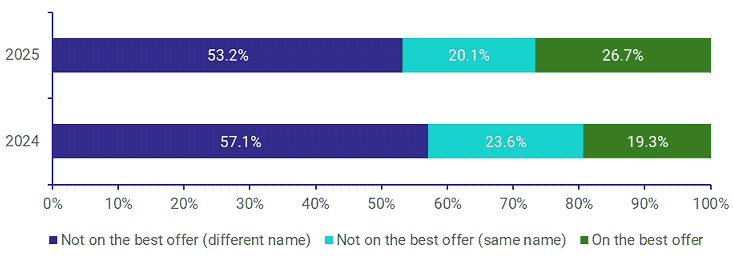
Approximately 27 per cent of residential customers were on their retailer’s best plan at some point in 2024–25; up from 19 per cent between January and August 2024. There was also an increased proportion of customers on plans less than a year old, jumping from 29 per cent in August 2024 to 42 per cent in August 2025.
The following graph shows the proportion of customers receiving different types of ‘Better/ Best Offer’ messaging, all regions combined; for the periods 1 January 2024 to 13 August 2024, and 1 July 2024 to 30 June 2025.
The ACCC previously flagged the electricity retailer loyalty penalty issue in late 2024.
Further Electricity Bill Reforms In The Works
As mentioned, the Better Bills reforms weren’t perfect. For example, the requirement for more prominent “better offer” messages saw some retailers create plans with the same names, but different (and lower) pricing for new customers. The practice is the subject of a ‘super-complaint’ lodged by consumer group CHOICE that will get some serious attention.
There are also some new rules from the Australian Energy Market Commission (AEMC) coming into play from July 1 this year; designed to:
- Protect customers from paying higher prices for their loyalty by ensuring they don’t pay any more than the standing/default offer price if their energy plan’s benefits change or expire.
- Remove unreasonably high penalties for not paying bills on time.
- Restrict retailers from jacking up prices more than once every 12 months for market retail contracts.
- Prohibit retail fees for vulnerable consumers and limit fees and charges to reasonable costs for all other customers.
A later final determination concerning improving the ability to switch to a better offer will come into effect on 30 December 2026. And the AEMC also intends to undertake a pricing review that includes examining broader reforms to help consumers engage more effectively in the retail electricity market.
Something else related in the pipeline is a reformed default market offer (DMO) pricing mechanism, designed to get the ‘best deal’ for consumers while still acting as the maximum price retailers can charge for standing offers in DMO regions2. The changes will be made as the current situation is not working out as intended according to Federal Minister for Climate Change and Energy Chris Bowen.
Footnotes
- A default offer is a regulated plan acting as a safety net of sorts that is applied when a customer doesn’t choose a market offer for whatever reason. It’s designed to prevent (too much) price gouging by electricity retailers. ↩
- DMO regions are NSW, SA and SE QLD; while Victoria has the Victorian Default Offer – VDO. Victoria last year saw significantly smaller bill increases compared to DMO regions. ↩
 About Michael Bloch
 RSS - Posts





So why are they worried about it in the electricity industry?
They have done sod all about it in the insurance industry where it has been a plague on customers for donkey’s years.
Just standard blood sucking corporate practice really.
I used the service of Electricity monster again to find a better plan for me a couple of months ago.
I was with Origin go variable. They offered me a plan called Origin affinity variable which was a bit better plus they gave me $100 credit and a $50 gift card.
This plan is not on offered on Origin’s website or app.
Unfortunately, Electricity monster don’t operate anymore.
Oh really. Last time I used them was Nov 2025.
It is actually very easy to switch electricity providers and there are almost always promo deals going on. Whenever I suggest this to friends complaining about “cost of living” they don’t want to listen. It’s like they like paying loyalty tax.
I had been with ORIGIN for many years and have kept an eye on readings from my smart meter from a solar system sold to me by ORIGIN. I reviewed my plan every year and managed to switch to cheaper plans as a result.
I have had several over the phone arguments with ORIGIN on different topics mostly about the Solar system they installed or their ever decreasing Input tariffs.
However when ORIGIN informed me recently that my current plan was going to be cut and a new much dearer plan replacing it. I thought enough is enough and switched to RED which worked out about $300 a year cheaper.
As soon as RED switched over I started getting calls from ORIGIN offering me cheaper plans that one cannot access online.
So my advice is “TELL YOUR PROVIDER YOU ARE GOING TO SWITCH AND SEE WHAT CHEAPER( unadvertised) deals they come up with.
Telling them you are going to shift is not enough. You actually have to shift like you did.
First mistake. Dealing with them to get solar. Second mistake. Get battery. Eliminate your electricity costs and play their game. Be a wholesale customer with a battery. Act before the rebate is slashed
I bailed OUT and away from the energy pirates. The solar + battery is the way. Now zero cost. After three days i do need to buy power. 5c a kw. Not 40c + I will just top up a little. Then i bailed on my gas after seeking comparison and none were really competitive. Its a cartel. But i switched. No soon i do that they call and offer a deal not advertised. Basically 50% off. And half cost supply charges. Plus…..a credit equal to a whole quarter.
Switching itself may not save you but they have ‘retention teams’ who will biy you back. So switch. And wait for the call of your number is on their files.
Yeah nah, if they don’t offer me / advertise their best deal without me having to beg or change suppliers, I am gone to whoever advertises the better deal.
But when it really comes right down to it, I dont really care what their electricity costs, i wont be buying any, it is about chasing the minimum daily service fee for me.
Another problem is that in a place like Canberra where we use significant
extra power overnight for heating in winter but bugger all (day or night) in summer because, at our place at least, we get by pretty well without aircon, even the provider’s own plans they recommend for us can change throughout the year – so, if they want to be really helpful (ha!) maybe local providers should offer region specific default plans that incorporate those swings, rather than have mug customers like us who are yet to get a battery (we had been thinking Sigenergy, but…) changing their plans two or three times a year.