
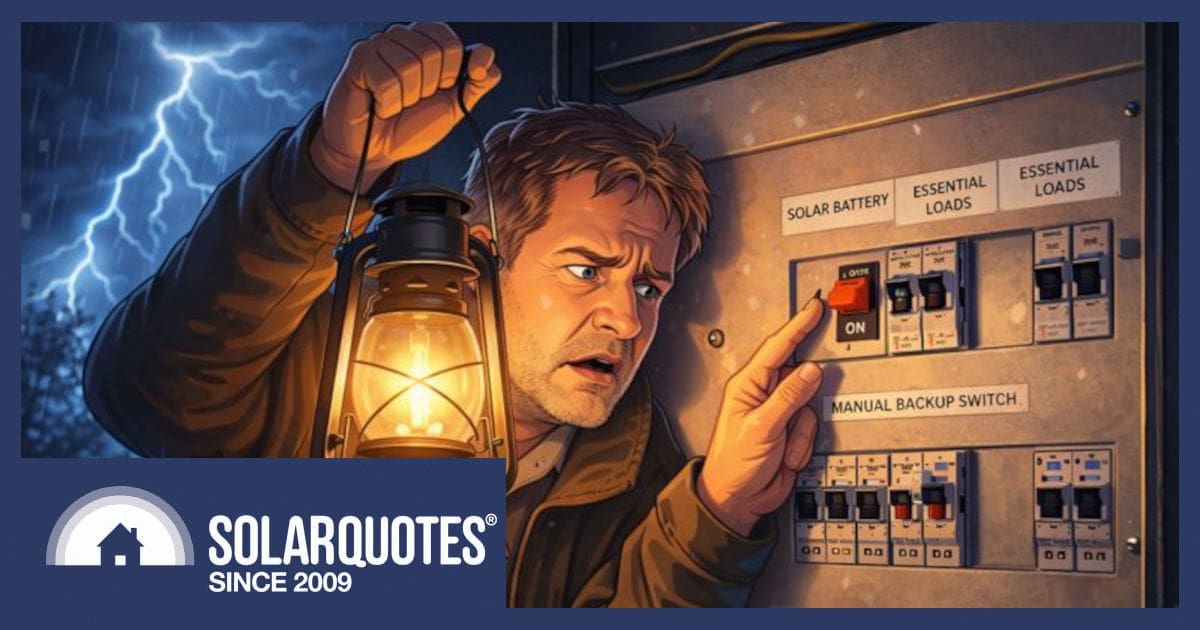
Imagine buying a home battery that offers automatic blackout protection, only to discover that when the lights go out, the installer set it up to require manual operation? It’s a trend that’s plunged far too many households into the dark across Australia. Here’s what to watch out for.
Is Your Home Battery Set Up To Provide Automatic Blackout Protection?
Why on earth would an installer set up a hybrid solar battery system, one that offers automatic blackout protection, then set it up with a switch that requires manual operation in the event of an outage?
I suspect the answer is they’re trying to avoid a few awkward conversations, namely:
- selecting a limited number of circuits for blackout protection
- extra cost to isolate or re-run the wiring for the fridge
- expensive switchboard rebuilds
That’s not the only way installers are leaving customers in the dark – why are battery owners posting on socials, or contacting SolarQuotes looking for clarity on how their system should actually work?
The company selling the system or the electrician installing it should be the ones explaining and demonstrating exactly how the system they’ve set up should work.
Unless there’s a technical reason, battery backup should happen automatically, without you having to intervene.
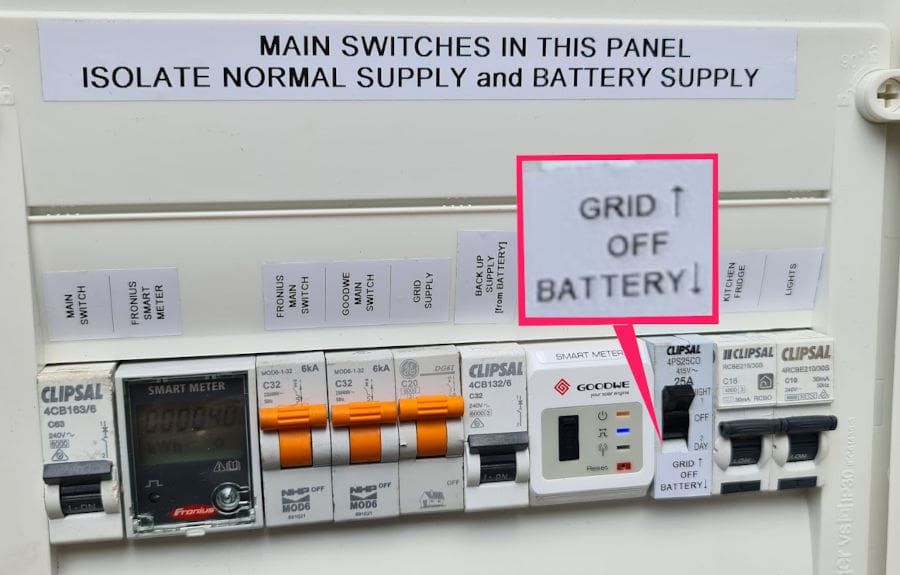
This highlighted two way switch controls backup for just two circuits. Though this switchboard has carefully printed stickers it lacks the engraved plastic labels, with specific wording used under today’s standards.
Shonks Will Be Shonks
There are solar retailers out there who’d rather you don’t have blackout protection. Seriously.
They’ve found problems arise when adding complexity to solar power systems. And paying peanuts to the worst subcontractors means things won’t work, the phone will ring and irate customers won’t want to pay.
I guess the cheap equipment they push either needs extra hardware to work (i.e., a long, expensive cable run or a backup box that has to be supplied and wired up correctly) or it’s unlikely to have sufficient surge capacity to cope with backup in any case.
As SolarQuotes founder Finn Peacock noted recently in his piece on battery backup myths, any retailer that recommends point-blank not getting protection is best avoided.
Bypass Switches Are Essential
Many solar battery inverters are what we call series-connected machines – that is, the backup circuits are wired through the inverter.
So whether it’s the whole house or just the modest but essential fridge, lights and internet, the inverter must carry the whole load. And if the inverter fails, so does whatever you have connected through the inverter.
So it’s absolutely essential that when you have a series-connected system, there must be a switch to bypass a broken inverter and reconnect mains power to your essential circuits. The ability to restore power yourself at the flick of a switch is the most basic customer service a solar power company can offer.
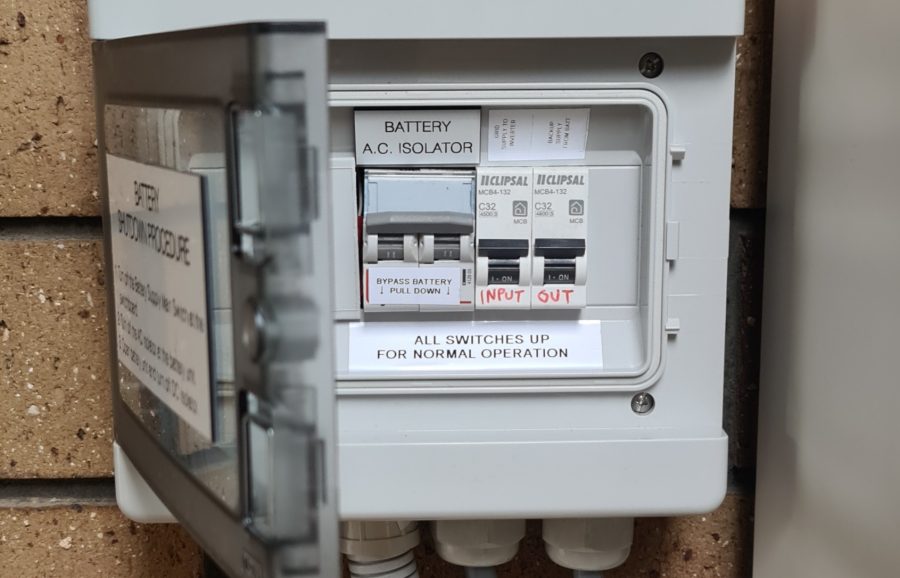
Here we have circuit breakers for the input and output of a hybrid inverter, but more importantly the bypass which puts your essential circuits back onto mains power if the inverter fails.
Bypass Switches Can Be Automated
We’ve written specifically about how a modest battery system shouldn’t be routinely overloaded by expecting it to run a whole house. Lightweight hybrid inverters, a run-of-the-mill 5kW inverter, for instance, won’t carry more than about 27 amps, so you can’t feed a 63 amp house load through them, no matter what.1
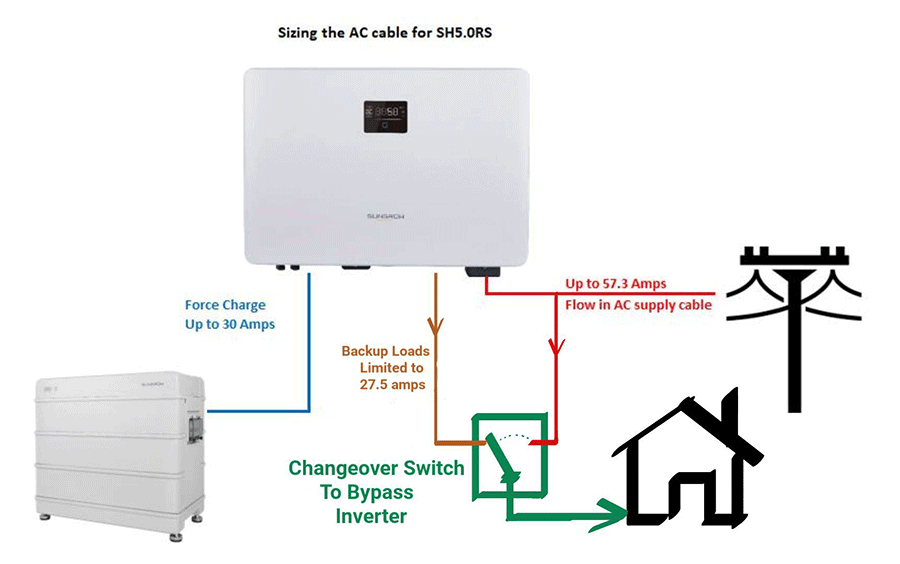
Series connected inverters will throttle whatever is connected to the backup port whether mains power is available or not.
Say there’s some extenuating circumstance – the mains connection and solar is on the shed with the house on a downstream distribution board, for instance. In that case your modest inverter can still be connected for “whole home” backup.
Using a contactor to power the house under normal conditions means that if there’s an outage, your backup power will still kick in.
Assuming nobody is home, the freezer will stay frozen, but of course, if the system is overloaded, you’ll still have no power.
Speed Isn’t Everything
Some brands of inverter don’t deliver what you’d call seamless supply. When the grid goes down, they may take up to 15 seconds to re-energise the house, and this is what I’d call a big, unmissable analogue warning for you to pull your head in and reduce consumption.
Some claim response times so fast you’ll never notice a blackout, which can be a bit of a trap if the air conditioning is going to chew through your battery.
Be Aware That Solar Hybrids Are NOT Uninterruptible
Any solar hybrid inverter can drop out and take a minute to restart, especially if the battery is well charged and the sun is shining when the grid fails.
Though fast response times often appear in the marketing material, they are not technically rated for uninterruptible supply, so if you have a mission-critical computer, then an uninterruptible power supply (UPS) will still be needed.
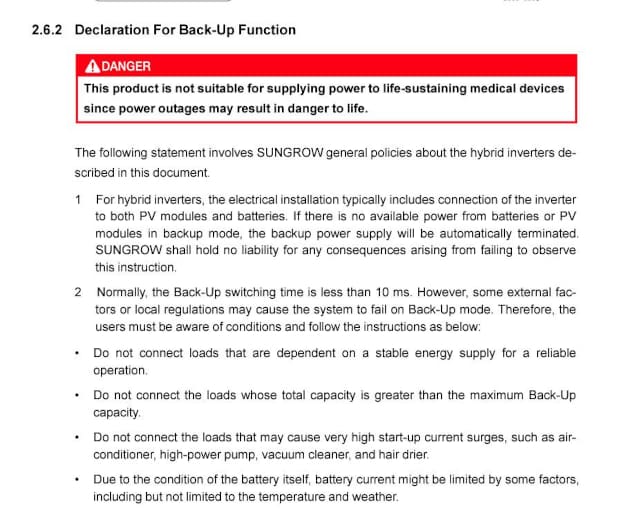
Sungrow are big enough to admit Emergency Power Supply doesn’t meet the stringent rules of a proper uninterruptible power supply – EPS is not UPS.
Perhaps Electricians Are Setting Expectations; Manually
When a system underdelivers, the phone will invariably ring, so perhaps installers are being pre-emptive when they make switchboard connections.
It doesn’t apply so much with the rise of inverters rated for “whole home” backup, but some customers are confused when a 10kW single phase machine is really gutsy compared to a 10kW 3 phase unit which only delivers a third of the capacity per phase.
As the bloke doing the wiring on the day, I’ve had to negotiate with and, in some instances, disappoint customers who thought they’d bought something far more capable. It can be embarrassing for the salesperson who glossed over, or the end user who simply didn’t want to hear, but when a 3kW rated toy won’t cope with much more than the fridge and lights, there’s often some sadness.
Simplifying Things For Installers Not Customers
By fitting the bypass switch as “normally off”, the whole house can be connected to it.
When there’s an outage, you have to go to the switchboard and turn on the backup supply manually, at which point you’re acutely aware of the blackout conditions and the need to reduce your consumption.
So the installing electrician can avoid any conflicts or embarrassment, and indeed just save time by identifying or dividing circuits to cope with a limited inverter capacity.
I’ve had to pull a new cable or chase wiring down walls to separate the fridge from the rest of the house, so I can see the appeal of just whacking in a switch in and telling the customer to “be careful”.
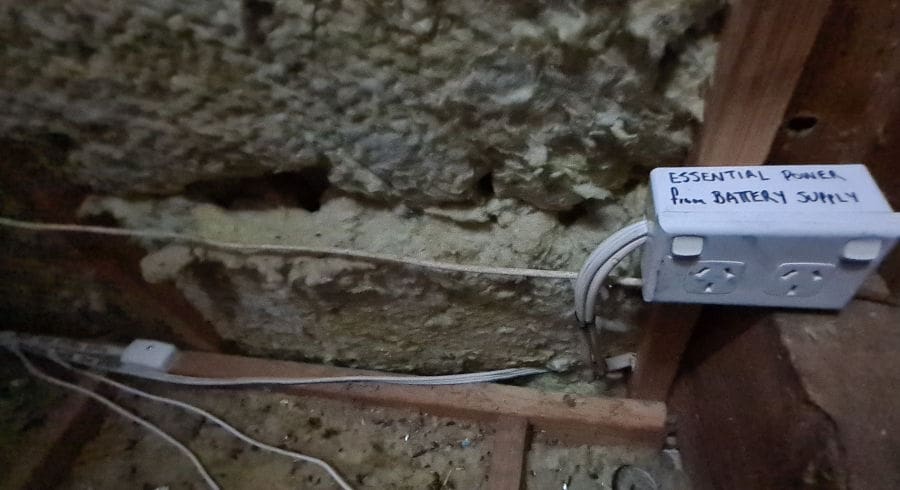
This power point was installed in the ceiling space to connect an internet router but thankfully the cable down the wall to the fridge was also easy to find here.
However, manual backup is fraught with danger because the average punter doesn’t have a good understanding of electrical load. If they don’t appreciate the system, it will struggle to start the rainwater pump, or won’t cope with the kettle and starting the fridge, the lights will flicker, and power might fail.
And of cours,e if you’re on holiday, the freezer is still going to thaw out. Again, this just produces sadness and irate phone calls.
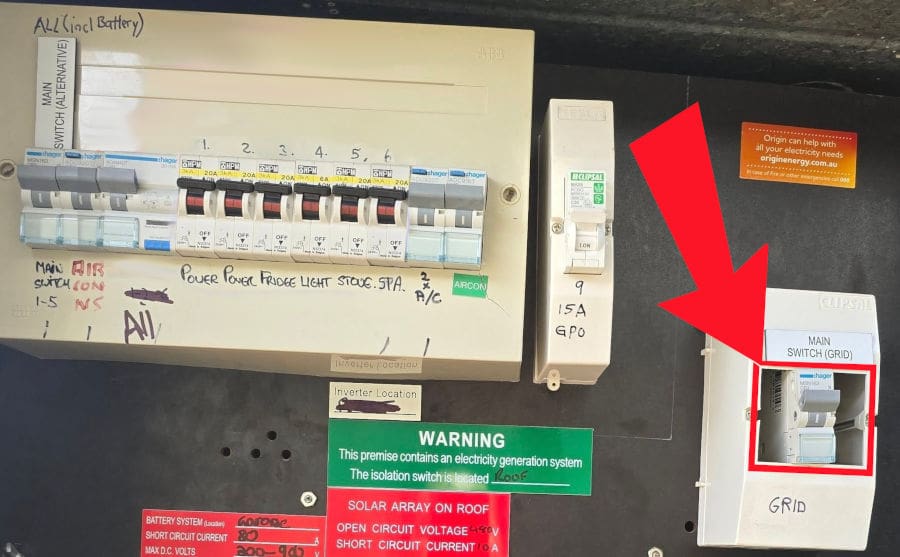
Proper engraved labels for main switches, but still a poor result. A bypass switch could easily go into this enclosure, but the gaping hole they’ve left is illegal.
Knowing The Ground Rules Is Key
These days, anything is possible if you throw enough money at it. I put a 5kW Selectronic SpPro on my place because it’s an exceptional system with 12kW surge capacity that knocks everything else into a cocked hat. Of course, it’s a bit pricey when you want Australian-made, though.
My advice is always make sure you understand what is feasible, or what your budget is going to buy. Make sure the salespeople are aware of your priorities. Obviously, a battery should help reduce your bills and reduce load on the network.
- Do you want to treat the grid with contempt?
- Does the house rely on a pump for rainwater or septic?
- Is backup super important to keep the air conditioning or heating going for a medical reason?
- Is it important to have black start capability to keep things going if there’s an outage that extends for days?
- Or is it just nice to have the fridge, telly and internet for a few hours?
Document what you want and what the system is supposed to deliver, so everyone is on the same page.
Not every battery system needs a bypass switch, but if it does, it should be used only if the inverter breaks down. Like buying a dog and doing your own barking, if you have to switch on your backup supply yourself, you’ve been sold a pup.
Read more about blackout protection for your home on our solar battery explainer page.
Footnotes
- Of course this advice for a modest 5 or 6kW single phase inverter doesn’t apply to a larger machine rated for 8 or 10kW and 63amp pass though. ↩
 About Anthony Bennett
 RSS - Posts





I am fortunate to have whole of house backup on my 3 phase system, however it was a long load.
The first quote was to have “essential” loads only, but we disagreed as to what they were.
They suggested fridge, TV and internet, but for me Fridge, HWS and cooking were the most important, due to our lifestyle.
HWS is a resistive unit and will last 3 days but on the 3rd day it’s essential.
From the initial quote, I deduced they were only interested in a sale, not my actual requirements.
I ended up going with another supplier and it came in about $1000 cheaper and it works.
One thing people need to do is test the system before they make the final payment. If the supplier wants the final payment on the completion of the job, find a different supplier. Perhaps a few days is all you need, but test it.
I guess many people mistakenly think the battery will last forever, so suppliers don’t want the grief if the customer runs A/C, HWS, Stove and the battery goes flat.
What I’ve found is that the solar panel and battery industry has followed the same path as the old in-roof insulation rebate scheme. Every Tom, Dick and Harry jumped in, and in some cases the results have been disastrous.
We have Finn to thank for putting together his website, which has saved people not just money, but possibly even lives.
We were lucky — we chose the same battery system Finn uses, and he even made a video showing the installation and how the backup works. If I hadn’t seen that video, I would never have known that our backup system hadn’t been wired up at all, because the installer didn’t know how to do it, or even how to connect it to the Wi-Fi.
When a properly trained technician finally came in and finished the job, I could, like Finn, confidently recommend Sungrow. The changeover is so fast that even the computers stay on.
Bob Moore Australind.
I have had solar for nearly 15 yrs. My first solar Panels of 2 kw died and had it replaced from info provided by Finn.
The solar panels installed and the smallest I could get 3.6kw.
Installation took place and waited until Synergy came good with rebates.
Rebates “Not on by Synergy” Reason because I had “upgraded”. Upgraded you ask 3.6kw is the smallest solar panels for a normal use of 2 people (Retired). Synergy has a problem with not keeping up with what is available, 2kw may be available for a one person use however are not made anymore.
STRIKE 1 I am out.
Questioned the same Synergy Customer Service Office with the hours of evening rebate from 3pm to 9pm. I pointed out the sun set at 6.45pm on that particular day. now back to 3pm to 6.45pm only hours 3.45 hrs for sun power and not the 6hrs as shown by Synergy.
I questioned this and was advise by the same Customer Service Officer with a comment “YOU HAVE THE BENEFIT OF SAYLGHT SAVING WICH WILL GIVE AN EXTRA HR.
But there’s a trade-off – with that extra hour comes accelerated drapes fade. Priceless. You couldn’t make this stuff up.
Hi Neil,
Everyone gets this wrong but I’m sure it’s the curtains that get confused and the cows are faded.
The article conspicuously omits the required current rating for an A/C bypass switch.
For example, our Goodwe GW5000-EH inverter has, on the datasheet (and, I believe, in the specifications on the inverter unit),
“Max. AC Current From Utility Grid (A) … 43.4”
The initial A/C bypass switch installed, was rated at 25A. They had intended to install a 20A sw3itch, but, relented and installed a 25A switch. After the initial inverter had to be replaced under warranty, the A/C bypass switch was upgraded to 40A, to try to avoid replacing the inverter. I believe that, with the “Max. AC Current From Utility Grid (A) … 43.4”
the A/C bypass switch should have been rated at 63A, to match the mains circuit breaker and the grid connection fuse.
The current rating of the cabling installed between the inverter and the switchboard; between the inverter and the A/C bypass switch, or between the A/C bypass switch and each of the switchboard and the grid fuse is not known.
It is not regulated.
I have the bypass switch you described and a budget 6kw inverter/battery. After installation it was set to battery. It functioned perfectly for a month but then I had a blackout on my essential circuits only – I had overloaded the battery’s power capacity. Now I leave the bypass switch set to “grid” which means I will have to manually change it to “battery” in the case of a blackout (rare). When I go away on holiday I switch it to “battery” so that the internet and fridge are protected from power outages. There is no chance of overloading the essential circuits when no one’s home. Rather than having been “sold a pup” I got a very affordable battery that has cut my bills and gives me basic backup protection, all it needs is a basic level of understanding.
Here here! I couldn’t agree more. This is the most sensible way to use a changeover / bypass / manual transfer switch (whatever you want to call it) Anthony’s opinions notwithstanding. Sorry Anthony, love your work, but this time you’re barking up the wrong tree
IMO you’ve got a poorly designed system that, with a tiny bit of thought, could work automatically, meaning one less thing for you to worry about.
There is thought, and there’s also experience. From experience, it’s best to know when you’re running on the battery. If automation is so important to you, leave the switch in the battery position!
In my day, we used to have to go to the meter box and replace the worn and rusty wire fuse in the dark. Flicking a switch is a trivial luxury when you can select battery supply and quickly get back to Netflix.
If the inverter trips, go to grid
If the grid fails, go to battery
The grid is bigger, so in my humble opinion should be the default position
“Though fast response times often appear in the marketing material, they are not technically rated for uninterruptible supply, so if you have a mission-critical computer, then an uninterruptible power supply (UPS) will still be needed.”
On the Goodwe GW5000-EH datasheet, is
“UPS level automatic switch in <10ms"
On the Goodwe EHB series datasheet, is
"<10ms UPS-level switching"
On the Goodwe single phase ESA series datasheet, is
"Seamless switching to backup <4ms"
When the backup switching works, it is good.
With the current Goodwe GW5000-EH (the ESA systems are still not yet available to the public, in WA) he last couple of times that the backup was used, whilst the computers were okay, the lights through the house were strobing for a few minutes, each time. The strobing of the lights, occurred only when the system backup was invoked.
I was annoyed I couldn’t get full house backup and was told the Fox ESS inverter had a max of 50a/around three circuits (10kw single phase). While it’s now setup for automatic cutover I wasn’t aware that an inverter reboot would cut power temporarily to the backed up circuits.
We have a Sungrow 3 phase and it backs up the essential circuits. Back up is so fast we often don’t notice it.
A power surge knocks out the back up circuits for a few minutes, the system resets and all is good.
Right now my grid power is off but I have a separate off grid system with separate outlets and a separate switchboard. My 5kw inverter and 25kwhr back up battery handles water pump.aircon.and two fridges and two freezers. Very rarely will all of these devices will be at max load simultaneously.
I will be without grid power for the next two hours but I hardly notice it. Personally I only use the grid as backup.They now give bigger all for feed in tariff. I have 6kw of solar panels
Following the install of my Bluetti EP760 with 19.8kWh storage, I found out that it voids the warranty if left in Automatic Backup mode and I was recommended by the Electrical installer and the tech guy from Bluetti to leave it in Grid mode, which I subsequently have.
The EP760 has a 7.6 kW continuous rated inverter which I have only ever seen us exceed once when my Wife went nuts with Reverse Cycle AC, Kettle and Oven all started at the same time, even then it only hit 8.2 kW before drawing some power from the grid.
Not that we get many outages in my area, still actually waiting for one to happen in the four months that it has been installed, but I am a little frustrated that it can’t simply be left in Automatic mode.
One of the comments earlier was an eye opener for me, in that by simply putting it in Automatic mode if your going away for any period makes 100% sense! I’ll be doing that in the future if the situation ever arises.
99% of my power comes from my own panels, love it!
I’m still waiting (2 months) for my installer to fix the fact that I’m still being charged for quite a lot of usage from my retailer despite strong solar and 60 to 100% SoC for the battery the whole day.
They’ve likely cross wired the CTs so they aren’t balancing to load correctly but the installer has kicked the can to Sigenergy support and they are a clown show.
Initially they said it was normal operation and that my retailer is not netting across all phases (they seem unaware that hall Australian retailers net across phases) and switched it to “per phase” mode which of course made it worse.
After a week of my telemetry (and my biller’s charges) showing that it’s still imbalanced I asked could they switch it back to total power mode.
About 12 hours later I get another message from the geniuses saying that they agree it is imbalanced and are switching it to “per phase mode” to see if it is still happening. And of course it is still happening
Back to square 1.
Hi Harry,
Sigenergy have a setting to change.
Unlike every other inverter on the market which recognises Australian retail metering will run a net balance, your installer must tick a box during commissioning to make it play nicely (as I understand it presently)
Harry,
Sigenergy installs use 1 CT in most cases for standard install, that if you have a gateway is prewired to the grid input. Vey hard to stuff that up.
Load is calculated between that and inverter internal CT.
One thing to know is Sigenegy sankey graph has reported ongoing accuracy issues with net metering – rely on your retailer data.
Option 1 – You have a HWS or other device on controlled load tariff. – Sigenergy will not see the load.
Option 2 – You only have a small inverter and are regularly exceeding phase limit and what it can cover with exports on other phases.
Option 3 – Something still wired in front of the gateway thus not seen by the Sigenergy as a load. EV chargers seem to be a common reason, I don’t know why.
If you want further help, as this is getting a little off topic there is a number of helpful people on the Sig app, and various forums that can take a look at your usage values and provide more thoughts.
@anthony
A 3 phase contactor with auto switchover ie would be difficult to achieve without a ATS?
Another rumor I heard is that running the whole house through the a backup circuit would add additional stress on the inverter?
Also the backup circuit is only limited to the inverter limit which in my case is 15kw. 5kw x 3 phase.
Hi Al,
I hope I’ve covered it in this article but let us know if you have any other ideas.
https://www.solarquotes.com.au/blog/backup-whole-house-contactor/
I had my battery installed prior to the current subsidy.
Its incredible the rate of change in terms of batteries and I feel its only really just starting to mature. Something I considered at the time is that if I did not pay for the extra cost of having backup capability then it would be more expensive to retrofit, I also recall when people were looking to do off-grid capability without a battery (obviously only during the day).
I think you have too many different systems available now which is not really in the interest of the consumer. Getting parts and service down the track may be difficult and its also complicated to find actual locations for the batteries that are suitable. It does feel strange that they are so strict about outdoor locations whilst allowing installations on a garage that forms part of the house. A lot of people use their garages as entrances to the home as well and they are adjacent to bedrooms.
My battery was installed with whole home automatic backup and the 5kW inverter could not always handle it even though it could briefly handle 7kW.
So I got the installation electrician back and we came to an agreement that for $600 he would reconfigure the box including needed parts.
I now have lights and one power circuit that includes essentials backed up automatically while I can manually switch on backup for the other power circuits if I am sure that the load at the time will be manageable.
Reading Andrew’s comment below, that the backup capability is limited by the inverter capacity piqued my interest.
At the time of the install I had a bit of a disagreement with the installer and the Bluetti people that were here about how I wanted the system to work.
The installer sprang a sub-board upgrade on me, which whilst I agree was warranted, probably should have been evident when he inspected to qoute the job.
Wanting done, I paid the extra $1,000 AUD in cash to get my sub-board upgraded, (on a Saturday and Sunday). When it came time to commission the system, there was a minor setback, however Bluetti did step up here and ‘re-string’ my 6.6 kW solar array to work with their system for no additional cost.
But going back to Andrew’s comment, I am now concerned whether I pushed Bluetti too hard to give me what I wanted and what their marketing materials lead me to believe their system was capable of delivering?
More details to follow if anyone comments and is interested?
Hi Brett,
Keep the details coming, we’re all ears.
If Bluetti say you can’t get the inverter to offer automatic backup then I’d be livid personally.