
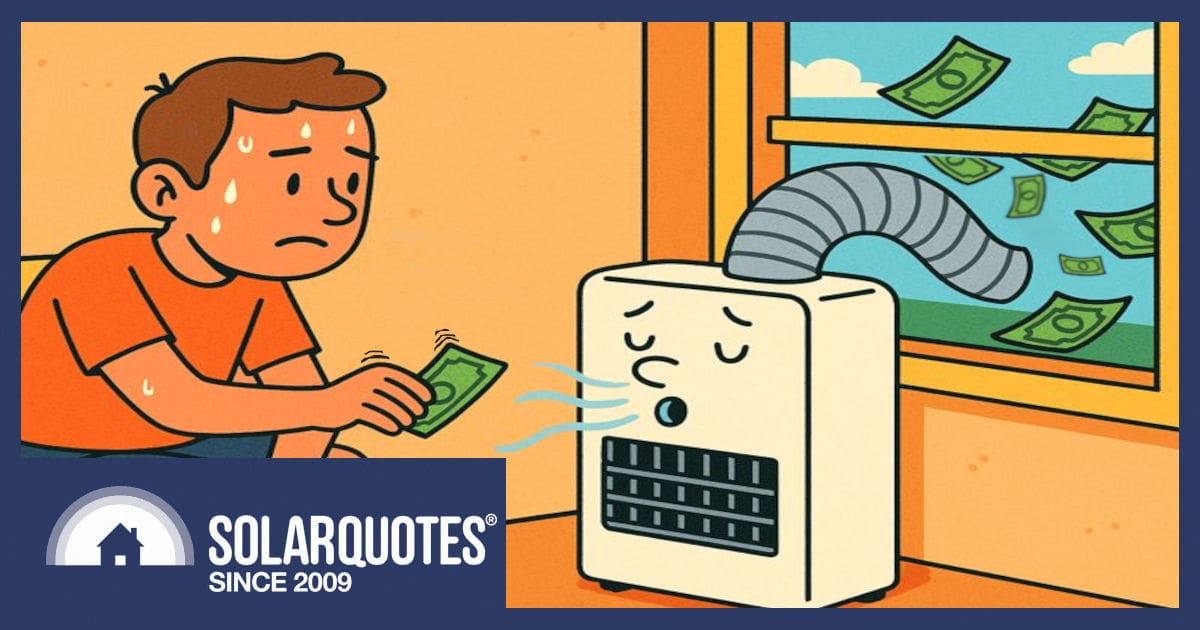
Are you thinking of a portable air conditioner? Don’t. Step back. Put your wallet away.
I can’t think of a better way to waste time, money and energy than buying a portable air conditioner – although there are a couple of exceptions that have their place.
Whether you call it a reverse cycle air conditioning or heat pump, refrigerative air conditioners share common traits, namely they need a decent supply of air to extract or reject heat.
If you’ve ever walked past a window rattler or the outdoor compressor unit of a split system, you’ll notice two things. Firstly they have a big fan which creates quite a breeze. Secondly, they’re usually noisy.
While we often point out that reverse cycle systems are the most efficient way to heat and cool your house with electricity, there are always exceptions.
So Why Are Portable Air Conditioners A Bad Idea?
We recently covered the spate of social media ads promoting tiny scam “air cooling” devices only available online, but even the devices they imitate – full sized portable air conditioners sold in store by major Australian retail chains – are suspect.
Put simply, they’re expensive, inefficient, ineffective, noisy, and actively force your house to leak energy.
They won’t make you comfortable unless you sit right in front of the vent, where you have to listen to the machinery.
The main problem with portable air conditioners is this :
They take the air you’ve just paid money to condition;
and then blow it straight out the window.
Really the only good purpose they serve is to part fools with their money, which is unfortunate because I’ve seen first hand how heat stress wrecks a normally rational person’s purchasing decisions. Even a qualified scientist will buy one of these things when sleep deprived and sweltering through a heatwave.

These things suck.
How Is Reverse Cycle Supposed To Work?
There are two coils in any heat pump, one heats air up, the other cools air down, and they’re normally placed so that one is inside the house to create a pleasant atmosphere, while the other is outside to reject thermal discomfort.
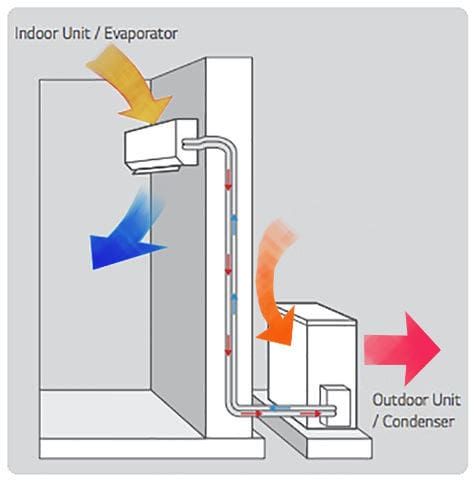
Reverse cycle makes cool air cooler and hot air hotter, but doesn’t mix them.
A straight air conditioner cools the inside of your house while a reverse cycle unit will work both ways to provide home heating and cooling.
The only time both coils are in the same box is when you have an old style window rattler. These units were sometimes fitted through a house wall but they always one coil in the air outside, while the other coil was separated to condition the air inside.
Extraction Fans Aren’t Comfortable
Say you’re using it for summer – a portable reverse cycle system passes your interior air over the inside coil to make it nice and cool (plus condense some moisture that will need to be collected and emptied occationally).
However the outside coil is in the same box, so the machine sucks up your cool inside air, heats it up again and blows it outside. They work like a range hood or bathroom extraction fan, except they extract air you’ve just paid money to cool.
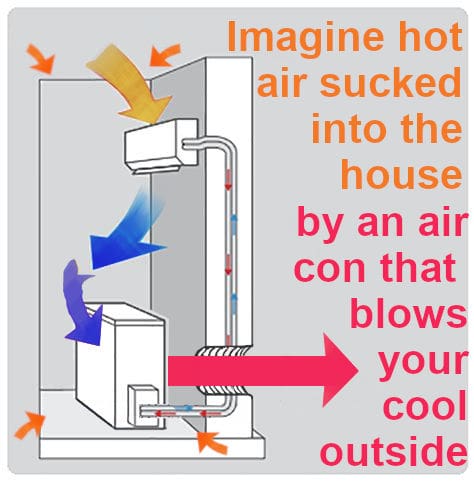
Portable air conditioning quite literally sucks. I’d ban them if I was king.
The Kicker Is Leaks
When you extract air from the room, to run through the coil which should be outside, then the uncomfortably hot air will be forced back into the room. Unconditioned air will leak from outside, through gaps, vents and doorways. Worst of all the exhaust pipe will undoubtedly leak where it goes out the window.
It’s just like your fridge – cool on the inside, warm on the outside, and pointless if you leave the door ajar.
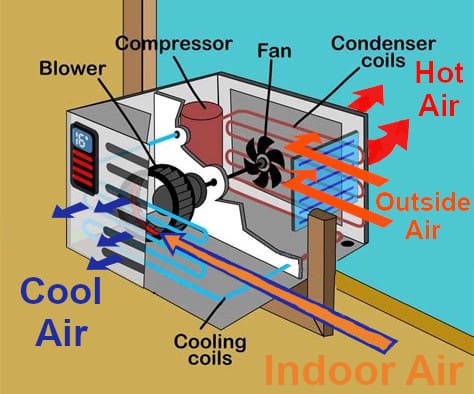
Window air conditioners might leak a bit, but they’re not outright fraud like a portable unit.
Some Portable Options Make More Sense
There are models with two hoses, (or two in one) to separate the outside air stream from the inside one. They’re not such a flawed design.
What’s fundamentally better is a portable split system. They may still be noisy and even more cumbersome but on general principle that’s what I’d go looking for if I was stuck in a place needing it.
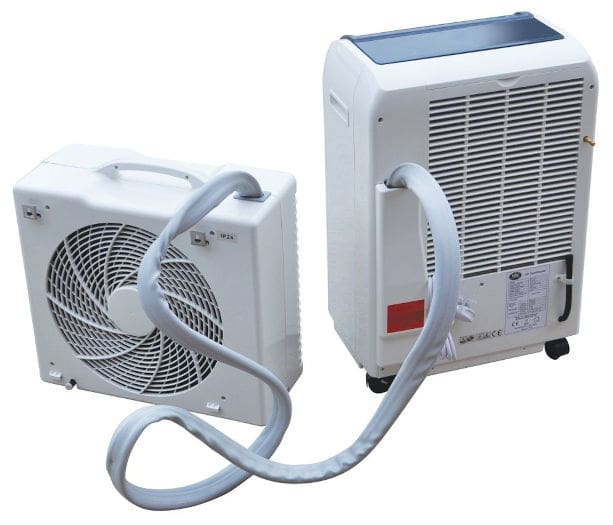
I’m not even sure these are available in Australia, but if you can chuck one half out the window and seal the opening with a towel it should work.
Don’t Confuse Evaporative Coolers
Colloquially known as a swamp box, a portable evaporative cooler is at least honest about its ability. At best, it’ll knock about 9 or 10ºC off the ambient temperature, but only works if you have low humidity to start with.
While it doesn’t sound like much, when temperatures drop to 20ºC you can really chill the place overnight and then close up the windows ready for the next day.
It’s basically a fan, a pump and some filter material, so they’re lightweight and cheap to buy. Unlike refrigeration, you need the windows and doors open so the air can flow through unimpeded, and that’s OK because they’re very cheap to run. All you need to do is keep the water reservoir full.
Trust Me, I’ve Tried
I’ve slept next to one of these noisy bastard things. I’ve even built a plywood duct, married up to an external window, to try and make it more effective. In temperature terms the experiment improved things from dismal to passable, but it was still too loud to be pleasant.
Sadly, it’s people who can’t afford a half decent split system installation that are likely to buy these things, proving yet again that it’s expensive being poor.
For an air conditioning solution that actually works, read our deep dive guide on reverse cycle systems.
 About Anthony Bennett
 RSS - Posts





You used to be able to buy portable AC units with 2 hoses but i haven’t seen them in a long time. I have also seen people hack the units and make their own.
Yep, they suck. But not as much if the alternative is nothing. I lived in a house where my home office which became my newborns bedroom was directly facing west. Take a summers afternoon and the room became uninhabitable until hours after the sun had set. The portable AC was what allowed my child to sleep in the afternoon. I wish I had it so I could do my part time study after work rather than after 10pm. Efficiency and noise were secondary to just getting by. Being in a house with decent aircon is glorious…
Not quite right….
These portable “air cons” create negative pressure within the house. it sucks air in from the outside to replace the air that was exhausted out. No different to a bathroom fan vent. Outside air must return to replace the vacuum it created, essentially bringing in hot air from outside back in.
The only way around this is a dual hose system to prevent the negative pressure. The dual hose essentially circulates the outside air which should be cooler than the heated air created by the heat exchanger. The internal cooled air is circulated around in the room without any interaction (or minimal) with the outside air. But these dual hose portable air cons are not cheap. Harvey Norman sells them for about $2200. Which makes them just as expensive as a proper split system air con.
If you rent, you pretty much have no other option but to use these. No they are not efficient, but they work. It also sure beats trying to sleep in a 27 degree 80% humidity night like last night here in SE Qld.
In a lot of States your landlord is forced to install air con or heating if the natural state of the house is uncomfortable for a tenant. Speak to them.
Gday I see mention of a reservoir system but none of ice or ice bricks,our son had one,rather large and noisy filled with ice bricks and ice,was passable for a small area but yes a full reverse cycle air con is the go.
Hi Glen,
Ice is a winner indeed.
On a related note, the yanks rate their air conditioning in tons. It’s related to the energy needed to freeze a ton of water…
Anthony, would that be a yankee short ton or a yankee long ton ? – we know it won’t be a real tonne!
Hi Andrew,
Who knows really.
I’m guessing it’ll be British Thermal Units per Acre-Feet of water volume.
Maybe with a correction factor for bushels of freedumb Eagle per oil war?
There is one type of portable AC not mentioned here that does work, but in a different way to all the other ones. It doesn’t pump the hot air anywhere, but pushes it upwards to the ceiling – where, as we know, hot air rises to.
The brand I’ve got is called Coolzy,(previously Close Comfort). I’ve had mine for nearly 8 years and it works well. As a personal AC it is designed to cool the 1 or 2 people sitting right in front of it – not the whole room.
In my living room, I have a large and expensive to run ducted system, but more often than not on a hot night, I’ll sit watching the TV with just the Coolzy blowing cool air on me from 2 metres away.
It only uses 300W/hr, as opposed to the 3-4 kw/hr of the ducted system.
It is a little noisy for sleeping, and can be used outside and with doors and windows open.
I have a Coolzy too, and it keeps me cool on hot summer nights for a lot less than my ducted A/C can. Sure it makes noise but I’m used to it, it’s just white noise eventually. I made the mistake of buying a portable A/C, and even at 4kW it could never cool my large bedroom down enough for me to be cool.
The bonus with a Coolzy is that it’s light enough to take camping, and when placed in the front door of my tent it ejects the warm air outside while aiming a nice cool breeze over the occupants. I can run it off a small lithium battery if there’s no site power.
My understanding from when I looked into this years ago was that two pipe and actual portable split systems (ie heat pumps) had to meet certain energy efficiency targets – the same targets as for for fixed split systems systems, and so there were no units available.
But single pipe ones didn’t. So our efficiency rules basically meant that we could only have inefficient systems.
We have a ducted swamp system in Canberra where the ambient heat is mainly dry and it works fine. There are a handful of days when it doesn’t work and we use a portable aircon in the main living area and that also works fine, if noisy. During the bushfires a couple of years ago the house continually filled with smoke so we sealed the place up and ran two large portables with hepa filters and dual ducting. We also invested in a large air purifier. Again, noisy, but effective. Those were the days, when all we had to worry about was climate change.
I’m a touch late to the party, but in the hope it helps someone, I thought I’d add my $0.02 worth.
All A/C units cool below the outlet, not above. Look in commercial spaces with high ceilings, there’ll be A/C vents not far above head height. The space above acts as a insulation from ceiling heat and there’s no one up there to appreciate the cooling. The same can be seen in data storage, system control and server rooms, only up to equipment height is cooled.
A window unit moved from hip height to above your head(when possible) will make a huge difference, also leave a 10′” plus air insulation buffer when possible. The same goes for split systems, mounting the internal unit, 2″ from the ceiling means you’re paying a fortune in a loosing battle to cool the ceiling plaster, that’s got 40 degree hotter air right above it.
Finally, if you’re going to allow your house to bake during the day, minimise the mass in your living areas, to make cooling quicker and cheaper in the evening.