
 Home electrification isn’t just the work of electricians, but also their natural enemy: the concreter. I’ve tried my hand at the dark arts of concreting over the years, and found that some jobs are about as painful as beating your head against a cement wall.
Do You Need A Concreter To Electrify Your Home?
In what may become a series of humorously painful yarns, today we’ll be cursing concreters, but don’t worry, we’re safe in this forum because they can’t read anyway. 1
At first glance they might not seem relevant to solar and home electrification, but there’s plenty of scenarios where the cement mixer needs summoning. While precast pavers are handy, sometimes there’s no substitute for pouring something proper to support your solar battery, hot water heat pump or the external unit of a reverse cycle air conditioner.
Heads Full Of Cement
Much like concreters themselves, concreting might seem simple, but it can get surprisingly complicated.
A few years ago I had an issue with the conduit installed into an off grid house. The formworkers had twisted the conduit around, and it ending up parallel to the wall instead of poking out of it. Getting wiring to draw through this would be impossible with an extra 90º bend involved.
Either we had to run pipe up the outside and make it ugly, or we could try exposing and turning the conduit. In this image the adventure had already begun.
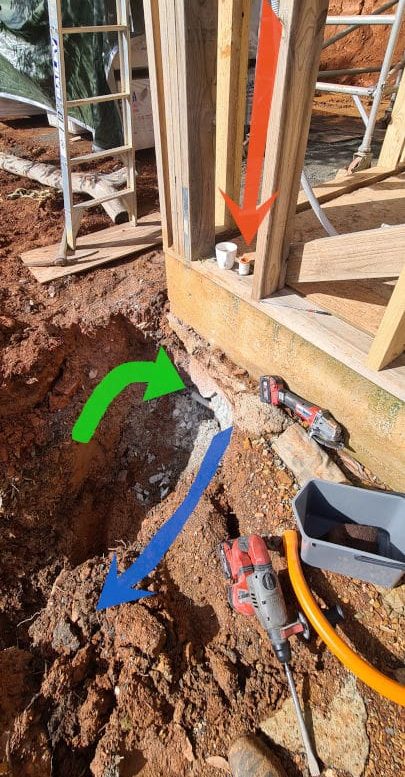
Orange shows where the cables would approach inside the wall frame and blue indicates where they had to go in a nice sweeping bend, but green explains the task is made impossible.
Wake Up And Smell The Concrete
If there’s one thing I’ve learnt over the years, it’s that concrete fresh out of a truck will go everywhere you don’t want it to and is almost as sloppy as the blokes who work with it. As a night owl myself, about the only respect I’ll offer them is for the ability to scramble out of bed to work in the early hours.
When I’ve set up shed floors and the like, I’ve found you have to be really specific with what you want, and make it downright difficult to do anything else, otherwise things will likely get mangled, misplaced or vandalised.
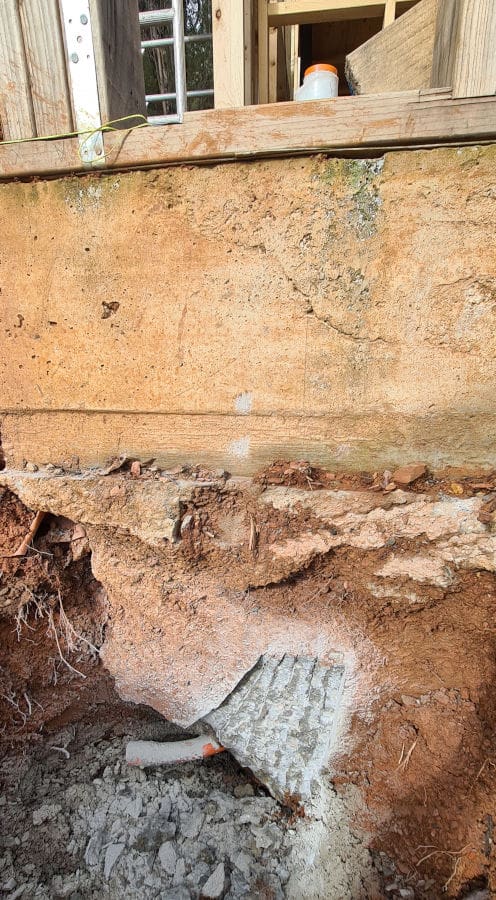
After a few passes with the grinder and the SDS chisel this was looking like a little more involved than first thought.
A smarter operator would have just made it the customer’s problem, but the problem as I saw it was this customer was a such a nice bloke. He was far nicer than my boss, who was also best mates with the customer, so I just had to make it work.
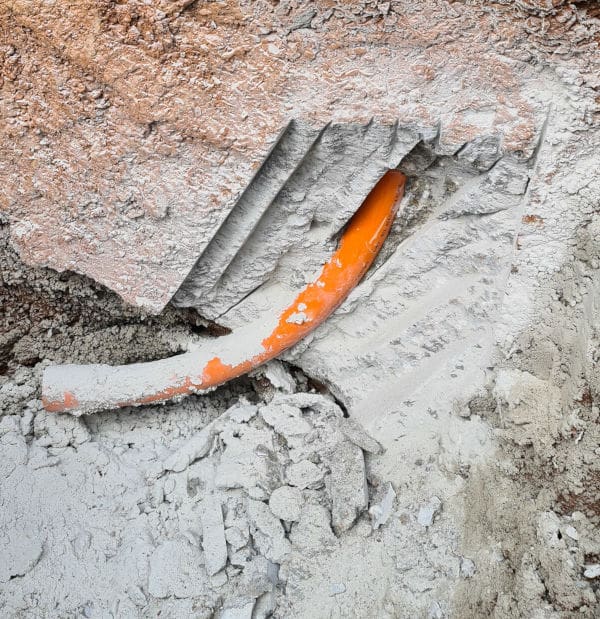
Once I was committed to it, I found there was a lot more cutting involved.
The solution was to attack this concrete with a diamond wheel on an angle grinder. Cutting grooves 25mm apart allowed me to chisel out strips using an impact drill. With only a 125mm grinding wheel I found the cuts were shallow, which forced the removal of a broad swathe, just to get to the depth required.
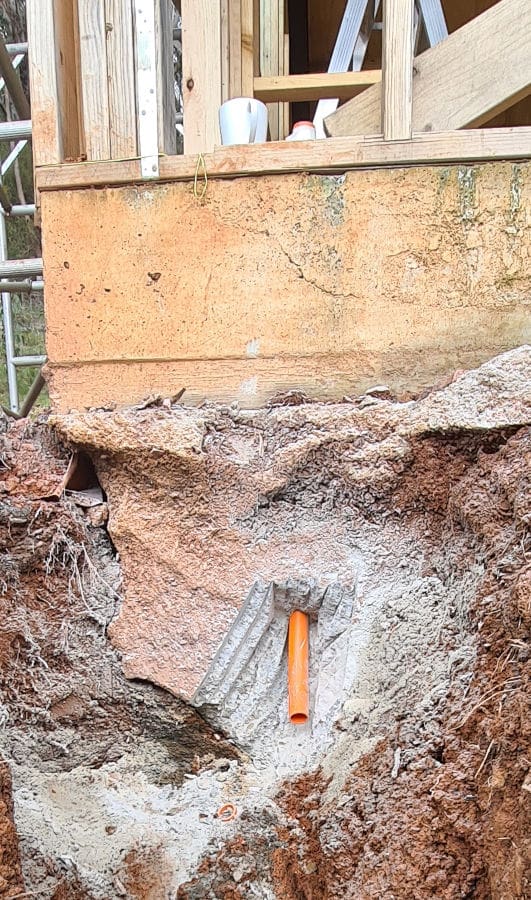
Thankfully this was on a hillside and the trench wasn’t hard to work in.
So after spending an hour or more with co-workers taking the piss about my abilities as an open cut miner, I finally got the conduit to turn and trimmed off half the sweep bend to get a nice smooth curve into the downhill trench. Hooray.
When Things Get Personal
When concreters arrived at my Mum’s to pour a new bathroom floor for a disabled access bathroom, they found me rearranging their formwork and subsequently abandoned the day’s activity.
The entire point of the renovation was to remove a 10mm step which made wheelchair access difficult. There was a bath removed and a door widened too, but the step was the bugbear which had to be ironed out.
So you can imagine the look on my face when I found a 30mm step formed up and a concreter saying “Mate you can just put a rubber strip there for a ramp”.
No sunshine, we’re not doing that just to make your day easy. In the end we saved a couple tonnes of heartache before they were poured, but it took some pointing and swearing to arrive at a compromise.
Set Your Expectations Or Have Disappointment Set In Stone
When setting up posts for a switchboard or ducts to carry cables to a new battery installation, the golden rule is to screw your conduits down, glue the joints and seal the ends with duct tape at the very least.
When you want a small step at the battery shed doorway to stop rubbish blowing under the door, I’ve found the best approach is installing a 15mm steel angle at the right level. Make sure it will withstand being walked on because setting a hard rule is the only way to get what you want.
Remember there will be blokes with shovels pushing tonnes of liquid gravel around, and they don’t give a rats ringpiece about how straight your pipework looks.
Leave nothing to chance; or you’ll find out like my old mate Mark did, after they concreted his $150 cable snake into the slab.
For more on home electrification, subscribe to the free weekly SolarQuotes newsletter.
Footnotes
- Illiterate concreters is only half a joke. One tried to pass off non-structural, speed set bagged concrete as suitable for my own bathroom floor. The story of how he had to chip it out and replace it is for another day ↩
 About Anthony Bennett
 RSS - Posts






Gday Anthony,I read you have decades of experience crawling around rat infested crevices like roof space and underground,as a younger kid I’ve experienced this,working for electricians,plumbers and concreters,I can assure you that your as much of a pain in their cracks as they are in yours,mixing up a barrow of concrete or cement for small outside appliance jobs is not hard, not quite stripping a wire but a bit of sweat sheds kilos and frustration,we all earn a quid however we can,offence for concreter’s taken,Glenn Castle.
Hi Glen,
With all the talk of natural enemies, we love you guys really.
At least we can all agree nobody likes talking to the plumbers, unless perhaps you need help to reach the ceiling? A plumbers wallet is usually a good step ladder…
Cheers
Concreters will come here and complain about how good electricians are with levels. If they could spell level.
Concreting has to one of the hardest jobs I’ve done. When done well a good concreter.will make it look easy and produce beautiful results.
Yes Craig,
Well played. The truck drivers might be fat but the concreters are always pretty lean.
It’s hard work and they only get one chance at getting it right.
Anthony,
In every trade, it depends on who you hire. On my last owner-build’s 25m x 8m slab, I waited months for the concreter crew recommended by a friendly builder. He came with half a dozen brothers and nephews, and was finished in three days. Despite the speed, he asked me what stepdowns I’d like at the garage doors and for the porch. Next day it was done, crisp as a first prize CWA cake, accurate to the mm. When the chippies later came to erect the prebuilt framing sections, the entire slab was square to within a couple of mm.
It was the plumber who tested my supervisory credentials. The laundry tub drain had to be 2.5m in from the slab edge, but was at 2.2m, right at the front of the cupboard under – the door probably wouldn’t have closed. It helps to have drawn the plans, when doing a check by eye. Someone didn’t check yours before pour.
The concreters who pushed tonnes of concrete 10m vertically x 20m horizontally for my first OB, on the side of a hill, did very well too.
Similar experience here.
Concreter came to the site where all the survey pegs were in place, got out his tape and decided that the surveying was not good enough and resurveyed it before he put in the formwork. Being an untrusting soul I checked all his measurements and couldn’t deny that the surveyor had been a few cm off. I then measured all the locations for pipes for the plumbers and marked them. After the pour I found some pipes were in the wrong place… Most drains and pipes were close enough that plumbers could bend things into place but I had to get custom made grates for the showers because those drains were way off centre.
I assume the plumbers had a somewhat ‘she’ll be right’ attitude to positioning and if a length of pipe got close it was close enough.
So plumbers and roofers were my problem.
When we put the walls up we found the slab was close to perfect. The wall guys were very impressed.
Many moons ago I was the school’s photographer at the first-floor slab pour on a large school gymnasium build. The sparkies had done their job, laying hundreds of metres of 20mm conduit just above the formwork, all darting between J-boxes facing downwards for lighting circuits in the ceilings of the floor below.
From the eye of someone who understood electrical installations it all looked perfect to me. Conduits propped up on little steel chairs, often twitched to the reo bar. J-boxes with their lids sitting neatly hard down on the formwork. So I was quite surprised that on the day of the pour I spotted the sparkie’s apprentice, dressed like a concreter in long wellies, ‘supervising’.
I asked him the purpose of his presence. He explained the headaches ahead if just one of those J-boxes was dislodged by someone’s careless size 12 steel-capped welly, or likewise a conduit broken moments before the shotcrete boom dumped tonnes of gravity-seeking misery all over the place.
Prevention!
Prevention is great and could be even greater if all trades stopped slagging off on one another.
bit harsh on the concreters – i hear the frustration with cowboys, but a good concreter is an artist and a worker and the results of their properly done work will support our lives for decades. be frustrated with all cowboys, but please dont generalise about some cowboys in a particular trade, cowboys are everywhere as are good tradies, you just have to find them and work with them, agreed re make your work solid as you do need to expect big gumboots walking around on it if its in their slab.
Biggest problem? Concretors using my 100mm HDPVC conduits as chutes, even after taking the ends.