
 New owners of solar energy systems are more likely to switch electricity service providers than the typical Australian household, according to a survey undertaken by Roy Morgan – with the trend even more pronounced for battery owners.
Are Solar & Battery Owners More Likely To Switch Energy Providers?
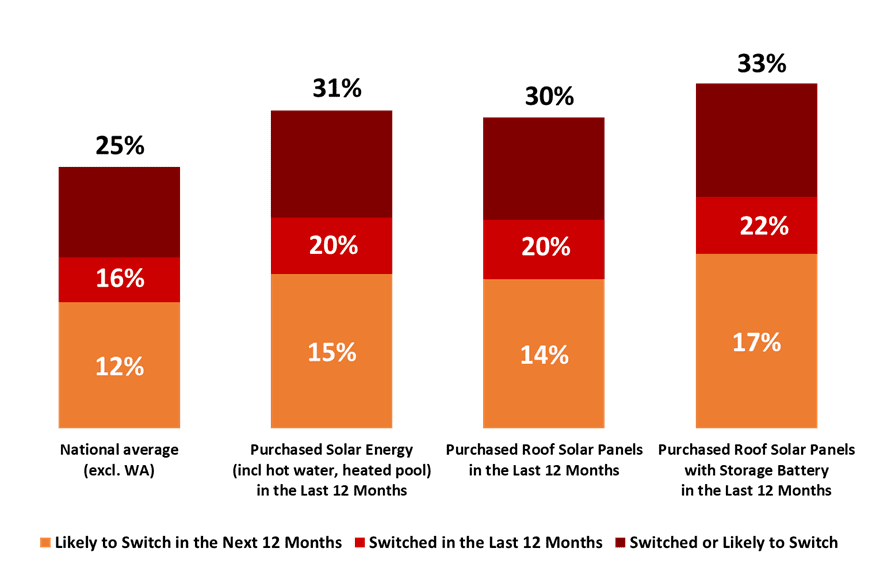
The survey found 31% of new solar energy system owners either did switch or are likely to change energy providers in the next 12 months, compared to 25% of all Australian households.
The figure is even higher for those with rooftop solar and battery storage, with 33% of those surveyed either switching or likely to do so soon.
Who Was Surveyed?
The survey covered households across Australia except for Western Australia (where the main grid has a monopoly for electricity supply through Synergy) from October 2024 through to September 2025.
The survey base was 56,356 households – of which 1,191 bought any solar energy system (including rooftop solar, solar hot water & solar heated swimming pools) in the preceding year. The majority of those – 1,010 – were purchasers of roof solar panels in the last 12 months. The results included 425 households that bought roof solar panels with battery storage.
How Many Actually Switched Providers?
A fifth of those who acquired solar energy systems in the past twelve months also switched electricity retailers – 4% points higher than the general Australian population. The rate of switching is 6% higher than the national average for households with both solar and battery.
Respondents that changed provider and bought solar in the last 12 months were most likely to choose Alinta or EnergyAustralia for their new provider, and less likely to choose AGL.
Why Are Solar And Battery Providers More Likely To Switch?
Roy Morgan CEO Michele Levine concluded that people investing in solar were clearly incentivised to ensure they were getting maximum value from their new investment.
“The data clearly shows that in this challenging economic climate decreasing feed-in tariffs, not just high energy prices, are impacting household decisions. These factors are pushing households to review their plan to make sure they are getting as much return on their investment as possible” Levine said.
Levine expects the rate of Australians switching energy provider will increase further as home battery uptake continues to increase.
“The Federal Government’s ‘Cheaper Home Batteries Program,’ which launched recently in July 2025 is expected to lead to an even more rapid uptake of solar energy storage battery systems in the coming years. With this continued increase in ownership of solar energy storage battery systems, this will almost certainly drive a substantial increase in the rate of switching electricity providers or even lead to households living completely off the grid,” she said.
What About People Only Considering A Switch?
Of the general population, 12% were planning to change energy provider, compared to 15% of households with solar energy systems, and 17% of those with both solar and battery.
This extends to those who intend to acquire any solar energy system in the next 12 months, of which 17% are also thinking about a switch.
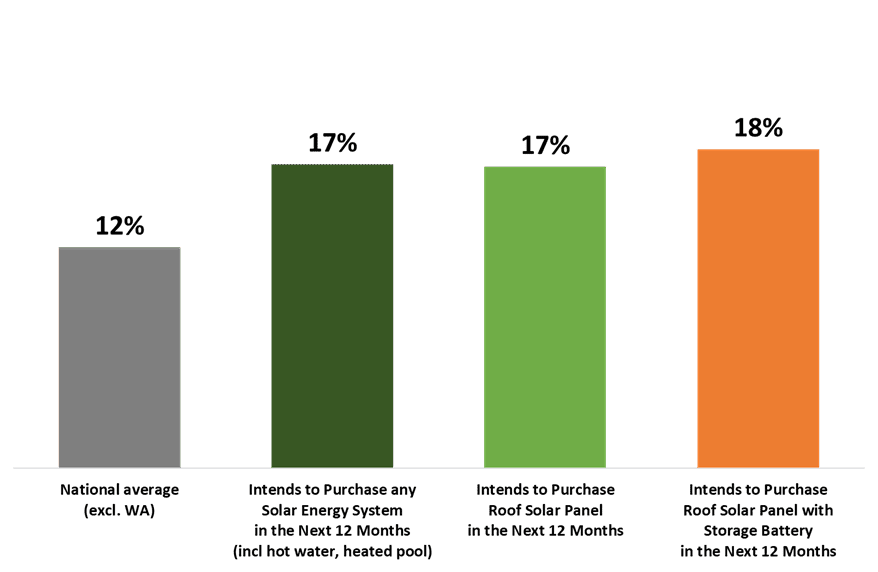
Proportion of respondents likely to be considering switching energy provider in the next 12 months.
Don’t Get Ripped Off By Your Energy Retailer
Levine warned that diminishing feed-in tariffs from electricity service providers might eventually slow the trend of solar households switching providers.
There are however plenty of other differences between energy plans that remain relevant to solar owners aside from feed-in tarriffs – including daily connection charges, as well as rates for peak, off peak and shoulder periods.
Battery owners meanwhile are being targeted by retailers with higher evening feed-in tariffs to encourage them to export their stored energy during peak demand periods.
The Australian Competition and Consumer Commission (ACCC) recently warned that households on the same electricity plan for more than three years were being slugged with a “loyalty penalty”, paying on average $221 more annually than customers on new plans.
New rules coming into place in July aim to protect customers by ensuring they don’t pay any more than the standing/default offer price if their energy plan’s benefits change or expire.
To compare energy offers and feed-in tarrifs, use SolarQuotes’ electricity plan comparison tool to make sure you are on the best deal for your needs.
 About Max Opray
 RSS - Posts






AGL are surveying their user base on the EV Charger plan. I recently received a survey that was targeting sensitivity to changes on EV Charger plan and how this might impact a switch.
ARH, thanks for the heads up !
I’ve been on that for a while, and even with SA fairly high usage tarrifs for peak (13 hours a day !!) this plan is excellent, not only the 8c for EV charging, but shifting HWS to regular circuit as all power into the home for that 6 hours is included.
0000-0600 gets a workout in our home.
I will post my thoughts on the AGL forum about any mooted changes, someone posted up there they were told there would be significant changes to tariffs on peak, off peak, shoulder, and maybe supply charge, but the 8c stays same.
. . . households on the same electricity plan for more than three years more likely to be paying loyalty “penalty” . . .
We’ve been with AGL for the whole time SA power was privatised, about 28 years now according to google.
My workshop power has been with AGL for 26 years too.
There is no retailer we can get a better overall deal from for power, tariff and daily supply charges considered . . .
With solar at home and high self consumption, it’s saving us a lot, but with a battery we’d be totally self sufficient, except for the dead of winter on ‘those’ days.
It’s no wonder people with a battery too are changing more, the deals for peak usage FITs are becoming much more common, while FIT’s for solar only are negilgable in many states, and tariffs / supply charges under constant increases annually.
Since the battery rebate, installed prices have increased I have noticed, maybe they will drop again after May 1st a little to counter drop in uptakes that will occur, saving to pay cash.
I switched three times when we got the solar + battery.. First was existing provider who refused to offer a solar plan. So they wanted to steal our solar. Smart? Then the next said they offerred a 20c feed in.tariff so when they eventually sent plan details which showed this was a lie i moved using cooling off. Same day old provider retention team called with a very competitive price and could offer a plan. Paid us $200 to come back.This offered a temporary position until amber got things sorted.
Its easy to switch but they all lie. And dong offer best pricing when they say thry do..
I only have a small solar system 6kW but have a 27kwh battery. I am with Alinta which paid the highest feed in tarriff at the time but now they have slipped to the lowest 4c. They have offered a better feed in tariff of 10c for the first 10kWh exported each day which suits me. I assume this is because they have lost a lot of customers so my instinct is to leave.
I am currently experiencing problems with my Powerwall 3 which started 7 days (it trips once per day) after it was installed so I am nearvous about changing supplier.
I have recieved a quote from Amber who claim that they do everything for a fixed fee of $25 per month which will come from the exports. But what I can see is that their daily cost is higher than Alinta so this is double dipping. What I worry about is if my system has a fault how much worse off I could be with their charges for electricity. I need to investiage more.
Hi Neil,
You need to get the system sorted first as Amber can be a bit of a trap for the uninitiated if their technology isn’t working properly.
How do switch providers when you only have the single provider.this article is useless unless you live in the big cities.