
 If you’re building a new home and thinking about solar (or a battery) down the track, the best advice I can give you is this: get your solar installer involved before the plasterboard goes up.
I know it’s tempting to leave solar until after the build’s done, but by then, you’ve missed the best opportunity to get the wiring right and hidden neatly inside the walls.
If your builder wants to “help out” by getting their own sparkie to run the solar cables during framing, that can work — but only if it’s done properly.
And that means:
- Your solar installer needs to review or approve the cable run before it’s all covered up.
- There should be photos of everything — the conduit, the cable markings, the earthing — and maybe even some test results to prove it’s compliant.
Without that, you risk ending up in a situation where your installer either can’t sign off on the job, or has to run fresh conduit down your beautiful new facade. Trust me — I’ve seen it happen more times than I’d like. A bit of planning early on can save you a headache later.
The Words No Solar Installer Should Want To Hear
There often comes a moment for solar installers visiting a new home when the builder says: “Don’t worry, our electrician’s already run the solar cables for you”. Yeah… that’s the moment to start worrying.
On the surface, it sounds like a time-saver. But in reality, it could be the beginning of a very expensive, very frustrating game of “Guess What’s Behind the Plaster.”
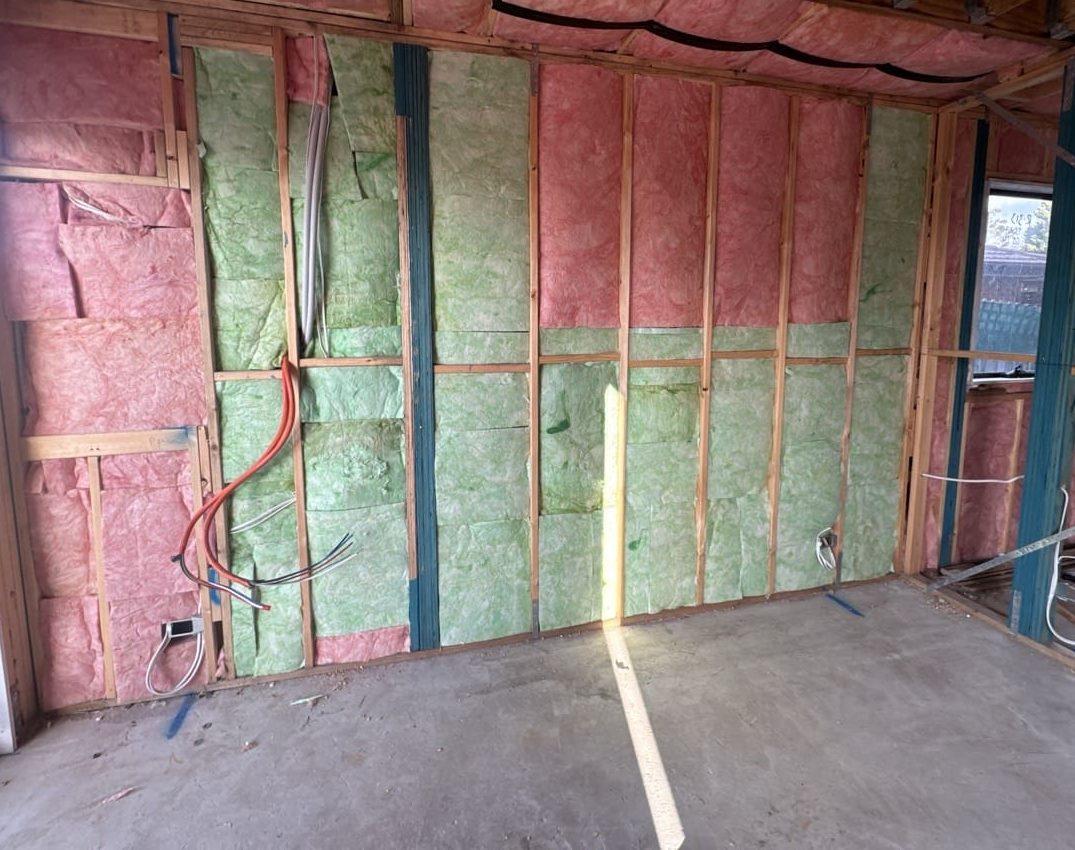
The Red Flag: When Your Installer Didn’t Do the Rough-In
If your solar installer didn’t run the cables, but is expected to fit off and certify the system, then they’re taking on a lot more than just the final connections. They’re taking on liability for work they didn’t see, can’t verify, and didn’t control.
In an ideal world, the same crew that does the rough-in would also finish the install. That way, they know exactly what’s in the walls, what conduit was used, and what kind of cable was run. But we don’t always live in an ideal world — we live in a world of builder deadlines and “she’ll be right” attitudes.
There’s No Such Thing As A Compliance Shortcut
This isn’t just a hypothetical scenario — it’s something that’s actually been reported to me as a solar inspector.
Installers are telling us they’re losing jobs to competitors who are happy to accept a builder’s pre-wiring and a certificate from the builder’s sparkie. In Victoria, that might be a non-prescribed Certificate of Electrical Safety (COES). In NSW, it’s a CCEW (Compliance Certificate of Electrical Work). Every state has its version.
But here’s the rub: these certificates don’t verify that the work meets solar compliance standards. A non-prescribed COES does not cover prescribed electrical work — and solar installs absolutely fall into that category.
So let’s call this practice what it is: risky, and non-compliant. Just because someone has handed you a certificate doesn’t mean the work behind the walls is up to scratch — or even legal. And if you’re an installer who’s taking the hit because you’re doing things by the book, you’re not alone — and you’re not wrong. This needs to be called out, and it needs to stop.
What’s Really Hiding Behind the Walls?
Let’s say the builder’s sparkie has roughed in the DC cables. Your installer didn’t see it happen. The plaster’s up. Maybe they got a blurry photo from three weeks ago, taken on a first-generation Nokia camera phone that looks like it’s been through the wash.
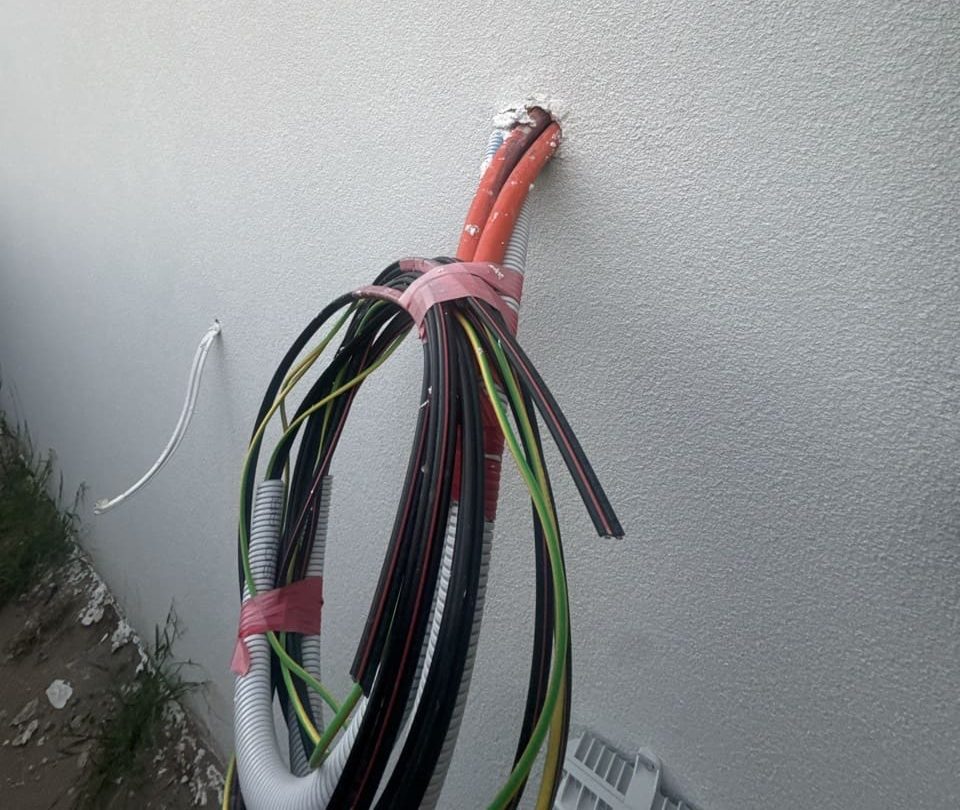
Looks neat now, but the real question is — what’s going on inside that wall? Without photos taken during the rough-in, there’s no way to confirm if the correct conduit was used or if the DC cabling meets the standard. And yet, the installer’s still expected to take full responsibility. This is exactly why your solar installer needs to be involved early — before the walls are sealed up and the guesswork begins.
What could go wrong?
- Wrong cable type (seen PV1-F, and even AC-rated stuff more times than I care to admit)
- No conduit — or the wrong conduit (not HD, cracked, or already crushed)
- Cables not fixed securely
- No earthing conductor
- Installed right up against plasterboard with zero mechanical protection
Now, about that mechanical protection…
If a DC cable is installed within 50mm of a building surface, it needs to be protected so that it can move freely — or more importantly, so it doesn’t get nailed or screwed into later. That’s not just a solar thing. That requirement actually comes straight out of AS/NZS 3000. Yep, the good old Wiring Rules.
Now, specialist installers know that AS/NZS 5033 is the bible for solar installs — and they need to know it back to front. But a general electrician, especially one who doesn’t do solar, may not realise that the mechanical protection rules from AS3000 still apply to DC cabling inside internal cavity walls.
And HD conduit might not cut it. In some cases, you’ll need steel conduit or something that meets a WSX3 mechanical protection rating. Most of the time, the builder’s electrician won’t even know what that means — and honestly, I don’t blame them. It’s not their world.
What I’d Expect to See (As an Inspector)
If installers absolutely have to take on a job where the pre-wire was done by someone else, here’s what to ask for before signing off:
Clear, close-up photos of:
- Conduit type (confirm it’s HD or better)
- Cable markings showing it’s DC-compliant (meets IEC standards)
- Earthing conductors (correct gauge and securely installed)
- Cables secured properly — no loose spaghetti
- Slack at both ends so you can verify what’s been run
Testing photos showing:
- Continuity of DC conductors
- Continuity of earths
- Insulation resistance test results
- No photo, no proof, no install.
Who Cops the Risk?
Here’s the fun part. If the install gets knocked back by the inspector — or worse, fails down the track — your installer is on the hook. Not the builder. Not their sparkie.
Solar installers wear the risk. And unfortunately, builders often push that risk downhill — straight onto the subcontractors. Why? Because they can. And because their margins come first.
So when installers are being asked to sign off on someone else’s hidden cabling work, remember: it’s their licence on the line.
What Installers Should Be Saying to Builders
I get it. It’s awkward. Builders don’t want to hear “no.” They want the job done yesterday, and they want you to “just work with what’s there.” But this is where you need to plant your feet and calmly say:
“Mate, unless I can verify what’s in that wall, I can’t sign it off. I’m not risking my licence for something I didn’t see.”
They might not like it. But they’ll respect it — eventually. And if they don’t? Well, maybe they weren’t the kind of builder you wanted to work with anyway.
Final Word: Protect Yourself
Pre-wiring during a new build can work — if it’s done right, documented properly, and verified before the plasterboard goes up. But if your installer didn’t do the work, and can’t prove how it was done, they’re being asked to sign off on a lucky dip.
And I don’t know about you, but I’m not in the business of signing off mystery cables inside someone’s $900,000 home.
Speak up. Ask for proof. And if it doesn’t stack up, walk away. Your home is worth more than a builder’s shortcut.
For more on buying solar, read SolarQuotes detailed guide on what you should know.
 About Pat Southwell
 RSS - Posts






From my recent experience, it was best to let the builder know you would be fitting solar panels and to which facing roof and ask them to reinforce it to take the weight. We had concrete tile roof with 60cm spacing of the trusses and noted on the plans. Fitting 40+ PV panels is some weight and not sure a tin roof with 120cm pacing would suffice.
Having said that, there was no way our SA builder (well known) was going to allow us to bring in a trade to do other work – explicitly prohibited in the contract. We could do minor works outside ( garden).
We even tried to get the builder to provide a fresh water outlet, in addition to a “lilac” recycled one to facilitate a future bidet, but no, not compliant. Good luck getting 3rd party electrical work done during the build
Has anyone had experience to report (either good or bad) with using pre-installed conduits with draw-wire, so that the solar installer can pull their own cables through at a later date?
As an aside, in the commercial building space I have seen drawings on which the Architect(!) has specified the types and number of cables to be run for future solar (they got it completely wrong of course 😆 )
From the installs I have seen, the cabling is quite thick (as well as plentiful), so you would want a large conduit and some pretty strong pull cord. You also wouldn’t want any 90 degree bends.
I think it would be much more simple to rough in before internal wall linings.
So, in reality unless the builder is also doing the solar don’t even go there, I just wanted to send this to a friend who will not get the 3 kw system the builder puts on each house but get solar later. After reading this i think i don’t even bother him with it.
3kw, why even bother !
Still, if no option, then the conduit should be suitable for a larger system / addition later, the inverter is probably 5kw so throw away, but all the pre work / wiring that can be used to pull through new system cabling would be a saving.
Our neighbour across the road had a 10+ yo 1.5kw system replaced with new 14kw (and battery stack), they used his conduit and as above for installing new cabling, right down to the old inverter in the garage, then to metering.
Saved them quite a bit of cost.
I would never put cable from panels to controller inside a wall cavity of flammable matchwood (pine) frame house Much better have it exposed in duct to facilitate additional cable in future. Also I don’t like the way the panels are fitted so close to the roof making it hard to clear leaves etc from behind them.
Making future maintenance and additions should be the a prime consideration.
New safety regulations require scaffolding before climbing on a roof making it more expensive to clean panels.
New homes should be designed with eaves rather than hip roofs.
Here, there are eaves on all the hipped roofs – only the gable end lacks them.
In my owner-build, solar could have been planned in, but wasn’t. Solar became a later effort, after an intervening 2 year renovation effort & sale 200 km away. But factory-installing inverters, MPPTs, isolators, and a new main switchboard on a 2m x 2m wall-mounted panel bypassed most rewiring of the old main switchboard – that just became a sub-board. New stuff, like the EV charger, and the old house, were then run out of the new main board. (So another sub-board over there.)
The old house did benefit from new breakers in place of ancient wire fuses.
(And there’s only supposed to be an MEN link in the main board, if memory serves.) Some refurbishment is very welcome.
Try to look at future loads, too. Here there’s up to 11 kW of EV charging now + other loads, HWS, 3 aircons, etc. There’s up to 24 kW of supply in sunny weather, but the main breaker only allows 14.5 kW of 230Vac – a potential bottleneck.
About the only thing I would disagree with in this post is the timing.
Solar should be considered at the design phase so that the owner is aware of what long-term trade off they are making with all those lovely looking hips, valleys, gables and artificial slopes in the roof design.
But in terms of the work itself, yes – pulling cables before internal linings makes things much easier. This is what we did on my FIL’s place recently – got the solar team to come in after the roof was installed, whilst the scaffolding was still in place and the internals were not yet started.
Of course, this was after designing a modern aesthetic house in the first place that ties in visually with a large flat roof!