
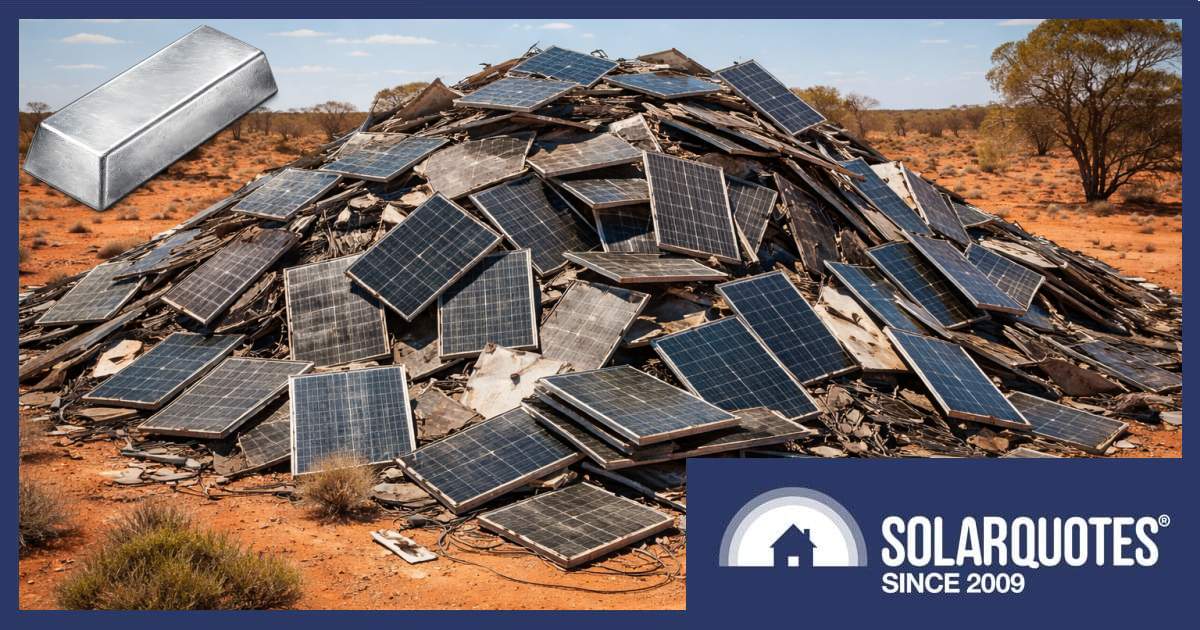
University of Newcastle researchers state they have developed a super-efficient method for the recovery of high-grade silver from end-of-life solar panels.
What Does The Silver Recovery Process Involve?
The new method, described as “fast, safe and highly effective” uses a physical separation technique combining:
- Comminution — the process of reducing a material’s particle size through mechanical means such as crushing, grinding, and milling.
- Flotation — using water, air bubbles and small quantities of standard reagents that float valuable metals to the surface as the waste materials sink.
The researchers say more than 97 per cent of the silver from an end-of-life solar panel can be reclaimed in just a few minutes using this technique, and using physical separation instead of chemical-intensive processes avoids significant environmental and safety risks.
Inspired By Mining Industry
Froth flotation is already in broad use across the mining industry1 in the separation of minerals from ore. But according to Associate Professor Mahshid Firouzi, from the University of Newcastle’s Centre for Critical Minerals and Urban Mining (CRITIUM):
“… this is, to our knowledge, the first demonstration of froth flotation for recovery of metallic silver from recycled, ground solar panels – something many in the field believed was not feasible.”
And based on various demand projections bandied around the place, that silver will be needed sooner rather than later for making more solar panels.
Maybe.
A Solar Shift From Silver?
But what if the solar industry — which was responsible for 19% of worldwide silver demand last year — starts turning its back on silver given the sustained high cost of the metal? It’s not always a case of being locked into silver, as there are alternatives (although less conductive).
For example, we reported a few days back Chinese solar panel manufacturer Longi is to cease using silver in the manufacturing of its back-contact solar cells; instead using “base metals” as replacement from the second quarter of this year.
Longi’s 2025 module shipments showed strong growth, reaching over 63 GW by the end of Q3 2025. It’s a heck of a lot of panels that suddenly won’t need silver, and from just one manufacturer. And Longi reportedly isn’t the only solar panel producer ditching it.
Combined with the evolution of recycling techniques such as that from the University of Newcastle team enabling economic extraction of valuable materials, maybe the scenario in a recently published study suggesting silver supply may meet only 62–70% of global demand by 2030 won’t eventuate.
But if manufacturers dump silver, that’s one less valuable resource that can be reclaimed from a solar panel, impacting the economics for solar panel recycling.
How Much Silver Is Used In A Solar Panel?
Around 20 grams. With the spot silver price per gram in AUD roughly $3.70 – $3.80 at the time of writing, that’s around $75 worth2 based on spot prices. And with solar panels currently so cheap — as little as $120 for a 440 Watt module from a decent brand — it’s little wonder manufacturers are really struggling.
The CRITIUM researchers state:
“End-of-life PV panels can contain high silver concentrations of 300–500 parts per million (ppm), comparable to – and is some cases exceeding – the cut-off grade of primary silver mines.”
According to the Clean Energy Council, the cumulative volume of end-of-life solar panels in Australia is expected to hit the 1 million tonne mark by 2035, and the total material value from this resource is projected to surpass $1 billion. And that resource valuation was based on much cheaper silver prices at the time.
CRITIUM Team Not Not Stopping At Silver
Beyond silver, the team is also looking at the recovery of silicon from the cells of end-of-life solar panels.
“Silver was our first test case, but there are likely significant opportunities to apply comminution, flotation science and hydrodynamic techniques to unlock billions of dollars’ worth of other metals and minerals currently trapped in urban and mining waste,” Associate Professor Firouzi said. “We cannot afford to let these valuable resources go to waste.”
Australia’s Solar Recycling Shame
While there is some movement at the station, as things currently stand only a small percentage of Australia’s decommissioned solar panels are processed by recyclers.
Rather it being a tech know-how problem, a joint statement signed by dozens of groups a couple of months ago says a failure to act by successive governments is to blame. But another major issue is the cost of transporting panels to a recycling facility, which can be greater than that of sending them to a local landfill where permitted.
Footnotes
- And the paper recycling sector. ↩
- When I wrote generally on the topic of solar silver in 2024, the metal was worth AUD $1.59 a gram. Going back to the 1970’s and it was around 50c a gram. ↩
 About Michael Bloch
 RSS - Posts




The real question is do they cause a problem in landfill, if not – who cares? Australia is not short of holes in the ground to dispose of rubbish, we are just one big mine site.
If they do cause problems in landfill, then yes recycling should be mandated.
Hi Andrew,
I think it’s more about respurce recovery so that we don’t have to expand the holes we dig so much.
To my knowledge, with a teaspoon of silver in every panel, it’s worth recovering.
The UNSW advice is a bit confused. Yes flotation is used for physical separation. But it requires chemicals to make a heavy metal like silver float. These chemicals are usually a coagulant and polymers to create a stable “float”. That is skimmed off and then you separate these chemicals from the silver and you are left with a chemical sludge or “tailings” in mining speak. These tailings are not recovered on any way but usually are not permitted to be discharged to the environment. They are stored at the mine site in tailings dams and dewatered by evaporation and buried on site permanently. In a city recycle plant this sludge would go to a toxic waste facility and be buried there (very costly). Finally you have recovered 20 grams of silver?? So the volume of waste is really unchanged and probably increased by the sludge volume
Good to see some progress in panel recycling. They’ve got plenty to practice on.The process in mining is froth flotation, only one a.
There is a reason silver is used. It is the best conductor and therefore minimises resistance between the many cells that make up a panel. Using base metals instead will result in less efficient panels. Eg. Silver is 5% more efficient as a conducter than than copper and also results in less resistive heating which directly affects efficiency of the silicon junctions that make up the solar cells. Silver also resists corrosion better, so silver based panels will last better. Aluminium is significantly worse, with about 60% of the conductivity of silver.
I would rather spend the extra few cents per panel and get panels that use silver instead of ‘other base metals’.
This is reach is one of the best. Earth & its environment is like a closed. We have to recycle every resource of earth. We have carbon cycle,water cycle in our environment. Resource of earth are to be recycled. It is a good idea to have human/science enhanced metal (fast) cycle. Nature’s also has its own metal cycle but it takes decades or may be centuries.
These science enhanced cycles will help humans to survive on this planet for longer & reduces waste. Earth was inherited by us from our ancestors & needs to be passed on to our future generation. A noble idea.