
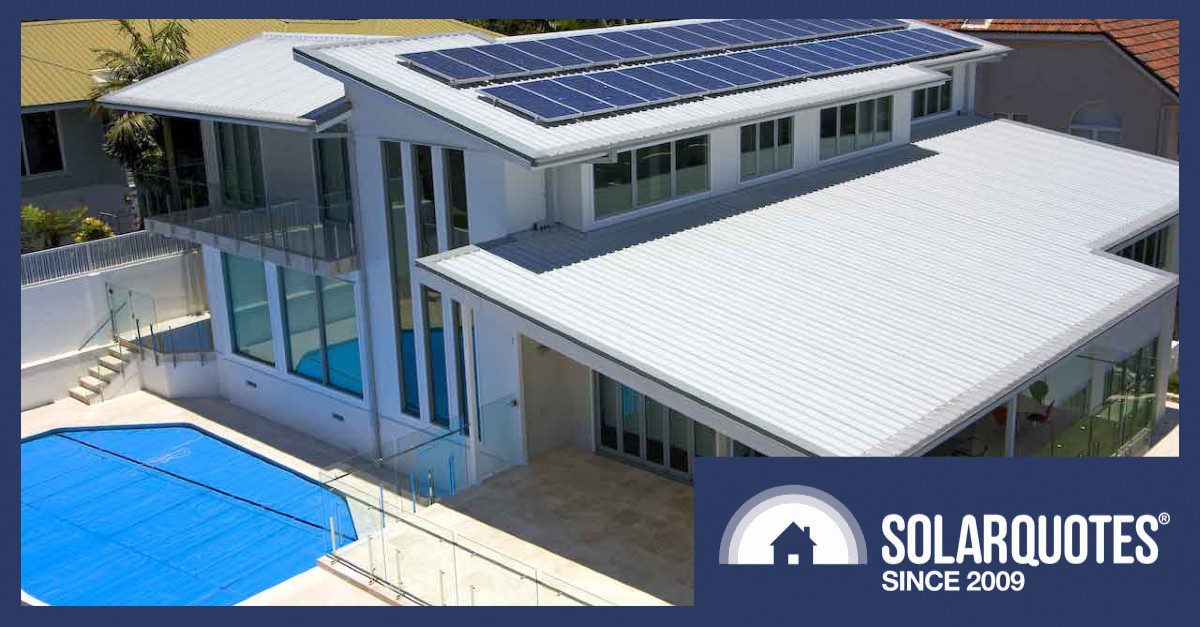
A home with a pool that had solar installed by Springers Solar.
Are swimming pools expensive to run? Absolutely, a pool is basically a big hole, which you need to pour electricity into to keep it clean.
Read on while we examine a few ways to minimise the cost and maximise your solar efficiency.
How Can You Make Pool Pumps Energy Efficient?
If you frequent some electrician forums you’ll see the subject of earthing around pools is always a lively topic. Basically anything metal within 1.2 metres of the water has to be bonded, but nobody wants to see the anchors for fancy glass fence panels strung together with green/yellow wires.
The maximum demand for a large pool heater (refrigerative/heat pump) sometimes raises a few eyebrows but what I find disappointing is that energy efficiency and control doesn’t seem to get much of a mention.
The most basic means of managing pool energy is a simple time switch. Combined with a “3 hours free” retail deal, you could make pool ownership relatively cheap, if you have a really big pump.
Another option might be a CatchControl device, or a what I call a sunshine circuit which is easy to arrange with your Fronius inverter for instance. It’ll monitor your consumption and switch the pump on when there’s something like enough solar power available. Putting energy into the pool which was otherwise being exported.
There Are Two Main Loads
Firstly, there’s filtering.
Every pool needs to be kept clean and the pump needed to circulate your pool water though the filter has to run for hours on end, every day.
There can also be an electrically powered “salt water chlorinator” which is roughly described as a low voltage DC battery charger. Pool water is sanitised by pumping it through an electrified grid housed in the pipe work, sometimes with an ultraviolet light too. This is variable but can amount to 3kWh/day in summer.
Secondly there’s heating, which comes in two main forms.
- For passive solar heating, using plastic pipes or rubber ribbons on an adjacent roof, there is often a second pump, which runs most of day to circulate water when the sun is shining. This is often a smaller load than the main pump.
- For active heating some people waste money burning gas, but best method these days is to use a heat pump. There’s still energy used to pump water through the heat exchanger, but the main power consumption is running the compressor in the refrigeration system.
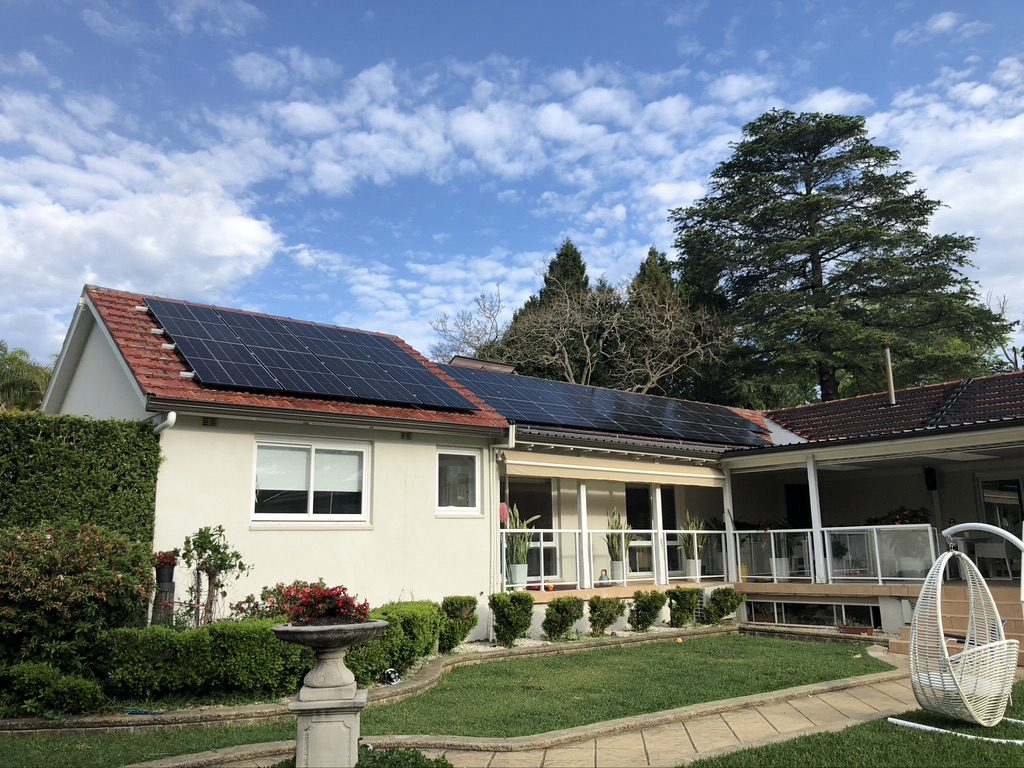
PV solar and pool ribbon on the right for low quality heat.
What Numbers Are We Talking?
My enquiries say an average 50,000-litre residential pool in Australia should be turned over 1-3 times per day via filtration, with the standard guideline being at least one turnover every 6-8 hours, but for better filtration and sparkly clean swimming, 3-4 daily turnovers is what’s needed to reach 95%+ filtering.
To circulate the entire 50,000L volume; you need a pump moving 104 litres per minute (L/min) to achieve one turnover in 8 hours.
So that means at very least a 0.75 ~ 1.2kW pump using 6 ~ 9.5kWh/day. (e.g. $1.90-2.85 at 30c/kWh) However your pool might want twice the pumping capacity and a bigger filter to go with it.
Guides tell us to run the pump 5-7 hours daily for medium pools like this (8-10 hours in summer, 4-6 in winter), split morning/evening for efficiency. Of course there’s a need to adjust based on usage, climate, and bather load.
Heating Is a Numbers Game Too
Heating a 50,000-litre pool with a heat pump1 typically requires 1,500–4,000 kWh of electricity per heating season (3–6 months in southern Australia), depending on desired temperature rise, ambient conditions, and unit efficiency.
Using our 50kL example pool, a standard 15–20 kW heat pump draws 4–6 kW input power with a COP of 5–7, meaning it runs 4–8 hours daily to raise/maintain 26–28°C. Daily use would be 20–48 kWh (e.g., $6–15/day at 30c/kWh).
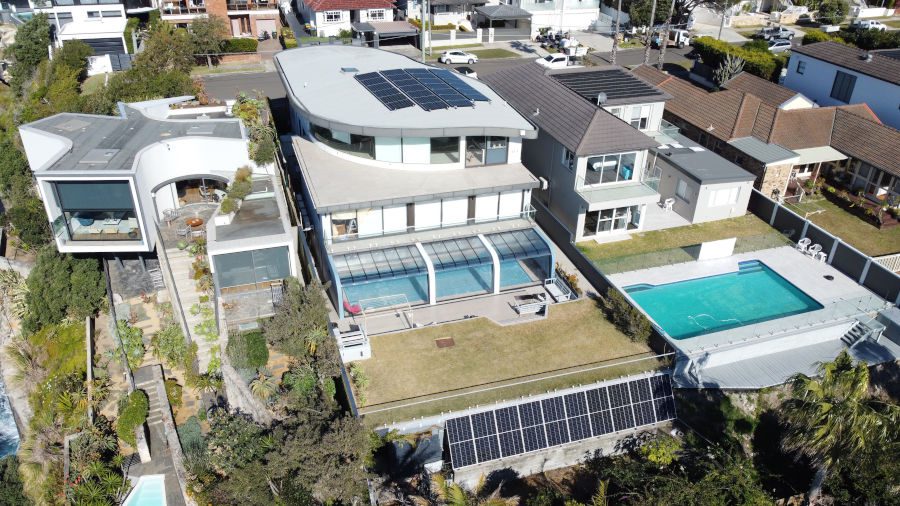
Something tells me an architect was involved on the left. That roof sucks for solar, but on the right we have pool heating. And in the middle there’s not only a roof array but ground level solar for bonus points. Winner.
Passive Heating Isn’t Always Cheap
While black plastic pool heating might use the same pump, and effectively heat for free when filtering the pool. As a solar installer I would often curse the pool people. They would use the good real estate on the roof, which we really needed for solar power.
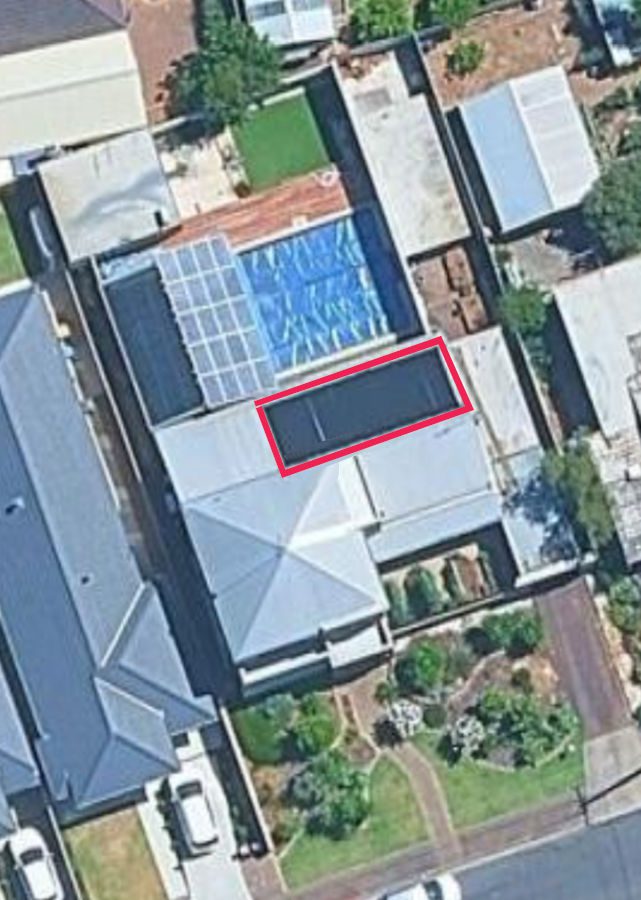
Highlight in red – pool heating sitting on roof space I coveted in around 2013, when just the parts for a 5kW solar system was $8700.
Dual Purpose Roofing
With the rise of heat pumps for pool heating, we now have a good reason to remove legacy pool heating mats. Solar PV panels can generate electricity to heat your pool, and when that’s done, the electricity can be used for other things.
For those who already have passive pool heating, I’ve seen at least two examples of creative solar array building. On an iron roof it’s not too difficult to push aside the rubber ribbons and fit alloy feet for conventional solar PV racking.
The fascinating result was an array that generates electricity AND low quality heat. The company who did this gathered a whole year’s worth of data to prove they had only given up 1ºC of pool heat. It appears that despite removing the direct radiant heat, it’s still warm under the solar PV panels, and keeping the cold breeze off a pool heating ribbon helps maintain efficiency.
Considering warranty obligations, it’s not something a lot of installers will be comfortable doing, but so long as you realise the risk of leaks and you’re prepared to abandon the rubber pipework if it does fail, then continuing use of a functional pool heater sounds good to me.
Single Purpose Solar
If you have a premium feed in tariff, difficult terrain to dig new cables into or you’ve run out of connection capacity with your local poles and wires authority, adding more standalone solar might be on the cards. There are direct DC powered solar pool pumps available which need no approval from the authorities nor any AC wiring.
One of my associates installed a DC solar pump years ago and couldn’t be happier. It’s no longer a load that appears on his power bill, and because the pump basically runs whenever there’s sunlight, the pool is cleaner than it had ever been when run on grid electricity rationed by a timer.
Be Aware Of The Gateway Trap
It’s undoubtedly a nice problem to have, but a sprawling property can prove challenging to set up for solar. In the example below there was solar and battery installed at the house but neither the electrician or customer realised the pool was supplied straight from the shed.
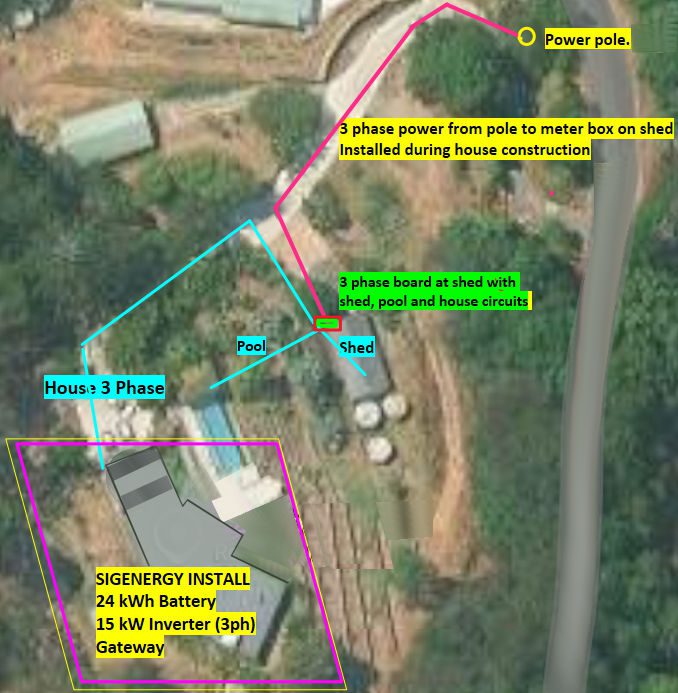
Power pole to the shed is the utility supply. The blue wires spread from the retailer meter, in the main switchboard at the shed.
The bills didn’t decrease because the the pool was upstream, completely outside the solar power infrastructure. The consumption was measured by the retailer meter, but it was invisible to the solar monitoring, because the customer consumption metering is done via a dedicated switchboard.
It is often branded a smart meter or gateway and along with measurement, it also isolates the mains during an outage. The prevents you electrifying network technicians and stops your system from trying to run the whole grid.
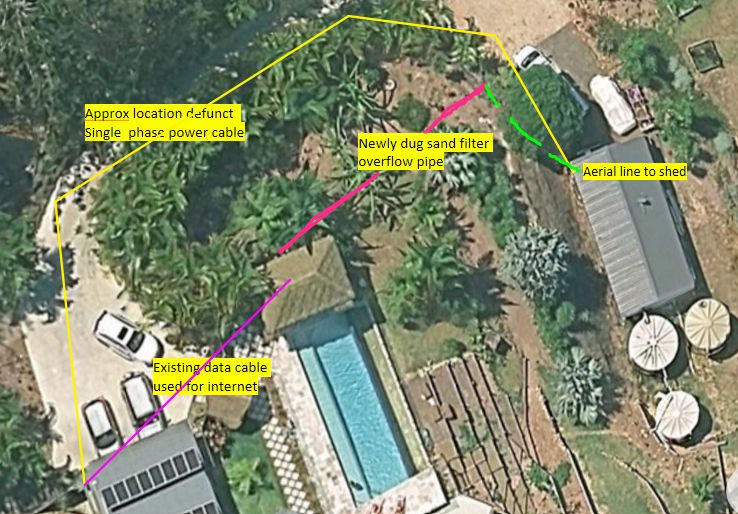
When the gateway moves from the house to the shed, it must be linked by a data cable via one of these routes
In this instance the gateway had to be moved so it could “see” the pool, which also means the house, pool and shed could have backup power during an outage. The tricky part was routing a data cable through the garden to make it work.
The Best Advice? Do Something Now
We’ve said it for years, powering a pool pump with grid electricity at 30, 40 or 50c per kWh is madness when solar is so cheap. even free hours of power on a special retail deal won’t help much, unless you have a huge pump and the wiring capacity to run it.
Footnotes
- Stay tuned and we’ll look into pool heat pumps soon, but to explain the concept, start here ↩
 About Anthony Bennett
 RSS - Posts






They say the two happiest days in a mans life are –
The day he installs a pool
The day he removes the pool…
Been running 15 French DualSun solar panels successfully since 2019 to heat my 60,000L swimming pool in Melbourne. DualSun and regular solar panels can be included in the same solar array. More expensive than regular solar panels but proven reliability and effectiveness. DualSun solar panels have an integrated water jacket that heats and circulates water. Also reduces summer panel heat resulting in up to 20% efficiency improvement in electricity output. Highly recommended with several good local installers. https://supremeheating.com.au/pool-heating-guides/heatseeker-dualsun-faq/