
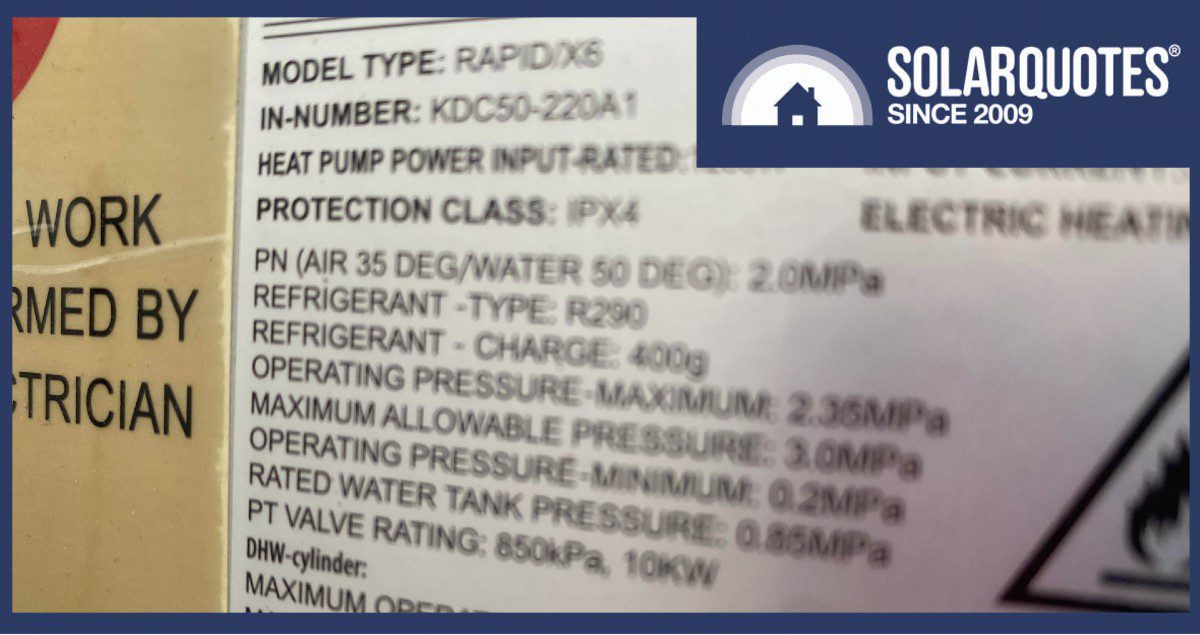
 Refrigerants are the invisible workhorses of modern climate control. They play a critical role in the operation of both heat pump hot water (HPHW) units and air conditioning (AC) systems. These specialised chemical compounds cycle continuously to absorb heat from one area and release it into another, and are a large reason why split systems and heat pump hot water units are so efficient and cheap to run.
Why Does Refrigerant Choice Matter?
The evolution of refrigerants is a story of technological advancement. Driven by an increasing awareness of environmental impact, the market has shifted from highly damaging compounds to today’s low-Global Warming Potential (GWP) alternatives.
In this article I’ll explain how they work, which refrigerants are available in Australia, and what types are best when shopping for a new hot water heat pump or air conditioner.
Refrigerants Aren’t Just For Cooling
The word “refrigerant” is derived from the Latin verb refrigerare, which means “to make cool or cold” or “to cool again”. But refrigerants can heat just as well as they can cool.
The fundamental principle of refrigeration – whether cooling a room or heating water – is based on the simple thermodynamic principle that a fluid absorbs heat when it evaporates and releases heat when it condenses. The refrigerant is the medium that makes this heat transfer possible by repeatedly changing its state:
Evaporation (The Cooling/Heating Step): The refrigerant, in a low-pressure liquid state, enters a heat exchanger (the evaporator). For a HPHW unit, this is typically the unit’s outdoor coil, where it absorbs heat from the ambient outdoor air.
Compression: The low-pressure gas is then drawn into a compressor which pressurises the gas and, critically, raises its temperature far above the temperature of the water it will be heating. This is the energy-intensive part of the cycle.
Condensation (Heat Release): The now-hot, high-pressure gas moves to a second heat exchanger (the condenser). In an HPHW unit, it releases heat into the water tank, heating the water.
Expansion: Finally, the high-pressure liquid passes through an expansion valve, causing it to suddenly drop in pressure rapidly and cool into a liquid, ready to start the process again.
There are two key takeaways worth knowing about the role of the refrigerant.
The refrigerant acts as a thermal shuttle, efficiently moving heat from point A to point B.
This process is super efficient – and why we love HPHWs and split systems. For every one unit of energy it takes to run a heat pump, often we get 3, 4 or even 5 units of energy out. This is why HPHWs and split systems are so cheap compared to gas equivalents.

What Refrigerants Are Available In Australia?
The refrigerant industry has undergone a major shift over the years, transitioning from compounds that damage the ozone layer to alternatives that minimise global warming. In Australia, the shift is highly regulated under the Ozone Protection and Synthetic Greenhouse Gas Management Act. The focus is on replacing high-Global Warming Potential (GWP) gases with low-GWP alternatives.
| Refrigerant | Type | GWP (Relative to CO2) | Typical Application in Australia | Environmental Concern |
| R-410A | Synthetic (HFC) Blend | ~2,088 | Older/Phasing Out AC and HPHW | High GWP (Major greenhouse gas) |
| R-32 | Synthetic (HFC) | ~675 | New/Current Split & Ducted AC | Medium GWP, but much lower than R-410A |
| R-290 | Natural (Propane) | 3 | New HPHW Units | Low GWP, A3 (Highly flammable) |
| R-744 | Natural (CO2) | 1 | Premium HPHW Units | Ultra-low GWP, but requires high-pressure systems |
Air Conditioning: The industry standard has largely transitioned from R-410A to R-32. R-32 is more efficient and, critically, has a GWP that is about one-third of R-410A, making it a better environmental choice while maintaining performance in split and ducted systems. With a still high GWP of 675, we expect the market for AC refrigerants to continue to develop.
Heat Pump Hot Water: The Australian HPHW market is heavily weighted towards ultra-low GWP refrigerants. R-290 (Propane) is currently the most common choice due to its excellent performance, affordability, and GWP of just 3. R-744 (Carbon Dioxide) is also used, particularly in premium units known for exceptional performance.
A Bad Refrigerant Means A Bad Product
I find there is a clear correlation between the quality of the refrigerant used in a heat pump and the quality of the product. It’s no coincidence that poorer-quality HPHWs and air conditioners use/used poorer quality refrigerants (and probably other poor quality inputs in the manufacturing process).
The following should be considered when analysing refrigerants:
1. Global Warming Potential (GWP):
Look for units using refrigerants with the low GWPs.
Most refrigeration systems leak. A low-GWP refrigerant ensures that if/when the unit leaks, its contribution to climate change is minimal. This is the single most important environmental metric. R-290 (GWP 3) and R-744 (GWP 1) are the best choices for HPHW, while R-32 (GWP 675) is currently the best mass-market choice for AC, as the transition to even lower GWP alternatives is still in progress for many AC systems.
The additional benefit of purchasing low GWP refrigerants is future-proofing. High-GWP refrigerants will become increasingly expensive, difficult to service, and difficult to dispose of as regulations tighten. Choosing a unit that uses a low-GWP refrigerant like R-32, R-290, or R-744 ensures your investment will be compliant and serviceable for decades.
2. Energy Efficiency (COP/EER):
While a refrigerant’s GWP is important, its efficiency determines your running costs and daily carbon emissions. Look for a high Coefficient of Performance (COP) for heating or Energy Efficiency Ratio (EER) for cooling, (but as always, be skeptical of manufacturer claims).
A highly efficient unit reduces demand on the electricity grid, leading to lower bills and a lower environmental footprint over the unit’s operating life.
3. Cost:
We of course need to balance these considerations with cost. What should we do if all we can afford is a HPHW unit that uses a poor quality refrigerant? On the one hand we want to encourage the heat pump over gas alternatives, but on the other we don’t want to install appliances with high GWP refrigerants.
I think the “lesser of two evils” is the heat pump. If the refrigerant escapes, it will have a lower environmental impact than burning gas for another 15 years (as well as the unburnt gas that escapes), and the efficiency gains mean energy bills will be drastically reduced.
The good news is that we can still find good quality appliances using natural refrigerants that are affordable. For example, while a Reclaim HPHW (which uses CO2) can be as much as 4 or 5 times the cost of other heat pumps, thankfully there are good quality mid-market units that use Propane that don’t break the bank.
The Right Choice For Your Wallet And The Planet
By considering both the immediate operating efficiency and the long-term environmental profile of the refrigerant, consumers can make informed choices that benefit both their wallets and the planet.
For more, read our dedicated guides to hot water heat pumps and air conditioning.
 About Tim Johnston
 RSS - Posts






Everyone tells me heat pump hot water systems are just an adaption of the air conditioning technology, but they typically use totally different refrigerants.
Why that is, intrigues me.
Hi Andrew, great question and one I’ve often thought of as well. I recently learnt the answer – it’s because air conditioning technology needs to heat and cool, whereas heat pump hot water only needs to heat. Some refrigerants are better at heating and cooling, whereas others are fine just to heat. For example, CO2 is poor at cooling, so not used in the air conditioning industry. I hope that helps.
cheers Tim, that makes a lot of sense!
One of SQ’s resident experts answered a very similar question for me about 12 months back.
All refrigerants have different boiling points, which equates to different temperature working ranges. So an HPHWS might need close on 80c from the gas whilst an AC wants substantially less.
Interesting to note that large ‘up market’ two-door fridges often have two compressors, with two different refrigerants to suit freezer v’s fridge temps.
cheers Clive.
I transitions from instantaneous gas hot water to CO2 HPHW almost a year ago and have been very impressed with the performance, efficiency and quietness of my system. No regrets.
It uses only -2-3kwh to replenish my hot water use per day which is only 16-24c loss of solar export. I got a premium system, so installed price was not insignificant it allowed my household to go fully electric now. No more LPG bottle rent or refill and similar space outside without the bottles
Many people complain about the noise but I can’t hear my Reclaim system at all while it is running, compared to my gas system which could be heard igniting and running from across the house every time you use hot water.
From my experience in several very different areas, heat pumps are anything but efficient or cost-effective..They are costly to install, frequently poor oerformers, excessively complex, quite unreliable, and extremely expensive to service. In short they are abortions on steroids.
Having installed nearly 600 units through Powrhouse, I’d have to respectfully disagree. I’ve analysed 24 months worth of gas and electricity bills for my own family and our heat pump. We’ve gone from spending $600-$700 a year for our gas hot water unit, to $120-$150 a year with a heat pump. We’re a family of 4, two adults, 2 young kids. Savings will be even higher for larger families that use more hot water. They can be expensive to install, but it depends what make and model you choose. We install good quality units for as low as $1,300. A typical payback period is around 2-3 years (that is, it’ll take 2 to 3 years to make back the installation cost in savings).
A friend in Towmsville had one which died prematurely, it had never worked well and would have cost a kings ransom to fix..Same with a sparkie near Yandina and another friend with waterfront property at Cleveland. Numerous associates in Gold Coast hinterland (cool to cold wet rainforest) tried several models and all found them disasters. Just maybe these things work in certain areas but I have yet to encounter one.
I agree a extra 2 panels and a resistive for me don’t have to worry about refrigerants and free hot water, also twice as cheap and last twice as long and no costly electrician call outs and no noise and hotter water,no moving parts !!
The question of heat pump vs (resistive electric + solar pv) is an interesting one. I agree it can make more sense, your electric unit will quite possibly last longer and it’s a simpler setup.
Where heat pump has a huge advantage over resistive electric is efficiency. If you have a whopping big solar pv system with plenty of excess, then this might not matter. But if you’re already maxing out your solar with an EV, electric heating/cooling, pool heat pump and other appliances, the heat pump becomes much more attractive. It’s my view that most houses will move towards this as everything is electrified and as solar PV setups are maxed out by limited rough space.
Everyone’s situation is different and efficiency doesn’t matter if you’ve got a few extra panels to cover the extra power for resistive as the sun is free, in my case I’m heating my hot water for free except for the lousy 1 cent on offer with what would’ve gone back to the grid !!
I agree heat pumps are cheaper to run !!
Our solar electric boosted HWS is around 25 years old and still running ok.
I’m not sure that a heat pump version would last that long.
EXACTLY !!
My heat pump hot water system is now 17 years old, going strong, and never had any problems. Touch wood it will get to 25 years like yours.
No mention of the elephant in the room. The synthetic refrigerants are highly regulated making any work on those systems expensive. The natural products are less regulated and will eventually lead to lower costs for servicing and the actual refrigerants.
The regulating body has for a long time run scare campaigns against propane and butane based systems. Butane based systems are commonly used in automotive settings as it is a relatively easy changeover from R134A.
Let’s see who pops up supporting the status quo?
Agreed.
At some point in the past the AC servicing industry changed from a trade to a cartel…
I’m presuming all the naysayer who claim excessive maintenance costs etc, don’t run air-conditioning for the same reasons
Wrong assumption, the reasons I don’t have air conditioning are that the house was designed to be extremely energy efficient and air conditioning wouldn’t work anyway. Absolutely nothing to do with the gases.
Gudday Tim,
Thank you for a very informative article.
I realise it’s all about ‘current’ refrigerants however I’d be keen to see an enlarged table [or separate one] with the obsolete gases for comparison. Starting with ammonia!
Thank you.
Doug Young, I have no interest other than as a constructor but if you have a look at the following link you might find an interesting approach along the lines you are considering.
I am not sure if links are allowed so sorry if it causes an issue.
https://www.hackster.io/stevetearle/loadmaster-xp-a-smart-pv-mppt-solar-hot-water-controller-4a813f
Very tricky 🙂 🙂 🙂
Looks like that would certainly work very well with high efficiency although it would take some time for non-geeks to get their head around it.. My issue is that I am already snowed under with projects.
Very informative Tim, good to know what to look for when considering options when a HW unit reaches end of life.
So if you have excess solar that could run a HPHWS, how does that compare to doing the same with your regular resistive element storage HWS ?
Obviously there are no real environmental downsides to the storage type unit either ?
I think I would rather stick to a normal resistive element type, I’ve read quite a lot of comments regarding problems with HP systems not getting water temps hot enough to kill bacteria, the usually accepted 60c, or running out of HW.
IMO simplicity is imperative. Heat pumps might be eficient when they are working (which isn’t for long) and they require a sparkie, hot water type plumber, and airconditioning technician for their care and feeding. Needless to say it doesn’t take long for maintenanace costs to exceed the value of the unit. Plumbers alone get their scale of fees from the Australian Medical Association / brain surgeon’s area. Simple evacuated tube systems are cheap and extremely efficient and only need a few minutes thought to deal with the overheating issue. Electrical heaters powered by solar panels are also cheap and simple although if one is that way inclined they can be made as tricky as one likes. Currently we have instantaneous gas as that was the best solution at the time I wanted a completion certificate although thanks to the inanity / tomfoolery of brainless politicians, the rules changed a few weeks later to allow orinary electrical hot water. What made this even more stupid, I export HEAPS
Thanks Les, I’m glad you found it informative.
I commented on another post about resistive vs HPHW, perhaps that’s the subject of another article!
I think the proof of the “heat pump pudding” is in the eating – we’ve installed 600 heat pumps and I don’t have customers falling over left, right and centre with legionella. It’s not an issue at all. I’ve also surveyed our database about the tank size and getting enough hot water and we had a 1% response rate saying they weren’t getting enough hot water.
If you’re looking for criticisms of heat pumps you’ll definitely find stories here and there, but on the whole the evidence is overwhelmingly clear that they work, and work well.
These articles are thought provoking, so please excuse the following musings, if they miss something. The R-32, still going in, sounds horrible at a GWP of 675 vs CO₂, but if there’s half a kilo of it a system, and there’s a big 50% loss, then is that as much as one year’s gas burning for hot water for a family with two teenagers?
Four and a half bottles of LPG p.a. is around 500 kg, and burns to nearly 1300 kg of CO₂ – 2600 times the amount of R-32 lost, so about 3.8 times worse than the leak. If one occurred every decade, then burning gas would be 38 times worse than the worst allowed refrigerant, it would seem.
And then there’s the indoor carcinogens and asthma triggers produced by gas combustion.
Off-grid here, overcast half the day, but from 13:00 to 19:00, ample panels put around 7 kWh into the HWS to top it up, and 18.4 kWh into the BEV. It takes quite a bunch of panels just for a 2.4kW resistive HWS in overcast, let alone 3.6kW. A heat pump can make do with less.
Many have commented of the advantage of resistive hotwater services being,…economy of purchase, ease of fitting and maintenance, silent running, infinite location options that allow for the fast delivery of hot water with limited heat loss and water loss while waiting for the hot to arrive, and especially for those in areas with high salt water where replacement of tanks is more frequent (thus high capital cost heat pumps and wasteful dumping are a great negative to the “efficiency” claims of supporters of heat pumps. The only downside being the additional energy use which can be easily and cheaply overcome by installing long lasting extra pv, which also has the advantage of giving access to more electrical energy in the early and late part of the day, when demand is higher and electricity prices are much more expensive. The resistive tank can then run during mid day, and utilise the surplus energy which is going to waste due to curtailment,… and no working gasses leaks either.
I agree and maintenance is a killer and a heat pump with heaps of moving parts and leaking gas neads maintenance and it costs a arm and a leg to get a electrician out, even if you can get one quickly which isn’t always the case 😉
Worse still is a plumber, easily the most expensive trade this side of a rocket engineer..The plumber who worked on my house build told me he got his scale of fees by calling the Australian Medical Association and checking with brain surgeons.. I had dealings with a brain surgeon / professor who worked on my late partner and his bills were way less than those from Peter the plumber.
Hi Doug,
I once heard a brain surgeon describe his trade as “bomb diffusion for cowards”
Very delicate, high stakes, but no risk for the person with the tools doing the snipping.
The local plumber won’t install heat pumps, got sick of getting emergency callouts all the time ,you’ve only got to see how many fridges are in hard rubbish as you drive past
Peter Johnston: – “I agree and maintenance is a killer and a heat pump with heaps of moving parts and leaking gas neads maintenance…”
What maintenance? Cleaning cobwebs from the heat exchanger on the outdoor unit infrequently? Checking the operation of the Pressure Temperature Relief (PTR) valve occasionally?
What leaking gas? Not with my system.
I’ve had a Sanden 250 litre tank Hot Water Heat Pump System supplying my hot water needs since Oct 2015. It has long since paid for itself compared with a resistive system based on whole-of-life costs.
https://www.solarquotes.com.au/blog/are-heat-pumps-better/#comment-1582686
The Sanden system is far more energy efficient compared with any resistive element hot water systems.
https://www.solarquotes.com.au/blog/heat-pumps-win-the-hot-water-efficiency-war/#comment-1727052
Peter Johnston: – “…even if you can get one quickly which isn’t always the case”
My experience has been good (so far).
Google solar quotes Are hot water heat pumps all they’re cracked up to be by Anthony Bennett and especially read the service conundrum who to call !!
I agree they’re cheaper to run but if you’re sending power back to the grid for a cent like me resistive is the way to go everyone’s situation is different !! Cheers 👍
Hi Peter,
Simplicity is a virtue but in the long run we’re looking at needing to get through winter without burning fossils.
Every bit of efficiency we can find will help, especially as we double consumption by making mobility & logistics electric.
Good quality heat pumps should be as reliable as your fridge.
Complexity ALWAYS comes back to bite, any savings due to efficiency inevitably get lost in maintenance costs. There is no such thing as a free lunch, someone will.always need to pay. Installers make much out of the positives which may well be real. however given that people tend ro miove regularly I doubt that the installers are around for expensive maintenance.
Doug Young: – “Complexity ALWAYS comes back to bite, any savings due to efficiency inevitably get lost in maintenance costs. There is no such thing as a free lunch, someone will.always need to pay.”
What maintenance costs? Are you speaking from experience, or are you just conjecturing without basis?
I’d suggest a hot water heat pump system is no more complex than an air conditioner, & a bit more complex than a refrigerator. Do you use air cons & fridges, Doug Young? When was the last time you paid someone for maintenance on your air con(s) &/or fridge(s)?
Doug Young: – “…I doubt that the installers are around for expensive maintenance.”
That suggests to me you have no first-hand experience – your comments appear to be conjecture without evidentiary or anecdotal basis.
My first-hand experience with heat pumps (i.e. hot water, air cons & fridges) suggests you don’t know what you are talking about. I’ve had 2 immersive element hot water heater units fail.
Misdirection to efficiency is yet again raised to justify the expense heat pumps,… so lets see what this really means in $ terms now that the FIT is a piddling 2c (or if you have a new inverter you are perhaps compelled to zero export in the middle of the day, which effectively means no FIT at all), We use 8kwh of free sunshine generated electricity per day to power our resistive hot water, which costs 16c in lost FIT( but those who are curtailed will not even have this cost/loss) and the best heat pumps (COP of 4) would use only 4c per day,…so a best cost saving of 12c/day or $43 per year,…so how can anyone now justify buying overpriced HPHWS (and the cost of the additional interest on them), when electricity prices can be so low and timers are so cheap?
And if you have a reasonable sized battery, there is no need for a timer at all.
If my hot water system kicks in at night, it runs for about 20 minutes and takes about 2% of the battery. It usually always kicks in in the morning after the family finishes showering, so direct fed from the solar, then on a cooler night, once again around 2am and it takes 2% of the battery.
A significant number of friends and associates have had very bad experiences with heat pumps. Particularly in my area which has issues not found in cities, they have proven to be useless. .A while back I was pressured to get one but after doing extensive research I decided they weren’t viable in my area. I don’t need an airconditioner as the house was designed to be extremely energy-efficient, in fact it won an award for that. It may be that a certain cohort living in what passes for civilization are suited to heat pumps but if you are one of those you shouldn’t assume that everyone lives in the same environment.
Exactly !!
There’s a reason the warranty on fridges and hot water heat pumps is very little, its moving parts !!
Consistent indoor comfort depends heavily on how well an air conditioning system is maintained over time. Dust buildup, worn components, and refrigerant issues can gradually reduce efficiency without obvious warning signs. Addressing minor concerns before they escalate helps avoid costly breakdowns.
I tried to order a Reclaim but they would not or could not service my area of Vic. It was also very hard to get in touch with them. I subsequently bought a Therman with CO2 and am very happy with it. It cut our elctricity bills in half, even with solar + batteries
I installed an aquatech hwhp actually from Tim a year or so ago and the wifi controller can be a bit wishy washy but the unit works well, it’s basically my solar battery for my old 2.3kw system and runs for free most days during the warmer weather and minimal cost during winter, I was paying $70+ every two months for my gas system previously but as that was my last gas appliance now had gas removed altogether, heat pumps are really efficient and saving me thousands a year as also had multi splits installed in place of gas ducted heating, does take some getting used to though