
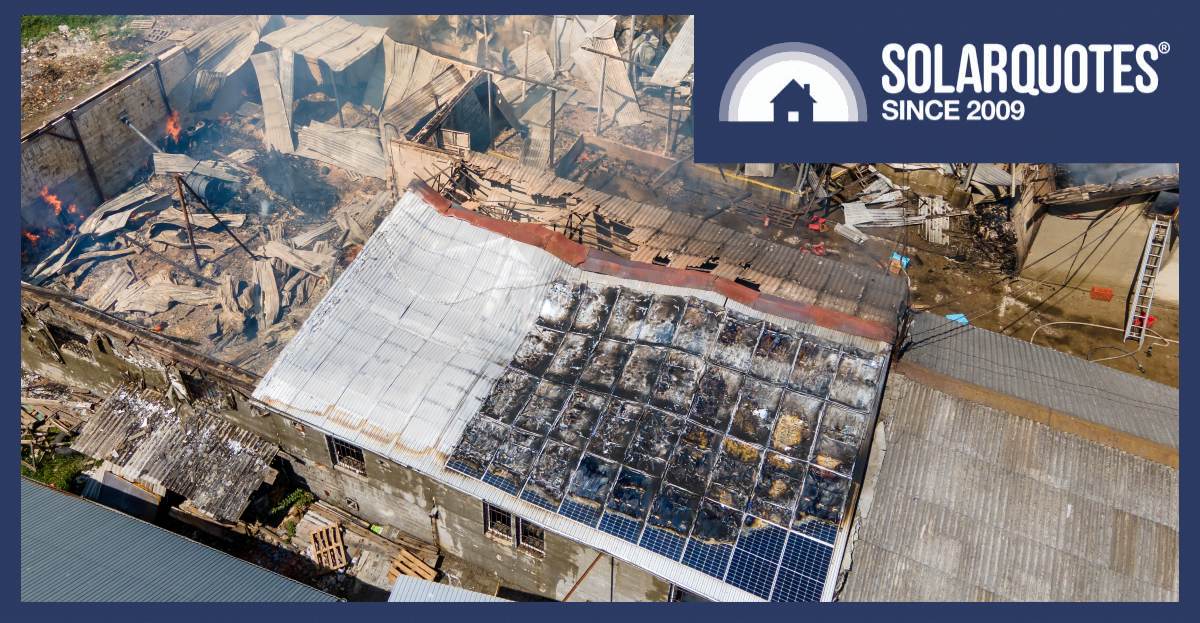
 Summer had a slow start around my place but it’s hard to miss now, and along with it, emergency warnings for bushfires, extreme heat and flooding.
So what special precautions should you take with your solar and battery systems?
Should You Switch Solar Off During A Bushfire Evacuation?
As bushfires tear through the state, authorities in Victoria have warned people that if they are going to evacuate, they should switch everything off in the main switchboard and shut down their solar, including any battery system.
I expect they’re trying to make it super simple for all involved. When the distribution authorities shut down the power for the whole district, they’re trying to make everyone safe and prevent any possibility of a fire being started by power lines. So firefighters can attack a building fire with confidence that there’s no power on.
If you don’t care about the contents of the freezer, go ahead and turn everything off in the main switchboard. However it strikes me as a bit counterproductive to shut down power when you’ve invested in an expensive battery to keep things running.
Some people actually rely on their battery system to run fire pumps, internet and security measures. Although you would need a very gutsy system, electric pumps are far more reliable and easier to start remotely than a petrol or diesel pump.
My advice is to consider your particular position. Nobody wants to see people hurt if they’re responding to an emergency, but that could mean turning the mains off and leaving outside lights on to guide those who are trying to put out a blaze or seek shelter.
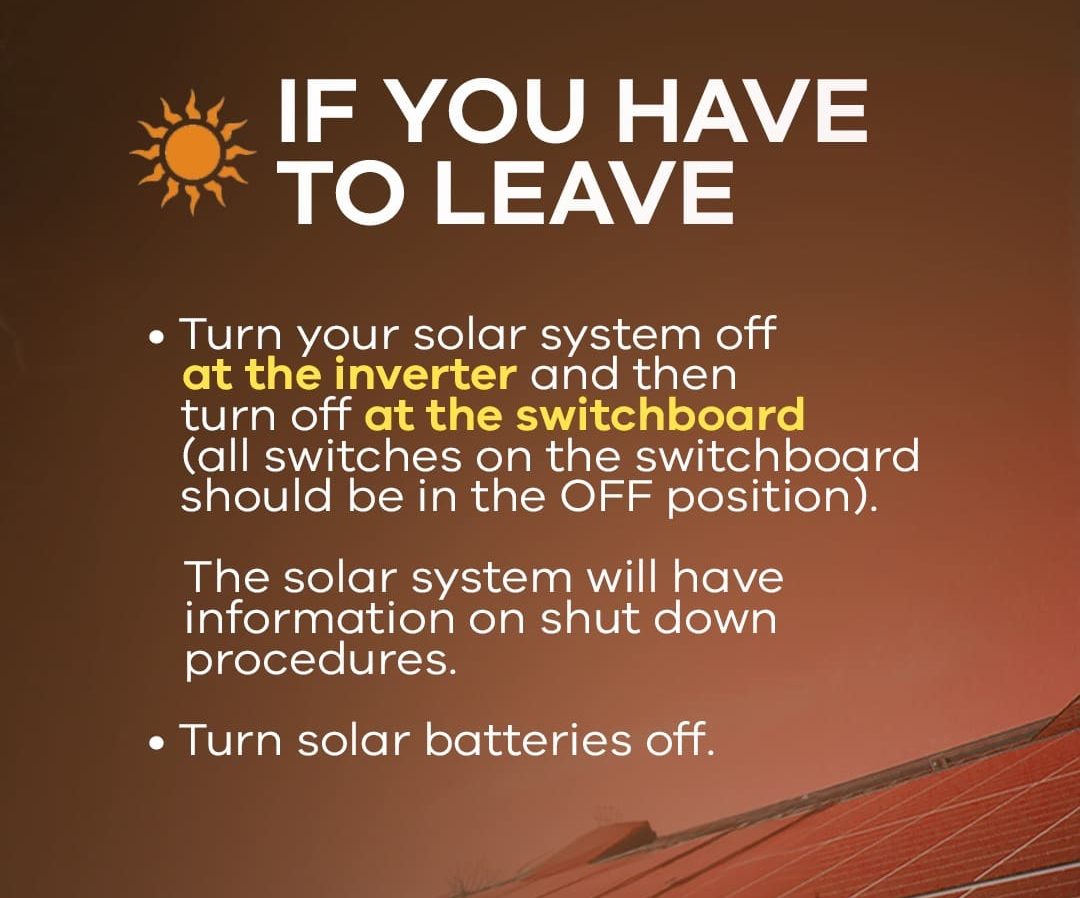
A warning from Energy Safe Victoria shared on social media.
What If You Aren’t Evacuating?
You may want to disconnect your battery system from a potentially unstable grid during an emergency. However you’ll be denying the grid support it could well need from your solar.
In any event, keep your consumption under control and bear in mind the grid might become the backup generator you need on day two or three of an extended emergency.
Aggregated together, every solar power system is helping reduce overall demand by something like 15-18%. It helps make the whole network more reliable and without it the wheels could well fall off the grid.
In the past we have seen particular events where network operators have called for people to turn off their solar power, however these have been technical emergencies where too much of a good thing is making life difficult for the grid.
Most natural disasters are a different beast. During Cyclone Alfred last year, Energy Queensland were instructing people to turn solar power off, for no good reason. They were simply creating confusion, especially for people who’d invested in a battery for emergency power. They weren’t extending the same advice to people who had plugged in a backup generator.
One key thing to remember with bushfires is that they can effectively make day into night, so your solar can be rendered pretty useless by thick clouds of smoke, or indeed heavy cloud cover that follows a tropical storm or cyclone.
An Abundance Of Caution
If you have standard grid connected solar then it will shut itself down if the authorities turn off the power. The only good reason to turn off the system yourself would be to prevent a grid fault damaging your inverter.
It’s possible a falling branch could short circuit transmission onto distribution lines, and if that happens, 11,000volts will likely fry everything in the house. So if you’re risk averse you can switch your inverter (and everything else in the main switchboard) off to protect it.
Batteries Are Beautiful
If you’re lucky enough to have a battery, the first thing you should do is make sure the installation has been properly set up to give you protection from outages.
Testing it should be as simple as flicking off the “Main Switch Normal Supply” (or for older installs it could be “Main Isolator Grid Supply”) and noting the lights stay on (or come back in 15 seconds)
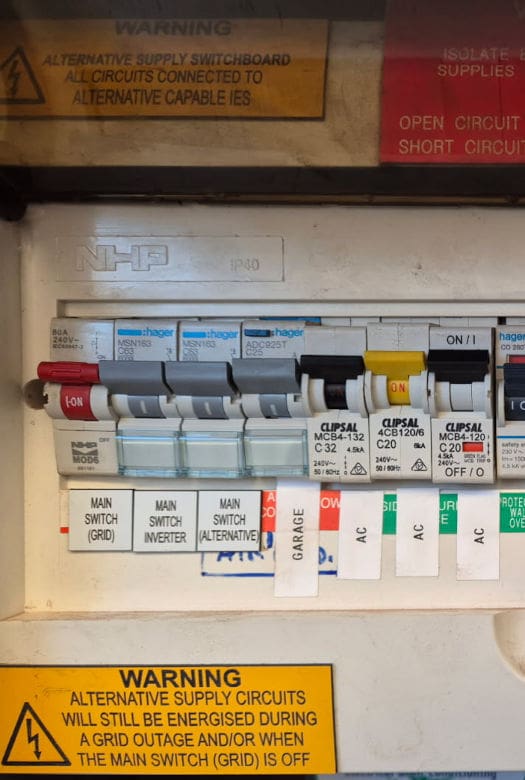
Turn the RED toggle off to disconnect from mains power. “Alternative” is the 2024 jargon for electricity furnished from a battery system.
Your electrician should have run you through this when they handed over the documentation at the end of the installation. If they didn’t, then ring up and get the service you’ve paid for.
If There Is An Emergency
The second thing you might do is force the battery to charge to 100% from the grid. Systems like Tesla are automated and call this function “stormwatch” however many will need you to intervene with a change in settings via the monitoring app.
This is especially important if you have a Virtual Power Plant exercising external control. Nobody cares much about making $2 on the wholesale electricity market during a fire or flood.
Summer Makes Energy Interesting
For years Australian energy systems have been most taxed in peak summer, driven by refrigeration and increasingly air conditioning of badly constructed, poorly designed, and oversized houses.
Whether it’s the generation assets, boilers, turbines, alternators, pumps & associated systems, or distribution, the transformers, switch yards, power lines & connections, in high summer heat everything is more prone to failure.
And it’s not just the environmental heat, it’s electrical heat from the inside, due to high current loads. I’ve seen cases where energy network office staff have literally been dragged out to substations, given a deckchair, hat and a hose and told to spray water on overworked transformers to get them through the afternoon.
TINGLING TAPS CAN KILL
Be Aware
If the power supply to your house develops a poor connection (sometimes called a loose neutral) then everything in the house connected to the earth circuit can become live. The metal case of any appliance may give you a shock.
- This can happen if a tree branch falls and breaks an overhead line or if there’s simply an overheated connection.
- RCD safety switches won’t work.
If you get a tickle, tingle or zap from your taps or appliances,
step away and ring your local network company.
- Don’t open the metal switchboard.
- The poles and wires people will send a truck quicker than you can hang up the phone
- They’ll diagnose for free, and if it’s a problem on their side of the supply fuse they’ll fix it for free too.
- While it’s a rare occurrence, it’s happened at my house this week, and it’s highly dangerous.
Solar Is The Good News
I’m reliably informed that over the last few days we’ve seen exceptionally high demand on the National Electricity Market. When you include the output from behind the meter solar, we’ve seen the 1st, 3rd and 4th highest demand days on record during the January 7th – 10th heatwave that swept the NEM.
Encouragingly, rooftop solar managed to carry a heavy share of the load through this period of intense demand, helping the grid sail through without the issued it used to suffer through hot summer days.
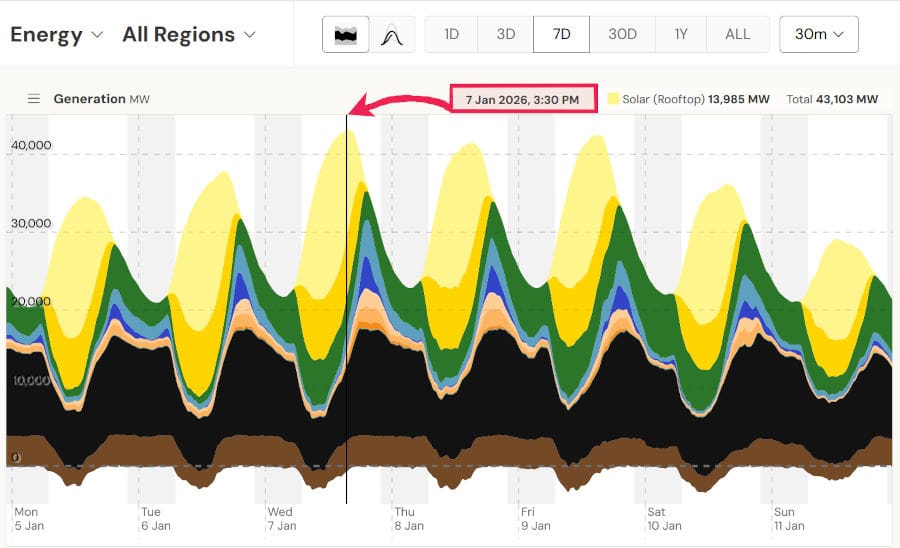
Green and gold represent wind and solar but the novelty for this year is the appearance of dark blue batteries which are eating the gas generators at tea time.
While the firefighters will curse the winds that came through with the cool change, wind generation is of course going great guns. That means when temperatures in Adelaide fall, the turbines across South Australia’s mid north spin up to drive cheap energy across the country.
For further reading, see my recent piece on how to protect home batteries from extreme heat.
 About Anthony Bennett
 RSS - Posts





Thanks for bringing a little common sense to this topic.
Without asking me, my sister turned her solar inverter off last year on (STUPID) advice from Energex in S.E. Qld. Her house was not damaged by the cyclone, nor at any remote risk of flooding. She then forgot to turn it back on until I reminded her a week or so later, which took her bill from credit to debit.
Maybe that was their plan all along?
Hi Anthony
I am interested to know where you got that graph from.
Also I have some who don’t believe that wind energy is worth the investment and resources. Any information on this would be appreciated.
Thanks
Hi John,
Click on the hyperlinks. ie the coloured text.
That’ll take you to OpenNEM or NEM watch.
I often use this link to show a trend even the crayon eaters can see.
https://explore.openelectricity.org.au/energy/sa1/?range=all&interval=half-year&view=discrete-time&group=Detailed
You can select state, whole history, year, week 3 or 1 day.
There’s also an AEMO monitor for pricing and interconnector flow but that’s often counter-intuitive.
Might be easier with the exact settings used in the image which is probably: https://explore.openelectricity.org.au/energy/au/?range=7d&interval=30m&view=discrete-time&group=Detailed
As to whether wind energy is worth the investment and resources, that very much depends on whether you ask pro-Green investment types or not, and whether you support taxpayer subsidisation and other ‘government’ skewing energy development.
Over the last 7 days, Wind provided as little as 2.4% of total energy or 879 MW. Coal remains the dominant form of power – just shy of 50% over the last year, while Wind was a mere 15.8%, (Rooftop) Solar 13.9%, (Utility) Solar 7.7%, Hydro 5.3%, and Gas 6.6% (I think – there’s a bunch of different Gas versions).
Remember, nameplate capacity and actual output for Wind tend to diverge radically!!!
Solar is loosely similar – spikes around noon, and nil dusk to dawn, but if you need reliable generation …
Transformer overheating is a prime reason for the utility to support rooftop solar. Even in Canada.
Our peak load north of the 49th parallel used to be at night, in winter, and transfprmers don’t overheat at -30 C. But as more houses are getting air conditioners, summer equipment failures do happen.
Could you do an article on protecting batteries from ember attack? Or I guess batteries and natural hazards more broadly. Appreciate if the house is engulfed in flames, the battery is a goner but it would be interesting to know if there are products or strategies to assist with this, from a bit of googling, seems there isn’t much information around.
Hi David,
It’s not a question I’ve considered before but at first blush I think it would need a metal shade structure built with perhaps a flat steel panel at the front for sun protection and stainless steel mesh for airflow at the sides?
We’ll do some more about it soon.
As Anthony wrote Oct. 24, 2022 the best place is a “cool garage”.
I would consider (being risk adverse) the material for top and front faces of an exterior protective enclosure in particular, be rated to FZ – Flame Zone, the highest Bushfire Attack Level (BAL).
The lid and front could be compressed cement exceeding recommended, but not mandatory, thickness of 6mm for non-combustible barriers protecting habitable rooms
https://www.erac.gov.au/wp-content/uploads/2021/03/Battery_Energy_Storage_System_02Feb2021.pdf
I would also slope the lid from the back of the battery mounted to the house to the front of the battery so embers can slide or blow off rather than sit on a flat surface. For ventilation as Anthony says, go with (316 grade not 305 stainless steel ) mesh (with max 2mm aperture) available at some big box HW outlets or specialist providers in different lengths, widths and wire diameters. Don’t forget to provide for access to switch off or service the BESS.
Hi Anthony,
Something I’ve been wondering about is a scenario where you are evacuating and not using a battery to drive sprinklers, pumps etc. might it make sense to discharge your battery in order to minimise fire/explosion risk.
Cheers
Our service line was knocked down and when essential came to reconnect it i said to the tech that I would go turn our solar off .he said dont bother there is no power to the smart meter so the inverter won’t
be live , if this is the case then there would be no point in turning anything off in an event like fire or cyclone?
I’m thinking more that radient heat causes the battery to catch fire then releaseing all that stored energy in a really nasty, hard extinguish fire that lithium is known for.
Hi Anthony. Thanks for your advice. Further to the bushfire events of the last week, what is your advice for solar / battery installations when leaving home for an extended period? During this latest event we were interstate in QLD, and had left solar / battery at home in regional VIC in normal operating mode. My inverter/ battery are in a locked shed which means that a controlled shut down would not have been possible by a well meaning neighbour, firey, or even me remotely.
Anthony,
I would like to question your assertion that
“So if you’re risk averse you can switch your inverter (and everything else in the main switchboard) off to protect it.”
As an electrical engineer, my understanding of the specification for domestic circuit breaker’s (CBs), the voltage rating is 600V AC for both 240V AC and 415V AC CBs. They also have an AC fault current rating (kA), typically less than 10kA.
Any 11,000V line falling onto the 415V overhead distribution lines in the street (or falling branches or lightning strikes) would create an arc across the small air gap inside each CB (when in the OFF position) and allow a 11,000V spike/surge on every house circuit, destroying all connected equipment.
This would occur for all houses connected to the local 415V distribution network. Hence the need for insurance.
The only safe method is to physically pull out plugs from GPOs of any electrical equipment in your house. Your thoughts ?
So you are advising people to ignore govt fire safety advice and leave their solar and battery on when they evacuate? That’s terrible advice!
Is this the same quasi-government department that back in the VCR time-shifting days used to advise unplugging your VHS machine from the wall before you went out for the night?
Yes, sure, a video recorder [or any other electrical device] on standby is at risk of catching fire. However we have to ASSESS the risk if we want to enjoy our lives.
Those are not comparable examples. What makes your enjoyment more important than protecting other’s lives, and what makes you more able to assess fire safety risk better than fire safety experts?
Hi Matt,
I’m not sure which examples you’re talking about however perhaps you missed the hyperlinks in this passage:
“Some people actually rely on their battery system to run fire pumps, internet and security measures. Although you would need a very gutsy system, electric pumps are far more reliable and easier to start remotely than a petrol or diesel pump.”
While I have utmost respect for trained firefighters, I’m a trained electrician, and I’ve also been the bloke who does hold a hose.
We have to remember that broad advice is designed for the broadest range of people, it’s not tailored, to avoid making it confusing.
At the end of the day, the emergency services have a joke about firefighters anyway:
“We don’t need to you spell car, we just need you to lift them off the patient”
My on-grid brother has 25 kWh of batteries, electric pumps, and rooftop sprinklers. When evacuating, batteries can maintain sprinkler operation after grid failure due to the fire. That’s brilliant – so long as you also have adequate water tanks. He has 44,000 L, and the roof gutters return the flow to that tank, so evaporation is the only water consumption.
Here, off-grid, my solar system runs 24/7 regardless of circumstances. The petrol firefighting pump remains off, fuelled and ready, until there’s fire. Under ember attack, the 240V electric domestic water supply pump’s VFD is wound up, and flow switched over to a 40mm water main feeding hydrants at cardinal points.
The inverters and batteries are in an airconditioned workshop – that’ll also run in a bushfire. (The aircon compressor might not make it.)
Firetrucks do not turn up as they used to, so I wouldn’t fuss about the prospect. They’ll probably turn up here, for the 10kL water I hold for them, if for nothing else.