
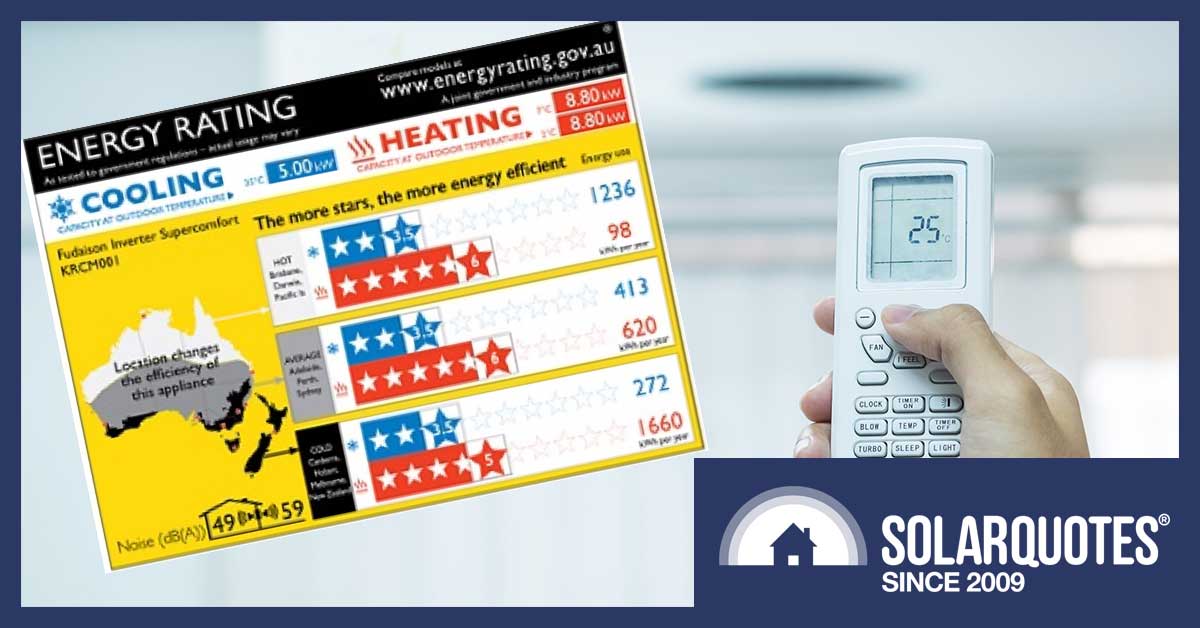
Pop quiz! What’s more important when it comes to buying an air conditioner?
- (a) Cooling efficiency
- (b) Heating efficiency
- (c) Purple monkey dishwasher
Is Air Con Heating Or Cooling Efficiency More Important?
If you replied “(a) Cooling efficiency” and live in the hotter northern parts of Australia, that’s correct! But if you, like most Australians, live south of Byron Bay or west of Brisbane, then “(b) Heating efficiency” is the right answer. And if you chose “(c) Purple monkey dishwasher” then you need to take me more seriously and respect my authority.
In this blog post, I’ll explain:
- Why heating efficiency is more important than cooling efficiency for most Australians when buying an air conditioner.
- How to read air conditioner energy efficiency labels.
- Why air conditioner labels always say cooling efficiency is higher than heating efficiency.
- Why this doesn’t matter.
- Why having rooftop solar increases the importance of good heating efficiency.
- Why having a battery doesn’t change the importance of heating efficiency.
That’s six points to cover. I promise I won’t add any more. This is partly because it would make the post too long, but mainly because I’d have to watch some Sesame Street first to learn more letters.
Air Conditioners: The Cheapest Way To Heat Your Home
If you want to heat your home, an air conditioner is the most cost-effective method. This is because it’s a type of heat pump that moves thermal energy around, which takes less energy than directly creating it. In summer, it can take heat from air inside your home and move it outside, while in winter, it can move heat from outside air into your home. While outdoor winter air may feel frosty, air at 0ºC still has 93% as much thermal energy as air at 20ºC, and a heat pump can move a portion of that inside, despite the outside temperature being lower.
But you will need to use a reverse cycle air conditioner, which means it can work backwards. When you switch one of these from cooling your home to heating it, the refrigerant fluid inside reverses direction, so it does the opposite of cooling. There are still air conditioners available for sale that don’t have a reverse cycle, but I don’t recommend them. You might save a few bucks, but it’s only going to be a few. Very little extra is required to make one reverse cycle. Even if you live in Townsville and only heat your home a few days a year, the minor extra expense can easily pay for itself over the air-con’s lifetime. (One day, 75 years ago, it got down to 1°C in Townsville. If it had gotten any lower, locals may have discovered it’s possible for ice to exist outside of freezer compartments.)
The efficiency of reverse cycle heating depends on the air conditioner and the location, but even easily affordable air conditioners can be three or more times as energy efficient as an electric resistance heater.
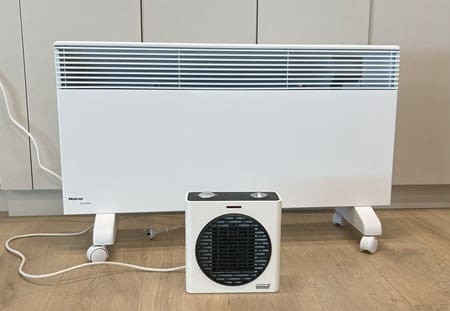
A couple of evil electric resistance heaters, no doubt plotting to do us in by running off coal power.
A reverse cycle air conditioner that is three times as energy efficient as electric resistance heating will also be around three and a half times as energy efficient as gas heating. You can save plenty of money by using your air con for heat instead of gas, but how much will depend on what you pay for gas and how much your solar system powers your air conditioner.
Air Con Labels
It’s easy to compare air conditioners because they now come with groovy Energy Rating stickers that give heating and cooling efficiency based on climate location. Here’s an example, freshly stolen from a government website:
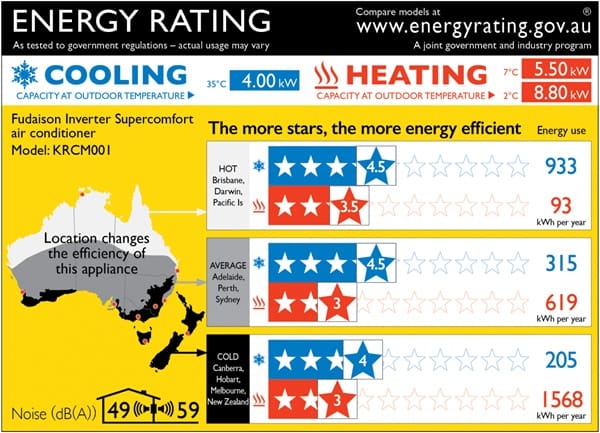
This label is a made-up sample for a reasonably efficient imaginary air conditioner.
Unfortunately, the government clearly did not spend the $300 it takes to hire a skilled Slovakian graphic designer. The number of efficiency stars is not obvious. If you look at the star ratings for the hot climate zone, it looks like there are 3 for cooling, but it actually has 4.5. It also looks like it has 2 stars for heating, but it really has 3.5. While saving money is generally a good thing, sometimes it’s worth letting a Slovakian feed his family and/or his Lady Gaga obsession.
I first wrote about these new labels five years ago, and now we’re in the distant future year of 2026, every new air conditioner should finally come with one — but don’t blame me if they don’t.
Air Conditioner Zones
These Zoned Energy Rating Labels, or ZERL labels, show heating and cooling efficiency in three climate zones:

For some reason, New Zealand is around 50% larger than it should be. This grinds my gears because it makes both countries appear incompetent at geography. If I find out New Zealand’s capital is responsible for this, we’re going to have a beef, Wellington!
These zones are different from the zones used for solar and for hot water heat pumps. They also have names instead of numbers:
- Hot Zone: This covers the northern third of Australia, including the coastal strip of South East QLD and a little bit of Northern NSW. It includes Brisbane — the capital of Queensland, Darwin — the capital of the NT, and the City of Townsville — the capital of sounding stupid when literally translated into another language, because it becomes Big Town Town Small Town.
- Average Zone: This zone can get hot in summer but winters are cool. Capitals include Sydney, Perth, and Adelaide.
- Cold Zone: These are the parts of Australia that get really cold in winter and the whole of Lewd Zealand. Included capitals are Melbourne, Canberra, Hobart, and Wellington.
Efficiency Stars
The more stars a label has for a climate zone, the more efficient it is at heating or cooling. They also give estimates of how many kWh the air con will typically consume in each climate zone over a year:
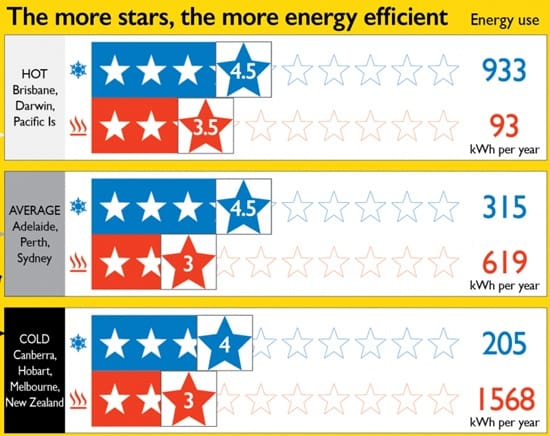
Note the star rating is the number in the final star, not the number of stars preceding it.
As the example label above shows, in every zone except the hot one, homes use a lot more electricity for heating than cooling. The actual ratio will depend on the household, but for the above example:
- Hot Zone: 10 times more energy is spent cooling than heating.
- Average Zone: Twice as much energy is spent heating than cooling.
- Cold Zone: 8 times more energy is spent heating than cooling.
The zones aren’t magical. Just because you’re in the Average Zone doesn’t mean you will definitely use more energy for heating than cooling. If you rarely or never heat your home, either because you have effective passive heating or because you’re like Elsa from Frozen and the cold never bothered you anyway, then the figure won’t match your consumption. It also may be off if you live at the edge of a zone. But, generally, they’re a decent guide for those whose heating and cooling habits aren’t too far off normal.
More Stars For Cooling Than Heating
Because most Australians live in climate zones where air conditioners use more electricity for heating than cooling, it means heating efficiency is usually more important than cooling efficiency. But if you look at air conditioner labels, or go to the government energy rating page and click on air conditioners, you’ll see that — except for the worst ones available — they always have more stars for cooling than for heating.
Below, I’ve put the best and the worst energy star ratings available in the three climate zones. While one of the worst is equally bad at both heating and cooling, the best all have 2.5 to 3.5 more stars for cooling than heating:
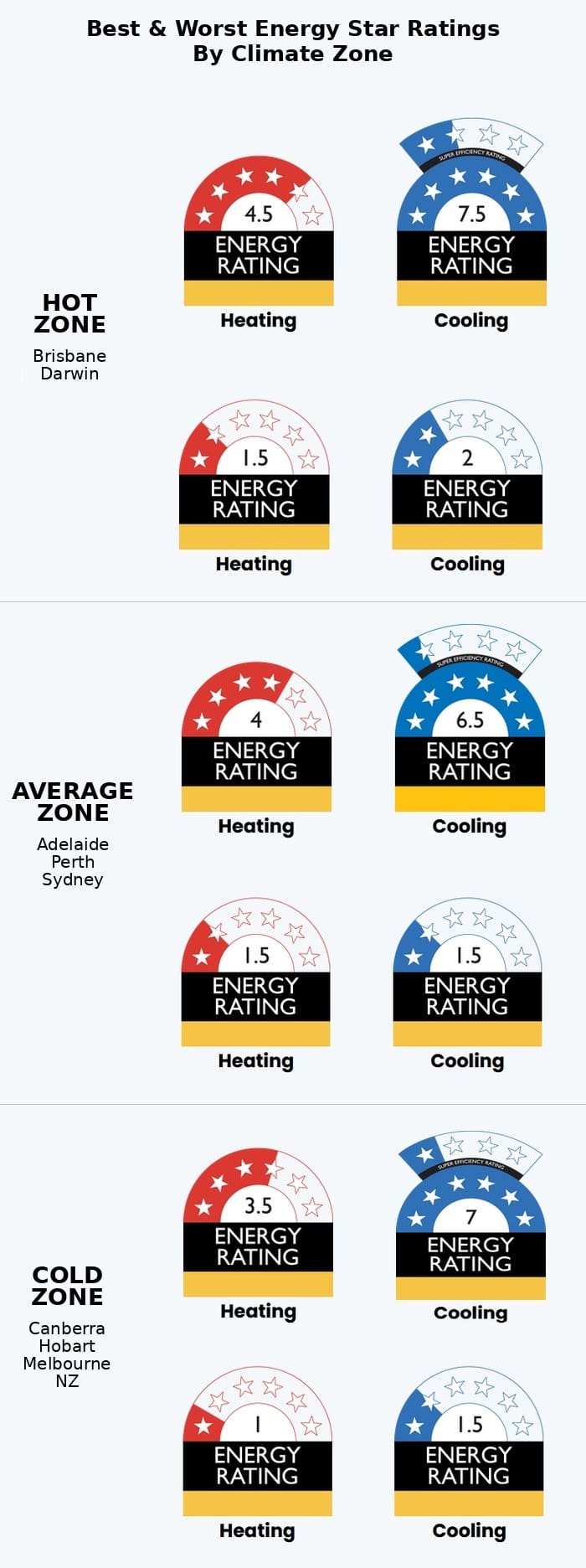
If you avoid the least efficient air conditioners — which is something I so recommend doing — you’ll always end up with more stars for cooling than heating. But this doesn’t alter the fact that, outside of the Hot Zone, an extra star for heating efficiency will save more money than an extra star for cooling efficiency for typical households.
It may seem strange that air conditioners have more stars for cooling than heating, since they’re basically doing the same thing, they’re just doing it backwards for heating. But there are two good reasons why:
- The tests aren’t equal, so it’s harder to get stars for heating than for cooling.
- When the outside temperature is below 5.5ºC, ice can form on air conditioner radiator piping and reduce efficiency.
On a hot 34ºC day, you might set your air conditioner to cool your home, or part of it, down to 24ºC. That’s a 10ºC difference. But if it’s 10ºC outside and you warm your home up to 24ºC, that’s a 14ºC difference. With a larger temperature difference, air conditioners have to work harder, and that reduces their efficiency. Because the efficiency tests assume a larger average temperature difference for heating, air conditioners end up with fewer heating efficiency stars than cooling stars.
Ice forming on air conditioner heat exchange piping also lowers heating efficiency. This happens because, when heating in reserve cycle mode, heat is moved inside and cold is moved outside, so the outside radiator pipes can be below freezing and ice up when the external air temperature is below 5.5ºC. This can require an energy consuming deicing cycle. Air conditioners can vary in how much ice builds up and how efficiently they get rid of it. While this isn’t an important consideration in the tropics, in the Cold Zone it can significantly affect the number of heating energy stars.
It’s In The Stars
By poking around the government energy rating page, I figured out how much electricity air conditioners with different energy star ratings will consume. Here’s the difference half a star makes for heating and cooling under the following conditions:
- An air conditioner large enough for a typical living room.
- In the Average Climate Zone (Adelaide, Perth, Sydney).
- With what the testers consider normal use.
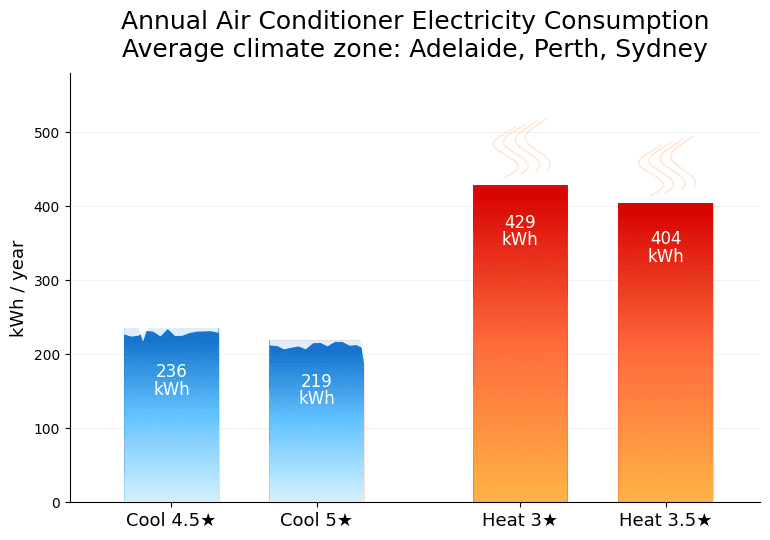
The above graph clearly shows…
- With expected use, homes in the Average Climate Zone use far more electricity for heating than cooling.
- An extra half a star doesn’t save a huge amount of electricity – but still helps.
If we do the same thing for the Cold Climate Zone, we get…
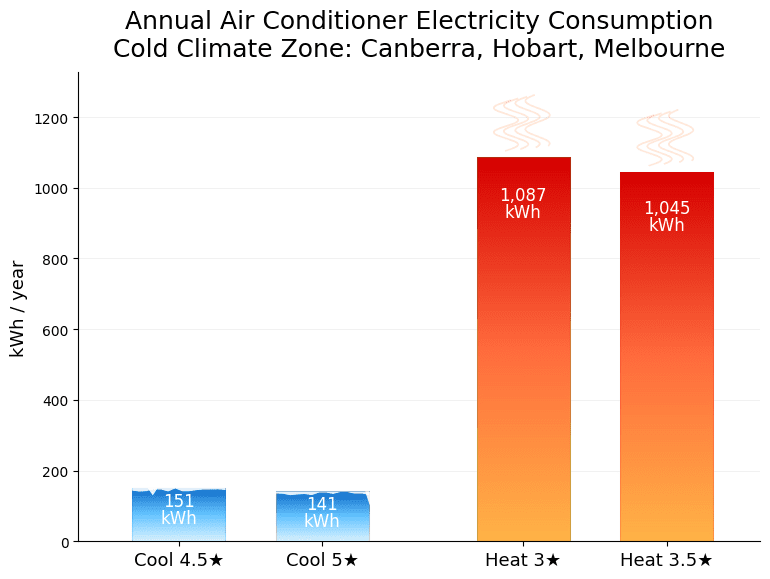
This shows that in places like Melbourne, they go easy on cooling and use less than half as much as in the Average Climate Zone. But they go hard on heating, and use around 75% more.
Savings
For the Average Climate Zone example above, the amount of electricity saved over a year by having an extra half an efficiency star is:
- Average Zone cooling: 17 kWh
- Average Zone heating: 25kWh
- Average Zone total: 42 kWh
How much money this will save you isn’t easy to work out — unless you have a flat tariff without solar. In that case, it’s really easy. Even I can do it. A Sydney home paying a flat tariff of 36c per kWh, without solar, will see the following savings:
- Average Zone cooling costs: $6.12
- Average Zone heating costs: $9
- Total annual savings: $15.12
A saving of around $15 a year doesn’t seem like much — because it isn’t. But if your air conditioner lasts 15 years, it will come to around $225 and can make paying extra for a slightly higher efficiency rating worthwhile.
For the Cold Climate Zone example, the total number of kWh saved by having an extra half an efficiency star for cooling and heating is:
- Cold Zone cooling: 10 kWh
- Cold Zone heating: 42kWh
- Cold Zone total: 52 kWh
If this home was paying the same 36c per kWh as the Average Climate Zone home, then the annual savings would come to $18.72 a year. But in Melbourne, where the largest number of Cold Zone Australians live, on a flat rate, electricity is around 23c per kWh. This makes the savings:
- Cold Zone cooling costs: $2.30
- Cold Zone heating costs: $9.66
- Cold Zone total annual savings: $11.96
While total savings are less in Melbourne, savings from higher heating efficiency are greater. So higher heating efficiency is still useful, even in the state with the lowest electricity prices.
Savings With Solar
If you have solar and/or a time-of-use tariff, savings become more difficult to determine, but the importance of heating efficiency increases. The greatest cooling demand occurs on sunny summer days of high solar output. While there’s variation between households, it’s easy for solar to cut cooling costs by half or more. But for heating, it’s the other way around, as the greatest heating demand is on cold, cloudy winter days when solar output is low. This means that, without an intentional effort to shift heating to the middle of the day in a well-insulated home, the reduction in air conditioner heating costs from solar is usually modest. So if you have solar, it makes even more sense to prioritise heating efficiency over cooling, outside of the Hot Climate Zone.
If you have a battery, you can store solar energy and use it for heating when solar output is minimal. But unless your solar system is massive, you still run the risk of running low during cold, cloudy periods. So even with a battery, heating efficiency remains important if you don’t live in the stinking hot zone.
That’s It!
I’ve covered all six points I said I would, and they basically boil down to:
If your location is cooler than Brisbane, air conditioner heating efficiency is normally a more important consideration than cooling efficiency.
Of course, if you don’t use air conditioning to warm your home, even though it’s the lowest cost method — especially if you have a battery — then I can’t help you.
Be sure to catch my next article, which will be on the benefits of powering your dishwasher with solar electricity, and I’ll complete it as soon as I manage to catch that purple monkey.
In the meantime, read our detailed guide to air conditioning for more tips, and our reviews page to browse different air conditioner brands.
 About Ronald Brakels
 RSS - Posts





Now I’m confused.
I live 30 mins south of Byron and now heating efficiency should be my priority.
Forget all about my days living in Canberra and start again 🤣
PS – There’s nothing wrong with my Purple Monkey Dishwasher…it works really well.
And prioritise storing the heat or cold in the thermal mass of your home, by running the reverse cycle units during the day even if you’re not home, off your solar. It can dramatically reduce the energy needed by the units to cool or heat your home when you get home, into the evening.
Only if your house has sufficient thermal mass AND an efficient thermal envelope. If your house is to the typical Australian standard it will leak like crazy and equilibrate with the outside temps pretty quickly. No point warming up a tent three hours before you arrive home to use the tent.
Of course.
You have nailed exactly my ethos when buying air con, however only glossed over the single biggest factor affecting cooling and heating energy efficiency- optimising the thermal efficiency of your home.
Most homes in Australia are incredibly draughty and poorly sealed. It’s easily equivalent to leaving several windows and doors open.
I did a small scale test in my old timber clad/timber frame/zincalume roof in the master bedroom using a Panasonic 2.5kw AC. The house had R3.5 in the roof, no wall or floor insulation. After closing the “vents” in the walls, adding r2.5 underfloor insulation and sealing gaps around the window frames inside and out (simple blockout curtains over the windows), and renewing the felt seals on the windows- average weekly energy use in summer dropped from approx 50kWh to less than 20. And heating in winter from >70 to under 20. Cost of AC unit approx $1,800 installed. Cost of “mods” <$500.
Lots of people find refrigerated airconditioning is too expensive to run at night so they don’t use it much at night for cooling. Daytime use may be mostly covered by solar power depending on the size of the unit so cooling efficiency does not matter as much. In winter most people with refrigerated airconditioning like to run it at night because it is so cold. Given that the sun does not shine at night and you receive no solar power at night heating efficiency therefore becomes more important.
Proximity to the ocean makes a pretty big difference.
We are costal mid-north NSW (between Nambucca & Coffs Harbour), about 600 m from the beach. I have individual circuit level monitoring so know exactly how much energy our two ducted aircon system use.
Jun 2025 – Aug 2025: 9.74 kWh/day on average
Dec 2025 – Feb 2026: 11.1 kWh/day on average
I’d say we are tilted slightly towards more cooling than heating demand but it’s close enough to call it even.
In our prior home (Bellingen) which is inland about 15 km of where we are now but still east of the ranges, the difference was dramatic. It had one ducted and one larger split aircon system.
Jun 2024 – Aug 2024: 13.2 kWh/day on average
Dec 2024 – Feb 2025: 36.5 kWh/day on average
Quite clearly the demand for cooling was far higher, nearly triple. The year before it was an even larger difference, close to 10 times the energy demand for cooling than heating.
Given the amount of solar panels I have on the roof and the size of my battery stacks, i have to go with the purple monkey dishwasher!
I find dish washing tedious!
Seriously, our older reverse cycle split systems are pretty frugal, but the new inverter systems we have put in the bedrooms, looking at the power graphs, it is hard to even tell when they cooling at night!
Strangely enough the new units had the same star ratings on the stickers as the 20 year old units they replaced, but use far less power… So i suspect that star rating system has been altered with time.
Hi Andrew,
You’re right, the star ratings are improved over time but I can’t recall if it’s an annual change to the baseline? Either way the OEMs have to keep improving.
While your story’s Star Ratings might accurately reflect the Thermal and Electrical Efficiency of Air-Cons, as someone who lives in the often tropical climes of Brisbane I certainly disagree, with your own conclusion, about the IMPORTANCE of the Heating Rating being greater, than the Cooling Rating.
Why..? Because, if the Ambient Temperature Rises by 20 degrees from 26 to 46, people with Health issues and without Air-Con, or with poorly functioning Air-Con, in their homes Can, and DO, DIE, as a result of those Heatwave conditions, and there is no other easy or efficient, way, that they can, get cool inside of their own homes, under those Heatwave conditions.
On the other hand, if the Ambient Temperature Drops, by 20 degrees, from 26 to 6 degrees, so what..? You put on another Layer of clothing, like a Jumper, and, an extra Blanket or Two on your Bed, and importantly, your may shiver, But, you Don’t DIE as a result, and Melbourne and Adelaide too, are also affected by Heatwaves.