

Like many home improvements, the type of air-conditioning that may be best suited for your house will depend on a number of factors, including if you have solar panels. See the pros and cons of the two main technologies, and other points to consider.
There are all sorts of approaches to home air conditioning; such as whole-house central ducted, split, multi-split, window and portable systems. The technology behind these systems is usually either evaporative or reverse cycle.
What’s The Best Air-Conditioning Choice If You Have Solar?
For homes with sufficiently sized solar power systems, a reverse cycle air conditioner system is likely the better choice. It will provide year-round comfort and efficient energy use as it offers both heating and cooling, is highly efficient when powered by solar energy, and works effectively in all climates.
But read on …
Evaporative And Reverse Cycle Aircon Summary
First, we’ll kick off with a brief side-by-side summary comparing a ducted evaporative with a split or ducted reverse cycle system for home use, followed by further information.
| Evaporative | Reverse Cycle | |
|---|---|---|
| Best for: | Warm, dry regions | All regions |
| Requirements | Windows/doors left open | Windows/doors closed |
| Heating & Cooling | No | Yes |
| Temperature control | Limited | Precise |
| Cost inc. installation | $3,000 – $6,000 (4BR) | $5,000 – $18,000+ (4BR) |
| Power use | Electricity sipper | Electricity sucker (comparatively) |
| Water use | 15+ litres an hour | 0 litres |
| Maintenance | Annual service ($250 – $350) | Annual service ($250 – $350) |
| Service life | 15+ years | 15+ years |
More Info: Evaporative Cooling
Evaporative air conditioning draws warm air from outside (in the case of a ducted system), passes it over water-soaked pads, cools the air through evaporation and then directs that cooler air into the home.
Evaporative coolers can be purchased as free-standing portable units, window, wall mounted or ducted systems.
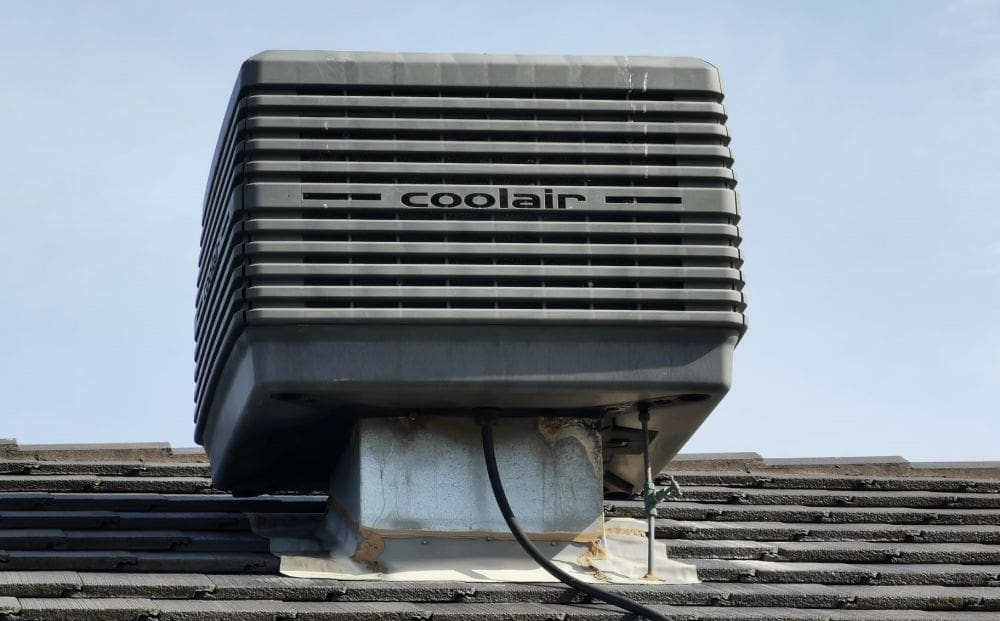
Ducted evaporative air conditioning – rooftop unit.
Best For:
Evaporative air conditioning is best for dry, warm climates. As relative humidity increases, their efficiency decreases. They are practically useless in very humid environments; adding more moisture to already humid air and increasing discomfort.
In humid situations, the only real relief is through using the fan setting, where the water pump is disengaged. You’re more likely to see evaporative coolers in use in Canberra, Melbourne, Adelaide and Perth.
Cost:
The total installation cost for a ducted evaporative air conditioner in a 4-bedroom home typically ranges from $3,000 to $6,000 or more, depending on factors such as system complexity, brand, your home’s layout, and the number of outlets required.
Requirements:
You’ll need to leave a sufficient number of windows or doors partially open to allow airflow, otherwise humidity will quickly build up inside. While on the plus side, this brings fresh air inside your house, it can also mean being exposed to increased noise levels from outside; which can be particularly problematic at night.
Main Benefits Of Evaporative Cooling:
- Low running costs in terms of electricity consumption, particularly if you have solar panels.
- Provides fresh air from outside.
- Fewer components.
- Systems can be more affordable to purchase and install.
Drawbacks
As well as being ineffective in humid climates, evaporative cooling doesn’t offer offer heating for the winter months, and may not be suitable in areas with high levels of outdoor air pollution. There’s little control over temperature, as that will be dictated by weather conditions.
For example, on a hot, dry day of 35C and 30% relative humidity, the temperature indoors can drop to 23C. But at 35C with a relative humidity of 60%, it may only drop to 30C.
Another issue are the indoor vents over winter that can act as a chimney, sucking out the warm air inside. Vent covers can be purchased.
In a country such as Australia, water use is also an issue. A whole-home evaporative air conditioning system for a 4-bedroom Australian house can use between 15 to 30+ litres of water per hour during continuous operation. And in particularly dry conditions where a large unit is used, water consumption can be more than 100 litres per hour.
Electricity Consumption
Evaporative coolers are electricity sippers (especially inverter-based systems), generally using only a few hundred watts for the fan and water pump; even with whole-of-home ducted systems. They can use up to 75% less electricity than reverse cycle systems.
If you’re using one past the time your solar power system is generating energy to cover it, the impact on your electricity bill shouldn’t be huge. And if you have a home battery, it may not impact it at all.
Maintenance
Regular cleaning is key to an efficient evaporative air conditioner; particularly in hard water areas. Filter pads can get clogged over time by dust, dirt, debris and minerals in the water supply, decreasing its performance. Service costs can range significantly, but you can expect to pay approximately $250 to $350, assuming the pads don’t need replacing.
Service Life
A good quality evaporative air conditioner installed right can last up to 15 years or more with proper maintenance.
More Info: Reverse Cycle Air Conditioners
A reverse cycle air conditioner (RCAC) works by using a refrigeration cycle to transfer heat, allowing it to cool a room in summer by moving heat outside and heat a room in winter by bringing heat inside from the outdoor air. They are most commonly installed as ducted or split/multi-split systems.
A ducted system consists of an indoor unit (typically mounted in the roof space), an outdoor compressor unit and vents indoors. A ducted system allows for independent temperature control for each area; known as ‘zones’.
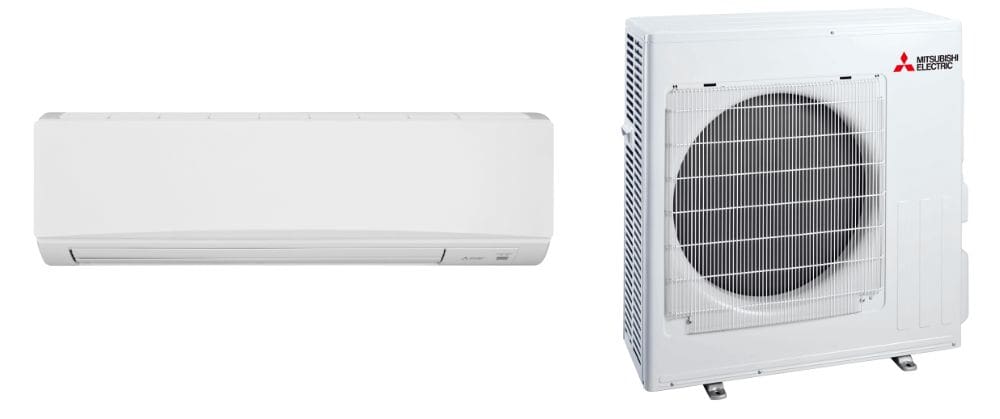
A split system has visible wall-mounted indoor head units for individual rooms, connected by pipes to an outdoor unit. Where multiple head units are installed, these can be individually controlled; also allowing for zoning.
Best For:
Reverse cycle air conditioners can be used anywhere in Australia; and are particularly useful in humid climates where evaporative coolers struggle, and areas where water supplies are constrained.
Cost:
The installation cost for a reverse cycle ducted air conditioner for a 4-bedroom home typically ranges from $12,000 to $18,000 or more. For a 4-bedroom home, the installation cost for a multi-split system can range from approximately $5,000 to $9,000.
Requires:
Keeping doors and windows closed to contain the conditioned air for efficient operation.
RCAC Benefits:
- Provides both cooling and heating.
- Precise temperature control and app support.
- Can work in humid conditions and removes humidity from the air.
- May have advanced filtration features that improve indoor air quality.
Drawbacks:
Reverse cycle air conditioners have higher upfront installation costs compared to evaporative coolers and also cost more to run in terms of electricity consumption.
Electricity Consumption
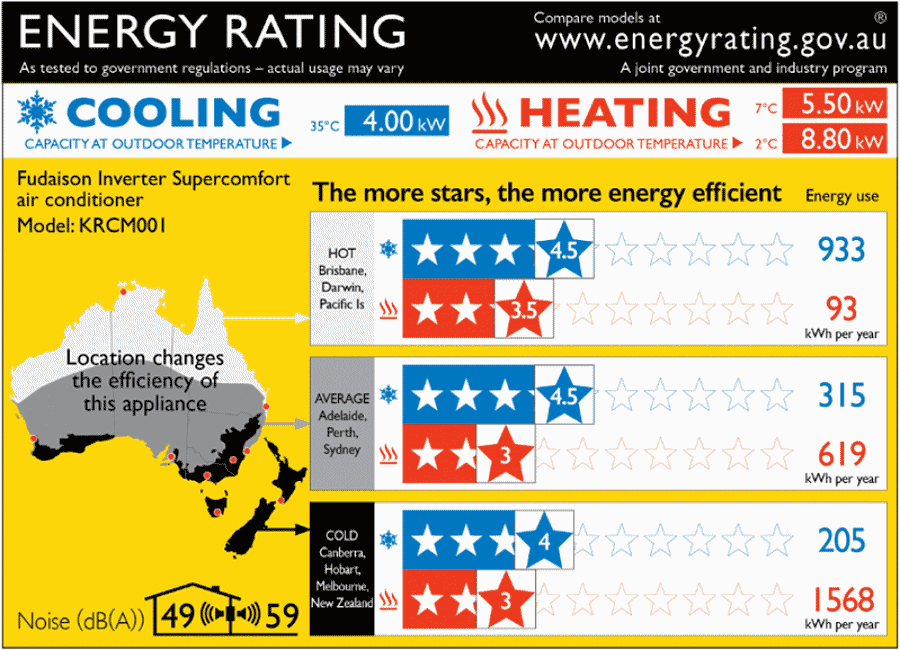
This is a “how long is a piece of string” situation. Thankfully, reverse cycle air conditioners for sale in Australia will have a zoned energy rating label. This offers information on energy consumption of the product based on the region it is installed, and star ratings for both heating and cooling. The more stars an RCAC has, the less electricity it will consume.
Generally speaking, a split system will use less electricity than ducted.
You can get an idea of how much electricity a specific reverse cycle air conditioner will use in a year on the EnergyRating website. While reverse-cycle aircons use significantly more electricity in general use than an evaporative unit, a solar power system can cover much of daytime use up until mid-afternoon in the cooler months, and late afternoon/evening during the warmer months.
Some owners pre-cool/pre-heat their homes during the solar window to use less electricity outside it when power prices can be sky-high. The effectiveness of this will depend greatly on the thermal efficiency of the home. But if you have an appropriately sized solar power system *and* a home battery, the stored solar energy could take you through the night.
Maintenance
Ducted RCACs should be serviced every year and this costs around the same as an evaporative air conditioner. However, these systems are more complex than a evaporative cooler and over the long-term may cost more for maintenance and repairs.
Split system reverse cycle air conditioners are easier to service and for the most part can be done yourself, by keeping the outdoor unit’s screen free of leaves and other detritus, and cleaning the filter in the head units regularly (a simple task).
Service Life
The average service life of a reverse cycle air conditioner is 10 to 15 years, but this can be extended to 20 years or more with proper, regular maintenance. We have a ducted system (4 zones) that’s around 13 years old and still seems to be working fine for what it is (and it’s not one of the better brands).
The Bottom Line:
- If you live in a hot, dry climate and want something that costs little to run, evaporative cooling can be ideal.
- If you need year-round climate control with precise temperature management — especially in humid or varied climates — and you have an appropriately sized solar system, split system reverse cycle air conditioning is the better choice. And even better if you have a home battery.
Choosing The Best Aircon For Your Home
An air-conditioning system can be a significant investment and there’s a lot to consider beyond reverse cycle vs. evaporative; such as type, size and brand. Additionally, a good system designer and installer is just as important as good quality equipment.
A purchase decision is one you’ll be living with (hopefully, comfortably) for a long time, so the best approach is to get advice from experts you can trust.
For more in-depth information, see SolarQuotes’ shiny new guide to air conditioning – which also covers system sizes, running costs and how to optimise aircon use with solar.
 About Michael Bloch
 RSS - Posts





Hopefully in the future we will see the second generation of evaporative units in Australia they use a system to cool part of the incoming air then this is used to dehumidify the other portion of the incoming air which is then evaporative cooled to achieve lower temperatures and reduced humidity. In addition an additional dehumidifying section can be added to help on very humid days.
Such systems are common on commercial buildings in the southern USA and are also to be found in Singapore.
Still find it hard to believe that homes are built without eaves, probably the most cost efficient thing you can have for year round comfort.
Chris,
The aesthetic horror is evidently to reduce building cost, regardless of decades of increased cooling costs. But the NatHERS computer modelling used to get us 7 stars, to be allowed to build, allows other cost items to be traded off against eaves.
Mind you, I’d omit unrelated items like golden taps, twin vanities, and heated towel rails, in favour of eaves. (Here, a 90 cm wide porch shades north-facing habitable room windows from late Spring to late Autumn, in addition to ample eaves elsewhere. They add roof area for more PV, as well. Win – Win.)
Then there’s rainwater collection – every m² collects 1L per mm of rain, 1 tonne per 5mm on 200 m². Neighbours trucked water before November’s rains, but here, 300 m² of roof plus ample tanks held out.
Climate resilience is partly dependent on your roof area, folks, when restrictions bite hard, or there’s no supply.
Just build on solar passive principles we did four and half years ago we use minimal heating and never uses cooling we live in southwest victoria the comfort factor of our home year round is amazing
We only cool our living end with a RCAC wall unit.
1000W until the room is at temp and then 300W. Lower if I use a mister on the outdoor unit.
Lived through an Evap reaching its limit aroud 46C a few years back. Not a lot of fun.
Opening windows and doors can help RCAC as well. On returning from the paddock this afternoon, the living area was at 26°C, due to sun load. It was quicker to open a S window & a N door, than wait for the aircon to cool it down. Fresh air too.
RCAC is also better for fully off-grid, i.e. on limited tank water. That’s needed for drinking, washing, and the fruit trees & veggie garden. 100L/day for evaporative cooling would be too much – 100L/hr is insanely profligate. Neighbours had been trucking in water as it is.
Running the RCAC costs zero. I’ve left it on all night, and its intermittent 700W puts very modest drain on the 46 kWh battery. Even in medium overcast, the 27 kW of PV has the battery on 100% long before days end, RCAC running all day.
On hot days I run the RCAC in the workshop to keep the inverters and batteries cool – again, at zero incremental cost. With adequate PV, evaporative has no use case, I submit. Certainly not where heating is also required.
We have both and absolutely love being able to turn on the Evap (without the evaporation most times) at night to simply blow out the hot air at night, and to get a constant breeze in our rooms.
As well it’s a lot quieter than running mini splits in each room.
My Evaporater in Tamworth DRY even though you might get humidity sometimes it still works well with very low water consumption and a quarter of the power of air conditioning.
I have a 9kw split system just for the
early winter mornings.
My last 3 monthly bills amounted
to Zero with my solar panels,admittedly
some help from the govt rebates but
even without my bills are very low
as I use every appliance
as well as a swimming pool during the day.
I am an installer with 20+ years experience. You do not have to service your ducted or split system AC every year. I recommend servicing a split system about every 5 years, and a ducted almost never needs to be serviced. The filters can be cleaned by the user and for under $50 you can have the return air filter replaced, which only needs doing every 5-10 years. Evaporative units cost nearly as much in extra maintenance than the additional power cost of a refrigerated unit.
In some bushfire-prone areas, new evaporative systems are prohibited (EG Shire of Yarra Ranges) because the can bring fire into the house with ember attack and the evaporation media can also catch fire.
I live in Perth. After installing solar using one of your great WA recommended companies, decided to buy a couple of splits. Chill the house down in the day using solar. Turn off at sunset and let the house insulation do its work. fan sometimes. I also retained by old working evap or Swampy as we call them over here for the mild days when there’s a cool sea breeze just to suck in the fresh air, Best of both worlds iI thimk.