

Six months ago, I retrofitted a SolarEdge Energy Bank battery to my 6.6kW solar system.
Finn encouraged me to join a Virtual Power Plant (VPP) to add depth to my battery ownership experience. I chose Amber Electric’s ‘Amber for Batteries’.
This post is a review of using Amber with a battery. I do not recommend using Amber Electric without a home battery.
A four-point summary of my review:
- Year-over-year, there was virtually no difference in my bills overall being with Amber Electric compared to being with Origin Energy.
- I expect Amber to come out ahead over the autumn/winter period.
- Negative electricity prices can hurt savings if you have an inverter that can’t export-limit.
- The tech that coordinates my SolarEdge solar power and battery system is fragile, reducing my savings.
If you want to learn how I reached those conclusions, read on…
What’s A VPP, Again?
As a refresher – joining a Virtual Power Plant (VPP) means relinquishing control of your battery to the VPP operator.
They will charge and discharge your battery as and when they like, to support the electricity grid when it’s stressed. In return, you’ll usually get a monthly credit as a line item on your bill.

“Would eight kilowatt-hours make you feel better?”
A handful of VPPs will offer a revenue split if they discharge your battery during a ‘grid event’. That’s when the price of electricity spikes (for example, due to storms or heatwaves), and the stored energy in your battery becomes much more valuable.
With my SolarEdge battery, I was only eligible for two VPPs – one run by Powershop (Powershop VPP) and the other by Amber Electric (Amber for Batteries).
Technically, Amber for Batteries isn’t a VPP, as you don’t have to give up control of your battery to them if you don’t want to. And they’ll only charge or discharge your battery for your financial benefit, not theirs.
Powershop offered $10/month off my bill in return for permission to hammer my battery whenever they like.
Amber promised me full control of my battery and access to wholesale energy prices – meaning on rare occasions, 10kWh of electricity in my battery could be worth up to $150.

How Amber benefits users, in a nutshell. FiT = Feed in Tariff (what you’re paid for exported solar energy). Image credit: Amber Electric
In exchange, by signing up, you pay a higher daily supply charge (approx. $1/day for me in South Australia) and a monthly membership fee ($15 per month). So, naturally, I joined Amber, as the potential upside for me was far higher than with Powershop.
The payoff was near-instant – within the first month of being with Amber, a wholesale price spike meant I netted ~$100 from a single day of exporting my energy:
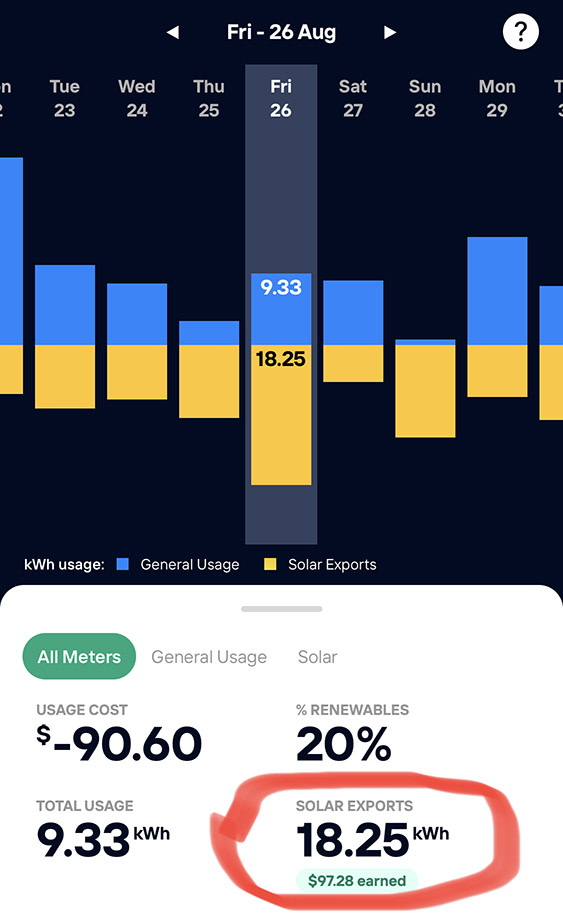
If only this could have been a regular occurrence – the reality of being on Amber over the last six months wasn’t quite as lucrative.
Amber Is For Enthusiasts
If you spend 5 minutes browsing the Amber Electric Users Group on Facebook, you’ll notice day-to-day posts involve the minutiae of individual homeowners squeezing every possible cent by micro-managing their usage:
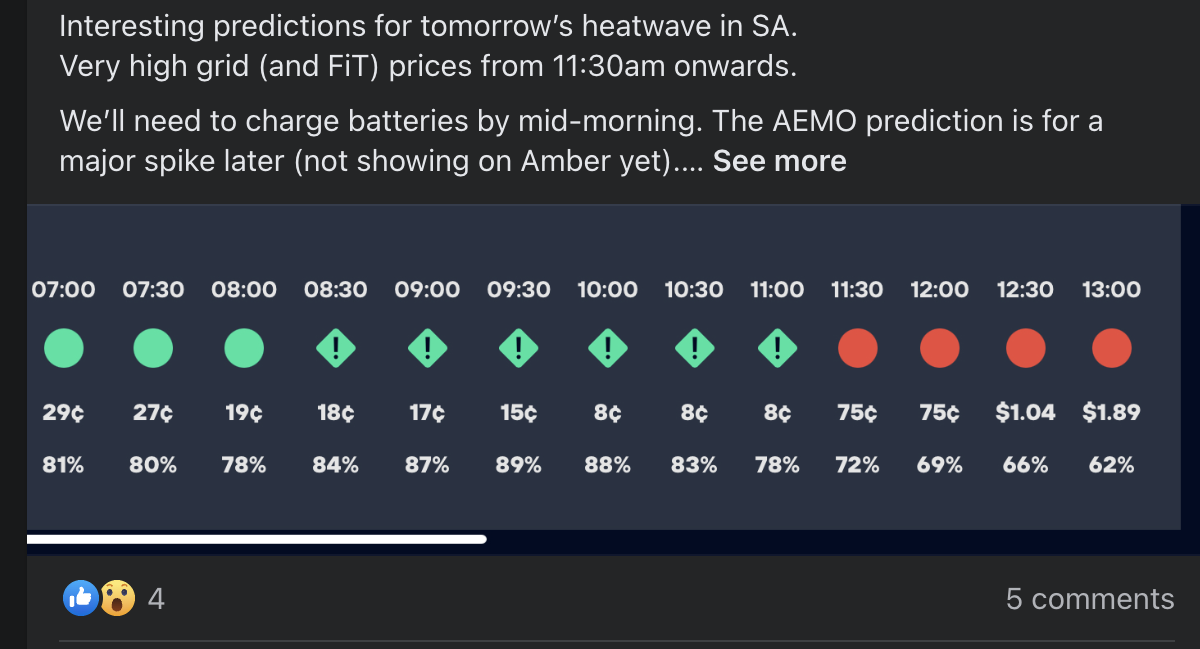
As wholesale electricity prices sometimes go a bit nutty, this inspires some equally nutty behaviour from Amber users.
On more than one occasion when my house was already at a comfortable temperature, I still cranked both of my aircons to their max settings to get paid to heat/cool my house when electricity prices were negative.
If you’re an average person who doesn’t want to worry about their energy use habits, spending 15 minutes reading these posts may (rightfully) scare you away from Amber. This isn’t a criticism of Amber – the reality is the most hands-on users will get the most out of it.
What Batteries Does Amber Electric Support?
At the time of writing, Amber-supported battery brands are:
- SolarEdge
- Tesla
- LG Chem
- Alpha-ESS
- Sungrow
Amber has told me they’re doing a lot of work behind the scenes to expand this list – so if you are interested in joining but don’t have a compatible battery, don’t give up hope!
Negative Electricity Prices Means Export Limitation Is Important, Depending On Your State
Sometimes electricity prices can go negative. Usually this is great, as Amber will automatically charge your battery for you – giving you a full battery and earning you money.
But negative prices have a downside – it means your solar feed-in tariff can also go negative. It’s not a good feeling when Amber charges you money to export your clean solar energy to the grid:
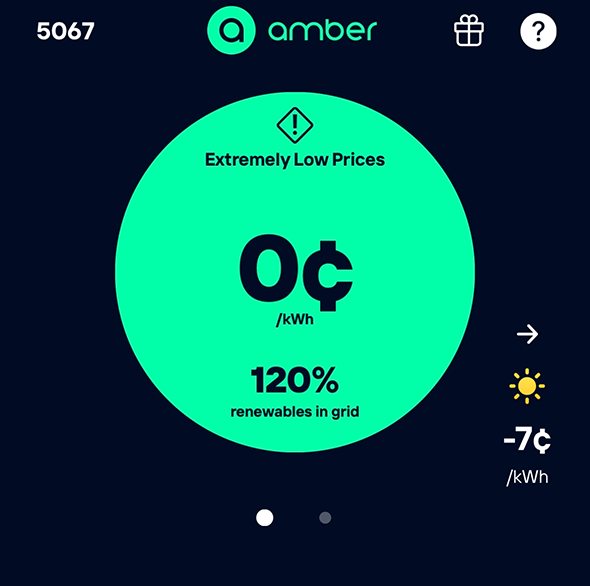
-7c/kWh feed-in tariff. Ouch.
At the time of writing, SolarEdge, AlphaESS, and Sungrow inverters can be export-limited by Amber. If you have a Fronius, SMA or Huawei inverter, you can get a free curtailment device through Amber’s partner Village Energy.
After speaking to Amber about their internal data, it seems that negative pricing events are far more common in South Australia compared to Victoria, Queensland and New South Wales.
So while they’re working hard on making every major inverter capable of export limiting, if you’re not in South Australia the financial downside of not having it is much smaller.
My Zero-Export Broke
For the first few months on Amber, my SolarEdge system would export-limit my solar to zero at times of negative pricing, preventing me from losing money.
Then, abruptly, Amber Electric emailed me to say something had broken with SolarEdge’s API, and my system had lost its zero export function. Full functionality was restored in early December.
My Battery Refused To Export At Full Throttle
While gathering information for this article, I noticed during a recent “grid event” my SolarEdge battery, with 5kW power output, was not exporting to the grid at this rate to maximise my savings – it was only hitting a peak of under 2kW, as this data export Amber provided shows:
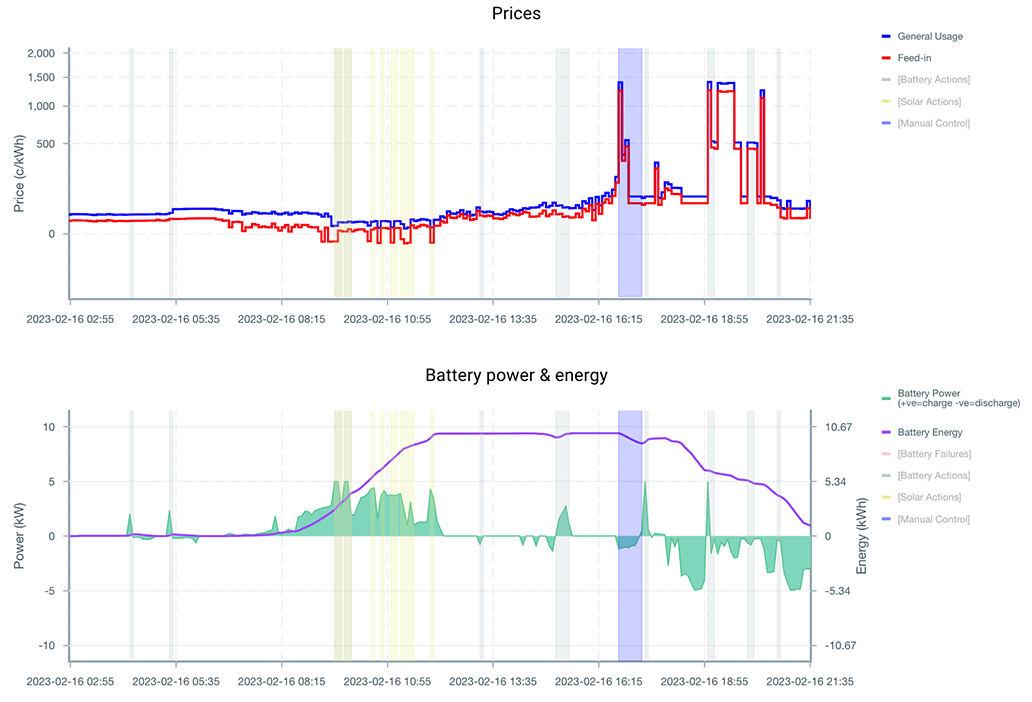
The blue vertically highlighted section shows a peak pricing period when discharge should have been ~5kW – but wasn’t anywhere close.
A call to my contact at Amber Electric confirmed this was not normal, and they’re investigating on their end to find out why this is happening.
Maximising savings with Amber is heavily reliant on the discharge power of your battery. Many grid events only last 30-60 minutes – every minute counts. My underperforming battery is costing me significant savings. I hope SolarEdge and Amber can fix this soon!
Show Me The Money
I’ve been on Amber for six months. What did it do for my bills versus a regular electricity retailer?
Before I dive into the comparison, I’ll note in the last three months, my household has gone from three people to five.
This has naturally increased the energy used. But since this has been over summer when energy is generally cheap, it had a minimal impact on my bills.
My Six-Month Savings
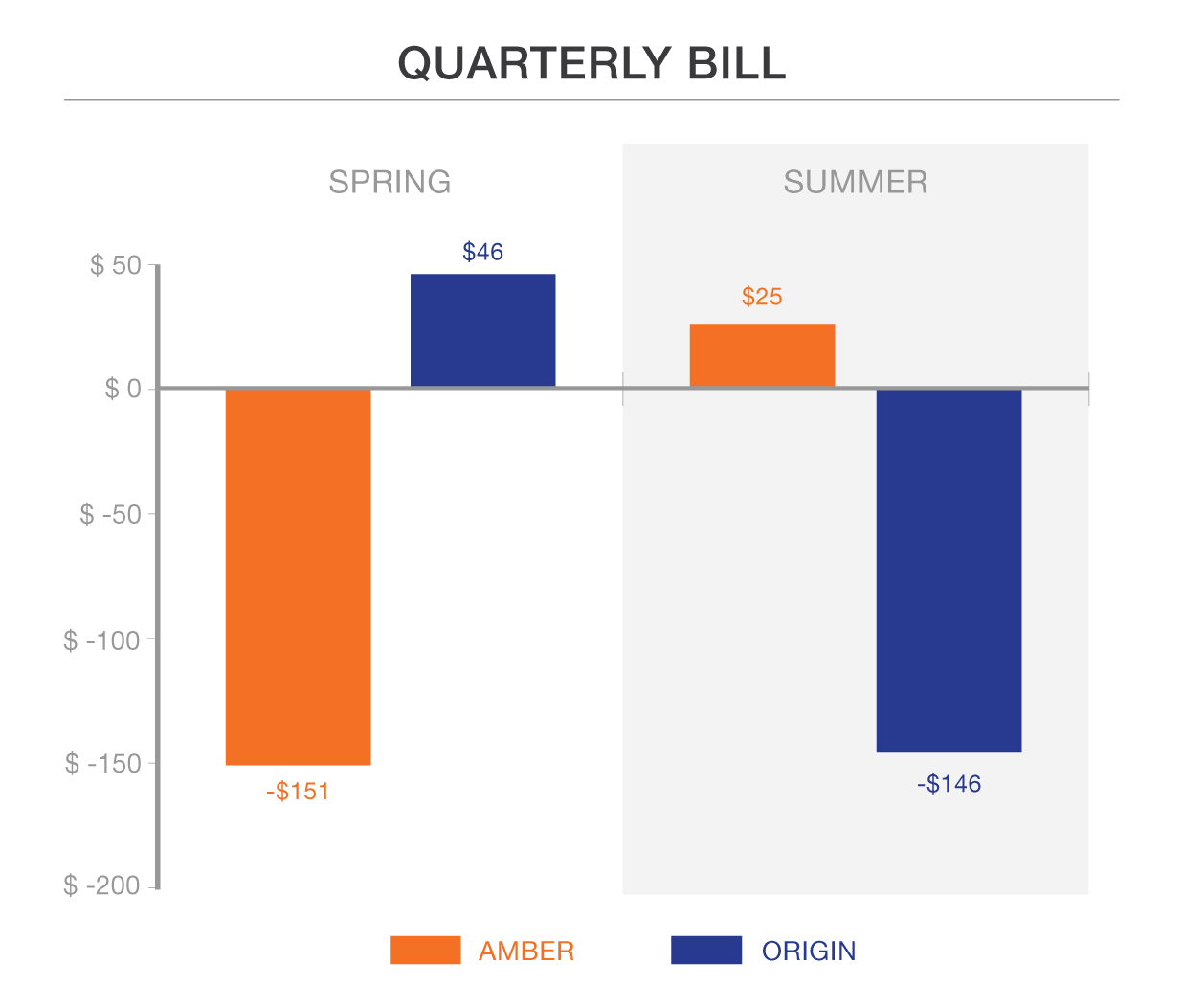
Without further ado – here are my savings over the past six months, as well as a comparison with the same period over 2021/2022 when I didn’t have a battery and wasn’t with Amber:
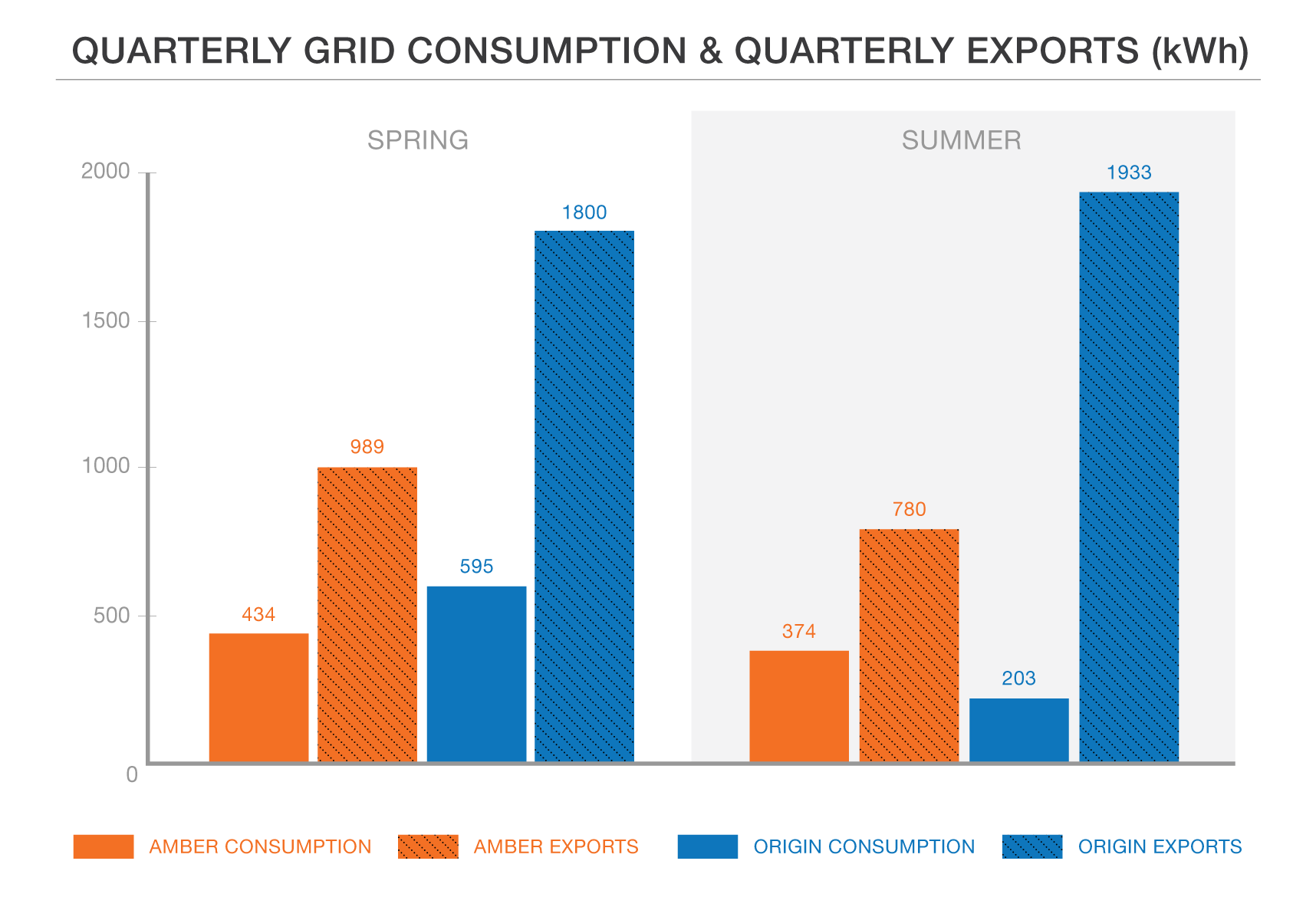
Here’s my grid consumption versus exports:
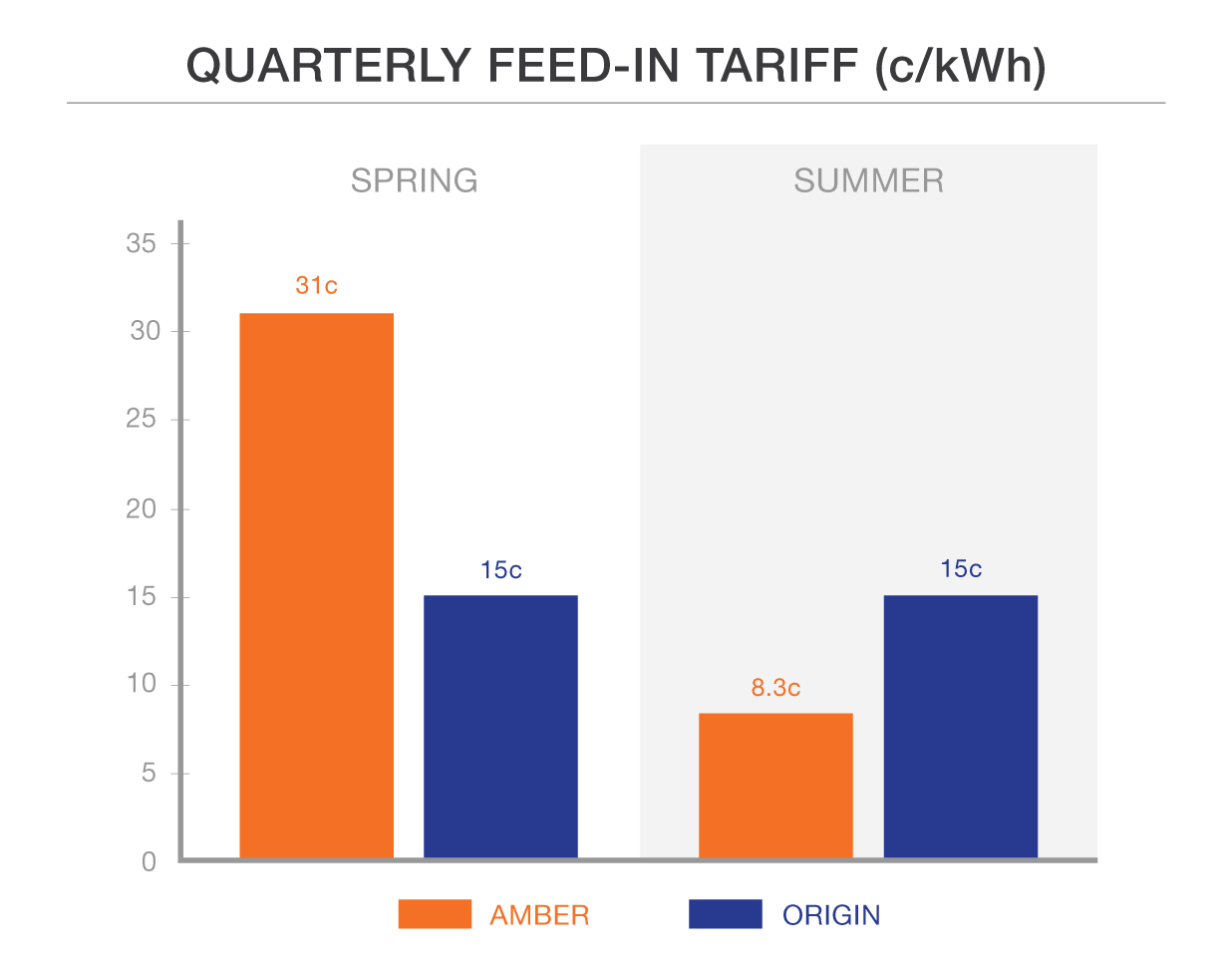
And here’s what I earned for my exports (for Amber, it’s an average value for the quarter, as the FiT varies daily):
As you can see, my spring bill on Amber, compared to Origin, was a solid credit. This is because I didn’t have a battery in spring with Origin, and I had days where I’d use more energy for heating.
While on Amber, I had a battery to keep my grid imports lower and had some ‘grid events’ (like the $100 day in late August), which gave me a good credit. There were also opportunities to top up my battery from near-zero (or negative) grid prices.
My summer bill on Amber was $25 versus a credit of $145 with Origin. This is for a few reasons:
- The number of people in my house went from three to five – increasing usage and decreasing exports.
- The median feed-in tariff for summer was approximately 8c/kWh versus 15c/kWh with Origin – meaning my exports made me less money. Note that Origin is currently offering an 8c FiT – so if I was still with them, my credit would be roughly half.
- There were many days in summer when electricity was really cheap on Amber. When grid electricity is cheap, your savings from solar power are lower.
- Amber Electric has a higher daily supply charge (~$1 versus 85c with Origin) and had a monthly membership fee of $15. Without the membership, I would have been in credit.
Overall – was I better or worse off by joining Amber Electric? I more or less broke even.
Amber Was Kind Enough To Provide Me With Internal Data
While talking with Amber about my battery’s power output issue, I asked if they could provide me with data for other users’ savings, broken down by state. I collated it all here:
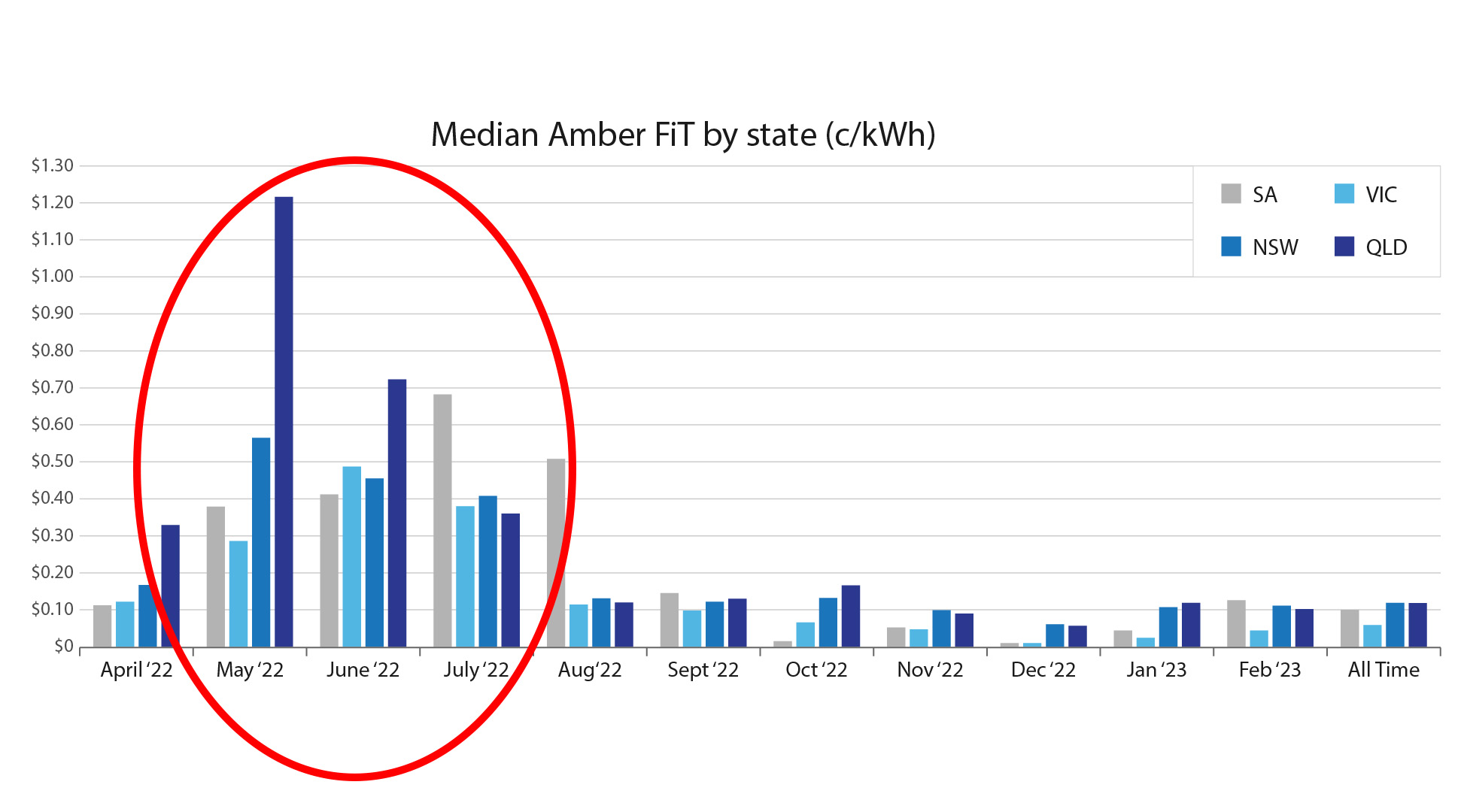
Most of the savings generated by Amber come from the autumn/winter period when wholesale energy prices are more volatile.
While keeping in mind past performance is not a predictor of future performance, the Eastern states seem to benefit the most from being on Amber Electric. Victorians get the short end of the stick.
A special mention goes to people in the Ausgrid network area (Sydney/Newcastle), as they get to double-dip. Amber customers on the Ausgrid two-way trial tariff get to add Ausgrid’s 27.8c/kWh bonus FiT on top of Amber’s wholesale FiT during peak hours (2-8pm), turbocharging their earnings.
My Predictions For The Next 6 Months
Being with Amber was an interesting experience. You spend more time managing your home energy compared to only having solar panels.
With solar power, all you need to do is try to maximise energy use when the sun is out. Not too hard.
With Amber Electric, it might be the case that energy prices will be lower outside of daylight hours and you’ll benefit more from running appliances earlier or later in the day. And then, when wholesale prices spike to $10/kWh at 7 pm and your battery is flat, you may seriously consider turning the power off to your house to avoid being slugged.
It’s a great feeling to crank up your big appliances like the air-conditioner when electricity prices are negative and get paid to use electricity. It’s not the best feeling to sit in a sweltering house, hiding the aircon remote from your mother-in-law because prices are spiking and it’d cost $50 to run it for an hour.
But once you average out the good and bad days and factor in the higher daily supply charge and monthly account fee, I broke even on savings with Amber versus Origin (or any other electricity retailer).
As Autumn begins, days shorten, average daily solar outputs drop and inclement weather becomes more frequent, I expect more wholesale price spikes – and thus more significant savings.
The chart I shared above showing Amber’s internal data for average FiTs by month, suggests late spring/early winter is the biggest opportunity to make money.
In September, I’ll follow up on this post to review a full year of being on Amber Electric. Stay tuned to see if my predictions are accurate.
Also check out Jono’s SolarEdge Energy Bank (aka Home Battery) review here.






Been with them 18 months now, last 9 with a battery, not really any benefit in Vic since the gov intervened and prices went back to somewhat normal. In that time there was 1 event where power was over $1 kwh, and their system had a bug and no one could take advantage, to their credit they are crediting 2 months of their monthly fees.
Otherwise our monthly bill is around $30 to $40 as the wholesale power prices are cheap during the day sending the Solar FiT into negative, so we are paying to put solar into the grid.
Its only $1 or $2 a day, so it slightly annoying knowing that I’m only pulling an average of 30kwh from the grid for the month and the rest of my solar is getting put back in. Its a price we pay for trying to be better with our usage.
I’m trying to ride it out knowing the cheap power can’t last forever, but its getting harder knowing that I could be leveraging a positive feed in rate from another energy company and easily be in credit quite quickly, especially with everything else going up around it.
Amber for batteries isn’t helping when the prices are like they are. There are very minimal automated feed in events when the power goes to 30 or 40c to offset the days solar tax.
I can’t even curtail the power with the Powerwall as there is too much generation at times, so its not possible to go off grid either, only to be fixed by purchasing another Powerwall.
So like the author I’m interested to see if there is a turnaround in the pricing. On the other side of that along with the author we are the lucky few able to ride out price spikes and higher prices, whilst those without solar and storage are going to cop it hard.
Similar..I just emailed support about the 3rd time….I’m a fairly new customer with battery and 6.6kw system. This morning smartshift was charging from the grid at 15c, when there was plenty of time and sun to charge the battery. Consequently it was full by 1pm, then smartshit (unfortunate typo!) started exporting in the early afternoon at 2c when it should wait until prices were higher in the evening. So I took it off line until around 6pm. Then I had about 94%, we were using between 2.5 and 4.5 kWh for cooking, and smartshift started drawing on the grid. So I used smartshift to self consume for 1 hour. Other previous reported issues were the inverter not shutting off when battery full unless I go off grid with tesla app, exporting continues long time after i end dispatch. Please check you have full control of battery and inverter. Is there something wrong?
I believe, as you say, the battery makes all the difference. Amber was nice enough to provide me with 12 months of pricing data (import / export) in 30minute chunks, which I could then compare to my downloads from current supplier – AGL.
It turned out for me, with 10kw Solar / 8kw inverter (no battery), and an EV which mostly charges at home using ChargeHQ, that Amber would be significantly more expensive. Note that this is using actuals from the past 12 months – perhaps with Amber our behaviour would change to maximise any benefit.
However – to change to Amber the whole household has to get behind it. Try telling a wife and 3 children without the same level of interest that running the aircon right now would cost $50… my judgement in choosing Amber would be questioned, no matter the preceeding benefits!
This is my problem too. I am the only person in the house who is ok with manipulating our power to suit conditions. Wifey and kids are already annoyed with me being a nazi. If I get a battery the whole point would be so they can get me off their backs about when to use power, not to make things worse. Now that you’ve had it longer, any thoughts?
With this “broken” limit, it is as easy, as use dry contact relay (such as Shelly 1) to clamp DRED to 0 or use contactor on inverter output which will do even better – it will stop PV entirely so that whole load will earn on negative price.
Interesting.
We’ve been with Amber for a few years now. We only have 6.6 kilowatt of PV and an EV, But no house battery yet to be able to participate in energy trading .
That will come later in the year after a switchboard upgrade etc.
The advantage of having an EV with Amber is crazy- cheap prices on Sundays in particular and often Saturdays too so we can fully charge for about 2 to $4 on most weekends. For about 300 km of weekly commuting. Grid power for between 2 & 8 C/kWh are common between 10 & 3 on the weekends.
The winter evening prices freak me out a bit, so we tend to use our wood heater to avoid the high evening prices. Once we get a battery we will be using our far cleaner reverse cycle air conditioner for heating.
We are on Ausgrid so hopefully they will still have the special offer by the time we get our battery.
Ian,
To this southerner, your winter evening cost exposure seems much more real than the “$50/hr aircon” scenario. If the PV array size is fit for purpose, then the aircon should always be self powered on hot sunny days, I figure. Is it that it’s also used in summer rain (negligible insolation) in the deep north?
If it’s been hammering during the day, can it be needed at night? (That’s what insulation and internal masonry are for, at least in my recently completed build, admittedly off-grid,where this stuff is serious.)
Here in the Dandenongs, I use about 10 tonnes of firewood p.a., so it’s handy to have 200 Ha of forest (out in Gippsland), a chainsaw, and a ute. When it comes to heating, there’s no better solar energy battery than CO2 neutral firewood. Even the wood ash is great for lawns and pasture, helping grass outcompete weeds like Capeweed. (OK, down in suburbia, electrostatic particle precipitators would be advisable if used widely.)
I am not sure, but I think that the overall bill is limited to the default market offer ( DMR to prevent $50/hour, but the fear is there :)!
That is a lot of firewood, about 5 x more than we need , so I worry about animal habitat for that amount x thousands of people. Fast growing eucalypts provide us with all the fire starting & kindling & some logs we need, the rest is demolition waste / offcuts – hardwood, so pretty low impact, & burns very hot due to extreme dryness.
After we get a battery, will be using RCAC as it is simply much easier to look after & just keep the fire for occasional ‘atmosphere’
We use the cooling cycle about 3 – 5 x a year, so not much
In October last year I booked a new system and battery to replace my old 2.4kw Talked to Amber at the time about Sungrow batteries and was told by the new year they would be good to go. Well your piece on Amber is wrong about Sungrow. Hear we are in mid March and still not up and running. Negative prices and can not empty my battery.
Last month when I spoke to Amber, they provided me with internal documents saying Sungrow integration is coming this month (March). I will double-check with my contact and amend my post if necessary.
Hello all I have noticed, the price of electricity has risen, because the temperature out side is 42 And every Town In Rural Victoria, is so hot , everyone has air on, On So The Grid , has decided to make money , Up it gos , and will stay until after 8.30 pm, they know . Everyone is Hot and must keep air on on . So we can’t win It’s all about Money , and the always WIN ,
Hi John,
The thing is that the more money they try to make, the more viable batteries and solar become, for those who can afford them.
We should never have sold off such an essential service to private for profit operators.
And the really rotten thing is that it is those least able to afford it who are hit hardest. Anyone with the resources ups and shifts aircon powering to photons, for negligible running costs. (The silver lining of a resulting fragmentary reduction in network load is small comfort to the remaining captive consumers.)
Battery affordability is improving, with wholesale cell prices reportedly falling 51% in the last year. Manufacturers of complete managed batteries must then be raking it in, as it takes a little bit of effort to find much reduction there.
There being no way global heating will be under 2 degC by 2040, and 46 or 47 degC threatened for the Western District today, we’ll see over 50 degC by then. That is though ample time to install multiple TWh of gridscale batteries, at ever increasing rates, and plummeting cost, already evident. Coal power ought to be history for nearly a decade by then. If not, then there will be an awful lot of people off-grid, making their own way to very substantial climate resilience.
Electricity pricing is complicated. The wholesale price is a minute by minute number which has peaks and negative prices too…. This is one of the reasons none of us can do any sort of true analysis. You have to keep on studying the numbers and then make a gut decision based on them. Or call it a best fit SWAG(Scientific wild-ass guess) decision.
The Amber scheme sounds great, but has costs associated and of course those costs can change too if the company was say sold to a big power company as has happened previously with many independent electricity resellers who offered good electricity prices being bought up and then the pricing structure changing.
As Jonathon found at the end of the comparison, the savings/ benifit of having an externally managed battery were marginal. But what’s not mentioned is that had the power outages where he was paid large amounts lasted longer, his battery would have been flat and might have lost the contents of say his freezer. There’s also no mention of the lifespan decrease by allowing your battery to be used harder than it would be normally. This also has a cost.
To me the advantage of a battery is that I have backup in the event of a power failure.
Norm
I was with Amber for about 6 months. Initially with a 5kw system and later with a 10kw system and Solar Edge battery. If you are a big energy user the Amber wholesale prices can be very cheap at times, useful for EV charging. However as I moved to a larger solar system with battery, I became a net exporter and my primary interest became Feed-in-Tariffs . At times Ambers FiTs can be high but overall my average FiT was less than 10c/kWh. I am in the Ausgrid network but no real benefit (as Johnathon’s article suggested). On the weekends Ambers FiT is often negative. Solar Edge works well with Amber SmartShift as it automatically reduces solar production during negative FiT periods. To get the best FiT you usually need to drain your battery at night or during spike events, leaving your battery with little or no power for the house. Sometimes you have to buy power the next day, defeating the purpose of exporting. The Amber software is still a bit clunky and is a work in progress. Having had my battery drained by SmartShift for as little as 4c/kWh in a spike event, I found the returns to be unpredictable.
I’ve now switched to Powershop. In NSW they have a fixed 13c /kWh FiT. I didn’t join their VPP as I prefer to keep all the power for self consumption.
I think eventually all power companies will operate like Amber once the solar market becomes saturated. Negative FiTs will be standard. But for now I try and get the highest FiT on offer.
Thoughts now you’ve gone through a winter? I have 10kw solar and am considering a 10kw battery.
I Have exactly 10kw system, battery…now in summer generating 40kw,, the battery lasts all night, 20% use…single….cost me $13000,
No bills ever…looked at amber but it’s like being a day trader,, not my thing,, getting 7c.kw from supplier,, good enough with no hassles and app nightmare trying to figure out new technology….2 options
1_chill out, let’s others worry about it.
2_ constantly worry about the fit amount…and looking at the appp all day…
Good luck.
Hi all
Interesting reading all these comments, makes great reading.
I’m in Ausgrid’s network, with a 10kW inverter and a recently installed 10kWh battery, both by SolarEdge.
My current retailer is Origin, FIT 10c/kWh for first 14kWh per day, then 5c/kWh for the rest. I called up Origin to say that I’m looking at switching retailers and they’ve improved my FIT to 12c/kWh for first 14kWh per day, a slight improvement.
I’m still not sold on this Amber thing, it does not sound like a clear winner, otherwise we’d all be jumping at it, is my conclusion (for now)!
An EV is next on my wish-list 🙂
A single battery on the wall, is not enough. If you are largely discharging that once ( or even twice) a day, the economics simply do not add up. Even with demand pricing FIT(feed in tariff) prices. Its simply tricky economics. The same tricky economics that the electricity companies have used to make any plan that you sign up to difficult to understand and completely dependent on how exactly you are using electricity.
As a solar user, I don’t really care how easy it is for the installer to install something other than the additional cost for that difficulty. I don’t think anyone would disagree that the Tesla Powerwall is a quality piece of kit that integrates seamlessly on the whole. However, every Powerwall has a built in inverter. You are paying for that every time at premium price.
I can purchase batteries at retail prices for roughly half the price of a Powerwall of the same capacity. This is important when you start increase your battery storage capacity beyond a single Powerwall capacity. Which you would want to do to decrease the daily discharge level. If I discharge to 80% daily I get a life for the storage based on that discharge level. If I discharge by only 20% daily my lifespan goes up not by a factor of 4, 80/20=4 but by a factor of roughly 25. So 6 times better than you would expect. Even more in fact as the rate of discharge for the increased battery storage is reduced too.
This is from the DOD cycle life quoted here. https://www.powertechsystems.eu/home/tech-corner/lithium-iron-phosphate-lifepo4/ To me, it’s important to educate all users and installers on the economics of scale. As you scale up, your economics get better not linearly, but exponentially. For this reason, a bunch of batteries that give me 3 to 5 days total usage and an inverter that supplies the demand power I require for my needs is always going to be financially better than a premium cost of a single underspecified power wall solution for my needs. A designed solution
Really good conversations and information. As I read it all seems to be retrospective with a lot of constraints and/or failings. Surely by now, the like if amber would have simulated models with data input, likely able to provide feedback for an optimised solution. I get the many variables, but perhaps averaging helps that, or what about a feature that is able to remove the top and bottom 5% of spikes, peaks and troughs. To make any decisions, I think what I need is a forecast based upon my historical data, matched to the actual market for tge same period. If this could provide a comparison it might be a simple choice. I think there is scope to enhance your future situation through toggling solar feed in and battery size, and electricity consumption.
We are smart enough to see the potential, but don’t leave us to guess what system size or features. Help us optimise our choice for best advantage. I have a 21 kW A/C, 2 solar systems ( 4.5 and 6.6kw respectively) and feed up to 70kw into the grid on a good day, but no battery (yet). I could turn my A/C on and chew my entire solar, plus a battery possibly plus grid….. so how do I optimise that? Come on amber… be proactive and help me decide by clear evidence for my situation. I’m keen but cautious.
Maybe a new A/C first if it uses that much. My inverter A/C uses around 1kw and cools my 60’s upgraded home. You are right about the averaging with Amber. I have a smaller system with a 16kw battery and can only sell about 25 on a good day. But not buying anything in.
Looking forward to seeing the update to this article 6 months later as promised…
Can you articulate why Amber has such a big spread between consumption tarrif and the FiT any point in time? I often see a 20c+ delta (Victoria).
update should be published next week…
Hi Adrian – I put your question to my contact at Amber, who replied:
“The difference is largely network tariffs. The customer may be on time of use (TOU) or anytime which will impact the cost of power.
https://help.amber.com.au/hc/en-us/articles/360037454711-How-do-Amber-s-wholesale-prices-work-
They should check their distributor and if there’s a TOU tariff that they think they will be better with, we will change them to that with an email to [email protected] ”
My one-year update is coming soon 🙂
Hi Jonathan
For the export limiting to be available on solaredge inverters, do you need a separate modbus energy meter or do the newer energy hub inverters have this included in the inverter?
Amber have advised this is required but also my installer has informed me our inverter has one inside – so very confused. Awaiting some clarity from Amber at the moment.
I am in SA and want to understand this a bit better as I think our systems are very similar and your experience will be beneficial to know if I do need anything extra installed.
Hi Ben – to my understanding the Energy Hub inverter has it included.
Hi Jonathon,
Thank you will see how we go.
Also apologies for the auto correct on your name in my OP.
Appreciate your review and look forward to your update over this next period of time might be able to compare!
Take care.
I have an Energy Hub inverter installed May 2022 and it curtails solar exports with Amber
I left a Google Review for amber, I was with Amber for nearly six months but had to leave. The technology is too immature for a modern electrified household (10kW worth of inverters, Solar hot water controller, 9.6kWh battery, EV charger…). Basically, Amber would trigger my solar hot water or my EV charger accidentally when trying to export power (especially when prices were high). I get that part of the problem are the OEM APIs that they integrate with, but it is still their product and blaming a third party just shows they haven’t put enough thought into how they integrate. What I worked out was that all the smart devices in my house would see the battery export as “Excess solar” and start trying to consume it. If I had time I would use their API and write my own control strategies that take into account the configuration of my house (which will be a very typical set up in the future).
I have left them as I can’t afford all the extra fees (Demand Use especially) and constantly micromanaging my smart devices which I want to use Solar only (not import power).
I look forward to better integrations in the future, but being a trail blazer here costs a lot more money then it saves.
I have been with Amber only three weeks but I’m a little concerned by the amount of FIT I’m missing out on due to solar curtailment. With AGL I would be being paid 15c/kWh for my esports. With Amber I’m not even exporting.
Curtailment also makes it hard to compare what would have happened with another provider because your panels simply don’t produce the power so it’s not recorded in the stats for the day or month to compare “same time last year”. The only information you get is todays cost vs the VDO and that’s a saving but what you really want to know is “todays cost vs what I would have paid/earned with AGL” and that’s impossible to work out because they have charged your battery with cheap power (which AGL can’t) and curtailed exports (which AGL won’t)
So I’m in the dark about how much money I’m saving/losing but I’m worried I am losing because the FIT is so minimal, both in kWh exported and the price paid compared to 15c. Their monthly fixed costs might be cheaper than AGL as AGL have a huge daily supply charge. Last 13 months I was a net exporter in all months except June so I suspect Amber is not going to be a good fit as it seems to favour people who need to use a lot of grid power and we are maximised to be as self sufficient on solar as possible.
As a side quirk I also have my panels split across two Solar Edge inverters and Amber only sees one of them as Solar. So it thinks the other is grid power in the App. I’ve notified Amber and they have assured me they won’t charge me grid charges for what is really my own solar and they are (supposedly) working with SolarEdge to find a solution.
Great comments all. I didn’t realise the Lowerwall inverter was actually in the case with the battery. I thought it was in the Gateway. Anyway, that means that if I get a second Powerwall I get an inverter I don’t need??
Is there another battery I can add to the original Powerwall to increase my capacity without further inverters?
Thanks.
With an AC coupled battery, such as yours, there are usually no exposed DC terminals for you to connect additional batteries. If you could find some, then you’d have a chance of adding to the DC side, sans second inverter. But parallelling low impedance high capacity batteries is not as simple as merely ensuring that chemistry, cell count, and current sharing are all equal/proportionate. At the very least, each string would need its own BMS.
It is much easier to expand a modular system where an inverter of appropriate capacity is included with each battery. It’s just plug & play at the 230 Vac level. Simples.
And that raises the question: Is it certain that the best system for your needs is double battery capacity, but no increase in load handling for unanticipated demand? And is the fault tolerance inherent in two inverters not valuable? There is also the natural increase in lifespan of lightly loaded inverters, due to running cooler.
That said, I’m going for a physically separate battery in an off-grid installation. It’ll be big enough to hang two 5 KVA battery inverters off it. That provides inverter redundancy and surge capacity for sizeable induction motors. With two PV inverters as well, there’ll be 4 inverters, with eventually a fifth on the garden tractor, so it can serve as an AC coupled mobile battery with other uses around the farm. (Just need to execute that impeding To-Do list first.)
Hi Erik. I meant to get on here earlier to say thanks for your reply.
I have a problem with SmartShift. I have written to Amber and have been told that it is just a case of SmartShift learning my user habits.
The problem is that the Plan function keeps planning to sell energy when the FiT is in negative territory. It states “The prices are high at the moment. A good time to sell energy”. It’s not a good time; it’s a terrible time to sell with a negative FiT. I find myself turning off the solar breakers so we stop producing power.
Do you know if anything can be done about thhis?
SunGro next generation batteries and the AI app that Amber offer, I would be really appreciative of recent feedback on. I note that the most recent comments are from October 2023.
I believe the new SunGro batteries are available from May 2024.
Any thoughts or advice?
Hi Gus,
Sungrow certainly do play well with Amber, we’ll be discussing that tomorrow at the SEIA conference in Adelaide so I’ll see what I can learn there.
Otherwise consult Facebook because I’m sure Amber has a presence there. Bear in mind the squeaky wheels are likely to complain online and so you might find an unreasonably pessimistic view from those few who ahve technical glitches or a habit of complaining.
I have been with Amber nearly a year, and had a battery for a number of months. Frankly, the Amber automation is awful – on numerous occasions, I have noted the system doing illogical things:
1) charging when power prices are high and discharging when they are low.
2) charging and then discharging into the grid for no reason.
3) not charging.
My advice is to steer clear.
I expect that at some stage a clever law firm will arrange a class action lawsuit against Amber and I for one will be happy to sign up.
It’s hard to believe that Amber has done such a bad job of the automation, really is it that hard?
I tried Amber for five months but ultimately decided to move on. I have a 10 kW solar system with a Tesla Powerwall 3. I ran Amber in the “earning optimiser” mode.
However, the SmartShift “technology” is just too unpredictable. In the last few winter days, we had some great price spikes and I managed to make $80 profit in one day. However, on two other occasions I ended up with $0 because there wasn’t enough solar during the day and Amber didn’t charge my battery during noon when it was relatively cheap.
Yesterday, however, I manually charged my battery from the grid in anticipation of some significant price spikes in the evening. I went into this event with a full battery but didn’t monitor it actively. After all, that’s what SmartShift is supposed to do, yes?
Turns out that it completely drained my battery for 60 Cents FiT at 5 pm when the price spike lasted well until midnight and the grid prices soared to $15 repeatedly throughout the evening.
Matt, if the app lacks a stockmarket-like “sell at: $xx” box for you to set, then it is not designed to work for you – it is serving someone else. It must also allow you to set a retention reserve for blackout insurance and battery durability, I figure.
In a decade, it’ll doubtless all work much better.
I have been with Amber for Batteries for 6 weeks. I have a 27kw system. On Earnings Optimiser Smartshift rarely does anything, waiting for prices to reach 15c minimum to sell, but then often does nothing even at near double that (maybe tries then fails sometimes). So the quoted average Fit was 30c+, but only a few 5 minute segments have ever been seen and I monitor very regularly. The battery is nearly full constantly 27kWh and you can only export at 5KWh, so to have 6kw for night consumption 4kw backup power I have 17kw available to export at night. However as Smartshift doesn’t work, with my manual intervention there is 15kw+ of battery power not sold and the following day would be 20-26 kwh exported to the grid usually at a negative Fit. Very unhappy with Smartshift and can’t get answers from Amber. In addition actual fixed charges for import 30% hight than quoted. With the $25 a month member fee anyone with a small battery is likely to loose money against a regular provider.
Probably in too much of a hurry. Don’t fiddle around too much and let it work it out. There is not a lot of money to make in spring and autumn. I’ve been with them more than two years and happy enough. I make a bit of money in the peaks and cruise the rest of the time. I’m like you and have to live with the 5kw inverter export restriction. A 10 wood be so much better. Amber will come into its own when I get an EV and can top up overnight cheaply in the winter months.
Glenn,
With a BEV and a level 2 charger, a saving of $3,000 p.a., relative to a fossil burner, is not hard. Some Melbourne households have 5 of them, so savings would multiply. Maintenance savings further increase the profit.
The energy retailers will stack things in their favour to the extent possible, and the VPP operator exists to maximise its profits, whether you make any or not. Farmers are exploited because the many compete for few wholesale buyers. Rats-n-mice energy generators are the same, I figure.
While coal is dearer than free sunlight, it can still mostly fill the evening peak at around 5 or 6 cents per kWh. When they go, batteries will do the same.
High volume self-consumption, domestic and transport, seems the only reliable way to make solar profitable.
Does dropping your sell price to 10c improve matters?
I don’t have an EV to soak up excess power during the day. Amber customers have no ability to dictate the sell price to Smartshift, which is automated behind the scenes and largely useless even past the first 30 days of its learning. I have manually sold power at times below 10c a kWh, just so I have a lower amount to be sold at a loss during the following day, noon -3pm when the battery is full.
When I was an Amber Customer, Smartshift worked really well for me. My biggest problem was I only had a 10kWh battery so Smartshift rarely had anything to sell. But whenever there was a big spike in the early evening (like $17/kWh, Smartshift definitely sold everything it could, leaving only enough to carry me through till 9pm when prices would drop. I have a Solaredge system. What is yours? Maybe it’s one of the ones that doesn’t work so well with Smartshift. Oh my other problem with Smartshift was that it occasionally used to charge, even at relatively high cost in anticipation of a big sell off that never eventuated. But those became a lot rarer after the introduction of the Advanced Pricing Guesser algorithm (then it became too conservative haha). Before I quit Amber, I disabled Smartshift control and used Home Assistant to run it the way I liked and that was fun. So that is an option if you are techy or you know someone who is.
I was with Amber for over a year in Victoria and, as low grid user and net exporter of power, I found that AGL gave significantly better overall return with it’s bonus FIT (10c for first 10kWh I think it was). Amber gives better average FIT but it curtails a lot of your export so you get zero for it. That means although you might be selling your power for 12 cents, you’re only selling half as much as you did with AGL so it’s effectively 6 cents per kWh average. Amber was exciting, especially when there was a big spike. Amber had very cheap grid prices in the Summer but because Solar and Battery took care of all of my needs, low grid power prices were of no use to me. In the winter, when a midday charge might be useful, their prices are often higher than AGLs. When my house goes all electric and I get an EV, then it might work out to be beneficial to be with Amber. It’s really tricky to consider all the scenarios.
I like the *idea* of Amber’s product. However their $25 per month subscription fee is excessive. With a large ( residential ) solar and battery installation, we’re only *just* breaking even, after network charges and Amber’s fee are taken into account – despite us not using ANY grid power, AND being able to export most of our solar production during the peak demand/price period each evening. Add to this the fact that there is NO support from Amber AT ALL ( call and select the “I’m a customer” option to see for yourself ), and it’s hard to escape the impression that you’re being ripped off.
With a 6.6kw system, breaking even is probably it. I’m about the same with 19.2 battery. I’m $200 up at the moment after a few good sells a few months ago. Big is better if you’re out to make a few dollars. Having no bill is still a win as the years go by.
Dan,
Off-grid here, so I lack the option of paying $300 p.a. for an export licence. But in between clouds today, I put 37.3 kWh into the MG4. That’s around 200 km, if we discount 10% for AC/DC charger losses. And that’s around $36 solar profit (at $1.80 per litre for fuel) for the day. Of course I won’t drive 200 km overnight so I can do it again tomorrow, but it’s still today’s gain – to be repeated in a week or so, to sum to perhaps $1800 p.a. expenditure saved. Do that for 10 years, and it’ll pay for a BEV. (Prices falling all the time.)
Others here suggest that selecting an optimal FiT, without any VPP, can have better returns. That may be worth a look – just to confirm that you are currently going with the worst available option?
Evidently a VPP is most profitable when its pricing doesn’t quite drive subscribers away, and an absolute minimum is spent on wages – preferably zero. (Just computer power & outsourced maintenance?)
Hello all, im new to the solar / battery world. Im looking at getting a solar and battery setup with primary focus on running the house. Looking at amber im confused as everytime i do a quote they have a usage charge. On my latest quote of a 10kw solar with 30kw battery they are saying i would have a useage charge $107 ( i would be in credit through exporting) according to latest energy bill we are highest daily use is 20kw.
So basically my question is why is Amber quoting for me using power when really my solar/ battery setup is greater than our worst daily consumption.
Sorry for the novel.
Hi Roy
What did you enter for your average quarterly usage and given you are new to solar, was that based on your pre-solar grid usage? If so, then Amber has likely assumed that you’re telling it that Grid Usage is what you still use typically even though you now have panels and a battery.
For comparison I have a 10kWh battery and 13kW of solar and my average power use is around 19kWh a day (less than three of which has to come from the grid on average).
So when I tell it I have an average grid usage of 3kWh a day, it estimates my amber bill will be $32 a month which is very close to what it did charge me in the worst months when I was with them
Hi kingston, thanks for responding. the quarter useage was 1286kwh (13.88kwh a day) . I cant confirm if i selected that option ( but here is the breakdown im talking about
Estimated usage price
$101
14 ¢/kWh x 725 kWh
Your estimated monthly cost for the electricity you use, based on the average wholesale price you can expect to receive and how much power you use.
Your estimated average usage rate is: 14 ¢/kWh
The breakdown of your estimated average usage rate is:
Wholesale market rate
Variable cost
-10.43 ¢/kWh
Network Tariff Fee
Fixed cost per kwh
21.3 ¢/kWh
Market Charges
Fixed cost per kwh
0.97 ¢/kWh
Environmental Certificate Costs
Fixed cost per kwh
1.02 ¢/kWh
Carbon Neutral Offset
Fixed cost per kwh
0 ¢/kWh
Price Protection Hedging
Fixed cost per kwh
1.1 ¢/kWh
If you use 13kWh of grid each day then yes, your monthly bill will be about $100 a month. Are you sure that’s what you will be using even though you now have solar and a battery? That seems really high. Like I said mine is less than 3kWh per day. I have more panels than you but less battery.
Thanks Kingston, I agree. I believe I said my quarter useage and my solar/battery setup and thats what the online quote spat out, so its possible I selected something wrong.
I think best approach is first get the solar and battery installed and stay with our current provider and reassess Amber in a couple of months after install.
Cause I do believe if Im using 14kw a day and I have the above mention solar/battery setup I shouldnt need grid power.
I would call Amber to discuss but I hear their support is basically non existent which is a cross against them in my evaluations.
I appreciate you taking the time to respond to my comment
Earnings Optimiser – generally won’t sell much at all, frustrating. Sell prices largely 15-25c today – Smartshift (SS) sold like crazy getting battery down to 24% and wanted to keep selling. Reserve set at 15% and given it was 9pm simple home consumption would lead to it being below 15% and then an auto top up at effectively 34c (including fixed charges). Frustration. I go of grid. Wait, reconnect. SS starts selling again. off grid, wait. Change to Battery Optimiser – so SS starts buying at 34c. Its’ loose, loose, loose in this scenario. SS sells too much, and then wants to top up at potentially double the sell price. Alternatively Battery Optimiser, sell very little, and then sell solar direct to the grid at a negative Fit, plus pay $25 a month for the privilege. I would think with a small battery you could never sell enough to even cover the $25 a month fee.
Glenn,
A battery is ideal for greater self-consumption and time-shifting the 3 free hours of grid supply, but the algorithmic behaviour you describe seems designed to fleece you mercilessly. And you pay for the privilege? That’s nuts. Let them pay you a monthly stipend, and then trade for their profit – or pull the plug?
Assured profit is available. My pseudo-export pays me well every month, without fail. If you have a 28 km daily commute to work, and replace the fossil-burner with a BEV, at $1.80/L that’ll pay you $200 per month, and probably more wen you go on holiday. Add the lower maintenance costs, no oil changes, and the profits just grow.
Of course BEV prices are still falling as volumes increase, but winning by $2400 p.a. or more beats VPPs, and quickly pays off the BEV, especially when the old ICE just about needs to go anyway.
When electricity is free, what point trying to sell it? Just don’t buy it or petrol. Simples.
Did you look ahead to see what the predicted Grid Price was going to be through the night? Was it going to be 34 cents the whole time? Switching to Battery Optimiser would likely have caused it to charge the battery when on Earnings Optimiser it would have sold what it could at 15-25 cents and then bought from the grid later at a cheaper than 25 cents rate I don’t know where you are but here in Vic last night’s overnight prices dipped to 10 cents making it likely worth emptying the battery at 25 cents and knowing it was leaving you at least 15% of battery to cover the period until Grid Prices got cheap enough. It estimates your late evening consumption based on patterns of usage so it well could have reasoned that 20% or something would have done it and grid usage costs be covered by Export FIT gain. But I’m guessing because I don’t know what Estimated Price it was showing it would get for the rest of the night.
I have always been on earnings optimiser (EO), only changed after below 25% battery left to battery optimiser to stop the outflow but then it wanted to immediately charge. Don’t forget that the buy rate is NOT the actual buy rate as you have to add 11c in fixed charges so a 10c buy is actually a 21c buy but then to buy and sell the battery will loose about 10% in the process so say 23c and sell rates during the day were rarely above that. Then add in battery degradation with every kWh charge which may be 1c?
No my battery is used often till 2pm as I am a night owl. Battery got to below 12% (I reset the minimum self consumption to cope with S/S’s terrible decision to sell below 25%, and then S/S started to recharge BO immediately, and then EO in the morning at an effective rate higher than the sale the night before.
The price estimates vary wildly $10.41 for 6.30pm tonight quoted at 11am but at 1.20pm its 55c. Yes its an estimate but I would bet $1 on it being within 20% 4 hours out.
You don’t need to add 11c to the buy price. All per kWh charges are included in the buy price shown in the app as well as GST. Only the Daily charges are left out and Demand Charges if you’re on a Demand tariff, same as a regular retail provider.
It’s not a terrible decision to sell below 25% if you can get a high enough FIT to compensate for the price of the grid usage at the expected low price later. And that’s what SS calculates. Its main problem that I’ve experienced is the future prices that it makes its decisions on often don’t eventuate as bidders change their bids. But if I were you I’d let it do its thing and and see how it went after a month. I think you might be miscalculating the cost of its actions and that’s why they don’t make sense to you,
You need to look at your bill – the 11c is not included in your buy price. Add up usage fees kwh Amount (kWH) and it will add up to your usage over peak, shoulder and off peak, and these add up to 11c per kWh across all usage. the shoulder rate for one bill is 45c for for 9.31 kWh (approx 4.8c) and I am absolutely sure no-one was offering me power at a buy price at -5c kWh.
Keeping the Bastards honest!
Last Thursday, Nov 28, we had a storm, and the FIT went ignoramus. At 10pm, I had made $48 – $3 for imports = $45 for the day, better than my normal accumulation with Amber of between $1.60 and $1.90.
The next morning my exports only showed $32.
What happened to the extra $13?
Before I joined Amber, the first 6 months of this year that I had solar and Batteries, I was importing everyday approx 0.3kwh (varied slightly, and my total house useage, was the same as pre solar, 5.5kwh during daylight and 2 kwh during night.
My habits are no different.
Since joining Amber, frequently my import useage shown on the app is around 9kwh, which is what I have been charged for,
made up of battery 2kwh, grid 0.3kwh and solar, the remainder, instead of charging me for the 0.3kwh that I imported.
Still better off with Amber, than the 3 cents FIT with Origin.
Get used to reading the Amber App.
Quite frequently what is posted in one tab, doesn’t correlate to the same thing
The money you made or spent as shown in the app that day is an estimate based on the app’s values. Overnight it is corrected by SolarEdge reading your smartmeter to get the actual kWh usage or export that were occurring during each five minute period of the spike and the Amber price during each of those five minutes..
This sounds exactly like my experience wit Amber. Today I watched while they drained half of my battery during a high price FIT period and gave me nothing. Even took some money back from me.
We joined Amber but have moved away again. Very disappointed. Our first bill arrived and they were charging us for estimated grid consumption of 14kwh per day. This is not realistic when we have a 32kwh battery and 13kw of solar. At the same time they were able to messire precisely the amount of power we fed to the grid. Actuals for feed in and draw please. Call centre does not respond. Curtailment during the day puts them behind other retailers – until rates change for free power during the middle of the day. While Amber advertise they give you access to wholesale prices this is hard to believe when the quoted feed in prices are near zero for up to 10 hours a day at present. I think those coal power plants would be squealing much louper if this is the price they are getting.
While you were still with still with Amber you can log into your account on their website and download the last three months worth of usage data from your smart meter. It shows kWH in and out every 5 minutes and the per kWh charge for each of those 5 minute intervals. But once they close your account I imagine you lose access to that data.
I’ve had a 32kW sigenstor battery and 15kW Solar array installed since August 2025. It’s been exciting to see price spikes while I am still generating from my solar array. I’ve earned more than $220 dollars on a few days and more than $70 on many days. But this is bonus to having no electricity bill.
But I have often noticed export during curtailment being active which is really annoying bleeding money and not being able to stop it despite frantically trying everything on both the Sigenstor app and the Amber App.
Also Amber do not provide an accumulated total of Credit.
They just provide a last 30 day usage cost window (currently at $-381.41)
The phone app and the web app do not show an accumulated total so I have no idea how much I have in the ‘Amber’ bank.
Oh, yeah, customer support. NON EXISTENT. What does exist is no better than a microsoft window that pops up and tells you the obvious that is unrelated to the question you ask.
Seems like Amber could be working for you.
Just to put some perspective onto incomings and outgoings, how much do you lose when exporting during -ve FiT?
Is there a “Billing History” button in the Mobile App?
Beyond a 3 month window into your Amber account via the Web Portal, you will need to email the request. (My AI Overview includes:
“…Up to 12 Months (Email Support): If you require up to 12 months of data for a deeper analysis of your wholesale costs, you can email Amber at [email protected] to request an export file….”
[Notice for Battery Owners: Interface Clarity and Investment Impact] [- 1/2]
I am sharing my experience regarding how digital pricing interfaces can influence significant hardware investment decisions.
1. Observations on Pricing Display (Prior to 16 Dec 2025)Until mid-December 2025, Amber’s primary interface displayed real-time wholesale electricity prices alongside a 12-hour historical graph. At that time, the display did not explicitly differentiate between electricity purchase prices and the rates applicable to battery exports (feed-in tariffs). This presentation could lead a customer to interpret that the high wholesale price spikes shown on the graph were applicable to their exported energy.
2. Impact on System Sizing and Capital ExpenditureBased on this interpretation of potential export value, I made the decision to install a battery system with a capacity significantly larger than my actual household requirements.
[Notice for Battery Owners: Interface Clarity and Investment Impact] [- 2/2]
This resulted in purchasing a system approximately twice the necessary size, leading to an additional capital expenditure of approximately $13,000.
3. Interface Update Following InquiriesAfter I raised inquiries regarding the clarity of the pricing display, the interface was updated on 30 December 2025. The revised screen now separately lists purchase prices and feed-in tariff rates, and the 12-hour graph has been removed from the main display. This update provides much-needed clarity for future users.
4. Observations for ConsumersWhile the interface has been updated, my concern regarding the financial impact on prior investment decisions remains. It is observed that regional export vola1mmitting to high-capacity hardware. Ensuring that system sizing is based on a clear understanding of how live market data translates into actual financial returns for a specific region is a key consideration for consumers.
“… It is observed that regional export vola1mmitting to high-capacity hardware…”
?
Seems something got mangled.