
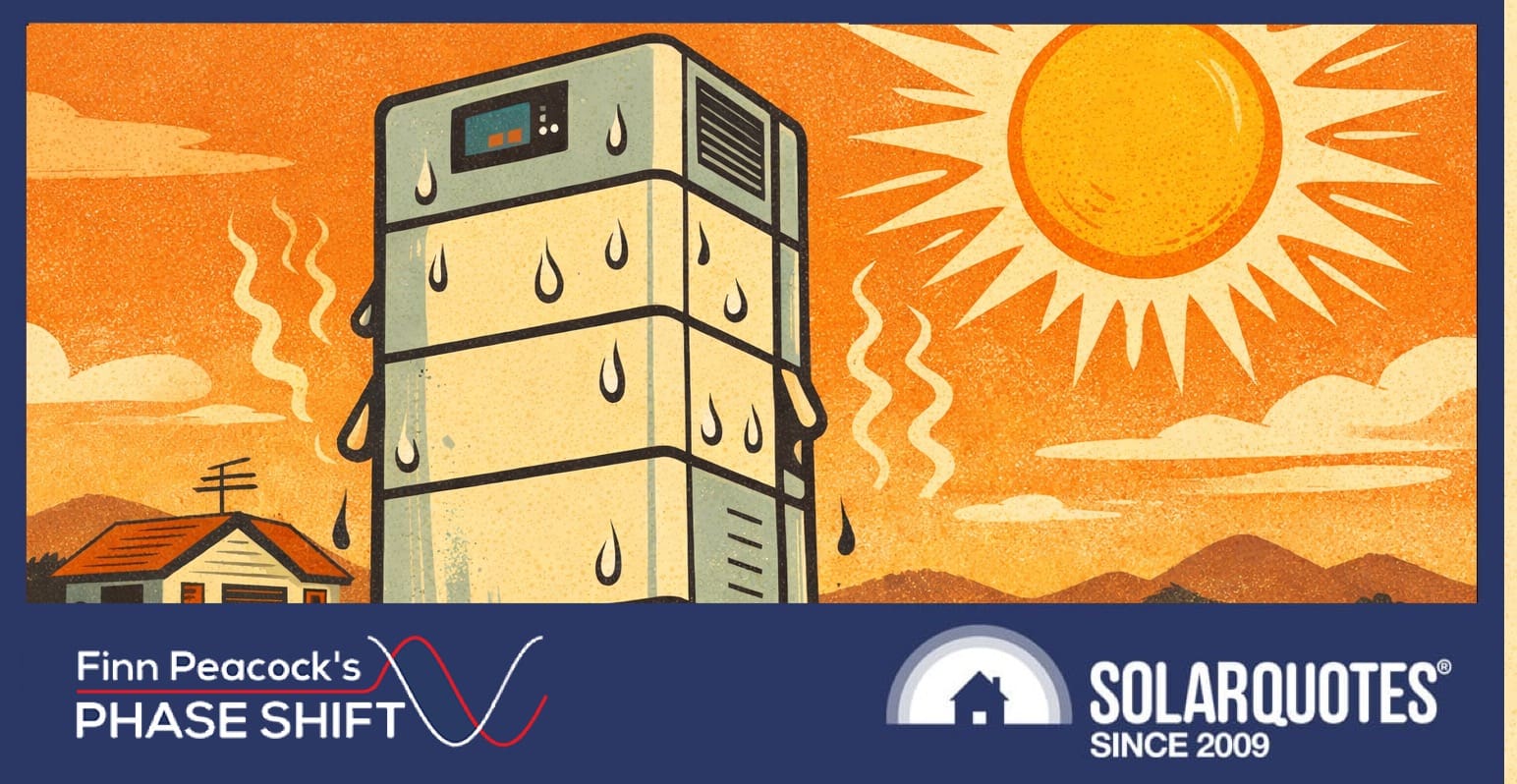
If you wanted to design the world’s harshest endurance test for home batteries, you wouldn’t build a lab. You’d build a normal Australian suburb.
Then add a hot garage, a ‘3-free’ tariff, and a savvy homeowner. That combination is pushing batteries harder than manufacturers ever planned for, and it’s happening during completely ordinary daily use.
Australia has accidentally become the world’s largest real-world battery torture test facility.
Heat: The Quiet Killer
Heat is the number one cause of early lithium battery death.
Australian batteries live in garages that can get to 50°C+, or bolted to walls outside where the air temperature can top 40ºC. A system that runs comfortably in a mild European climate will age much faster after a few Australian summers. High temperature is the number one killer of batteries and power electronics, and Australia has plenty of temperature.
The Three-Hour Hammering
Tariffs turn the stress dial even further.
“Three free hours” energy plans encourage owners to charge flat out every day. A 30 kWh battery paired with a 10 kW inverter pulling maximum power for three straight hours is a common household routine. No gentle top-ups. Full current, daily.
Engineers once treated this kind of repeated full-rate charging as extreme testing. Australian households now treat it as normal battery cycling.
And Then We Empty Them
Evening feed-in rates complete the cycle. After about 5 pm, many batteries export at maximum power because the grid pays well. The daily pattern becomes charge hard, discharge hard, repeat. No soft operating envelope. Just sustained high effort in both directions.
There is no need for a dedicated national torture lab for batteries. The suburbs have got this.
We’ve Seen This Movie
This pattern already played out with inverters. Early imported hardware arrived expecting polite climates and struggled badly in Australian heat. Some manufacturers adapted. Over 10 years ago Fronius redesigned a failing PCB in their IG inverters after local conditions killed them left, right and centre. Now their gear is considered among the most reliable in Aussie conditions. Survival required redesign, iteration, and commitment to the market, starting decades ago.
Reliability in Australia is earned through exposure.
The Real Takeaway
My advice to friends: use your one-shot battery rebate wisely and buy hardware from a brand that understands Aussie conditions, has survived them for many years, corrected early failures, and demonstrated long-term support. Proven Aussie toughness is the metric that matters.
Australia is the harshest residential battery proving ground on the planet. The brands that last here earn that reputation the hard way.
Phase Shift is a weekly opinion column by SolarQuotes founder Finn Peacock. Subscribe to SolarQuotes’ free newsletter to get it emailed to your inbox each week along with our other home electrification coverage.
 About Finn Peacock
 RSS - Posts





Maybe Na+ batteries will better survive Aussie neglect – they’re not only better at low temperatures, but appear to range a bit higher too. Add longer room temperature cycle life, and an expected somewhat lower price, and they’ll make a good replacement for cooked LFP batteries.
Not all batteries can be installed in an airconditioned workshop, but an insulated non-habitable room, especially with a door to an airconditioned room, would greatly extend battery life.
And an oversized battery helps a bit – it cycles less, and (dis)charges at a lower C rate, for a given load, so runs a little bit cooler, if adequately protected from the sun, and allowed ample convective cooling. A cooling fan is not expensive.
Na+ assumes folk wait long enough for them to go mainstream. Many aren’t, but some will.
A relative of mine got quotes for some large battery options (2-3x what I look at) simply because the household has far higher power usage. After factoring in lost interest and capital costs versus actual savings (usage cost – FiT) he concluded the maths still doesn’t work for him.
Most folk don’t really have anywhere to put a battery system other than the garage next to an external wall, so AC is unlikely unless you have a dedicated home office nearby, assuming that’s even legal? (What counts as a habitable room again?).
John, I’ll pass on the “habitable room” ruling – it’s beyond my pay grade – despite two owner-builds under my belt, I often have to ask.
But Na+ batteries are going mainstream now. CATL, which has 40% of the entire global Li+/LFP/Na+ battery market share, has been mass delivering Na+ to volume customers since December 2025. Perhaps counter-intuitively, many appear to be going into BEVs, offering 3.6M mile (5.8M km) life, i.e. more than three times the vehicle life. Their 5C charge rate is also attractive, for quicker fast charging.
My guess is gridscale is next, as a 10,000 cycle life, at comparable price, alters its economics markedly.
Consumer expectation of lower price, now partly negated by lower bulk LFP prices, may begin to be met in a year or two, as development costs are amortised, and volume offsets fixed costs.
My interest is in the units with the new anode technology, which flattens the otherwise droopy discharge curve. Are they out yet?
I must say, our household doesn’t use our battery the way you’ve described.
Solar charges the batteries during the morning, by about 12:30pm, they’re full. The house effectively utilises solar only, until the sun isn’t capable of fulfilling the household load.
The battery then slowly takes up the slack as solar energy reduces. By about 6-7pm (summer) or 4-5 pm (winter) we’re on battery power. This is enough to take us through to the next morning.
Our daily average draw from the grid is about 740Wh.
I’m guessing because we have an AC Coupled battery, there’s no way of avoiding some draw from the grid.
We dont ever export battery power to the grid. Our fixed feed in tariff of $0.01 doesn’t make it viable. (I don’t want to anyway. I’m utilising it, and if I don’t there’s excess in case I need it) Every kW we don’t import is worth between $0.28 and $0.32 to me.
I use my solar/battery in the same way and comfortably charge my hybrid car and run ducted air when required. I have not experienced any isues and dont expect to. I do feed in excess solar power at 5cents.
Yes, but the window is rapidly closing on using the battery rebate. I just had my battery upgraded this week (booked before christmas) and my installer said they are already booked out well into April with people putting in large batteries and they are not doing any more quotes under the current rebate levels.
I’m sure other installers are in a similar situation. A drop of over $8500 in the rebate for a big battery come May 1 has the market fairly hot at the moment.
A timely article. I’ve been looking at the heat in my garage where my battery is located. Easily 50° plus on a hot day.
I am wondering whether using insulation on the garage door will improve tje situation meaningfully.
Thoughts?
I have insulated my garage door and it has made a huge difference! Noticeably less hot in summer and less cold in winter, it also helped reduce noise. I went with custom cut styrofoam and it was easy to install and was a reasonable cost. I definitely recommend it.
a carport in front of the garage is more effective and more useful than insulation
I’d say definitely, depending on what the rest of the garage is.
My garage rarely gets over 25 unless we put a hot car in there.
The concrete floor on a 35 degree day is about 21. But my battery is outside on the South wall of the house. I consider batteries a potential fire risk.
Besides, a 20kW battery at full tilt will heat up the garage pretty quick.
Hmmm, might consider redirecting some heat come winter!
I used a product called Foilboard, it comes in various thickness`s. I purchased 4 2400 x 1200 x 25mm thick sheets and build out blocks, cut to size 20 pannels for my double garage door, total cost was approx $270.00. It made a huge difference, well worth the effort. The build out blocks stick to the inside of the g/door and create an air gap between the door and the insulation, on reflection I could have used a thicker Foilboard but was unsure of the extra weight factor on the door system. Good luck.
Our Fronius IG30 was installed in 2008 and is still going strong. It lives in an insulated room which is cooler than the house most days.
I assume the installer suggested the location for that reason.
My batteries live in a room adjacent to the house and as I have so much spare energy now, the AC cools that room too.
Fingers crossed, this helps with longevity.
Rod,
Dropping the temperature 10°C from the top end can double battery life, asymptoting toward the 20 year theoretical kid-gloves maximum, at room temperature all the time, with no excessive dis(charge) rates. (All subject to individual product variations – this maths is statistical, sadly.)
My guess is you’re saving thousands of dollars in extended battery life, taking you to a time when better batteries will cost less. If more folk would take similar care, the nation could save a billion or three in the next decade.
I think you’ve said Tesla’s Powerwalls have runs on the board in Australia, proven reliability?
Its nice to see an article which mentions the failures of the IG series as it serves as a valid reminder that engineering and testing should be prioritized over marketing.
Huawei really changed the game in PV by spending serious money on R&D with labs in Germany, Sweden and Cyprus. The labs in Cyprus are somewhat similar to Australia as Cypus does experience heatwaves.
I agree that pushing batteries hard in closed garages, northern facing walls and with rapid charging is a recipe for disaster. Note that with the current battery rebate it encourages larger arrays which reduce the load on each cell when rapid charging or discharging however that is now being wound back so we may see smaller packs that are pushed harder.
One failure of the entire industry and the government is not investing in independent testing labs, trained professional installers and enhanced protections for independent reviewers who publish tear downs and commentaries on systems.
What ambient temperature is considered too high. high enough to cause long term degradation to the life and long term performance issues with the inverter and/or lithium battery. It seems to me that the granting of compliance to equipment designed for cool climate operation needs greater scrutiny before it is granted compliance in our hot climate. The worthless platitudes of a manufacture that says “if it fails in warranty” are lost when the failure and exit from the approved list due to bad product are mirrored in the failure by exit from the market. What the consumer needs is proper harsh real world testing for compliance, and a mandatory bond payment to cover customer’s when the supplier goes ‘belly up ” .The non fitment of external additional fan assist cooling for our environment is a cost cutting exercise to save a few cents per unit. Typical “Chinese economical logic” Electronic components are not reliably rated at the extremely high board temperatures considered safe.
A little off-topic…
I am wondering if lithium batteries in caravans are at risk from these heatwaves. Unlike EV (and home?) batteries they have minimal in-built protection from temperature extremes.
I am finding my caravan (stored outside at home) needs a kick start from mains supply in order to light up the control panel – the battery supply does not seem to be available.
Once the panel light up the battery capacity reads around 80% so hopefully the 2 lithium batteries are OK.
A problem is there is no easy way to test them as most 12V devices have very low current draw and it would take days to discharge the batteries to , say, 50%, if they start with a full charge. It not easy to take them to a battery shop for testing.
Found an answer… these RV batteries likely have a battery management system (BMS) that prevents charging or discharging if the temperature exceeds 54C (130F). They should be OK below this temperature but it is best to not use them in the high 40s. They are OK to store at higher temperature – maybe up to 60C.
Ths record high temperature for this date in Calgary, Alberta was +16 C, in 1931.
The record low was in 1929, -40 C.
It’s hard to believe sometimes that we share a planet. It’s a rare morning that the battery heater isn’t running on my morning drive to work.
We do get 40 C days in summer, but also it’s light from 4 AM to 10 PM so the aircon runs directly off solar from 6 AM to 8 PM.
Is it at all practical to put these batteries in a vault underground? Or easier to use a ground source heat pump to cool the garage?
Randy,
You’ve given the easiest solution, just prior to the question. 😉 Here also, there’s often ample sun on a hot day, and it’s easier to whack in an extra split system aircon than dig a cellar. (I don’t know of one aussie house that has one.) A third aircon in the workshop, mostly for my comfort, also keeps the inverters & batteries at 21°C on the hottest day.
Even in summer overcast, an oversized PV array supplies ample energy – with less sensitivity to roof orientation, as the clouds re-radiate everywhere. And a little 3.5 kW (thermal) aircon uses only 600W or so most of the time – piffle.
Here, we sometimes dig a fire-cellar some distance from the house, in case of failure to evacuate before being cut off by bushfire. Put all the gear down there, and you could have light and internet to while away the wait before it’s safe to surface. (My new electric excavator could do a lot of the work, but it’s still a pile of expense – much cheaper to scoot off to the pub in town.)
Main problem is that victron gear often used in big RVs is even more fussy than the lithium batteries. Even moderate days will have victron stuff starting to derate. Designed in Holland doesn’t make it comfortable in Australian summers.
Hi Tony,
Victron is a favourite for mobile applications for good reason. Most other equipment is crap quality by comparison.
Victron offer many options with excellent integration & monitoring.
They’re pretty capable units but the caravan fan club are dedicated to using 12 Volts and that means they use lots of current.
I’ve seen examples where a 12V 3kW inverter is using close to 300 Amps while cooking breakfast.
That continuous current consumption creates a lot of heat.
They’d be much better off using a 48V system.
Yes, it’s just nuts to stick with 12V in a caravan/boat with e.g. aircon or induction cooker. Victron’s 24V or better still, 48V inverters should then be used, for adequate power delivery – at cooler temperatures. If the vehicle’s alternator delivers only 12V, add a DC/DC converter/charger – a Victron perhaps. But their 240V inverters are also chargers, so 48V battery top-up in a caravan park is just effortless plug-n-play.
Only LFP batteries make sense; cheaper, safer, double cycle life, SoC tolerant. No-one buys Li-Ion now.
Derating results mostly from poor system design/build. My off-grid 16 kVA Victron system runs at full whack on a 43°C day, because they’re in an airconditioned workshop. All good equipment derates in overtemperature, for extended life, so build to keep it cool.
Running welder or plasma cutter, lathe or milling machine, or charging two BEVs is no stretch for my Victrons. And they make ’em bigger for heavy 3-phase loads. Design better for good results. 😉
Tony,
I took your reference to European-flavoured design with a pinch of salt – BUT taking a look at 10:08 in https://www.youtube.com/watch?v=UPfUn5ki7OM ,
I see that the temperature marking on the electrolytic capacitors, in the middle of the image, only rates them to 85°C, not full industrial 105°C, which I’d use in our conditions.
If the inverters throttle throughput to limit temperature, that mostly protects the investment, but could melt the icecream.
Anthony, have you seen inside a Selectronic? I’m guessing they’ll have gone whole hog, being more familiar with conditions here? Those electrolytic capacitors will be the first to cook in high ambient temperatures, both short term and accelerated degradation.
Victron really should have “Aussie-rated” models, I think.
Caravan batteries are virtually ALWAYS lithium iron phosphate.
As such, they have a very flat voltage curve. You can only balance cells and ascertain an accurate state of charge when fully charged.
State of charge gauges typically work by counting energy in vs energy out, which is then synchronised only the next time it’s at top of charge (when the voltage rises).
Over time large errors eventually creep in- I’ve seen such gauges say 90% when the battery is effectively all but dead flat. So moral of the story is: if it’s a long time since your state of charge meter was synchronised at full charge, don’t believe it.
Oh and if you’re wondering: the same rules apply with LFP batteries in houses and cars. It’s why Tesla say to fully charge RWD models (LFP batteries) reasonably regularly, say for example weekly for the average motorist, or even daily for those doing high mileage.
I’m in the tropics and went with a Powerwall 2 in 2024 due to its higher temp window and water resistance ratings than most but know that manufacturer ratings for Aussie conditions and especially tropical conditions are likely a best guess as this piece reflects.
As a solar and battery enthusiast I’m not sure what to recommend to others who are considering getting on board. Obviously suggest reading solar quotes but many don’t have the enthusiasm to read for years before deciding. I followed the Canberra battery testing centre data with interest but sadly is no more and hard to know how the testing process reflected real usage.
Is there any potential for a future solar quotes top ten list or review with high temperature as a major factor in the ratings?
Or maybe a breakdown of the the existing top gear scores by installers by region?
That could be a crude metric for how a battery performs in mostly dry and hot south Australia) vs wet and hot (north Queensland).
Finn Peacock: – “Australian batteries live in garages that can get to 50°C+, or bolted to walls outside where the air temperature can top 40ºC.”
IMO, that has already become ancient history.
On 4 Jan 2020, Penrith Lakes, NSW, was officially the hottest place on Earth at 48.9 °C.
https://www.bom.gov.au/climate/current/month/nsw/archive/202001.sydney.shtml#recordsTmaxDailyHigh
On the same day, some other locations unofficially experienced even hotter temperatures, up to 52 °C.
https://www.smh.com.au/national/nsw/the-sydney-suburbs-that-hit-50c-last-summer-20201002-p561by.html
Extreme heatwaves in Jan 2026 have brought dangerous temperatures near 50 °C to VIC, NSW & SA.
https://www.abc.net.au/news/2026-01-28/australia-heatwave-smashes-temperature-records/106275472
Without significant climate action, 50+ °C days will become a reality & increasingly more frequent.
https://theconversation.com/the-reality-of-living-with-50-temperatures-in-our-major-cities-85315
There’s plenty of room in Canada, eh?
The record low in Calgary, AB for today, Jan 20 was -40 C, in 1929. And a record high of 16 on Jan 20 two years later.
Those temperatures are hard to imagine, outside of a closed car.
The best climate action for Australians is probably to add solar and batteries. And charging an EV at work, during the day.
Most houses here have deep basements, so we have a retreat from not uncommon 35 C summer temps further east in Medicine Hat.
Randy Wester: – “Those temperatures are hard to imagine, outside of a closed car.”
The hottest temperature ever recorded in Canada is 49.6 °C (121.3 °F), set in Lytton, British Columbia, on 29 Jun 2021, during a historic heat dome event. This record surpassed the previous Canadian record of 45 °C set in Saskatchewan in 1937. The town of Lytton was subsequently destroyed by a wildfire the day after the record was set.
https://www.rmets.org/metmatters/record-breaking-heat-canada
Even Canada is a warning that more & more of the world will soon be too hot for humans.
https://www.theguardian.com/commentisfree/2021/jun/30/canada-temperatures-limits-human-climate-emergency-earth
Projected areas with a Mean Annual Temperature >29 °C as the GMSAT increases are shown in purple – too hot for humans to comfortably/safely live in.
https://images.squarespace-cdn.com/content/v1/5bc6826490f904980a50659a/0105c0ea-c715-4925-97e3-c484b9e04380/HCN-FullSequence_c.gif?format=1500w
Yes, when we were driving across Canada in our motorhome there were stories of people in big trouble because of heat wave conditions – and they weren’t British “heat waves” either but pretty good imitations of Australian heat waves.
I dropped my charge rate to 25% as most sunny days the battery was full before 10am. Now it is full by 2pm and the battery temperature is 4-5 degrees cooler.
I was investigating whether to sell some excess back in the evening, but with my current bill averaging 70 cents a day that price is probably worth the extra life I’ll get out of the system.
Guess the people who purchased a 5kW inverter with a 50kWh battery won’t have to worry about overworking their battery.
Which batteries are actually proven, tried and tested? Powerwall 3 is new chemistry for Tesla, sigenergy is only a few years on the market, Sungrow was marketed to me as a “cheaper” brand only a few years ago when I bought solar panels.
My battery was an upstart brand and although working well it has developed some rust on the metal case where the powder coat has delaminated. At least it was cheap!
New chemistry is an acceptable risk if the company has already proven themselves in Australia for 10 years plus. We can’t expect longstanding companies to never innovate.
Low risk options:

Fynn, I’m wondering why you haven’t included Pylontech in that chart? They were one of the better performers in the National Battery testing.
“You’d build a normal Australian suburb.”
I understand that “a normal Australian suburb” is an imaginary concept, like a unicorn.
We have the climate here in Perth (“temperate” zone, so it never gets above 30 degrees – ROFL) with temperatures and heatwaves reaching the mid 40’s, the climate in Brisbane and Darwin, will have their humidity issues, in addition to possible high temperatures, and we have the climate in Hobart.
And, with cyclonic climates, what force, the driving rain, and, how does that impact on the IP ratings?
I suggest that the greater issue, in the lack of regulation, especially, in the conspicuous absence of mandatory inspections of all installations, is the bodginess of installations.
How many inverters and batteries, are in direct sunlight, in the heat of the day, with the installations designed to be dangerous?
Quite a few around here.
Our initial installation, – no warranty, one inverter, in direct sunlight, was very hot to touch the cover, it died 18mths
Pain threshold is around 60°C – add just 30°C in from cover to to component exteriors + 15°C to semiconductor junctions = 105°C or general vicinity. That should last more than 18 months, if it wasn’t a good bit hotter. I’m guessing the wet electrolytics went first – they’re the weak link, temperature-wise.
My brother added sunshade and two 15cm fans, pushing in series, in place of of one 10 cm fan. I have my inverters in an airconditioned workshop. Given the off-grid investment, it’s definitely worth it. (It’s 21°C in there now, batteries same temperature)
The climate isn’t cooling, at least down under. We’ll improve our personal energy infrastructure to adapt – more cheaply if proactively, I figure.
I have 3 hours free, 48kwh battery, 20kw inverter in a western garage. First day I hit 43 when charging. I reduced charge to 16kwh, added vornado fan and typically I now hit 37-38.
Im going to add an exhaust fan to suck cool air from the house into the garage next. Some people aren’t concerned but keeping the battery under 40c can only help it’s longevity.
Drop 10°C, double its expected life. (Significantly shortened over 40°C, as you say.)
I don’t agree with the main thrust of the article.
By HOME standards it’s a cruel test. And the article says that. But by EV standards, it’s moderate.
“A 30 kWh battery paired with a 10 kW inverter pulling maximum power for three straight hours is a common household routine. No gentle top-ups. Full current, daily.”
For the battery, this is charging (or discharging) at 0.3C, which is hardly anything. An EV fast-charging at 150KW DC would be hitting perhaps 2C, which is much closer to the limit.
For the inverter, 3 hours at max rate is an everyday scenario for charging an EV.
For temperature. A garage might reach 50°C, but so would an EV parked outside.
An EV has further engineering challenges, primarily that it’s a vibrating, shaking platform (rather than bolted fast to a garage wall).
So for home use. Yes it’s pushing them hard, but we know how to make hardware work in harsher conditions,
I agree with this sentiment. Charging rates have more considerations, including when PV is available. A system designed time sure that it is charged on a winter day using PV will undoubtedly charge faster in summer on a sunny day. I oversized my PV to charge in the morning and the natural AM ramp up of available PV power is the only limiting factor in charge rates. My batteries are able to accept charging at 0.5C and I effectively never see this rate, if I do it is for a short period.
Batteries are also an expensive investment, if you’re not getting the use out of them while they are under warranty, are you really getting your money worth?
yeah not sure what’s going on, the article makes sense regarding heat but over the top in places, eg. who is charging their battery from 0 to full every day? even if they do have 3 free hours? where is this large contingent of battery only, no solar users who are fully utilising their battery from 100 to 0 every single day?
sounds like hyperbole to me
Solar plus battery is quite likely to go from 100% to zero and back every day in summer. Run aircon most of the night and then lots of solar to recharge and run AC during the day. 3 hours free power isn’t really relevant
I don’t see a problem. EV batteries have been put through the ringer for decades now. They’ve been subjected to huge temperature ranges, all types of weather, massive swings in current loads (both acceleration and regen) and have come through pretty well. They are lasting far longer than anyone thought possible. House batteries are the same technology. They should last a long time wherever they are placed and how they are used.
Thanks to all the contributors. My takeout (from all the comments) as installation of my system occurs prior to 1MAY26 is monitor battery and ambient temperature for awhile. Big question. Who will have all the amazing data being now collected via the various apps? Will it be shared amongst the general community or hoarded by manufacturers as commercially sensitive?
Can you please confirm.
I have a 16kw Sigenergy battery which is performing well, I was hoping to increase the capacity to 20kw with a 4kw battery, I have been told by our solar installer that they can only add an 8kw battery, is this correct
Hi Gary,
To my knowledge the internal architecture of the Sig is quite flexible.
They have a high voltage DC bus through the stack and DC-DC converters in each battery means you can stack whatever combinations you like, including the DC car charger module.
You could ask Sigenergy but apparently their technical support is a difficult line to get through to.
Hey Gary,
Sigenergy come in 5kWh or 8kWh battery modules, in theory you could add a 5.0 and end up with 21kWh but I’d guess another 8.0 is more cost effective giving you 24kWh.
Tesla has recently deployed a feature known as “Optimized Charging,” which is essentially a rebranding of what is more commonly understood as a thermal ceiling. In practical terms, this is a protective mechanism built into the battery management system that dynamically limits charging power when the battery cells reach elevated temperatures. The intent is to reduce thermal stress, manage long-term degradation, and ensure the battery operates within safe design limits—particularly during sustained high-rate charging events. While marketed as an optimization feature, its primary function is lifecycle protection rather than performance enhancement, with the side effect being a temporary reduction in available charging capacity under certain conditions.
I have two powerwall 2 inside a garage which gets very hot at times. Would there be a benefit in having a standard pedestal fan blowing on them during those occasions? If so, where is the best part of the batteries to point the fan?
My Sungrow battery is also in the garage and we have had temps up to 45 deg in Corowa NSW,last week. I have been running a pedistal fan in front of the 5 module array for some time now. Is this sufficient as a temporay solution? Would encasing the battery enclosure with coolite be worthwhile?
Robert,
My brother picked up 3 thermometers (maybe at Jaycar?). A drilled hole lets him view displays with one probe on the master inverter inside the enclosure, others to suit. He added two 15cm computer fans for more cabinet throughflow. To also cool the pair of exposed ABB PV inverters, a fan capable of water misting is directed at the whole assembly of gear on the wall. Such a fan shouldn’t mind a bit of rain, so can be left in place. (Misting not used.)
I’d consider fitting an exhaust fan close by your battery, to extract heat. If it’s above, and an inlet could be added far below, to minimise recirculation, temperatures should drop. Once battery heat extraction is achieved, insulating the battery box from garage heat could help. So many garages heat badly through both uninsulated roof and garage door(s).
My BMS reports battery temperature. A cheap thermometer can do the same, just not on the phone. (Or can they now?)
I have a 32kwh Sigenstor battery with a 15kw inverter in the garage, mated to a 16.32kw solar system. This time of year in Melbourne, the battery is fully charged by 11-12 noon. On those hot to really hot days I have the AC on early, set between 19&21c depending on outside temp, running entirety on solar. I have the door between the house and garage opened to keep it cool. By 5.30pm, I would turn the AC off and export 22kwh from the battery plus whatever the solar is making between 5.30-7.30pm for 35c/kwh. I keep 10kwh in the battery for overnight usage. By 7.30am the next day, there is 3.5 kwh left in the battery and it slowly charges from solar again.
I find that the house is still comfortably cool by about 10pm doing it this way, even on those really hot days. So I guess I fall right into the category that this article is describing. Since mid Jan till now, my average daily export is 24kwh. I hope I am not damaging the battery too quickly by this approach.
Something I wondered about is the difference in BMS amongst all the brands, especially given LFP need to recalibrate.
For example, in our EV, 100% charge weekly and below 10% to 100% charge is recommended quarterly to keep useful statistics.
With the constant cycling of home batteries, I wonder which brands do the best job of managing their batteries and providing the best statistics for SOC?
Has anyone at solar quotes looked at this aspect?