
Installations in 2025 under the Albanese Government’s Cheaper Home Batteries Program (CHBP) surpassed even some previous optimistic estimates.
How Many Batteries Have Been Installed So Far Under CHBP?
According to Federal Minister for Climate Change and Energy Chris Bowen:
“From 1 July to 31 December Australians have installed 184,672 home batteries under the Albanese Government’s Cheaper Home Battery policy,” he posted on Facebook. “This has added 4.27 gigawatt hours of storage capacity.”
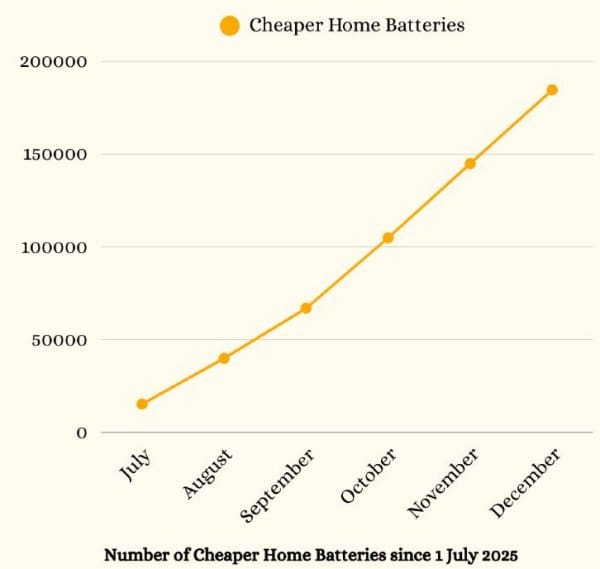
Previously, some forecasts pegged the total installed/commissioned since July 2025 to the end of the year would hit 175,000; representing around 3.9 GWh of useable capacity.
Big Installation Numbers, Big Capacities
It’s not just the install numbers that are eye-popping, but the useable capacity of battery systems installed is growing. In 2024, the average home battery’s usable capacity was 10 – 12 kWh.
Based on Bowen’s figures:
4.27 GWh (4,270,000 kilowatt-hours) divided by 184,672 = average 23.12 kWh useable capacity per system in the second half of 2025.
For SolarQuotes founder Finn Peacock’s thoughts on the CHBP big battery trend, see his recent column: Supersize Me: The Rise Of The McBattery.
2026: Battery Rebate Ch..Ch.. Changes
The success of the CHBP has been such that the original funding earmarked for it ($2.3bn) could have run out by June next year — well before the intended end in 2030. It’s not just the number of installations, but the bigger batteries have really been draining the funding as the rebate is based on useable capacity (up to 50 kWh).
The Albanese Government has reacted by taking steps to rein some aspects in while increasing availability.
Battery Budget Boost
The originally announced $2.3bn budget has been beefed up to $7.2bn over the next four years; expected to deliver an additional 40 gigawatt-hours of storage capacity. This is a huge amount that will not only help finance more batteries for more households, but also amplify the benefits for the mains grid — which benefits everyone.
Reining In The Rebate
For home batteries installed from the start of May, 2026 there will be tightened subsidy requirements. While the first 50kWh of an approved energy storage system up to 100 kWh will still be eligible for the subsidy, it will reduce significantly for larger systems under a new tier structure.
Additionally, it was already baked in that reductions to the rebate would happen over time, and those could change depending how the program was tracking. The reductions will be greater from May 1, 2026 and occur more often — every 6 months instead of annually.
We recently published an article that contains a table with examples of rebate reductions for various battery systems; but you can also get an estimate using our super-quick and simple federal battery rebate calculator.
Jumping On The Battery Bandwagon In 2026
After a well-deserved break, installers will be back on the tools soon. 2026 is going to be quite a year for them.
If you’re thinking of joining Australia’s residential energy storage revolution in 2026 and want to get the best solution for your circumstances, check out the SolarQuotes home battery guide.
And if you’re nearing a purchase decision to go ahead with an installation, you can get up to 3 quotes from installers we know and trust; with the added reassurance of their work being backed by the unique SolarQuotes Good Installer Guarantee.
Battery Installation Forecast For 2026: Place Your Bets
Anyone keen to take a stab at estimating how many battery systems will be installed under the Cheaper Home Batteries Program in 2026, and/or perhaps the useable capacity average over the next year?
Leave your guesses below and we can return to this post in early 2027 to see who was closest. I guess there should be a cut-off date for this exercise — so let’s say next 5pm next Friday, January 9.
The winner gets an intimate evening with Ronald. Two evenings if you’re closest on both numbers and capacity. But I guess that I should clear that prize idea with Ronald first.
He can cook and sing you know.

 About Michael Bloch
 RSS - Posts






My estimate for battery number for calendar year 2026 is 75,000.
A large reduction because so many have have hit the ground running and installed. There will of course be a rush between now and 1st of May of anyone left who hasn’t jumped yet for a decent size battery.
But after the 1st of May I reckon battery only installs will slow down to a much lower level, and most batteries will be installed with new or upgraded solar systems.
I predict another 250,000 for the calendar year.
You’re missing all the FOMO from those seeing the results of the energy independent
310,000 installs in 2026.
The average household still won’t know what a kilowatt-hour is, but they’ll be absolutely certain they need more of them.
At that point, most homes are effectively running their own mini electricity wholesaler, which means a VPP stops being optional and starts being infrastructure.
350,004 installs. 6.9GWh
A touch cautious, maybe.
Distributed grid firming, through time-shifted rooftop feed-in and heavily reduced peak demand, will save $billions in grid upgrades, and utilise otherwise wasted duck-curve energy. Feeders too thin for masses of BEV & heavy haulage fast chargers (2 MW per semi) on top of prior demand, will gain extended as-is life. That must surely reduce the inevitable spike in fixed and usage electricity costs, for the network upgrades needed to stop burning the planet.
I’ve read of new Na+ batteries with a flatter room temperature discharge curve, removing their Achilles heel. (They were already comparatively good at low temp.) At 30% cheaper straight off, 70% cheaper in time, with longer cycle life, no fires, CATL in volume production now, no Cobalt or Nickel, and Sodium everywhere, it’s hard to see measured rebate reduction harming the critical transition, more vitally essential to our wellbeing than some realise.
Do it when you can, to cut costs. Net outlay should gradually sag, I figure.
Maybe 291,000 batteries installed in 2026 and an average capacity of 18.5kWh
I figure that the first three months will actually accelerate a little as its the last of the old rebate and a lot of people will be buying large batteries. Then I expect to see it drop off a lot.
Due to the momentum of all these manufacturers, sales people, trades ect they can offer discounts to keep things moving. Also more products are emerging into the market.
Something else to consider is that SA TS 5398 is mandatory from 2027 (unless its deferred). This is much stronger than current standards required in Australia and manufacturers will look to dump old stock that they know will be non-compliant. A lot of the batteries on the market are just generic (third party OEM and ODM) batteries that are not true in-house designs. All that will happen is these companies will just add another new battery to their lineup, It would have been interesting if the battery testing from ITP had continued.
Having access to wholesale pricing, this might be interesting.
In Jan 2026 the price difference between a Foxess 41.94kWh (usable) battery, after Fed STCs is $3,506 less than a Sigenergy 23.4kWh (usable) battery.
On May 1st the price difference will be only $1,045.
I posit that for the vast majority of people, the 23.4kWh battery is ‘right-sized’, probably slightly over-sized, for actual self-consumption outside solar production hours.
The vast majority of people don’t need anywhere near as large as 40+kWh and many don’t have the surplus solar to charge a battery that big. But they buy it because it looks like a bargain. Bigger is best, right?
Will they continue to do so when the price difference is minimal between their very basic battery against much better quality right-sized products with fire-extinguishers and DC-DC converters and parallel not series connection between modules? I think not.
Yep, I saw someone on a local Facebook group asking for an opinion on their quote for a 6.6kW system with a 40kWh battery. The price was okay but there is little hope that battery will be filled too often.
The constant talk and deadline should see a busy 5 months. I would estimate 255,000 just in that period. Then far far less until Dec. Total 290,000.
Wait… What?
Michael!!!
Your buy.
Relax Ronald. You just need to scoop the betting pool to snatch the free dinners on the SQ corporate card. A man of your numerical skills has got this sewn up!
You can book-end the current bids at 4pm on Friday. A couple of ghost accounts should do it — Anthony probably has some he can lend you. I’m convinced his ‘sparring partners’ are characters he’s created to spice up the forum. 🙂
Hi Glen,
The trolls are 100% real. We try to help people, even the tedious ones.
Not all of them get an airing, some I like to remove links and add a note to explain what AI spam looks like.
However some wear out the welcome. Once they descend into name calling, conspiracies and outright science denial, I find the whoosh of the airlock is quite cathartic.
They still rage breathlessly… but without the oxygen provided by an audience.
275,000 new installs in 2026 with a total of 6GWh. I think the current rate will slow slightly but there are still a lot of people who are still unaware of the rebate and will come on board. The size of the battery will remain higher than previously predicted because of marketing and people’s ignorance of what they need.
263000 systems, 6.75 GWh.
Are there any figures on how many people actually joined VPPs? To me VPPs seem like an essential tool for vanquishing coal but they have not done a great job of convincing the public.
Hi Scott,
Either the retailers need to make a genuine effort to make VPPs attractive or they’ll find the customers evaporate, like the gas industry is currently seeing disconnections rising.
Scott, i think the retailers have done a stellar job of convincing the public about VPP’s – convincing the public that joining a VPP is a really bad idea!!
350,000 instllations, 7.6GWh;